
MELU-105 · Lesson 4 of 12 · 27 min
Motor overload protection
▶ Video coming soon A video version of this lesson is on the way.
The compressor starter arrived with a bag of overload heaters and a selection chart taped inside the door. Tyler wanted to pick the heater that matched 34 amperes. Dana stopped him and pointed at the motor nameplate instead: 32 amperes, service factor 1.15. Overload protection is the one place in Article 430 where the nameplate, not the table, rules, and the service factor decides how high the setting may go. It is also the protection that does most of the real work. Short circuits are rare; overloads from a jammed saw blade, a failing bearing, a dirty filter or a lost phase happen every year.
This lesson covers Part III of Article 430: what overload protection does, the basic settings in 430.32 for continuous-duty motors over 1 horsepower, how service factor and temperature rise change the setting, what to do when the overload trips during a normal start, small motors of 1 horsepower or less, how many overload units a three-phase motor needs, and how overload relays, drives and thermal protectors fit together.
What overload protection does
An overload is an operating overcurrent that, if it lasts long enough, damages the motor or its conductors by overheating. A motor carrying 125% of its rated load is not in immediate danger, but if it runs that way for an hour its winding insulation ages quickly. Overload protection must allow the high current of a normal start for a few seconds, allow brief bumps above full load, and open the circuit when the current stays high long enough to cause damage. Overload relays do this with a time-current characteristic: the higher the current, the faster they trip. Section 430.31 states the purpose, and Part III requires overload protection for most motors, with the settings in 430.32.
Continuous-duty motors over 1 horsepower
For a continuous-duty motor rated more than 1 horsepower, 430.32(A)(1) requires a separate overload device responsive to motor current, set or selected to trip at not more than a percentage of the motor nameplate full-load current. In this course's illustrative values, the percentages are these.
| Motor marking | Maximum overload setting used in this course |
|---|---|
| Service factor of 1.15 or more | 125% of nameplate FLA |
| Marked temperature rise of 40 °C or less | 125% of nameplate FLA |
| All other motors | 115% of nameplate FLA |
A motor with a service factor of 1.15 can carry 15% more than rated load continuously, so its overload may be set higher. A motor marked with a low temperature rise runs cool and has the same thermal headroom. Every other motor, including a motor with a service factor of 1.0, gets the lower setting.
Worked problem
Overloads for the compressor
Delgado's compressor nameplate reads 32 A, service factor 1.15. Find the maximum overload setting.
Show solution
- Use the nameplate current, 32 A, not the 34 A table value.
- Service factor of 1.15 or more: 125%.
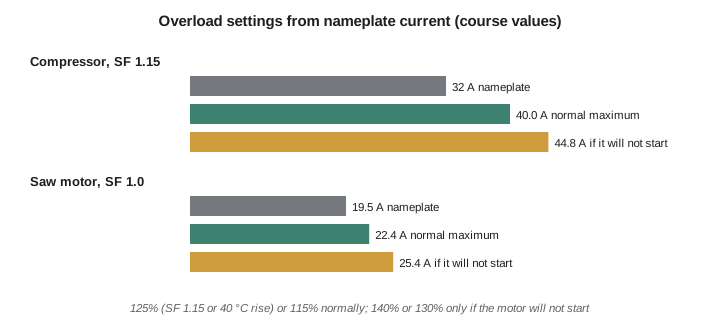
- Maximum: 1.25 × 32 = 40.0 A.
Answer: An overload trip setting of not more than 40 A.
Worked problem
Overloads for a saw motor
Each 15 hp saw motor has a nameplate current of 19.5 A and a service factor of 1.0. Find the maximum overload setting.
Show solution
- Service factor of 1.0 and no low temperature-rise marking: 115%.
- Maximum: 1.15 × 19.5 = 22.4 A.
Answer: Not more than about 22.4 A.
In practice, overload relays come in two forms. Older and smaller starters use replaceable heater elements, each covering a range of current, and the manufacturer's selection chart tells you which heater to use for a given nameplate current. The charts already account for the 115% or 125% factor, so you look up the nameplate current directly. Newer starters use adjustable bimetallic or electronic relays with a dial or setting in amperes; for those you set the dial to the motor's nameplate current and the relay's design trips at the right multiple, or you set it to the permitted percentage, depending on the manufacturer's instructions. On exams, the question asks for the maximum trip setting, and you compute it from the nameplate as shown.
When the overload trips on a normal start
A heavily loaded motor may take longer than usual to accelerate, and an overload set at the basic value may trip before the motor reaches speed. Section 430.32(C) allows the next higher size or rating of overload relay, provided the trip current does not exceed a higher limit. In this course's illustrative values, that limit is 140% of nameplate current for motors with a service factor of 1.15 or more or a temperature rise of 40 °C or less, and 130% for all other motors.
Worked problem
Raising the compressor's overloads
The compressor's overload relay set at 40 A trips during starts against a full receiver. What is the highest trip setting permitted?
Show solution
- Service factor 1.15: limit 140%.
- Maximum: 1.40 × 32 = 44.8 A.
- The setting may not exceed 44.8 A, and the cause should be checked first, since a long start can mean a mechanical problem.
Answer: Not more than 44.8 A.
Like the short-circuit exception in Lesson 3, this is a ceiling, not a rounding permission. Exam questions that ask for the maximum overload setting want the basic 115% or 125% value unless they say the motor fails to start.
Small motors of 1 horsepower or less
Motors of 1 horsepower or less have their own rules in 430.32(B) and (D). A motor that is not permanently installed and is manually started, within sight of its controller, is considered protected against overload by the branch-circuit short-circuit device, provided the branch circuit is not more than 20 amperes at 120 volts. Automatically started small motors, such as a sump pump with a float switch, need overload protection, which is often a thermal protector built into the motor and marked "thermally protected". The logic is that a person standing at a manually started tool will notice it laboring, but nobody watches a pump that starts by itself at night.
Worked problem
Delgado's sump pump
The 1 hp, 230 V sump pump starts on a float switch. Is a separate overload required?
Show solution
- It is automatically started, so the small-motor exemption for manually started motors does not apply.
- It needs overload protection: an integral thermal protector, or a separate overload device sized from its nameplate.
Answer: Yes, unless the motor has an approved integral thermal protector.
How many overload units
Older editions required a specific number of overload units by system type; today 430.37 and its table set the number and location of overload units. For a three-phase motor, the common answer is three overload units, one in each phase conductor, which also gives protection against single phasing, the loss of one phase that makes the other two carry much higher current. Single-phase motors on 120 volts need one unit in the ungrounded conductor; 240-volt single-phase motors need one unit in either ungrounded conductor. Exams test the three-phase answer most often.
| Motor supply | Overload units |
|---|---|
| Three-phase, any system | Three, one in each phase conductor |
| Single-phase, one ungrounded conductor | One, in the ungrounded conductor |
| Single-phase, two ungrounded conductors | One, in either ungrounded conductor |
Other forms of overload protection
Article 430 accepts several devices as overload protection, each with its own conditions.
- A separate overload relay in the controller, the most common method, sized as above.
- A thermal protector integral with the motor, approved for use with that motor, which opens the motor circuit or a control circuit when the winding gets too hot.
- A protective device integral with the motor that senses temperature, such as winding thermostats or thermistors working with a relay.
- For motors on adjustable-speed drives, the drive's own electronic overload function, when the drive is marked to provide overload protection. Section 430.122 and the drive markings govern; when a drive feeds several motors, each motor needs its own overload protection.
- Fuses sized as overload protection, used in some small installations; dual-element fuses can serve as both overload and short-circuit protection when sized at the overload percentages.
Ray uses electronic overload relays for most new work because they protect against phase loss and unbalance better than bimetallic heaters and they can be set exactly to the nameplate current. Older shops like Delgado's still have dozens of heater-type starters, so Dana learned to read heater charts too.
Automatic restart and other safety points
Section 430.43 prohibits an overload device that can restart a motor automatically after tripping if the restart could injure anyone. A saw or a conveyor must not suddenly come back to life after it cools down. The motor must be restarted deliberately by a person, which is one reason most starters use three-wire control with a stop-start station, covered in Lesson 5. On exams, the question about automatic restart usually asks what condition prohibits it, and the answer is that it would endanger people.
def overload_limit(fla, service_factor=1.0, temp_rise_40=False, wont_start=False):
    high = service_factor >= 1.15 or temp_rise_40
    pct = (1.40 if high else 1.30) if wont_start else (1.25 if high else 1.15)
    return round(fla * pct, 1), pct

for name, fla, sf in [("compressor", 32, 1.15), ("saw motor", 19.5, 1.0),
                      ("dust collector", 13.2, 1.15), ("exhaust fan", 7.1, 1.15)]:
    normal, p1 = overload_limit(fla, sf)
    raised, p2 = overload_limit(fla, sf, wont_start=True)
print(f"{name:15} FLA {fla:>5} A: normal {normal:5} A ({p1:.0%}), if it will not start {raised:5} A ({p2:.0%})")compressor FLA 32 A: normal 40.0 A (125%), if it will not start 44.8 A (140%) saw motor FLA 19.5 A: normal 22.4 A (115%), if it will not start 25.4 A (130%) dust collector FLA 13.2 A: normal 16.5 A (125%), if it will not start 18.5 A (140%) exhaust fan FLA 7.1 A: normal 8.9 A (125%), if it will not start 9.9 A (140%)
Filling in the schedule
Dana added the overload column to her motor schedule. The compressor gets 40 amperes, the saw motors about 22.4 amperes each, the dust collector 1.25 × 13.2 = 16.5 amperes, and the exhaust fan 1.25 × 7.1 = 8.9 amperes. Each entry is based on nameplate current and service factor, and each is well below the branch-circuit breaker from Lesson 3. That gap is exactly how the two kinds of protection share the work.
| Load | Nameplate FLA, SF | Overload maximum | If it will not start |
|---|---|---|---|
| Compressor | 32 A, 1.15 | 40.0 A | 44.8 A |
| Saw motor (each) | 19.5 A, 1.0 | 22.4 A | 25.4 A |
| Dust collector | 13.2 A, 1.15 | 16.5 A | 18.5 A |
| Exhaust fan | 7.1 A, 1.15 | 8.9 A | 9.9 A |
Reading a heater selection chart
Tyler's first job with the compressor starter was to choose the heater elements from the chart inside the starter door. A typical chart lists ranges of motor nameplate current beside heater catalog numbers, and a note says the chart applies to motors with a service factor of 1.15 and must be adjusted for other service factors, often by choosing one heater size smaller. The chart already includes the overload percentage, so you look up the nameplate current itself.
Worked problem
Choosing a heater
The compressor's nameplate current is 32 A, service factor 1.15. The starter chart lists heater H-62 for 30.1 to 33.0 A and H-64 for 33.1 to 36.4 A, for 1.15 service factor motors. Which heater applies?
Show solution
- Look up the nameplate current, 32 A, in the chart.
- 32 A falls in the 30.1 to 33.0 A range.
- The chart is for 1.15 service factor motors, so no adjustment is needed.
Answer: Heater H-62.
Two field conditions change heater selection. A starter in a much hotter location than the motor trips early, and one in a cooler location trips late, so manufacturers publish ambient adjustments or offer ambient-compensated relays. And a motor with power factor correction capacitors on the load side of the overload relay draws less current through the relay, which Lesson 10 covers. Exam questions rarely test ambient compensation directly, but they often test the rule that the chart is entered with nameplate current.
Common mistakes
MistakeSizing overloads from the table full-load current.
InsteadUse the motor nameplate current for overloads.
MistakeUsing 125% for a motor with a service factor of 1.0.
InsteadA service factor below 1.15, with no low temperature-rise marking, limits the setting to 115%.
MistakeTreating the 140% or 130% limit as the normal setting.
InsteadThose limits apply only when the basic setting will not carry a normal start.
MistakeAllowing an overload to reset and restart a saw automatically.
InsteadAutomatic restart is prohibited where it could injure people.
Summary and key terms
- Overload protection guards the motor and its conductors against sustained overcurrent.
- For continuous-duty motors over 1 hp, the setting is based on nameplate current: 125% with service factor 1.15 or more or 40 °C rise or less, otherwise 115% (illustrative values).
- If the motor will not start, the limits rise to 140% and 130%, as maximums.
- Automatically started small motors need overload protection; manually started portable ones within sight on small circuits may not.
- Three-phase motors normally have three overload units.
- Overload devices must not restart a motor automatically where that could injure people.
- Overload
- An operating overcurrent that causes damage if it lasts long enough.
- Overload relay
- A device in a motor controller that opens the motor circuit on sustained overcurrent.
- Thermal protector
- A device built into a motor that protects it from overheating.
- Single phasing
- Loss of one phase of a three-phase supply, which overloads the remaining windings.
- Heater element
- A replaceable element that sets the trip current of a bimetallic overload relay.
Practice problems
Work each problem on paper first, then reveal the answer to check.
A motor has a nameplate current of 24 A and a service factor of 1.15. Find the maximum overload setting.
Show answer
1.25 × 24 = 30 A.
A motor has a nameplate current of 24 A and a service factor of 1.0. Find the maximum overload setting.
Show answer
1.15 × 24 = 27.6 A.
The second motor's overload trips on normal starts. What is the highest permitted setting?
Show answer
1.30 × 24 = 31.2 A.
How many overload units does a three-phase motor normally need?
Show answer
Three, one in each phase conductor.
Lesson quiz · 5 questions
Score 60% or more to complete this lesson.
Create a free account to save your progress, take quizzes and earn a certificate.