
MELU-105 · Lesson 11 of 12 · 28 min
Industrial machinery
▶ Video coming soon A video version of this lesson is on the way.
The second CNC mill arrived on a flatbed in a crate taller than Tyler. Unlike the compressor or the saws, it came as a complete machine: spindle motor, axis drives, coolant pump, chip conveyor, way-lube pump, control computer and lighting, all wired inside its own cabinet by the builder. Dana's job was not to size each motor; the machine's builder had done that. Her job was to read the machine's nameplate, bring it a properly sized supply circuit with a disconnect and short-circuit protection, and confirm the machine could survive the fault current available at its location. That is the subject of Article 670, one of the shortest articles in the code and one of the most practical.
This lesson covers the scope of Article 670 and how it relates to NFPA 79, the nameplate information a machine must carry, sizing the supply conductors, overcurrent protection, the disconnecting means, short-circuit current ratings and the available fault current, and where Article 430 still applies on a machine job.
Scope: where the NEC stops and NFPA 79 begins
Article 670 covers the definition of industrial machinery, the nameplate data required, and the size and overcurrent protection of supply conductors to the machine. Article 100 defines industrial machinery as a power-driven machine, not portable by hand while working, used to process material by cutting, forming, pressure, electrical, thermal or optical techniques, lamination, or a combination of these, including associated equipment used to transfer material or tooling and to inspect, test or package. The wiring inside the machine, from the supply terminals onward, is governed by NFPA 79, which the machine builder follows. The electrician installing the machine follows the NEC up to the machine's supply terminals.
The machine nameplate
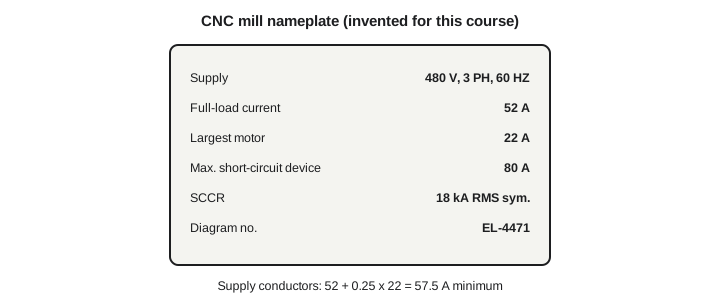
Section 670.3(A) requires a permanent nameplate on each machine with the information needed to supply it safely. In general terms the nameplate lists the supply voltage, number of phases, frequency and full-load current; the maximum ampere rating of the short-circuit and ground-fault protective device; the ampere rating of the largest motor, from the motor nameplate, or the largest load; the short-circuit current rating of the machine's industrial control panel; and the electrical diagram number or the number of the index to the diagrams. The full-load current on the nameplate is not less than the sum of the full-load currents of all motors and other equipment that may be in operation at the same time under normal conditions of use.
| Nameplate item | What the installer uses it for |
|---|---|
| Supply voltage, phases, frequency | Matching the supply circuit |
| Full-load current | Sizing the supply conductors |
| Largest motor or load current | Applying the 125% factor to the largest load |
| Maximum short-circuit and ground-fault device rating | Upper limit for the supply breaker or fuses |
| Short-circuit current rating (SCCR) | Checking against the available fault current |
The CNC mill's nameplate, as invented for this course, reads: 480 V, 3 phase, 60 Hz; full-load current 52 A; largest motor 22 A; maximum short-circuit protective device 80 A; short-circuit current rating 18 kA; diagram number EL-4471.
Supply conductors
Section 670.4(A) sets the minimum ampacity of the supply conductors. In general terms, the conductors must have an ampacity of not less than 125% of the full-load current of all resistance heating loads, plus 125% of the full-load current of the highest-rated motor, plus the sum of the full-load currents of all other connected motors and apparatus that may be in operation at the same time, based on their duty cycle. In practice, the nameplate full-load current already sums the loads, so the calculation adds an extra 25% of the largest motor to the nameplate total.
Worked problem
Supply conductors for the CNC mill
Using the nameplate (52 A total, largest motor 22 A, no resistance heating), find the minimum supply conductor ampacity.
Show solution
- Largest motor at 125%: 1.25 × 22 = 27.5 A.
- Other loads: 52 − 22 = 30 A.
- Total: 27.5 + 30 = 57.5 A, the same as 52 + 0.25 × 22.
Answer: At least 57.5 A.
Where a machine includes resistance heating, such as a plastic molding machine with barrel heaters, the heating load is also taken at 125%. Exam questions on Article 670 often give the nameplate full-load current and the largest motor, and expect exactly this calculation.
Worked problem
A machine with heaters
An injection molding machine's nameplate lists 70 A full-load current, including a 30 A largest motor and 24 A of resistance heating. Find the minimum supply conductor ampacity.
Show solution
- Largest motor: add 0.25 × 30 = 7.5 A.
- Heating: add 0.25 × 24 = 6.0 A.
- Total: 70 + 7.5 + 6.0 = 83.5 A.
Answer: At least 83.5 A.
Overcurrent protection
Section 670.4(C) requires the supply conductors to be protected by an overcurrent device, and the machine's nameplate states the maximum rating of the short-circuit and ground-fault protective device. That marked value is a limit: the supply breaker or fuses may not exceed it. Where the machine is supplied by a branch circuit, the protection must also comply with the branch-circuit rules, and where the machine has a single motor, the motor rules of Article 430 can apply to the supply. When the machine includes its own overcurrent device for the supply conductors at the machine, 670.4(C) treats the supply conductors as a feeder protected by that device under the stated conditions. On exams, the most common question asks which value limits the supply overcurrent device, and the answer is the nameplate maximum.
Worked problem
Choosing the supply breaker
The CNC mill's nameplate allows a maximum short-circuit device of 80 A, and the supply conductors have an ampacity of 65 A at 75 °C. What breaker may be used?
Show solution
- The breaker may not exceed the 80 A nameplate maximum.
- Under the motor-type supply rules that permit protection above the conductor ampacity, an 80 A breaker is within the marked limit.
- Ray chose a 70 A breaker, comfortably above the machine's starting needs and within both limits.
Answer: Any suitable breaker up to 80 A; Brightwater installed 70 A.
The disconnecting means
Section 670.4(B) requires a disconnecting means for the machine, and it may be the machine's own supply circuit disconnect, mounted on the machine, as NFPA 79 normally requires. A machine supplied by more than one source needs a disconnect for each, with markings. Many machines arrive with an integral through-door disconnect handle, lockable in the off position. If the machine has one, the installer usually adds a separate disconnect only when local rules or the facility's lockout program require it, or when the supply circuit length and route make a disconnect in sight useful. Article 430's in-sight rules still apply to any separately installed motor outside the machine.
Short-circuit current ratings
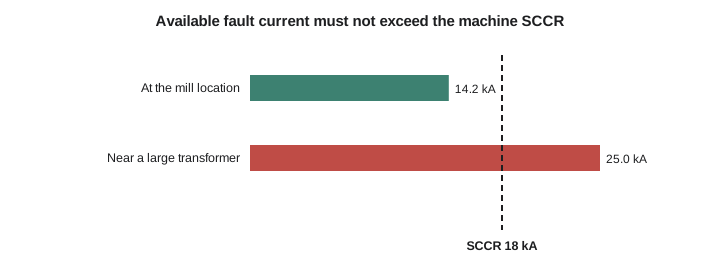
Section 670.5 addresses the machine's short-circuit current rating. Industrial machinery must not be installed where the available fault current exceeds its short-circuit current rating, and the available fault current at the machine's supply terminals must be documented and available to the AHJ. This is one of the most practical rules in the article: a machine's control panel may be rated only 5 kA or 10 kA, while the fault current at a machine near a large transformer can be 30 kA or more. A machine installed beyond its rating can explode its control components during a fault.
Worked problem
Is the mill safe at its location?
Dana calculated the available fault current at the mill's location as 14.2 kA, based on the transformer and conductor impedances. The machine is rated 18 kA. Does it comply?
Show solution
- The available fault current, 14.2 kA, is less than the 18 kA rating.
- Document the calculation for the inspector.
Answer: Yes; 14.2 kA does not exceed the 18 kA short-circuit current rating.
If the available fault current had exceeded the rating, the options would be a current-limiting device ahead of the machine selected to bring the let-through current within the rating under the manufacturer's guidance, more conductor length or a transformer to add impedance, or a machine with a higher rating. Similar rules apply to industrial control panels under Article 409, air-conditioning equipment, and other equipment marked with a short-circuit current rating.
Where Article 430 still applies
Article 670 does not replace Article 430 for every motor on a machine job. Motors installed separately from the machine, such as a remote coolant chiller pump or a central dust collector, follow Article 430 in full. A feeder serving several machines follows the feeder rules, combining each machine's nameplate data as the motor feeder rules of 430.24 and 430.62 suggest. Machines that are really a single motor with a simple starter may be treated under Article 430 directly. On exams, read whether the question calls the equipment industrial machinery with a nameplate or a separately installed motor.
Worked problem
A feeder to two machines
A feeder will supply the CNC mill (52 A total, largest motor 22 A) and an older mill (38 A total, largest motor 18 A). Find the minimum feeder ampacity, treating the largest motor across both machines at 125%.
Show solution
- Total of nameplate currents: 52 + 38 = 90 A.
- Largest single motor: 22 A; add 25%: 5.5 A.
- Minimum: 90 + 5.5 = 95.5 A.
Answer: At least 95.5 A.
def machine_supply(fla_total, largest_motor, heating=0.0):
    return fla_total + 0.25 * largest_motor + 0.25 * heating

print("CNC mill supply conductors:", machine_supply(52, 22), "A")
print("Molding machine:", machine_supply(70, 30, heating=24), "A")
print("Feeder to both mills:", machine_supply(52 + 38, max(22, 18)), "A")

available_ka, sccr_ka = 14.2, 18
print("Available", available_ka, "kA vs SCCR", sccr_ka, "kA:", "OK" if available_ka <= sccr_ka else "exceeds rating")CNC mill supply conductors: 57.5 A Molding machine: 83.5 A Feeder to both mills: 95.5 A Available 14.2 kA vs SCCR 18 kA: OK
Commissioning a machine
Connecting the supply is not the end of the job. Before the machine builder's technician starts the mill, the electrician confirms a short list of items, and exam questions sometimes ask about them because they are where field mistakes happen.
- Voltage at the supply terminals is within the machine's rated tolerance, with the machine's transformer taps set correctly if it has one.
- Phase rotation matches the machine's requirement, checked with a rotation meter, so pumps and spindles turn the right way.
- The equipment grounding conductor is connected to the machine's protective bonding terminal, often marked PE, and its size suits the supply overcurrent device under Table 250.122.
- The supply disconnect locks in the off position and is labeled.
- The available fault current label or documentation is in place for the inspector.
On the Delgado mill, the rotation check caught a problem: the new feeder's phases were landed in the order C, B, A at the machine, so the coolant pump ran backward during the builder's first test. Swapping two supply conductors at the disconnect fixed it. Dana added a line to her standard checklist: confirm phase rotation before the machine's own startup test, not after.
Worked problem
Grounding conductor for the mill
The mill's supply is protected by a 70 A breaker. Using this course's illustrative reading of Table 250.122, which lists 8 AWG copper for devices up to 100 A, what minimum copper equipment grounding conductor applies?
Show solution
- Find the row for an overcurrent device not exceeding 100 A.
- Read the copper column: 8 AWG in this course's illustrative value.
Answer: 8 AWG copper, unless the phase conductors were upsized for voltage drop, which requires a proportional increase.
Common mistakes
MistakeRecalculating every motor inside a machine with Article 430.
InsteadUse the machine nameplate under Article 670; the builder sized the internal wiring under NFPA 79.
MistakeSizing machine supply conductors at 100% of the nameplate current.
InsteadAdd 25% of the largest motor, and 25% of any resistance heating.
MistakeInstalling a supply breaker larger than the nameplate maximum.
InsteadThe nameplate's maximum short-circuit device rating is a limit.
MistakeIgnoring the short-circuit current rating.
InsteadThe available fault current must not exceed the machine's SCCR, and it must be documented.
Summary and key terms
- Article 670 covers supply conductors, overcurrent protection and nameplates for industrial machinery; NFPA 79 covers the machine's internal wiring.
- The nameplate lists voltage, full-load current, largest motor, maximum protective device and short-circuit current rating.
- Supply conductors: nameplate full-load current plus 25% of the largest motor and 25% of resistance heating.
- The supply overcurrent device may not exceed the nameplate maximum.
- A machine may have its own disconnect; separately installed motors follow Article 430.
- Available fault current must not exceed the machine's short-circuit current rating, and it must be documented (670.5).
- Industrial machinery
- A power-driven machine, not portable by hand while working, used to process material.
- NFPA 79
- The standard for the electrical equipment of industrial machinery.
- Short-circuit current rating (SCCR)
- The prospective fault current a piece of equipment can safely withstand.
- Available fault current
- The largest current that could flow at a point during a short circuit.
- Supply circuit disconnecting means
- The disconnect that removes power from the whole machine.
Practice problems
Work each problem on paper first, then reveal the answer to check.
A machine's nameplate lists 40 A total and a largest motor of 16 A. Find the minimum supply conductor ampacity.
Show answer
40 + 0.25 × 16 = 44 A.
A machine lists 60 A total, largest motor 20 A, and 12 A of heaters. Find the minimum supply conductor ampacity.
Show answer
60 + 5 + 3 = 68 A.
The available fault current is 22 kA and the machine's SCCR is 10 kA. What must change?
Show answer
The installation; for example, add a suitable current-limiting device or impedance, or use a machine with a higher rating.
Which standard governs the wiring inside an industrial machine?
Show answer
NFPA 79.
Lesson quiz · 5 questions
Score 60% or more to complete this lesson.
Create a free account to save your progress, take quizzes and earn a certificate.