
MELU-105 · Lesson 12 of 12 · 43 min
Equipment practice set
▶ Video coming soon A video version of this lesson is on the way.
Three weeks before her exam date, Dana set aside a Saturday morning for a timed practice session on Chapter 4. Marcus came over with coffee and his own code book, Ray left a stack of old exam-style problems on the table, and Tyler sat in to watch. The rule was simple: one problem at a time, a timer running, the code book open, and the answer written with the section that supports it. Equipment questions make up a large share of most master exams because they combine table lookups with arithmetic, and because the same few traps catch candidates every time. This lesson walks through the session's problems, organized by the earlier lessons, then gives a strategy for working equipment questions under time pressure.
Each problem below uses this course's illustrative motor currents and percentages. The method is what matters; on the real exam you will read the values from your own adopted edition, which may differ.
A plan for each problem
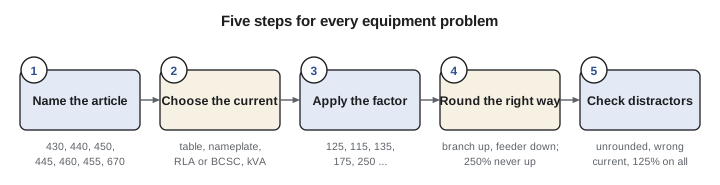
Before starting the timer, Dana wrote her five-step plan at the top of the page, and she used it on every problem. It is the habit that keeps equipment questions from turning into guesswork.
- Identify the equipment and the article: a standalone motor is Article 430, a hermetic compressor Article 440, a transformer Article 450, a generator Article 445, a capacitor Article 460, a converter Article 455, a machine Article 670.
- Find the right current: the table full-load current for motor circuits, the nameplate for overloads, the marked rated-load or selection current for compressors, the kVA calculation for transformers and generators.
- Apply the right factor: 125%, 115%, 135%, 175%, 250% or another value, from the right section, to the right current.
- Round in the right direction: up to the next standard size where the code permits it, down where the result is a maximum.
- Check the answer choices for the common distractors: the unrounded value, the value from the wrong current, or the value with the factor applied to every load.
Problems on motor currents and conductors
Worked problem
Problem 1: which current?
A 20 hp, 460 V three-phase motor has a nameplate current of 25 A and this course's illustrative table current of 27 A. Find the minimum branch circuit conductor ampacity and the maximum overload setting for a service factor of 1.15.
Show solution
- Conductors use the table current: 1.25 × 27 = 33.75 A.
- Overloads use the nameplate current: 1.25 × 25 = 31.25 A.
Answer: Conductors at least 33.75 A; overloads not more than 31.25 A.
Marcus answered the first part with 31.25 amperes, using the nameplate for both. That one mistake costs a point on almost every exam.
Worked problem
Problem 2: a feeder with lighting
A 480 V feeder supplies motors with table currents of 40 A, 27 A and 14 A, plus 12 A of continuous lighting. Find the minimum feeder ampacity.
Show solution
- Largest motor at 125%: 1.25 × 40 = 50 A.
- Other motors: 27 + 14 = 41 A.
- Continuous lighting at 125%: 1.25 × 12 = 15 A.
- Total: 50 + 41 + 15 = 106 A.
Answer: At least 106 A.
Problems on motor protection
Worked problem
Problem 3: branch breaker
Find the maximum inverse-time breaker for a motor with a 27 A table current, using 250%, and the standard sizes 60, 70 and 80 A.
Show solution
- 2.50 × 27 = 67.5 A.
- Not standard; the next higher standard size is permitted: 70 A.
Answer: 70 A.
Worked problem
Problem 4: feeder breaker
The feeder in Problem 2 has branch breakers of 100 A (40 A motor), 70 A (27 A motor) and 35 A (14 A motor). Find the maximum feeder breaker for the motor load, ignoring the lighting, using standard sizes 125, 150 and 175 A.
Show solution
- Largest branch device plus other motors' table currents: 100 + 27 + 14 = 141 A.
- This is a maximum; round down: the largest standard size not over 141 A is 125 A.
Answer: 125 A for the motor load; with the lighting added under 430.63, the limit rises by the lighting load.
Dana nearly wrote 150 amperes by reflex, rounding up as she had in Problem 3. Writing "feeder: round down" in the margin of her plan saved her.
Worked problem
Problem 5: overload for a motor that will not start
A motor's nameplate current is 18 A, service factor 1.0. Its overloads trip during normal starts. What is the highest setting permitted, using 130%?
Show solution
- 1.30 × 18 = 23.4 A, a maximum.
Answer: 23.4 A.
Worked problem
Problem 6: disconnect
Find the minimum ampere rating of a disconnect for a motor with a 52 A table current.
Show solution
- 1.15 × 52 = 59.8 A.
- A 60 A switch meets the ampere rating; check its horsepower rating too.
Answer: At least 59.8 A.
Problems on air conditioning
Worked problem
Problem 7: minimum circuit ampacity
A condensing unit has a compressor rated-load current of 16.7 A, a selection current of 19.0 A and a fan of 1.4 A. Find the minimum circuit ampacity.
Show solution
- Use the larger compressor current, the selection current: 1.25 × 19.0 = 23.75 A.
- Add the fan: 23.75 + 1.4 = 25.15 A.
Answer: About 25.2 A.
Tyler asked why the unit's own nameplate would not just give the answer. It does, and on the job you use it; but exam writers like to make you calculate it, and they almost always include both a rated-load and a selection current to see which you choose.
Problems on transformers
Worked problem
Problem 8: transformer protection
A 112.5 kVA, 480 V to 208Y/120 V three-phase transformer is protected on the primary only. Find the rated primary current and the maximum primary device, using 125% and standard sizes 150, 175 and 200 A.
Show solution
- Primary current: 112,500 ÷ (1.732 × 480) = 135.3 A.
- 125%: 1.25 × 135.3 = 169.1 A.
- The next higher standard size is permitted: 175 A.
Answer: 135.3 A rated; a 175 A primary device.
Worked problem
Problem 9: secondary with primary-and-secondary protection
For the same transformer with primary-and-secondary protection, find the maximum primary and secondary devices, using 250% and 125%.
Show solution
- Secondary current: 112,500 ÷ (1.732 × 208) = 312.3 A.
- Primary: 2.50 × 135.3 = 338.3 A, a maximum: round down to 300 A.
- Secondary: 1.25 × 312.3 = 390.3 A; the next higher standard size, 400 A, is permitted.
Answer: 300 A primary and 400 A secondary.
Problems on generators, capacitors and machinery
Worked problem
Problem 10: generator conductors
A 150 kW, 480Y/277 V generator at 0.8 power factor. Find its rated current and the minimum output conductor ampacity.
Show solution
- kVA: 150 ÷ 0.8 = 187.5 kVA.
- Current: 187,500 ÷ (1.732 × 480) = 225.5 A.
- Conductors: 1.15 × 225.5 = 259.4 A.
Answer: 225.5 A rated; at least about 259.4 A of conductor ampacity.
Worked problem
Problem 11: capacitor conductors
A 15 kvar, 480 V three-phase capacitor. Find the rated current and the minimum conductor ampacity.
Show solution
- Current: 15,000 ÷ (1.732 × 480) = 18.0 A.
- Conductors: 1.35 × 18.0 = 24.4 A.
Answer: 18.0 A rated; at least 24.4 A.
Worked problem
Problem 12: machine supply
A machine nameplate lists 64 A full-load current, a largest motor of 28 A and 16 A of resistance heating. Find the minimum supply conductor ampacity.
Show solution
- Add 25% of the largest motor: 0.25 × 28 = 7 A.
- Add 25% of the heating: 0.25 × 16 = 4 A.
- Total: 64 + 7 + 4 = 75 A.
Answer: At least 75 A.
Reviewing the session
Dana finished the twelve problems with eight minutes to spare and got two wrong on her first pass, both from rounding: she rounded the feeder breaker in Problem 4 up before catching it, and in Problem 9 she first rounded the 250% primary value up to 350 amperes. Marcus got four wrong, three of them from using the nameplate current for conductors or applying 125% to every motor. They agreed on a plan for the last three weeks: one timed set of twenty mixed equipment questions every second day, with every wrong answer recorded in a log by cause, not by topic. A log of causes, such as "wrong current", "wrong rounding" or "wrong article", shows patterns that a log of topics hides.
| Cause of error | How to prevent it |
|---|---|
| Nameplate used for conductors or breakers | Table for circuits, nameplate for overloads (430.6) |
| 125% applied to every motor | Only the largest motor gets 125% (430.24) |
| Feeder device rounded up | Feeder maximums round down (430.62) |
| 250% transformer primary rounded up | Only 125% values round up (Table 450.3(B)) |
| Rated-load current used when a selection current is marked | Use the larger, the selection current (440.4) |
| Wrong voltage column | 460 V for 480 V, 200 V for 208 V, 230 V for 240 V |
Time management
Equipment problems take longer than lookup questions, but they are worth the same single point. A good strategy on a timed exam is two passes. On the first pass, answer every question you can finish in about two minutes and mark the rest. On the second pass, return to the marked calculations. Within a calculation, write each intermediate value in the margin; when you check your work, you can find a single slip without redoing the whole problem. Finally, never leave a question blank, because a guess among four choices has a one-in-four chance and a blank has none.
import math
s3 = math.sqrt(3)
problems = {
    "1 conductors (table 27 A)": 1.25 * 27,
    "1 overloads (nameplate 25 A)": 1.25 * 25,
    "2 feeder": 1.25 * 40 + 27 + 14 + 1.25 * 12,
    "3 branch breaker before rounding": 2.5 * 27,
    "4 feeder breaker before rounding": 100 + 27 + 14,
    "6 disconnect": 1.15 * 52,
    "7 MCA": 1.25 * 19.0 + 1.4,
    "8 primary current": 112500 / (s3 * 480),
    "9 secondary current": 112500 / (s3 * 208),
    "10 generator conductors": 1.15 * 150000 / 0.8 / (s3 * 480),
    "11 capacitor conductors": 1.35 * 15000 / (s3 * 480),
    "12 machine supply": 64 + 0.25 * 28 + 0.25 * 16,
}
for name, value in problems.items():
print(f"Problem {name:34} {value:7.2f}")Problem 1 conductors (table 27 A) 33.75 Problem 1 overloads (nameplate 25 A) 31.25 Problem 2 feeder 106.00 Problem 3 branch breaker before rounding 67.50 Problem 4 feeder breaker before rounding 141.00 Problem 6 disconnect 59.80 Problem 7 MCA 25.15 Problem 8 primary current 135.32 Problem 9 secondary current 312.27 Problem 10 generator conductors 259.36 Problem 11 capacitor conductors 24.36 Problem 12 machine supply 75.00
Two more problems
Worked problem
Problem 13: a motor with a drive
A 30 hp motor's drive is marked with a rated input current of 46 A. Find the minimum supply conductor ampacity to the drive.
Show solution
- Use the drive's rated input current: 1.25 × 46 = 57.5 A.
Answer: At least 57.5 A.
Worked problem
Problem 14: panel protection
A 125 A main-lug panelboard will be fed from a 150 A feeder breaker. Does it comply with 408.36, and if not, what is the fix?
Show solution
- The device protecting the panel may not exceed its 125 A rating.
- A 150 A feeder breaker exceeds it.
- Fixes: reduce the feeder breaker to 125 A or less if the load allows, or install a panel with a 125 A main breaker, or use a panel with a 150 A or larger bus.
Answer: It does not comply; protect the panel at 125 A or less, or use a larger panel.
Marcus got Problem 14 right and Problem 13 wrong, sizing the drive's supply from the motor's table current instead of the drive's input current. Dana pointed out that it was the same kind of error as using the nameplate for conductors: the right current depends on the equipment, and the equipment is named in the first words of the question.
Common mistakes
MistakeWorking a problem without first naming the article.
InsteadIdentify the equipment and its article before choosing a current or factor.
MistakeKeeping only a topic log of wrong answers.
InsteadLog the cause of each error to find patterns such as rounding or wrong current.
MistakeSpending ten minutes on one calculation on the first pass.
InsteadMark it, move on, and return in the second pass.
MistakeLeaving answers blank.
InsteadMake your best guess; a blank earns nothing.
Summary and key terms
- Name the article first, then choose the current, apply the factor, round correctly and check distractors.
- Motor circuits use table current; overloads use nameplate current.
- Branch-circuit motor protection rounds up where permitted; feeder protection rounds down.
- Use the selection current when an air-conditioning compressor has one.
- Transformer 125% values may round up; the 250% primary value may not.
- Generators 115%, capacitors 135%, machinery nameplate plus 25% of the largest motor and heating.
- Distractor
- A wrong answer choice designed to match a common mistake.
- Two-pass method
- Answering quick questions first and returning to marked calculations.
- Error log
- A record of practice mistakes classified by cause.
- Standard size
- A fuse or breaker rating listed in 240.6.
Practice problems
Work each problem on paper first, then reveal the answer to check.
A motor has a table current of 65 A. Find the minimum branch conductor ampacity.
Show answer
1.25 × 65 = 81.25 A.
Find the maximum time-delay fuse for the same motor, using 175% and standard sizes 110 and 125 A.
Show answer
1.75 × 65 = 113.75 A; next higher standard size 125 A.
A 45 kVA, 480 V primary transformer is protected on the primary only. Find the maximum device using 125%.
Show answer
54.1 × 1.25 = 67.6 A; next higher standard size 70 A.
A machine nameplate lists 30 A total and a largest motor of 12 A. Find the minimum supply ampacity.
Show answer
30 + 3 = 33 A.
Lesson quiz · 5 questions
Score 60% or more to complete this lesson.
Create a free account to save your progress, take quizzes and earn a certificate.