
MELU-105 · Lesson 5 of 12 · 25 min
Motor control circuits and disconnects
▶ Video coming soon A video version of this lesson is on the way.
Gloria Haynes walked the Delgado shop on her rough-in inspection with a flashlight and two questions she asks at every motor. Where is the disconnect, and can you see the motor from it? Is the control circuit protected? The first question decides whether a mechanic can safely work on a saw blade without someone switching it on from another room. The second keeps a small control wire from becoming a fire when a coil shorts. Both come from Article 430, and both are favorite exam topics because the rules are specific and the distances and ratings are easy to test.
This lesson covers motor control circuits in Part VI of Article 430, including how control circuits are protected and when a control transformer is needed; motor controllers in Part VII; and the disconnecting means rules in Part IX: location, the meaning of "in sight from", the lockable exception, the types of disconnect permitted, and how to size one.
Control circuits
A motor control circuit carries the electrical signals that direct the controller but not the main power to the motor. In a typical starter it includes the stop and start push buttons, the contactor coil, the overload relay's normally closed contact, and any pressure switch, float switch or limit switch. Section 430.71 defines its scope, and 430.72 requires that control circuits be protected against overcurrent.
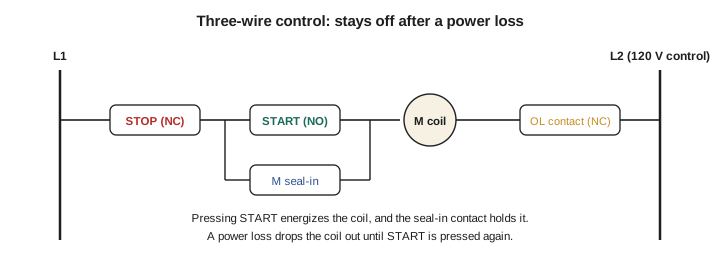
Control circuits are fed in one of two common ways. Many small starters tap the control circuit directly from two of the motor's line conductors on the load side of the branch-circuit device, so the coil runs at the motor voltage, such as 480 volts. Larger starters, and many installations where people operate push buttons, use a control transformer that steps the voltage down to 120 volts or less. A 120-volt control circuit is safer to work on and allows standard pilot devices.
Protecting control conductors
Section 430.72(B) addresses conductors that are tapped from the motor branch circuit. Because the branch-circuit device may be rated far above what a small control wire can carry, the control conductors need their own protection unless an exception applies. The rules allow, in general terms, control conductors that do not leave the controller enclosure to be protected at a higher value than conductors that extend beyond it, and they allow the branch-circuit device to protect the control conductors when its rating does not exceed limits that the section ties to conductor size. This course uses the idea rather than the table values: small conductors leaving the enclosure need protection close to their ampacity, while short conductors inside the enclosure may be protected at a few times their ampacity. Exam questions on this section quote the conductor size and location and ask for the maximum protection; tab the table in 430.72(B) so you can read the value.
Where a control transformer is used, 430.72(C) requires protection for the transformer itself, normally on the primary side, sized in relation to the transformer's rated primary current. Small control transformers have their own rules, and the section allows the secondary conductors of a two-wire secondary to be protected by the primary device when the ratio of voltages is accounted for, the same principle as 240.4(F) in Lesson 7.
Worked problem
Control transformer primary current
Delgado's compressor starter uses a 150 VA control transformer, 480 V primary to 120 V secondary. Find the rated primary and secondary currents.
Show solution
- Primary: 150 ÷ 480 = 0.31 A.
- Secondary: 150 ÷ 120 = 1.25 A.
- The primary protection is sized from the 0.31 A rated primary current under 430.72(C) and the transformer's instructions.
Answer: About 0.31 A primary and 1.25 A secondary.
Two-wire and three-wire control
Control circuits come in two basic types, and the difference matters for safety. A two-wire control circuit uses a maintained contact, such as a thermostat or float switch, so the motor restarts automatically when power returns after an outage. A three-wire control circuit uses momentary stop and start buttons and a seal-in contact, so after an outage the contactor drops out and stays out until someone presses start. This is called low-voltage protection, and it prevents a saw or conveyor from starting unexpectedly. Section 430.43 and good practice call for three-wire control wherever automatic restart could injure someone, which covers nearly all machine tools.
| Control type | After a power outage | Typical use |
|---|---|---|
| Two-wire (maintained contact) | Restarts automatically (low-voltage release) | Pumps, fans, compressors on pressure switches |
| Three-wire (momentary contacts with seal-in) | Stays off until restarted (low-voltage protection) | Saws, conveyors, machine tools |
Section 430.74 adds that control circuits must be arranged so that an accidental ground in the control circuit cannot start the motor or bypass the stop button. That is why the stop button and coil are placed on the correct side of a grounded control circuit, and why a grounded control transformer secondary connects the coil to the grounded conductor and the switches to the ungrounded side.
Controllers
Part VII of Article 430 covers motor controllers, the devices that start and stop a motor. Section 430.83 requires a controller to have a horsepower rating at the application voltage not lower than the motor's, with exceptions for small motors and for some general-use switches and circuit breakers. A starter rated by NEMA size, such as Size 2, has horsepower ratings at each voltage printed on it; an IEC-rated contactor lists horsepower or current by utilization category. Section 430.84 says the controller need not open all conductors to the motor, unless it also serves as the disconnecting means. On exams, controller questions usually test the horsepower rating requirement or the distinction between a controller and a disconnect.
The disconnecting means: where it goes
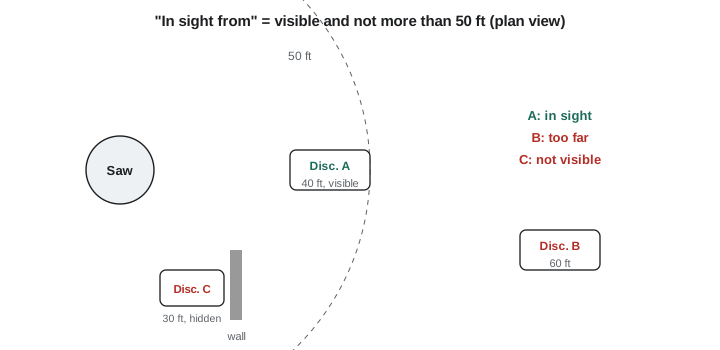
Part IX requires a disconnecting means for each motor and its controller. Section 430.102(A) requires a disconnect for the controller, located in sight from the controller. Section 430.102(B) requires a disconnect for the motor, located in sight from the motor location and the driven machinery. One disconnect can serve both purposes if it is in sight of both. Article 100 defines "in sight from" as visible and not more than 50 feet away. Both conditions must be met: a switch 30 feet away behind a wall is not in sight, and a switch 60 feet away across an open floor is not in sight either.
There is an important exception for the motor disconnect. Section 430.102(B)(2) allows the controller's disconnect, if it is lockable in the open position, to serve as the motor's disconnect even when it is not in sight of the motor, in specific situations: where a disconnect in sight of the motor is impracticable or would introduce additional hazards, or in industrial installations with written safety procedures where only qualified persons service the equipment. Section 110.25 defines lockable: the locking provision must stay in place with or without the lock installed, so a portable clip-on lock adapter does not count. On exams, the question will describe the situation and ask whether a lockable disconnect out of sight is acceptable; the answer depends on whether one of the listed conditions is stated.
Worked problem
Can the saw disconnect be in the electrical room?
Ray wants the saw line's disconnects in the electrical room, 70 ft from the saws and out of sight. The shop has no written lockout program yet. Is that acceptable?
Show solution
- The disconnects are not in sight of the motors (out of view and over 50 ft).
- The exception for a lockable disconnect requires that a disconnect in sight be impracticable or hazardous, or that the industrial conditions with written procedures and qualified persons apply.
- Neither condition applies here, so a disconnect in sight of each saw is required.
Answer: No; install a disconnect in sight of each saw, or meet the exception's conditions.
The disconnecting means: what type and how big
Section 430.109 lists the types of devices that can serve as a motor disconnect: a listed motor-circuit switch rated in horsepower, a listed molded-case circuit breaker, a listed molded-case switch, an instantaneous-trip breaker that is part of a listed combination controller, a self-protected combination controller, and a few others, along with special permissions for small motors, such as a general-use switch or an attachment plug and receptacle for portable motors of 1/3 horsepower or less. The disconnect must open all ungrounded supply conductors, and 430.103 requires that it plainly indicate whether it is open or closed.
Section 430.110 sets the size. For motors rated 1,000 volts or less, the disconnect must have an ampere rating of not less than 115% of the motor's full-load current from the table. A horsepower-rated switch must also have a horsepower rating at least equal to the motor's. When a disconnect serves several motors or motors and other loads, 430.110(C) sizes it on the combined load, using the total of the full-load currents and, for horsepower, an equivalent horsepower from the combined locked-rotor and full-load currents.
Worked problem
Sizing the compressor disconnect
Size a fused motor-circuit switch for the 25 hp, 480 V compressor (34 A table current).
Show solution
- Minimum ampere rating: 1.15 × 34 = 39.1 A.
- Common switch sizes are 30, 60, 100 and 200 A, so the next size above 39.1 A is 60 A.
- The switch must also be rated at least 25 hp at 480 V, and its fuse clips must accept the 60 A fuses from Lesson 3.
Answer: A 60 A, 480 V switch rated at least 25 hp.
Worked problem
One disconnect for the three saws
Could one disconnect serve all three 15 hp saws (21 A each)? Find its minimum ampere rating.
Show solution
- Combined full-load current: 3 × 21 = 63 A.
- Minimum: 1.15 × 63 = 72.5 A.
- A 100 A switch would be needed, and it must be in sight of all three saws, with a horsepower rating found under 430.110(C).
Answer: At least 72.5 A, so a 100 A switch in sight of all three saws.
| Load | Table FLC | 115% of FLC | Disconnect size chosen |
|---|---|---|---|
| Compressor | 34 A | 39.1 A | 60 A switch, 25 hp rated |
| Each saw motor | 21 A | 24.2 A | 30 A switch, 15 hp rated |
| Dust collector | 14 A | 16.1 A | 30 A switch, 10 hp rated |
| Exhaust fan | 7.6 A | 8.7 A | 30 A switch, 5 hp rated |
SWITCHES = [30, 60, 100, 200, 400]

def disconnect(flc_total):
    need = round(1.15 * flc_total + 1e-9, 1)
    return need, min(s for s in SWITCHES if s >= need)

for name, flc in [("compressor", 34), ("saw motor", 21), ("three saws together", 63),
                  ("dust collector", 14), ("exhaust fan", 7.6)]:
    need, size = disconnect(flc)
    print(f"{name:20} FLC {flc:>4} A -> at least {need:5} A, switch {size} A")

print("Control transformer 150 VA: primary", round(150 / 480, 2), "A, secondary", 150 / 120, "A")compressor FLC 34 A -> at least 39.1 A, switch 60 A saw motor FLC 21 A -> at least 24.2 A, switch 30 A three saws together FLC 63 A -> at least 72.5 A, switch 100 A dust collector FLC 14 A -> at least 16.1 A, switch 30 A exhaust fan FLC 7.6 A -> at least 8.7 A, switch 30 A Control transformer 150 VA: primary 0.31 A, secondary 1.25 A
Exam strategy
Disconnect and control questions reward careful reading. Note the distance and the line of sight before deciding whether a disconnect is in sight. Note whether the question gives a reason for a remote lockable disconnect, because the exception depends on it. Use the table current, at 115%, for the disconnect rating, and remember the horsepower rating. For control circuits, note whether the conductors stay inside the enclosure and whether a transformer is used, then read the protection value from the table in 430.72.
Common mistakes
MistakeTreating any switch within 50 ft as in sight.
InsteadIn sight from means both visible and within 50 ft.
MistakeAccepting a portable lock adapter as making a disconnect lockable.
InsteadSection 110.25 requires the locking provision to remain in place with or without a lock.
MistakeSizing a motor disconnect at 125% like the conductors.
InsteadMotor disconnects are sized at 115% of the table full-load current, plus a horsepower rating.
MistakeUsing two-wire control on a saw.
InsteadUse three-wire control so the saw does not restart by itself after an outage.
Summary and key terms
- Control circuits must be protected against overcurrent; tapped conductors and control transformers have specific rules in 430.72.
- Three-wire control provides low-voltage protection; two-wire control restarts automatically.
- Controllers need a horsepower rating at least equal to the motor's.
- A disconnect is required in sight from the controller and in sight from the motor; in sight means visible and within 50 ft.
- A lockable controller disconnect may serve the motor out of sight only under the stated conditions.
- Motor disconnects are rated at least 115% of the table full-load current and at least the motor horsepower.
- Motor control circuit
- The circuit of a control apparatus that carries signals directing the controller, not the main power.
- In sight from
- Visible and not more than 50 ft away.
- Lockable
- Capable of being locked in the open position with a provision that remains in place without the lock.
- Low-voltage protection
- Control that drops out on loss of voltage and requires a manual restart.
- Motor-circuit switch
- A switch rated in horsepower for disconnecting motors.
Practice problems
Work each problem on paper first, then reveal the answer to check.
Find the minimum disconnect ampere rating for a motor with a 21 A table current.
Show answer
1.15 × 21 = 24.2 A, so a 30 A switch.
A disconnect is 45 ft from a motor with a clear view. Is it in sight?
Show answer
Yes; it is visible and not more than 50 ft away.
A disconnect is 30 ft away but behind a wall. Is it in sight?
Show answer
No; it must also be visible.
Find the secondary current of a 250 VA control transformer at 120 V.
Show answer
250 ÷ 120 = 2.08 A.
Lesson quiz · 5 questions
Score 60% or more to complete this lesson.
Create a free account to save your progress, take quizzes and earn a certificate.