
MELU-105 · Lesson 10 of 12 · 28 min
Capacitors and phase converters
▶ Video coming soon A video version of this lesson is on the way.
Delgado's first electric bill after the expansion carried a line Hector had never noticed before: a power factor penalty. The utility's meter showed the shop's demand at 0.75 power factor, and the tariff charged extra below 0.90. Ray proposed a capacitor bank. In the same meeting Hector mentioned a used lathe he had bought from a farm auction that needed three-phase power at his small satellite shop out on Route 9, where only single-phase service was available. That meant a phase converter. Both pieces of equipment have their own short articles in Chapter 4, Article 460 for capacitors and Article 455 for phase converters, and both produce a few reliable exam questions.
This lesson explains power factor and how capacitors correct it, the sizing of capacitor banks in kilovolt-amperes reactive, Article 460 rules for capacitor conductors, protection, disconnecting and discharge, the special case of capacitors connected at a motor, and Article 455 rules for rotary and static phase converters.
Power factor in brief
Induction motors draw two kinds of current: the in-phase current that does useful work, measured in kilowatts, and the magnetizing current that sets up the motor's magnetic field, measured in kilovolt-amperes reactive (kvar). The total current, measured in kilovolt-amperes, is the vector sum of the two. Power factor is the ratio of kilowatts to kilovolt-amperes. A shop full of lightly loaded motors can run at a power factor of 0.70 to 0.80, which means the wiring and the utility's transformers carry more current than the work requires.
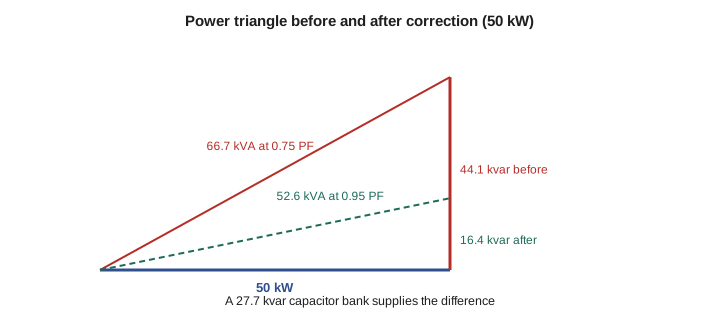
A capacitor draws leading reactive current, opposite to the lagging reactive current of a motor. Installed near the motors, it supplies their magnetizing current locally so the utility does not have to. The kilowatts stay the same; the kilovolt-amperes and the current from the utility go down.
Sizing a capacitor bank
The kvar needed to improve the power factor from one value to another comes from the tangents of the two power factor angles. This is a standard exam calculation, and it does not depend on the code; it is basic electrical theory that master exams include.
Worked problem
Correcting Delgado's power factor
The shop's demand is 50 kW at 0.75 power factor. How many kvar of capacitors raise it to 0.95?
Show solution
- θ₁ = cos⁻¹ 0.75 = 41.4°; tan θ₁ = 0.882.
- θ₂ = cos⁻¹ 0.95 = 18.2°; tan θ₂ = 0.329.
- kvar = 50 × (0.882 − 0.329) = 27.7 kvar.
Answer: About 27.7 kvar; Ray chose a standard 30 kvar bank.
Worked problem
Current before and after
Find the demand current at 480 V three-phase before and after correction to 0.95.
Show solution
- Before: 50 ÷ 0.75 = 66.7 kVA; 66,700 ÷ (1.732 × 480) = 80.2 A.
- After: 50 ÷ 0.95 = 52.6 kVA; 52,600 ÷ (1.732 × 480) = 63.3 A.
Answer: The current drops from about 80.2 A to about 63.3 A for the same 50 kW of work.
Capacitor conductors: 460.8
Section 460.8(A) sets the ampacity of capacitor circuit conductors at not less than 135% of the capacitor's rated current. Capacitors carry more current than their rating would suggest because harmonic currents and voltages above nominal increase their current, and capacitors are manufactured with a tolerance that allows somewhat more kvar than marked. For a capacitor connected to a motor circuit, the conductors must also be at least one-third of the ampacity of the motor circuit conductors and not less than 135% of the capacitor current.
Worked problem
Conductors for the 30 kvar bank
Find the rated current of a 30 kvar, 480 V three-phase capacitor bank and the minimum conductor ampacity.
Show solution
- Rated current: 30,000 ÷ (1.732 × 480) = 36.1 A.
- Minimum ampacity: 1.35 × 36.1 = 48.7 A.
Answer: About 36.1 A rated, with conductors of at least 48.7 A ampacity.
Protection, disconnecting and discharge
Section 460.8(B) requires an overcurrent device in each ungrounded conductor of a capacitor bank, with an exception for a capacitor connected on the load side of a motor overload device. The rating or setting is to be as low as practicable. Section 460.8(C) requires a disconnecting means in each ungrounded conductor for each capacitor bank, also with the motor-connected exception, and it must be rated at not less than 135% of the capacitor's rated current. The disconnect must open all ungrounded conductors at once.
Section 460.6 requires capacitors to have a means of discharging stored energy. In general terms, for capacitors of 1,000 volts or less, the residual voltage must be reduced to 50 volts or less within one minute after the capacitor is disconnected. Most capacitors have internal discharge resistors for this purpose. A motor winding connected directly across the capacitor, with no switch between them, also provides a discharge path. This rule is a favorite exam question because the numbers, 50 volts and one minute, are easy to state and easy to confuse with the five-minute value for higher voltages.
| Item | Rule (general terms) | Section |
|---|---|---|
| Conductor ampacity | At least 135% of rated capacitor current | 460.8(A) |
| Overcurrent protection | In each ungrounded conductor, as low as practicable | 460.8(B) |
| Disconnecting means | In each ungrounded conductor, rated at least 135% of capacitor current | 460.8(C) |
| Discharge | To 50 V or less within 1 minute (1,000 V or less) | 460.6 |
Capacitors at the motor
An alternative to a central bank is to connect a small capacitor directly at each motor, on the load side of the motor controller, so the capacitor switches on and off with the motor. This avoids overcorrection when motors are off. Section 460.9 then requires an adjustment to the overload setting, because the capacitor supplies part of the motor's magnetizing current, so the current through the overload relay drops. The overload must be selected based on the improved power factor of the motor circuit, not on the full nameplate current; otherwise the relay would allow the motor to overheat. The capacitor's kvar is also limited so that it does not exceed the value needed to raise the motor's no-load power factor to unity, which prevents self-excitation when the motor coasts down.
Worked problem
Overloads with a motor capacitor
A capacitor at a motor reduces the current through the overload relay from 32 A to 28.5 A at full load. The motor's service factor is 1.15. What is the basis for the overload setting?
Show solution
- Under 460.9, the overload is based on the improved current of the motor circuit, 28.5 A.
- Using Lesson 4's illustrative factor: 1.25 × 28.5 = 35.6 A, rather than 40 A.
Answer: About 35.6 A, based on the reduced current.
Phase converters: Article 455
A phase converter produces three-phase power from a single-phase supply, which lets three-phase motors run where the utility offers only single-phase service. There are two common kinds. A rotary phase converter uses an idler motor to generate the third phase and can run several motors and start them under load. A static phase converter uses capacitors to start a motor and then drops out, leaving the motor running on single phase with reduced capacity; it suits a single motor that starts lightly loaded.
Article 455 covers both. In general terms, 455.6 sets the ampacity of the single-phase supply conductors at not less than 125% of the phase converter's nameplate single-phase input full-load current. Where the converter's nameplate does not list the input current, the section bases the conductors on the three-phase loads served, using a multiplier to convert three-phase current to single-phase input. Section 455.7 requires overcurrent protection for the single-phase supply, 455.8 requires a disconnecting means, and 455.9 requires that single-phase loads connected on the load side of a converter not be connected to the manufactured phase, the phase the converter generates, because its voltage is not stable.
Worked problem
Supply for the Route 9 converter
The rotary converter for the lathe has a nameplate single-phase input current of 42 A at 240 V. Find the minimum ampacity of the supply conductors.
Show solution
- Minimum: 1.25 × 42 = 52.5 A.
Answer: At least 52.5 A.
Section 455.9 matters on the Route 9 job because Hector wanted to plug a small 240-volt single-phase grinder into the same three-phase panel. Dana pointed out that it must be connected between the two utility conductors, not to the manufactured phase, and that the manufactured phase must be identified so no one makes that mistake later.
import math

def kvar_needed(kw, pf1, pf2):
    return kw * (math.tan(math.acos(pf1)) - math.tan(math.acos(pf2)))

def amps_3ph(kva, volts=480):
    return kva * 1000 / (math.sqrt(3) * volts)

print("kvar to go from 0.75 to 0.95 at 50 kW:", round(kvar_needed(50, 0.75, 0.95), 1))
print("Current before:", round(amps_3ph(50 / 0.75), 1), "A; after:", round(amps_3ph(50 / 0.95), 1), "A")
cap = amps_3ph(30)
print("30 kvar bank current:", round(cap, 1), "A; conductors and disconnect at 135%:", round(1.35 * cap, 1), "A")
print("Converter supply conductors:", 1.25 * 42, "A")kvar to go from 0.75 to 0.95 at 50 kW: 27.7 Current before: 80.2 A; after: 63.3 A 30 kvar bank current: 36.1 A; conductors and disconnect at 135%: 48.7 A Converter supply conductors: 52.5 A
Overcorrection, harmonics and placement
More capacitance is not always better. If a capacitor bank supplies more reactive power than the motors need, the power factor becomes leading, the voltage can rise, and at light load the bank can overcorrect badly. That is one reason central banks are often switched in steps by a controller that watches the power factor, adding or removing stages as motors start and stop. Fixed banks are sized for the base load that is always present.
Capacitors also interact with harmonic currents from drives, electronic ballasts and computers. A capacitor bank and the system's inductance form a resonant circuit, and if the resonance falls near a harmonic produced by the loads, the harmonic currents can be amplified, overheating the capacitors and blowing their fuses. In shops with many drives, engineers use detuned banks with series reactors. Exams rarely test the engineering, but they do test the reason capacitor conductors are sized at 135%: harmonics and overvoltage increase capacitor current.
Where to place the capacitors is a design choice. At the motor, each capacitor switches with its motor and relieves the feeder and branch circuit as well as the utility, but every motor needs its own unit and the overloads must be adjusted. At the panel or service, one bank serves many motors and is easier to maintain, but it does nothing for the branch circuits. Delgado's 30 kvar bank went at the shop's main distribution panel, on its own breaker, because the penalty was a utility charge and the branch circuits were already adequate.
Worked problem
Choosing between placements
The saw line's three 15 hp motors each need about 4 kvar to reach 0.95 power factor. Compare individual capacitors with adding 12 kvar to the central bank.
Show solution
- Individual: three 4 kvar units, each on the load side of its starter; overloads reset to the improved current; branch circuits relieved.
- Central: one 12 kvar step added at the panel; branch currents unchanged; no overload changes; risk of overcorrection when the saws are off unless the step is switched.
Answer: Both are acceptable; the central step is simpler, the individual units relieve more of the wiring.
Common mistakes
MistakeSizing capacitor conductors at 125% like a continuous load.
InsteadSection 460.8(A) requires at least 135% of rated capacitor current.
MistakeLeaving the overload at its original setting after adding a capacitor at the motor.
InsteadBase the setting on the improved current through the overload under 460.9.
MistakeConnecting a single-phase load to the manufactured phase of a converter.
InsteadSingle-phase loads must not connect to the manufactured phase (455.9).
MistakeConfusing the discharge time for low-voltage capacitors.
InsteadFor 1,000 V or less, discharge to 50 V or less within 1 minute.
Summary and key terms
- Capacitors supply motors' magnetizing current locally, raising power factor and reducing current.
- kvar needed = kW × (tan θ₁ − tan θ₂).
- Capacitor conductors and disconnects are rated at least 135% of the capacitor's rated current.
- Capacitors of 1,000 V or less must discharge to 50 V or less within 1 minute.
- Capacitors at a motor reduce the current through the overload, so the overload is reset to the improved current.
- Phase converter supply conductors are at least 125% of the nameplate single-phase input current; single-phase loads stay off the manufactured phase.
- Power factor
- The ratio of real power in kW to apparent power in kVA.
- kvar
- Kilovolt-amperes reactive, the reactive power that magnetizes motors.
- Capacitor bank
- A group of capacitors installed to supply reactive power.
- Phase converter
- Equipment that produces three-phase power from a single-phase supply.
- Manufactured phase
- The phase generated by a phase converter, not supplied by the utility.
Practice problems
Work each problem on paper first, then reveal the answer to check.
Find the kvar needed to raise 80 kW from 0.80 to 0.95 power factor.
Show answer
80 × (0.750 − 0.329) = 33.7 kvar.
Find the rated current of a 20 kvar, 480 V three-phase capacitor.
Show answer
20,000 ÷ (1.732 × 480) = 24.1 A.
Find the minimum conductor ampacity for that capacitor.
Show answer
1.35 × 24.1 = 32.5 A.
A converter's nameplate input current is 60 A. Find the minimum supply conductor ampacity.
Show answer
1.25 × 60 = 75 A.
Lesson quiz · 5 questions
Score 60% or more to complete this lesson.
Create a free account to save your progress, take quizzes and earn a certificate.