
MELU-104 · Lesson 9 of 12 · 26 min
Grounding at separate buildings
▶ Video coming soon A video version of this lesson is on the way.
Few installations generate as many arguments in the field as a feeder to a detached building. Ask ten electricians how to wire a garage subpanel and you may get three answers: three wires with the neutral bonded at the garage, four wires with the neutral isolated, or four wires plus a rod. Only one of those is right for new work under the 2023 NEC, and it is the one the master exam expects. Dana Whitfield met the question in real life when Helen Brandt asked Brightwater to feed a new detached workshop behind her house on Orchard Lane, and again at the Kowalczyk farm, where a new machine shed was going up beside a barn wired decades ago. This lesson covers 250.32, the rules for grounding and bonding at buildings or structures supplied by feeders or branch circuits from another building.
As always, the rules are explained in our own words, with illustrative values stated as this course's examples. Confirm each requirement and value in your own adopted edition and local amendments.
Each building needs its own electrode
Section 250.32(A) requires a building or structure supplied by a feeder or branch circuit to have a grounding electrode or grounding electrode system installed in accordance with Part III of Article 250. Everything from Lesson 4 applies: all electrodes present at the building must be used, a new building's concrete-encased electrode must be bonded in, and a single rod needs a supplemental electrode unless it measures 25 ohms or less. The grounding electrode conductor connects to the building disconnecting means.
There is one exception. A grounding electrode is not required where only a single branch circuit, including a multiwire branch circuit, supplies the building or structure, and the branch circuit includes an equipment grounding conductor for grounding the normally non-current-carrying metal parts of equipment. A garden shed fed by one 20 ampere circuit, or by one multiwire circuit with a shared neutral, needs no rod, provided the circuit has its equipment grounding conductor. Two separate circuits to the same shed, however, put it outside the exception, and an electrode becomes required.
Why does the code want an electrode at a detached building that already has an equipment grounding conductor back to the main building? Recall Lesson 1. The electrode does not clear faults; the equipment grounding conductor does that. The electrode limits voltages from lightning and surges at the building, where the feeder may be a long, exposed run that picks up induced voltages, and where the local earth may rise far above the main building's earth during a nearby strike. Both are needed, for different reasons.
Four wires, neutral isolated
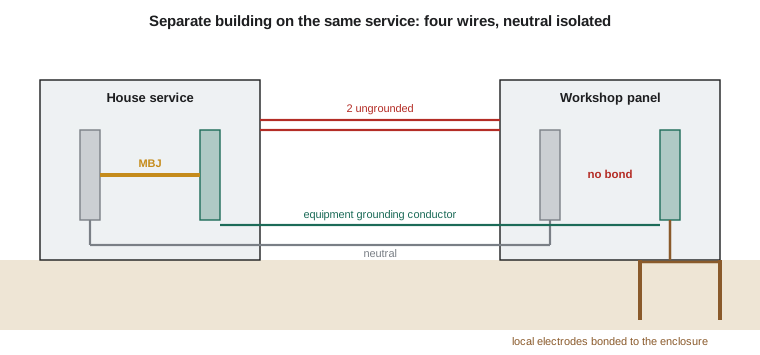
Section 250.32(B)(1) is the core rule for new installations. Where the building is supplied by a feeder or branch circuit from the same service, an equipment grounding conductor, as described in 250.118, must be run with the supply conductors and connected to the building disconnecting means and to the grounding electrode or electrodes. The grounded conductor, the neutral, must not be connected to the equipment grounding conductor or to the grounding electrodes at the building. In practical terms, the feeder to Helen Brandt's workshop has four conductors, two ungrounded, one neutral and one equipment grounding conductor, and the workshop panel's neutral bar is isolated from its enclosure, with the bonding screw or strap left out, exactly like a subpanel in the main building.
The reason is the same objectionable current argument from Lesson 3. If the neutral were bonded to the enclosure at the workshop, with an equipment grounding conductor also running back to the house, the neutral current would divide between the neutral and the equipment grounding conductor. And because the workshop also has its own electrode, some neutral current would flow through the earth between the two buildings' electrodes, and through any other metal path between them: a metal water line, a communications cable shield, a chain-link fence. Keeping the neutral isolated at the workshop gives neutral current only one path home.
Worked problem
The Brandt workshop
Helen Brandt's workshop is fed from her house panel by a 60 A, 120/240 V feeder with 6 AWG copper conductors in PVC. The workshop has slab footings with no reinforcing steel in contact with the earth and a plastic water line, so Dana will drive rods. This course's examples use 10 AWG copper for the 60 A row of Table 250.122 and 8 AWG copper for the row of Table 250.66 covering 2 AWG or smaller. Size the equipment grounding conductor and the grounding electrode conductor, and describe the panel bonding.
Show solution
- Equipment grounding conductor, from Table 250.122 by the 60 A feeder device: 10 AWG copper, run in the PVC with the feeder.
- Grounding electrode conductor, from Table 250.66 by the largest feeder ungrounded conductor (6 AWG): 8 AWG copper. It runs only to rods, and the 6 AWG cap is larger, so 8 AWG stands; protect it in raceway or armor because it is smaller than 6 AWG.
- Two rods at least 6 ft apart, unless one measures 25 Ω or less.
- In the workshop panel, the neutral bar is isolated, the equipment grounding conductor and grounding electrode conductor land on the equipment grounding bar bonded to the enclosure, and no bonding screw is installed.
Answer: 10 AWG copper equipment grounding conductor, 8 AWG copper grounding electrode conductor to two rods, neutral isolated at the workshop.
Sizing the electrode conductor at a separate building
Section 250.32(E) sizes the grounding electrode conductor at a separate building from Table 250.66, based on the largest ungrounded supply conductor, the feeder or branch circuit conductor, as though it were a service. The caps of 250.66(A), (B) and (C) still apply: a run to rods only need not exceed 6 AWG copper, and a run to a concrete-encased electrode only need not exceed 4 AWG copper. The equipment grounding conductor run with the feeder is sized separately, from Table 250.122 by the feeder's overcurrent device. Candidates who mix up the two lose points on almost every separate-building question.
Metal water piping at the separate building must be bonded too. Section 250.104(A)(3) requires the water piping to be bonded to the building disconnecting means enclosure where it is located at the building, to the equipment grounding conductor run with the supply conductors, or to the building's electrodes, with the bonding jumper sized from Table 250.102(C)(1) by the feeder or branch circuit conductors that supply the building.
Worked problem
The Kowalczyk machine shed
The new machine shed at the Kowalczyk farm is fed by a 125 A feeder of 1 AWG copper. The shed sits on new footings with reinforcing steel, so a concrete-encased electrode is present. This course's examples use 6 AWG copper for the 200 A row of Table 250.122 and 6 AWG copper for the row of Table 250.66 covering 1 or 1/0. Size the conductors.
Show solution
- Equipment grounding conductor, from Table 250.122 by the 125 A device: the 200 A row, 6 AWG copper.
- The concrete-encased electrode is present in a new building, so 250.50 requires it to be used.
- Grounding electrode conductor, from Table 250.66 by the 1 AWG feeder conductors: 6 AWG copper. The run is to the concrete-encased electrode only, whose 4 AWG cap is larger, so 6 AWG stands.
- Neutral isolated at the shed's disconnect; equipment grounding conductor and electrode conductor bonded to the enclosure.
Answer: 6 AWG copper equipment grounding conductor and 6 AWG copper grounding electrode conductor to the footing steel.
The existing-installation exception
Before the 2008 NEC, a detached building fed by a feeder could be wired with three conductors, with the neutral bonded to the enclosure and to a local electrode at the building, provided certain conditions held. That practice is no longer permitted for new work, but 250.32(B)(1) keeps an exception for existing installations that were made under earlier codes. The grounded conductor run with the supply to the building may continue to serve as the ground-fault return path where three conditions are met: there was no equipment grounding conductor run with the supply, there are no continuous metallic paths bonded to the grounding system in each building or structure involved, and ground-fault protection of equipment has not been installed on the supply side of the feeder. Where the grounded conductor is used this way, it must be sized for the fault current it may carry, at least the size required by 250.122.
The second condition is the one that trips people up in the field and on the exam. A continuous metallic path between the buildings, such as a metal water line, metal gas piping, a shielded communications cable, or a metal fence connected to both buildings' grounding systems, would carry part of the neutral current, because both ends of the path would be connected to a bonded neutral. So an existing three-wire feeder can stay in service only as long as nothing metallic connects the two buildings. Add a copper water line to the barn, and the old feeder no longer qualifies; it must be upgraded to four wires with the neutral isolated.
Worked problem
The old Kowalczyk barn
The Kowalczyk barn was wired in 1994 with a three-wire feeder, the neutral bonded at the barn panel and a rod at the barn. The family now wants Brightwater to run a copper water line from the house to the barn for a stock tank heater circuit and drinking water. Can the three-wire feeder stay?
Show solution
- The installation predates the four-wire rule, so it may qualify for the existing-installation exception.
- A copper water line bonded to both buildings' grounding systems would create a continuous metallic path between them.
- With that path, the exception's conditions are no longer met.
Answer: No. Either run the water line in plastic so no metallic path is created, or upgrade the feeder to four wires and isolate the neutral at the barn.
| Situation | Electrode at the building? | Feeder conductors | Neutral at the building |
|---|---|---|---|
| Single branch circuit (including multiwire) with an equipment grounding conductor | Not required | Circuit conductors plus equipment grounding conductor | Isolated |
| Feeder or two or more circuits, new installation | Required | Ungrounded, neutral and equipment grounding conductor | Isolated from the enclosure |
| Existing three-wire feeder meeting all exception conditions | Required | Ungrounded and neutral only | Bonded, as originally installed |
| Supplied by a separately derived system | Required | As 250.30 directs | As 250.30 directs |
Other supply arrangements
Section 250.32(B)(2) covers a separate building supplied by a separately derived system, such as a transformer at the main building. If the overcurrent protection is at the source, an equipment grounding conductor runs with the supply conductors, and the building follows 250.32(B)(1). If no overcurrent protection is provided at the source, the separate building's disconnect is the first disconnect of the derived system, and the bonding follows 250.30. Section 250.32(C) covers a building supplied by its own separate service, which is grounded and bonded like any service under 250.24. And 250.32(D) covers the less common case where the disconnecting means for the separate building is located at the main building or elsewhere, with conditions on running an equipment grounding conductor and on where the grounded conductor may be bonded.
A calculator you can edit
The listing below decides whether a separate building needs an electrode and sizes the two conductors that most often get mixed up, from this lesson's illustrative rows. Change the feeder size and overcurrent device to practice.
EGC_ROWS = [(20, "12 AWG"), (60, "10 AWG"), (100, "8 AWG"), (200, "6 AWG")]             # illustrative
GEC_ROWS = [(66.36, "8 AWG"), (105.6, "6 AWG"), (167.8, "4 AWG"), (350, "2 AWG")]        # illustrative

def row(rows, value):
    return next(size for limit, size in rows if value <= limit)

def separate_building(circuits, ocpd_amps, feeder_kcmil):
    electrode = "not required" if circuits == 1 else "required"
    return electrode, row(EGC_ROWS, ocpd_amps), row(GEC_ROWS, feeder_kcmil)

for name, circuits, ocpd, kcmil in [("Garden shed, one multiwire circuit", 1, 20, 6.53),
                                    ("Brandt workshop, 60 A feeder of 6 AWG", 2, 60, 26.24),
                                    ("Kowalczyk shed, 125 A feeder of 1 AWG", 2, 125, 83.69)]:
    e, egc, gec = separate_building(circuits, ocpd, kcmil)
print(f"{name}: electrode {e}; EGC {egc}; GEC {gec if e == 'required' else 'n/a'}")Garden shed, one multiwire circuit: electrode not required; EGC 12 AWG; GEC n/a Brandt workshop, 60 A feeder of 6 AWG: electrode required; EGC 10 AWG; GEC 8 AWG Kowalczyk shed, 125 A feeder of 1 AWG: electrode required; EGC 6 AWG; GEC 6 AWG
Common mistakes
MistakeBonding the neutral to the enclosure at a detached garage fed by a new four-wire feeder.
InsteadIsolate the neutral at the separate building; only the equipment grounding conductor and electrodes bond to the enclosure.
MistakeOmitting the equipment grounding conductor because the detached building has its own rods.
InsteadThe electrode limits surge voltages; the equipment grounding conductor clears faults. Both are required.
MistakeSizing the separate building's grounding electrode conductor from the feeder overcurrent device.
InsteadUse Table 250.66 with the largest feeder ungrounded conductor; the equipment grounding conductor uses Table 250.122.
MistakeKeeping an old three-wire feeder after adding a metal water line between the buildings.
InsteadA continuous metallic path voids the existing-installation exception; upgrade to four wires or keep the water line nonmetallic.
MistakeDriving a rod at a shed fed by two separate 20 A circuits and calling it optional.
InsteadThe single-circuit exception covers only one branch circuit, including a multiwire circuit; two circuits require an electrode.
Summary and key terms
- A building supplied by a feeder or branch circuit needs a grounding electrode system, except where a single branch circuit with an equipment grounding conductor supplies it.
- New feeders to separate buildings carry an equipment grounding conductor, and the neutral is not connected to the equipment grounding conductor or electrodes at the building.
- The separate building's grounding electrode conductor is sized from Table 250.66 by the feeder conductors, with the usual caps; the equipment grounding conductor from Table 250.122 by the feeder device.
- Water piping at the separate building is bonded with a jumper sized from Table 250.102(C)(1) by the feeder conductors.
- Existing three-wire feeders may remain only if there is no equipment grounding conductor, no continuous metallic path between buildings and no supply-side ground-fault protection.
- Buildings fed by separately derived systems or separate services follow 250.30 or 250.24.
- Separate building or structure
- A building or structure supplied by a feeder or branch circuit from another building.
- Building disconnecting means
- The disconnect at a separate building where the grounding electrode conductor and equipment grounding conductor connect.
- Continuous metallic path
- A metal connection between buildings, such as water piping or cable shields, that can carry current between their grounding systems.
- Multiwire branch circuit
- A branch circuit with two or more ungrounded conductors sharing one neutral.
- Existing-installation exception
- The provision allowing older three-wire feeders to separate buildings to remain under strict conditions.
Practice problems
Work each problem on paper first, then reveal the answer to check.
A detached garage is fed by a 100 A feeder of 3 AWG copper. This course uses 8 AWG copper for the 100 A row of Table 250.122 and 8 AWG copper for the 2 AWG or smaller row of Table 250.66. Size both conductors.
Show answer
Equipment grounding conductor 8 AWG copper; grounding electrode conductor 8 AWG copper, protected because it is smaller than 6 AWG.
A shed is fed by one 20 A, 120 V circuit with an equipment grounding conductor. Is a rod required?
Show answer
No; the single branch circuit exception in 250.32(A) applies.
A detached building's panel has the bonding screw installed and a four-wire feeder. What is wrong?
Show answer
The neutral must not be bonded at the separate building; remove the screw so neutral current returns only on the neutral.
Which three conditions must an existing three-wire feeder meet to remain?
Show answer
No equipment grounding conductor was run, no continuous metallic paths between buildings, and no ground-fault protection on the supply side.
How is metal water piping bonded at a separate building?
Show answer
To the building disconnect enclosure, the equipment grounding conductor or the electrodes, with a jumper sized from Table 250.102(C)(1) by the feeder conductors.
Lesson quiz · 5 questions
Score 60% or more to complete this lesson.
Create a free account to save your progress, take quizzes and earn a certificate.