
MELU-104 · Lesson 7 of 12 · 28 min
Equipment grounding conductors and Table 250.122
▶ Video coming soon A video version of this lesson is on the way.
The equipment grounding conductor is the conductor that actually saves lives on the premises wiring. It is the path that carries fault current back to the source so the breaker opens, and it bonds equipment frames so that people touching them stay safe while it does. On a master exam it is also the conductor most likely to be sized from the wrong table. Marcus Lee, studying with Dana Whitfield, once sized the equipment grounding conductor for a 400 ampere feeder from Table 250.66 and got 1/0 AWG, which was among the answer choices. The right answer from Table 250.122 was smaller. This lesson covers what qualifies as an equipment grounding conductor, how it is identified, and how it is sized, including the adjustments for upsized conductors, parallel runs, multiple circuits and motor circuits.
The rules are in Part VI of Article 250: 250.110 through 250.114 for what must be grounded, 250.118 for the types of equipment grounding conductors, 250.119 for identification, and 250.122 for size. We describe the rules in our own words and use illustrative values stated as this course's examples. Confirm every value in your own copy of Table 250.122 and the adopted edition; the 2026 edition revised parts of the table's presentation, so check carefully if your state has adopted it.
What must be grounded
Sections 250.110 through 250.114 tell you which equipment must be connected to an equipment grounding conductor. Exposed, normally non-current-carrying metal parts of fixed equipment likely to become energized must be grounded where any of several conditions applies: within 8 feet vertically or 5 feet horizontally of ground or grounded metal objects and subject to contact by persons, in wet or damp locations not isolated, in electrical contact with metal, in a hazardous location, supplied by a wiring method that provides an equipment grounding conductor, or operating with any terminal at over 150 volts to ground, with limited exceptions. Section 250.112 lists specific equipment that must be grounded regardless of voltage, such as switchboard frames, motor frames, electric signs and luminaires. Section 250.114 covers cord-and-plug-connected equipment, such as refrigerators, washers, dishwashers, hand-held motor-operated tools and portable luminaires in wet locations, with exceptions for listed double-insulated tools and appliances.
For the exam, the practical summary is simple. Nearly all equipment you install is grounded. The questions focus on the exceptions, such as double-insulated portable tools, and on the rare conditions where grounding is not required, such as certain equipment over 150 volts that is guarded or isolated.
What can serve as an equipment grounding conductor
Section 250.118 lists what may serve as an equipment grounding conductor. The first item is a conductor: a copper, aluminum or copper-clad aluminum wire, solid or stranded, insulated, covered or bare, in the form of a wire or a busbar of any shape. The rest of the list is metal wiring methods that qualify by themselves, without a separate wire. The list includes rigid metal conduit, intermediate metal conduit and electrical metallic tubing, all of which qualify with listed fittings made up tight.
Flexible wiring methods qualify only with conditions, and exam writers love those conditions. Listed flexible metal conduit qualifies where the conduit is terminated in listed fittings, the circuit conductors inside are protected at 20 amperes or less, the combined length of flexible metal conduit, flexible metallic tubing and liquidtight flexible metal conduit in the same ground-fault return path does not exceed 6 feet, and the conduit is not installed for flexibility after installation, such as for vibration or movement. Listed liquidtight flexible metal conduit qualifies under similar conditions, with limits by trade size: in this course's examples, the 3/8 through 1/2 trade sizes are limited to circuits of 20 amperes or less, and the 3/4 through 1 1/4 trade sizes to 60 amperes or less, again within the 6 foot combined limit and not for flexibility. Flexible metallic tubing qualifies for circuits of 20 amperes or less within the 6 foot limit.
Where flexibility is needed after installation, as for a motor on a vibrating base or equipment that moves, or where the length or rating limits are exceeded, a wire-type equipment grounding conductor must be installed inside the flexible raceway. Other items on the list include the armor of Type AC cable, the copper sheath of Type MI cable, Type MC cable that provides an effective ground-fault current path as its listing permits, cable trays and cablebus framework meeting their own articles, other listed electrically continuous metal raceways and auxiliary gutters, and listed surface metal raceways.
| Wiring method | Qualifies as an equipment grounding conductor when (this course's examples) |
|---|---|
| Rigid metal conduit, IMC, EMT | Installed with listed fittings made up tight |
| Flexible metal conduit | Listed fittings; circuits 20 A or less; total flexible length 6 ft or less in the path; not for flexibility after installation |
| Liquidtight flexible metal conduit, 3/8 to 1/2 | Listed fittings; circuits 20 A or less; 6 ft total; not for flexibility |
| Liquidtight flexible metal conduit, 3/4 to 1 1/4 | Listed fittings; circuits 60 A or less; 6 ft total; not for flexibility |
| Flexible metallic tubing | Circuits 20 A or less; 6 ft total |
| Type AC cable armor | Always, with its internal bonding strip |
| Type MC cable | Only where its listing identifies the sheath or a combination as an equipment grounding conductor |
Identification
Section 250.119 controls identification. An equipment grounding conductor may be bare, or it may have a continuous outer finish that is green, or green with one or more yellow stripes. Conductors with those colors may not be used as ungrounded or grounded circuit conductors. An insulated equipment grounding conductor 4 AWG or larger may be identified at the time of installation by a distinctive marking at each end and at every point where the conductor is accessible: stripping the insulation from the entire exposed length, coloring the insulation or covering green, or marking it with green tape or green adhesive labels. Smaller conductors must have green or green-and-yellow insulation from the factory, with narrow exceptions for multiconductor cables in industrial settings with qualified maintenance.
Sizing with Table 250.122
Section 250.122 sizes wire-type equipment grounding conductors. The size depends on the rating or setting of the automatic overcurrent device in the circuit ahead of the equipment, raceway, conduit or cable, read from Table 250.122, which has columns for copper and for aluminum or copper-clad aluminum. The table lists overcurrent device ratings in rows that each cover a range up to the listed rating. In this course's illustrative examples, 15 A gives 14 AWG copper, 20 A gives 12 AWG, 60 A gives 10 AWG, 100 A gives 8 AWG, 200 A gives 6 AWG, 400 A gives 3 AWG, 600 A gives 1 AWG, 800 A gives 1/0 AWG, and 1,200 A gives 3/0 AWG. Confirm each row in your own table before using it.
Two clarifications in 250.122(A) are often tested. The equipment grounding conductor is never required to be larger than the circuit conductors supplying the equipment. And where a cable tray, raceway, cable armor or sheath is used as the equipment grounding conductor, it must meet 250.118 and the conditions above rather than a size from the table. Look again at what the table is entered with: the overcurrent device rating. Not the conductor size, not the load, and not the service size. A 60 ampere breaker protecting 6 AWG conductors still gets a 10 AWG copper equipment grounding conductor in this course's example.
Worked problem
Equipment grounding conductor for a feeder
The Copper Kettle's 225 A feeder from the Harlow Commons switchboard runs in PVC conduit with 4/0 AWG copper ungrounded conductors. This course's example row for 300 A in Table 250.122 is 4 AWG copper. What size equipment grounding conductor is required?
Show solution
- The overcurrent device is 225 A, which falls in the row up to 300 A.
- That row gives 4 AWG copper in this example.
- PVC is not a metal raceway, so a wire-type equipment grounding conductor must be installed.
Answer: 4 AWG copper (check the 300 A row in your edition).
Upsized conductors
Section 250.122(B) addresses a situation that comes up whenever conductors are increased for voltage drop or other reasons. Where ungrounded conductors are increased in size from the minimum size that has sufficient ampacity for the intended installation, wire-type equipment grounding conductors, where installed, must be increased in size proportionately, according to the circular mil area of the ungrounded conductors. The logic is that a longer run with larger conductors needs a proportionally larger fault return path to keep the fault loop impedance low enough for the breaker to open quickly.
The method has four steps. Find the minimum ungrounded conductor size that would have been sufficient. Divide the circular mil area of the actual conductor by the area of the minimum conductor to get a ratio. Multiply the circular mil area of the Table 250.122 equipment grounding conductor by that ratio. Choose the next standard size at least that large, using Chapter 9, Table 8 for areas.
Worked problem
Upsizing a feeder equipment grounding conductor
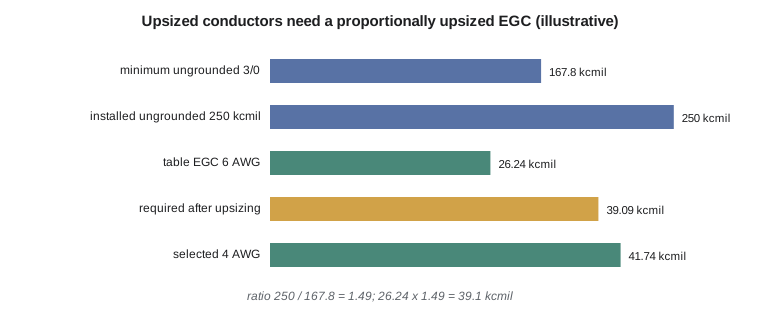
The feeder to Delgado's new machine bay is protected at 200 A. The minimum ungrounded conductor would be 3/0 AWG copper (167,800 cmil), but the run is long, so Ray installs 250 kcmil copper. This example uses 6 AWG copper (26,240 cmil) for the 200 A row. What size equipment grounding conductor is required?
Show solution
- Ratio = 250,000 ÷ 167,800 = 1.49.
- Required area = 26,240 × 1.49 = 39,094 cmil.
- 6 AWG is 26,240 cmil, too small; 4 AWG is 41,740 cmil, large enough.
- So the equipment grounding conductor increases from 6 AWG to 4 AWG copper.
Answer: 4 AWG copper.
Worked problem
Upsizing a branch circuit
A 20 A receptacle circuit at Lakeview Outfitters runs 160 ft, so Dana increases the conductors from 12 AWG (6,530 cmil) to 10 AWG (10,380 cmil). The table gives a 12 AWG copper equipment grounding conductor for 20 A in this example. What size is required now?
Show solution
- Ratio = 10,380 ÷ 6,530 = 1.59.
- Required area = 6,530 × 1.59 = 10,380 cmil.
- The next size at least 10,380 cmil is 10 AWG.
Answer: 10 AWG copper, the same size as the circuit conductors.
Multiple circuits, parallel runs and motor circuits
Section 250.122(C) lets one equipment grounding conductor serve several circuits in the same raceway, cable or cable tray. It is sized for the largest overcurrent device protecting conductors in that raceway or cable. A conduit carrying circuits protected at 20, 30 and 50 amperes needs one equipment grounding conductor sized for 50 amperes, which is 10 AWG copper in this course's example.
Section 250.122(F) covers parallel conductors, and its rule is the opposite of what intuition suggests. Where conductors are run in parallel in multiple raceways or cables, the equipment grounding conductor, where used, must be run in parallel in each raceway or cable, and each one must be sized from Table 250.122 based on the overcurrent device protecting the whole set of conductors. Each raceway gets a full-size equipment grounding conductor. You do not divide the size among the raceways, because a fault in one raceway sends most of its current back through the equipment grounding conductor in that raceway, and that conductor must be big enough to carry it.
Worked problem
Parallel feeder in two raceways
A switchboard feeder at the Commons is protected at 800 A and run as two parallel sets of 500 kcmil copper in two conduits. This example uses 1/0 AWG copper for the 800 A row. What equipment grounding conductors are required?
Show solution
- Each raceway needs its own equipment grounding conductor.
- Each is sized for the full 800 A overcurrent device: 1/0 AWG copper in this example.
- Two 1/0 AWG copper equipment grounding conductors in total, one per conduit.
Answer: 1/0 AWG copper in each conduit.
Section 250.122(D) handles motor circuits. Because a motor branch circuit's short-circuit and ground-fault protective device is often sized well above the motor's running current, the equipment grounding conductor is sized from Table 250.122 using the rating of that motor branch-circuit short-circuit and ground-fault protective device. Where the device is an instantaneous trip circuit breaker or a motor short-circuit protector, the size may be based on the rating of the motor overload protective device instead, but not smaller than the table value. MELU-105 covers motor circuits in detail.
Section 250.122(E) covers flexible cords: where the equipment grounding conductor is part of a flexible cord assembly, it may be the same size as the circuit conductors for circuits of 10 amperes or more, and for smaller circuits it must not be smaller than 18 AWG copper and not smaller than the circuit conductors. And 250.122(G) addresses feeder taps: the equipment grounding conductor for a tap is sized from the overcurrent device ahead of the feeder, but need not be larger than the tap conductors.
A calculator you can edit
The listing below sizes an equipment grounding conductor from an overcurrent device rating and then applies the proportional increase for upsized conductors. Its table holds this lesson's illustrative rows only, and the areas come from Chapter 9, Table 8; check both before relying on them.
ROWS = [(15, "14 AWG"), (20, "12 AWG"), (60, "10 AWG"), (100, "8 AWG"), (200, "6 AWG"),
        (300, "4 AWG"), (400, "3 AWG"), (600, "1 AWG"), (800, "1/0 AWG")]   # illustrative
CMIL = {"14 AWG": 4110, "12 AWG": 6530, "10 AWG": 10380, "8 AWG": 16510, "6 AWG": 26240,
        "4 AWG": 41740, "3 AWG": 52620, "2 AWG": 66360, "1 AWG": 83690, "1/0 AWG": 105600}

def egc(ocpd, min_cmil=None, actual_cmil=None):
    size = next(s for limit, s in ROWS if ocpd <= limit)
    if min_cmil and actual_cmil and actual_cmil > min_cmil:
        need = CMIL[size] * actual_cmil / min_cmil
        size = min((s for s in CMIL if CMIL[s] >= need), key=lambda s: CMIL[s])
    return size

print("225 A feeder:", egc(225))
print("200 A, 3/0 upsized to 250 kcmil:", egc(200, 167800, 250000))
print("20 A, 12 upsized to 10 AWG:", egc(20, 6530, 10380))
print("Raceway with 20, 30 and 50 A circuits:", egc(max(20, 30, 50)))225 A feeder: 4 AWG 200 A, 3/0 upsized to 250 kcmil: 4 AWG 20 A, 12 upsized to 10 AWG: 10 AWG Raceway with 20, 30 and 50 A circuits: 10 AWG
Common mistakes
MistakeSizing the equipment grounding conductor from Table 250.66 or from the conductor size.
InsteadUse Table 250.122, entered with the rating of the overcurrent device ahead of the circuit.
MistakeForgetting to upsize the equipment grounding conductor when the circuit conductors are increased for voltage drop.
InsteadIncrease it in proportion to the circular mil areas, as 250.122(B) requires.
MistakeDividing the equipment grounding conductor among parallel raceways.
InsteadEach raceway gets a full-size equipment grounding conductor based on the overcurrent device for the whole set.
MistakeRelying on flexible metal conduit as the equipment grounding conductor for a 30 A circuit.
InsteadFlexible metal conduit qualifies only for circuits of 20 A or less within the 6 ft limit; install a wire-type conductor.
MistakeUsing green tape to identify a 6 AWG equipment grounding conductor.
InsteadField identification is permitted only for 4 AWG and larger; smaller conductors must be green or bare from the factory.
Summary and key terms
- Equipment grounding conductors provide the effective ground-fault current path and bond equipment frames.
- Section 250.118 lists wires and qualifying metal wiring methods; flexible methods qualify only within strict rating and 6 ft length limits and not where flexibility is needed.
- Equipment grounding conductors are bare, green or green with yellow stripes; 4 AWG and larger may be field-identified.
- Size from Table 250.122 by the overcurrent device rating; never larger than the circuit conductors.
- Upsize proportionally by circular mils when circuit conductors are upsized; run a full-size conductor in each parallel raceway.
- One conductor may serve several circuits in a raceway, sized for the largest device; motor circuits use the short-circuit and ground-fault device rating.
- Equipment grounding conductor
- The conductive path that bonds equipment and carries fault current back to the source.
- Overcurrent device rating
- The rating or setting of the fuse or breaker protecting a circuit, which enters Table 250.122.
- Proportional increase
- Enlarging the equipment grounding conductor by the same circular mil ratio as upsized circuit conductors.
- Double-insulated
- Equipment built with two layers of insulation so it need not be grounded, when listed and marked.
- Fault loop impedance
- The total impedance of the path a fault current follows, which sets how much current flows.
Practice problems
Work each problem on paper first, then reveal the answer to check.
A 100 A feeder runs in PVC. This course's 100 A row is 8 AWG copper. What equipment grounding conductor is required?
Show answer
8 AWG copper, run inside the PVC.
A 60 A circuit's conductors are upsized from 6 AWG (26,240 cmil) to 3 AWG (52,620 cmil). The table gives 10 AWG (10,380 cmil). What size is required?
Show answer
Ratio 2.005; 10,380 × 2.005 = 20,815 cmil, so 6 AWG copper (26,240 cmil).
A 600 A feeder runs as two parallel sets in two conduits. This course's 600 A row is 1 AWG copper. What equipment grounding conductors are needed?
Show answer
One 1 AWG copper conductor in each conduit.
May 4 ft of liquidtight flexible metal conduit in 1/2 trade size serve as the equipment grounding conductor for a 30 A air-conditioner circuit?
Show answer
No; that size qualifies only for circuits of 20 A or less, so a wire-type conductor is required.
A raceway carries three circuits protected at 15, 20 and 40 A. What single equipment grounding conductor size is required in this course's examples?
Show answer
Size for 40 A, which falls in the 60 A row: 10 AWG copper.
Lesson quiz · 5 questions
Score 60% or more to complete this lesson.
Create a free account to save your progress, take quizzes and earn a certificate.