
MELU-104 · Lesson 6 of 12 · 25 min
Bonding of services and other systems
▶ Video coming soon A video version of this lesson is on the way.
Gloria Haynes keeps a short list of the corrections she writes most often on service inspections in Harlow, and she shared it with Dana Whitfield's study group when she spoke to them in October. At the top: concentric knockouts with standard locknuts on service raceways, missing intersystem bonding terminations, water pipe bonding jumpers sized from the wrong table, and gas piping that nobody bonded at all. None of those is a rare rule. All four are in Part V of Article 250, and every one of them shows up on master exams. This lesson covers bonding at the service, the intersystem bonding termination, bonding jumpers, and the bonding of metal piping and structural metal.
The rules are mainly in 250.92, 250.94, 250.96, 250.97, 250.102, 250.104 and 250.106. As always, we explain them in our own words and use illustrative values stated as this course's examples. Check every requirement and table value in your own adopted edition.
Why the service needs special bonding
On the supply side of the service disconnect, there is no overcurrent device between the utility transformer and a fault, except the utility's own protection, which may be sized for a far larger load. A fault on a service raceway or meter enclosure can therefore draw enormous current for a long time. Section 250.92 responds by requiring that the normally non-current-carrying metal parts of service equipment be bonded together with connections that will carry that current reliably. The parts include service raceways, service cable armor or sheath, service equipment enclosures, meter fittings, boxes and other enclosures that contain service conductors, including any metal raceway or armor enclosing a grounding electrode conductor, as 250.64(E) also requires.
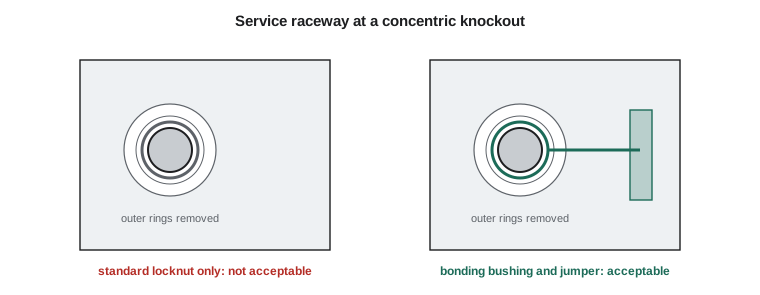
Section 250.92(B) lists the methods of bonding that are acceptable on service equipment. Bonding may be made to the grounded service conductor, by the methods in 250.8. Connections may use threaded couplings or threaded hubs on enclosures, made up wrenchtight. Threadless couplings and connectors may be used where made up tight for metal raceways and metal-clad cables. And other listed devices may be used, such as bonding-type locknuts, bushings or bushings with bonding jumpers. Bonding jumpers meeting 250.102 must be used around concentric or eccentric knockouts that are punched or otherwise formed so as to impair the electrical connection to ground, and standard locknuts or sealing locknuts alone are not acceptable as the sole means of bonding.
Concentric knockouts are the issue Gloria finds most. A concentric knockout has several rings that can be removed to fit different raceway sizes. If only the inner ring is removed, the knockout is solid, and a locknut makes good contact. If the outer rings are removed, the remaining metal around the raceway is connected to the enclosure only by thin, punched tabs, which can burn open under service fault current. On the service side, a bonding bushing with a jumper to the enclosure's bonding point, or a bonding locknut where it is suitable, takes the place of the standard locknut.
Bonding on the load side and above 250 volts
Downstream of the service overcurrent device, the fault current is limited by the overcurrent device, and 250.96 relaxes the rules. Metal raceways, cable trays, cable armor, cable sheath, enclosures, frames, fittings and other metal non-current-carrying parts that serve as equipment grounding conductors must be bonded to ensure electrical continuity and the capacity to conduct safely any fault current likely to be imposed. Standard locknuts and listed fittings are normally enough. Any nonconductive paint or coating must be removed where the connection is made, as 250.12 also requires.
Above 250 volts to ground, though, 250.97 brings back part of the service rule. For circuits of over 250 volts to ground, such as the 277 volt and 480 volt circuits at Delgado Fabrication, the electrical continuity of metal raceways and cables with metal sheaths that contain any conductor other than service conductors must be ensured by one or more of the methods in 250.92(B)(2) through (B)(4). An exception lets you use standard fittings where oversized, concentric or eccentric knockouts are not encountered, or where a box or enclosure with concentric or eccentric knockouts is listed to provide a reliable bonding connection. The practical effect is that 480Y/277 volt feeders entering concentric knockouts need bonding bushings or bonding locknuts, just as service raceways do.
The intersystem bonding termination
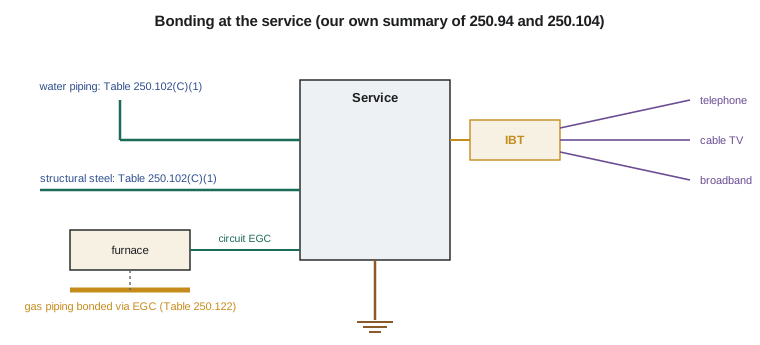
Communications systems, such as telephone, cable television, satellite and broadband, enter a building through their own cables and have their own grounding and bonding rules in Chapter 8. For safety during lightning and power faults, those systems must be bonded to the building's electrical grounding electrode system, so that all systems rise and fall together. Section 250.94 makes that bonding easy by requiring an intersystem bonding termination, a device with terminals for the communications bonding conductors, at the service equipment or metering equipment enclosure and at the disconnecting means for any additional buildings supplied by a feeder.
The intersystem bonding termination must be accessible for connection and inspection, must have the capacity to connect at least three intersystem bonding conductors, and must not interfere with opening the service or metering equipment enclosure. It may be mounted on or in the meter enclosure, the service equipment enclosure or the grounding electrode conductor, among the locations 250.94 permits, and where it is not mounted on the enclosure it is connected with a copper conductor of at least 6 AWG. The terminals must be listed as grounding and bonding equipment. Existing buildings where the communications equipment was installed before the intersystem bonding termination requirement are covered by an exception.
Bonding jumpers and their sizes
Section 250.102 governs bonding conductors and jumpers. They must be copper, aluminum, copper-clad aluminum or another corrosion-resistant material, attached by the methods in 250.8. Their size depends on which side of the overcurrent device they are on. A supply-side bonding jumper, such as the jumper around a concentric knockout on a service raceway or the jumper bonding a meter enclosure, is sized from Table 250.102(C)(1) by the largest ungrounded supply conductor, with the 12.5% rule above the last row. Where several raceways or cables contain parallel service conductors and a single bonding jumper bonds them all, the jumper is sized from the total area of the largest ungrounded conductors in all of them; where each raceway gets its own jumper, each jumper is sized from the conductors in that raceway.
A load-side bonding jumper, on the load side of an overcurrent device, is sized from Table 250.122 by the rating of the overcurrent device ahead of the circuit. Where one jumper serves several circuits, it is sized for the largest overcurrent device among them. And 250.102(E) controls installation: a bonding jumper may be inside or outside a raceway, but where it is outside, it may not exceed 6 feet in length and must be routed with the raceway or enclosure. That 6 foot limit applies, for example, to a jumper around a flexible section of conduit installed outside it.
Worked problem
Supply-side bonding jumper for parallel raceways
Delgado's service runs its two parallel sets of 3/0 AWG copper in two separate conduits, each entering the service enclosure through a concentric knockout with a bonding bushing. Size the jumper for each bushing if each conduit gets its own jumper. This example uses 4 AWG copper for the row covering 2/0 and 3/0 copper in Table 250.102(C)(1).
Show solution
- Each raceway contains one set of 3/0 copper, so each jumper is sized from 3/0.
- The row covering 2/0 and 3/0 copper gives 4 AWG copper in this example.
- If one jumper bonded both bushings together, it would be sized from the total area, 335.6 kcmil, which falls in the next row.
Answer: 4 AWG copper for each individual jumper.
Bonding metal water piping
Section 250.104(A) requires metal water piping systems installed in or attached to a building to be bonded. The bonding jumper may connect to the service equipment enclosure, the grounded conductor at the service, the grounding electrode conductor where it is of sufficient size, or one or more grounding electrodes used. Since the 2017 edition, the jumper is sized from Table 250.102(C)(1), by the largest ungrounded service conductor, and the points of attachment must be accessible. Remember the difference from Lesson 5: the metal underground water pipe may be an electrode, sized by Table 250.66, but the bond to the interior metal water piping is a bonding requirement, sized by Table 250.102(C)(1). For most services the two tables give the same answer, which is why candidates confuse them; for very large services they differ, because Table 250.102(C)(1) has the 12.5% rule.
Multiple-occupancy buildings get a special option in 250.104(A)(2). Where the metal water piping in each occupancy is metallically isolated from the piping in the other occupancies, as often happens when plastic risers serve metal branch piping in each unit, the piping in each occupancy may be bonded to the equipment grounding terminal of the panelboard or switchboard serving that occupancy, with the jumper sized from Table 250.122 by the rating of the overcurrent device for that occupancy's feeder. Buildings supplied by a feeder, under 250.104(A)(3), bond their metal water piping at the building disconnecting means, the equipment grounding conductor run with the feeder, or the building's electrodes.
Worked problem
Water piping bonds at the Maple Street fourplex
The fourplex's water distribution uses a plastic main riser with copper branch piping in each unit, isolated from the other units. Each unit's feeder is protected at 150 A, and this example uses 6 AWG copper for the 200 A row of Table 250.122. What bonding jumper may be used in each unit?
Show solution
- The copper piping in each unit is isolated, so 250.104(A)(2) applies.
- Each unit's piping may be bonded to the equipment grounding bar in that unit's panel.
- Size the jumper from Table 250.122 by the 150 A feeder device, which falls in the 200 A row: 6 AWG copper in this example.
Answer: 6 AWG copper from each unit's piping to its own panel's equipment grounding bar.
Bonding other metal piping and structural metal
Section 250.104(B) covers other metal piping systems, including gas piping, that are installed in or attached to a building and are likely to become energized. They must be bonded to the service equipment enclosure, the grounded conductor at the service, the grounding electrode conductor where it is large enough, or one or more electrodes. The jumper is sized from Table 250.122, using the rating of the circuit likely to energize the piping. The equipment grounding conductor of that circuit, such as the furnace or water heater circuit that also connects to the gas piping, is permitted to serve as the bonding means. An informational note points to the fuel gas code for corrugated stainless steel tubing, called CSST, whose manufacturers and the fuel gas code commonly call for a direct bonding conductor, often 6 AWG copper, at the point where the gas service enters the building. Check the requirements your jurisdiction has adopted.
Section 250.104(C) requires exposed structural metal that is interconnected to form a metal building frame, is not intentionally grounded or bonded, and is likely to become energized, to be bonded to the service equipment enclosure, the grounded conductor at the service, the disconnecting means for buildings supplied by a feeder, the grounding electrode conductor where it is large enough, or one or more electrodes. The jumper is sized from Table 250.102(C)(1) and installed following the protection rules of 250.64. Where the building frame is in contact with the earth for 10 feet or more, it may already be an electrode under 250.52(A)(2), and it is then connected as part of the grounding electrode system.
Separately derived systems, which Lesson 8 covers, have their own piping and steel bonding rule in 250.104(D): the metal water piping and exposed structural metal in the area served by the derived system must be bonded to the derived system's grounded conductor, unless the building steel or water pipe is already used as the system's grounding electrode.
Finally, 250.106 requires the lightning protection system's grounding electrodes to be bonded to the building's grounding electrode system, as Lesson 4 noted. The lightning system's conductors and the electrical system's metal parts also need separation or bonding under NFPA 780, which the NEC references in an informational note.
| Item bonded | Jumper sized from | Section |
|---|---|---|
| Service raceways, enclosures, meter fittings (supply side) | Table 250.102(C)(1), largest ungrounded supply conductor | 250.92, 250.102(C) |
| Equipment on the load side of an overcurrent device | Table 250.122, overcurrent device rating | 250.102(D) |
| Metal water piping | Table 250.102(C)(1); Table 250.122 for isolated occupancy piping | 250.104(A) |
| Gas and other piping likely to be energized | Table 250.122, rating of the circuit likely to energize it | 250.104(B) |
| Exposed structural metal frame | Table 250.102(C)(1) | 250.104(C) |
| Communications systems | Intersystem bonding termination; 6 AWG copper minimum where remote | 250.94 |
A calculator you can edit
The listing below decides which table sizes a bonding jumper from a short description of where it goes. It is a study aid for the decision, not a table lookup; the sizes themselves come from your code book.
def bonding_table(item, supply_side):
    if item == "communications":
        return "intersystem bonding termination (250.94)"
    if item in ("gas piping", "isolated occupancy water piping") or not supply_side:
        return "Table 250.122 (overcurrent device rating)"
    return "Table 250.102(C)(1) (largest ungrounded supply conductor)"

cases = [("service raceway knockout", True), ("water piping", True), ("structural steel", True),
         ("gas piping", True), ("feeder raceway jumper", False), ("communications", True)]
for item, supply in cases:
print(f"{item}: {bonding_table(item, supply)}")service raceway knockout: Table 250.102(C)(1) (largest ungrounded supply conductor) water piping: Table 250.102(C)(1) (largest ungrounded supply conductor) structural steel: Table 250.102(C)(1) (largest ungrounded supply conductor) gas piping: Table 250.122 (overcurrent device rating) feeder raceway jumper: Table 250.122 (overcurrent device rating) communications: intersystem bonding termination (250.94)
Common mistakes
MistakeUsing a standard locknut on a service raceway in a concentric knockout with rings removed.
InsteadUse a bonding bushing with a jumper, a bonding locknut or another method in 250.92(B).
MistakeSizing the interior water piping bonding jumper from Table 250.66.
InsteadSince the 2017 NEC, 250.104(A) sizes it from Table 250.102(C)(1).
MistakeUsing gas piping as a grounding electrode.
InsteadGas piping is bonded under 250.104(B), never used as an electrode.
MistakeLeaving out the intersystem bonding termination in a new service.
InsteadSection 250.94 requires one at the service or meter enclosure, with room for at least three conductors.
MistakeRunning a bonding jumper 10 ft outside a raceway.
InsteadAn external bonding jumper may not exceed 6 ft and must be routed with the raceway.
Summary and key terms
- Service equipment metal parts must be bonded by the reliable methods in 250.92(B); standard locknuts alone are not enough at concentric or eccentric knockouts.
- Above 250 V to ground, 250.97 requires similar bonding methods where concentric or eccentric knockouts are encountered.
- An intersystem bonding termination with room for at least three conductors is required at the service and at buildings supplied by feeders.
- Supply-side bonding jumpers are sized from Table 250.102(C)(1); load-side jumpers from Table 250.122.
- Metal water piping is bonded with a jumper sized from Table 250.102(C)(1), or Table 250.122 for isolated occupancy piping.
- Gas piping is bonded through the circuit likely to energize it (Table 250.122), and exposed structural metal frames with Table 250.102(C)(1).
- Intersystem bonding termination
- A device with terminals for bonding communications systems to the building's grounding electrode system.
- Supply-side bonding jumper
- A bonding conductor on the supply side of the service or derived system overcurrent device.
- Load-side bonding jumper
- A bonding conductor on the load side of an overcurrent device.
- Concentric knockout
- A knockout with removable rings for several raceway sizes, which can impair bonding when outer rings are removed.
- CSST
- Corrugated stainless steel tubing, a flexible gas piping with special bonding requirements in the fuel gas code.
Practice problems
Work each problem on paper first, then reveal the answer to check.
A 200 A service has 2/0 AWG copper conductors. This course uses 4 AWG copper for the 2/0 row of Table 250.102(C)(1). What size is the water piping bonding jumper?
Show answer
4 AWG copper, from Table 250.102(C)(1).
A gas furnace is supplied by a 15 A circuit with a 14 AWG equipment grounding conductor. What may bond the gas piping under 250.104(B)?
Show answer
The circuit's 14 AWG equipment grounding conductor may serve as the bonding means; check any CSST requirements adopted locally.
How many intersystem bonding conductors must the termination accommodate?
Show answer
At least three.
A 480Y/277 V feeder conduit enters a concentric knockout with rings removed. What does 250.97 require?
Show answer
One of the bonding methods in 250.92(B)(2) through (B)(4), such as a bonding bushing with jumper, unless the enclosure is listed for reliable bonding.
A bonding jumper is installed outside a flexible raceway. What is its maximum length?
Show answer
6 ft, routed with the raceway.
Lesson quiz · 5 questions
Score 60% or more to complete this lesson.
Create a free account to save your progress, take quizzes and earn a certificate.