
MELU-104 · Lesson 4 of 12 · 22 min
The grounding electrode system
▶ Video coming soon A video version of this lesson is on the way.
Dana Whitfield's study group met at Brightwater's shop on Thursday nights, and the week they reached grounding electrodes Ray Ochoa brought a prop: a three-foot length of foundation rebar with a scrap of 4 AWG bare copper clamped to it, pulled out of a demolition job years ago. He handed it to Marcus Lee and asked what it was. Marcus said a ground connection. Ray said it was the best electrode in most buildings in Harlow, that half the electricians in the city walk past it every day without bonding it, and that the master exam knows it. This lesson covers the electrodes the code recognizes, which ones must be used, how they are installed, and how they are bonded together into one grounding electrode system.
The rules are in Part III of Article 250, mainly 250.50, 250.52, 250.53, 250.58 and 250.60. As always, the lesson explains them in our own words with illustrative examples. Check every dimension and condition in your own adopted edition and in your local amendments.
All electrodes present must be used
Section 250.50 sets the governing principle: all the grounding electrodes described in 250.52(A)(1) through (A)(7) that are present at each building or structure served must be bonded together to form the grounding electrode system. The key word is present. You do not get to choose the most convenient electrode and ignore the others. If a building has a metal water pipe in the earth, a concrete-encased electrode in its footings, and structural steel in contact with the earth, all three must be bonded together, and the grounding electrode conductor connects to the system they form.
Where none of those electrodes exists, 250.50 requires you to install one or more of the electrodes from 250.52(A)(4) through (A)(8), such as a ground ring, rods, pipes or plates. And there is a special point about concrete-encased electrodes. In new buildings, the steel reinforcing in the footings is present the moment the concrete is poured, so it must be used, unless an exception applies. The 250.50 exception allows an existing building's concrete-encased electrode to be left unused where reaching it would require disturbing the concrete. In new construction there is no such excuse, which is why inspectors in Harlow, like Gloria Haynes, want to see the concrete-encased electrode connection before the footing is poured or a stub of rebar or conductor left accessible.
The electrodes the code recognizes
Section 250.52(A) lists the electrodes that may be used. Learn each one by what it is and the conditions that make it count. The dimensions below are the ones this course uses for its examples; confirm each one in your edition.
The first is a metal underground water pipe in direct contact with the earth for 10 feet or more, including any metal well casing bonded to it. It must be electrically continuous, or made continuous by bonding around insulating joints, to the points where the grounding electrode conductor and bonding conductors connect. Because plastic water services have become common, many buildings no longer have this electrode, and even where it exists, 250.53(D)(2) requires a supplemental electrode, because a utility might replace the metal service with plastic at any time.
The second is the metal in-ground support structure: structural metal, such as steel columns or piles, in direct contact with the earth vertically for 10 feet or more, with or without concrete encasement. Above-ground building steel is not an electrode by itself; it becomes part of the grounding system through bonding, as Lesson 6 explains.
The third is the concrete-encased electrode, often called a Ufer electrode after Herbert Ufer, who studied it in the 1940s. It consists of at least 20 feet of bare, zinc-galvanized or other conductive coated steel reinforcing bars or rods of not less than 1/2 inch diameter, or at least 20 feet of bare copper conductor not smaller than 4 AWG, encased in at least 2 inches of concrete and located horizontally within the part of a foundation or footing in direct contact with the earth, or within vertical foundations or structural components in direct contact with the earth. Concrete holds moisture and has a large contact area with the soil, so this electrode commonly measures far lower resistance than a rod. Reinforcing bars may be bonded together by the usual steel tie wires to make up the 20 feet.
The fourth is a ground ring, a bare copper conductor encircling the building in direct contact with the earth, at least 20 feet long and not smaller than 2 AWG, buried at least 30 inches deep. Ground rings are common around telecommunications buildings and industrial plants.
The fifth is the familiar rod or pipe electrode. Rods and pipes must be at least 8 feet long. Pipe electrodes must be at least 3/4 trade size and galvanized or otherwise protected if of steel or iron. Rod electrodes must be at least 5/8 inch in diameter, unless listed; listed stainless or copper-clad rods may be smaller, commonly 1/2 inch.
The sixth covers other listed electrodes, such as chemically enhanced electrodes. The seventh is the plate electrode, which must expose at least 2 square feet of surface to the soil; iron or steel plates must be at least 1/4 inch thick, and nonferrous plates at least 0.06 inch thick. The eighth covers other local metal underground systems or structures, such as piping systems, underground tanks and well casings that are not bonded to a metal water pipe.
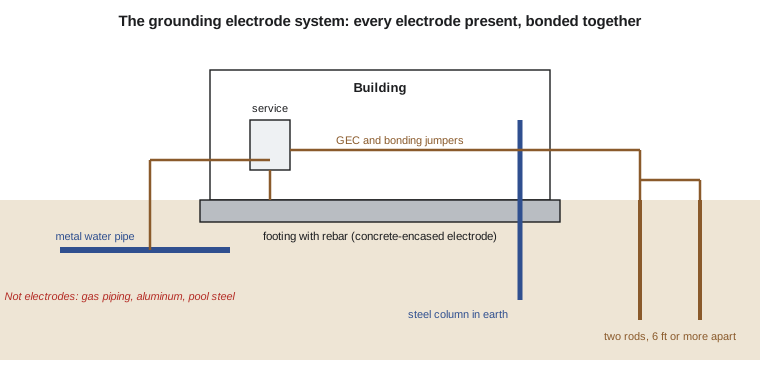
Section 250.52(B) lists what may not be used as an electrode. Metal underground gas piping systems are excluded outright; you bond gas piping under 250.104(B), but you never use it as an electrode. Aluminum is excluded because it corrodes in soil. And the structures and reinforcing steel described in 680.26 for swimming pools are not to be used as grounding electrodes, though they are bonded as part of the pool's equipotential bonding grid.
| Electrode | Key conditions in this course's examples | Section |
|---|---|---|
| Metal underground water pipe | 10 ft or more in direct contact with earth; must be supplemented | 250.52(A)(1), 250.53(D) |
| Metal in-ground support structure | 10 ft or more vertically in contact with earth | 250.52(A)(2) |
| Concrete-encased electrode | 20 ft of 1/2 in rebar or 4 AWG bare copper, 2 in of concrete, in contact with earth | 250.52(A)(3) |
| Ground ring | 20 ft or more of 2 AWG bare copper, 30 in deep, encircling the building | 250.52(A)(4) |
| Rod or pipe | 8 ft long; rods 5/8 in unless listed; pipes 3/4 trade size | 250.52(A)(5) |
| Plate | 2 sq ft exposed; 1/4 in iron or steel, or 0.06 in nonferrous | 250.52(A)(7) |
| Not permitted | Underground gas piping, aluminum, pool steel of 680.26 | 250.52(B) |
Installing rods, pipes and plates
Section 250.53 governs installation. Rod and pipe electrodes must be installed so that at least 8 feet of length is in contact with the soil. They are driven vertically wherever possible. Where rock bottom is encountered, the electrode may be driven at an oblique angle not exceeding 45 degrees from vertical, or, where rock is met at an angle up to 45 degrees, it may be buried in a trench at least 30 inches deep. The upper end of the electrode must be flush with or below ground level unless the above-ground end and the connection are protected against physical damage.
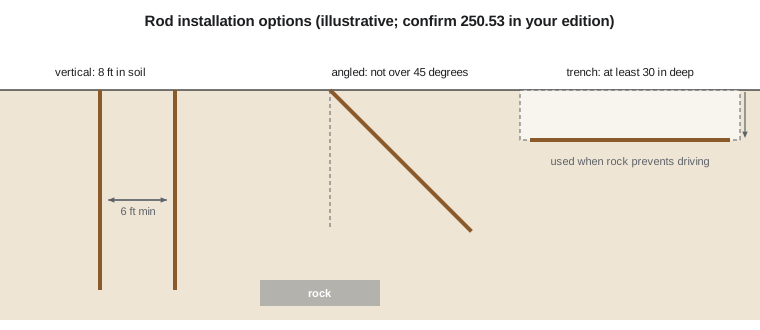
The best known installation rule is in 250.53(A)(2). A single rod, pipe or plate electrode must be supplemented by an additional electrode of a type specified in 250.52(A)(2) through (A)(8), unless the single electrode has a resistance to earth of 25 ohms or less. In practice, almost no one measures, because measuring takes special equipment and the second rod costs less than the test. Electricians simply drive two rods. Section 250.53(A)(3) requires supplemental rods to be at least 6 feet apart, because rods closer together share the same body of soil and add little to each other's effectiveness. Many electricians space them farther, at least the length of the rod, for a better result.
Worked problem
Is one rod enough?
At a remote pump house that the Kowalczyk farm is adding, the only electrode available is a driven rod. Tyler measures it with a ground resistance tester and reads 38 Ω. What does 250.53(A)(2) require, and how far apart must the rods be?
Show solution
- The rod measures more than 25 Ω, so it must be supplemented by an additional electrode.
- The supplemental electrode may be a second rod or another electrode from 250.52(A)(2) through (A)(8).
- A second rod must be at least 6 ft from the first under 250.53(A)(3).
- Once two rods are installed, the code does not require the combined resistance to be measured or to reach 25 Ω.
Answer: Add a supplemental electrode, such as a second rod at least 6 ft away; no further measurement is required.
That last step surprises many candidates. The 25 ohm figure is not a performance target the system must meet. It is only the condition under which a single rod may stand alone. Once a supplemental electrode is installed, the code is satisfied even if the pair measures 60 ohms. That makes sense once you remember Lesson 1: the electrode's job is to limit voltages from lightning and utility events, not to clear faults, so a lower resistance is nice but not critical to safety on the premises wiring.
Other installation rules round out 250.53. Electrodes must be free of nonconductive coatings such as paint or enamel. Where practicable, rods and pipes are embedded below the permanent moisture level. Plate electrodes are installed at least 30 inches below the surface. The conductor that bonds supplemental electrodes to each other or to the rest of the system, the bonding jumper, is sized under 250.53(C) and 250.66, which Lesson 5 covers, and need not be larger than 6 AWG copper where it serves only rods.
Water pipe electrodes and their supplement
A metal underground water pipe is still a valued electrode where it exists, but it comes with two special rules. First, 250.53(D)(1) requires the continuity of the grounding path or the bonding connection to interior piping not to rely on water meters, filtering devices or similar equipment. That is why you see a bonding jumper around the water meter. Second, 250.53(D)(2) requires the metal water pipe to be supplemented by an additional electrode of a type listed in 250.52(A)(2) through (A)(8). Where the supplemental electrode is a rod, pipe or plate, it does not itself need the 25 ohm test of 250.53(A)(2); it is simply installed.
The supplemental electrode may be bonded to the grounding electrode conductor, the grounded service conductor, a nonflexible grounded service raceway, any grounded service enclosure, or the interior metal water piping within 5 feet of where it enters the building, as 250.53(D)(2) allows. And 250.68(C)(1) adds a limit on the water piping itself: interior metal water piping located more than 5 feet from the point of entrance to the building may not be used as part of the grounding electrode system or as a conductor to interconnect electrodes, except in industrial, commercial and institutional buildings where conditions of maintenance and supervision ensure that only qualified persons service the installation and the piping is exposed.
Common electrodes and lightning protection electrodes
Section 250.58 requires that where an AC system is connected to a grounding electrode in or at a building, the same electrode be used to ground conductor enclosures and equipment in or on that building. Two or more electrodes bonded together are treated as a single electrode system. In other words, a building has one grounding electrode system, and every system in the building uses it.
Lightning protection systems have their own electrodes, called strike termination grounding, designed under NFPA 780. Section 250.60 says the lightning protection system's electrodes may not be used in place of the grounding electrodes required by Article 250. But 250.106 requires the lightning protection grounding system to be bonded to the building's grounding electrode system, so the two cannot reach different voltages during a strike. Separate electrodes, one bond: the same idea as everywhere else in Article 250.
A calculator you can edit
The listing below estimates the resistance of a single driven rod with a common textbook formula, the Dwight formula, using soil resistivity in ohm-meters and rod dimensions in meters. It shows why a second rod or a concrete-encased electrode is so often needed. The resistivity values are illustrative; real soil varies widely with moisture, temperature and composition.
import math

def rod_resistance(rho_ohm_m, length_m, diameter_m):
    """Dwight's approximation for one driven rod."""
    return rho_ohm_m / (2 * math.pi * length_m) * (math.log(8 * length_m / diameter_m) - 1)

length = 2.44      # 8 ft rod
diameter = 0.0159  # 5/8 in rod
for soil, rho in [("moist loam", 30), ("clay", 60), ("dry sand", 300)]:
    r = rod_resistance(rho, length, diameter)
    verdict = "may stand alone" if r <= 25 else "needs a supplemental electrode"
print(f"{soil}: {rho} ohm-m -> about {r:.0f} ohms, {verdict}")moist loam: 30 ohm-m -> about 12 ohms, may stand alone clay: 60 ohm-m -> about 24 ohms, may stand alone dry sand: 300 ohm-m -> about 120 ohms, needs a supplemental electrode
Common mistakes
MistakeUsing only a convenient rod when a concrete-encased electrode is present in a new building.
InsteadSection 250.50 requires all electrodes present, including the footing steel, to be bonded into the system.
MistakeTreating 25 ohms as a target the electrode system must reach.
InsteadIt is only the condition for one rod to stand alone; with a supplemental electrode, no measurement is required.
MistakeSpacing supplemental rods 4 ft apart.
InsteadSection 250.53(A)(3) requires at least 6 ft between supplemental rods.
MistakeUsing underground gas piping as an electrode.
InsteadSection 250.52(B) prohibits it; gas piping is bonded under 250.104(B), never used as an electrode.
MistakeConnecting to interior water piping 15 ft inside a dwelling as the electrode connection point.
InsteadInterior water piping more than 5 ft from entry may not be used as part of the electrode system, except in the qualified-maintenance conditions of 250.68(C)(1).
Summary and key terms
- All electrodes in 250.52(A)(1) through (A)(7) that are present at a building must be bonded together into one grounding electrode system.
- Recognized electrodes include metal water pipe, in-ground structural metal, concrete-encased electrodes, ground rings, rods, pipes, plates and other listed or local underground metal.
- Underground gas piping, aluminum and pool steel are not permitted as electrodes.
- Rods and pipes need 8 ft in contact with soil, installed vertically, at up to 45 degrees, or in a 30 in trench where rock prevents driving.
- A single rod, pipe or plate needs a supplemental electrode unless it measures 25 ohms or less; supplemental rods are at least 6 ft apart.
- A metal water pipe electrode must always be supplemented, and lightning protection electrodes must be bonded to, not substituted for, the building's electrodes.
- Grounding electrode system
- All the electrodes present at a building, bonded together.
- Concrete-encased electrode
- At least 20 ft of rebar or bare copper encased in concrete in contact with the earth, often called a Ufer.
- Ground ring
- A bare copper conductor encircling a building, buried in the earth.
- Supplemental electrode
- An additional electrode required alongside a water pipe or a single rod, pipe or plate.
- Soil resistivity
- The resistance of soil to current flow, which largely sets an electrode's resistance.
Practice problems
Work each problem on paper first, then reveal the answer to check.
A new office building has a metal water service, footing rebar and steel columns in contact with the earth. Which must be bonded together?
Show answer
All three, because 250.50 requires every electrode present to be part of the grounding electrode system.
A single rod measures 18 Ω. Is a supplemental electrode required?
Show answer
No; a single rod of 25 Ω or less may stand alone under 250.53(A)(2).
A crew strikes rock at 4 ft while driving an 8 ft rod. What are the options?
Show answer
Drive it at an angle not over 45 degrees from vertical, or bury it in a trench at least 30 in deep, keeping 8 ft in contact with soil.
Why is a bonding jumper installed around a water meter?
Show answer
So electrode continuity and interior pipe bonding do not depend on a meter that may be removed or have insulating parts, as 250.53(D)(1) requires.
May a lightning protection system's ground rods serve as the building's grounding electrodes?
Show answer
No; 250.60 prohibits that substitution, and 250.106 requires the two systems to be bonded together.
Lesson quiz · 5 questions
Score 60% or more to complete this lesson.
Create a free account to save your progress, take quizzes and earn a certificate.