
MELU-104 · Lesson 3 of 12 · 28 min
System grounding and the main bonding jumper
▶ Video coming soon A video version of this lesson is on the way.
The Maple Street fourplex passed its rough-in inspection with no corrections, and Dana Whitfield was proud of that. Two weeks later, setting the meter-main and the four unit panels, Tyler Brooks asked her a question she could not answer in one sentence: why does the green bonding screw go in the meter-main but come out of the unit panels? She knew the rule. She had followed it for eleven years. Explaining it took her twenty minutes and a sketch on the back of a material list. This lesson is that sketch, written properly: which systems must be grounded, where the service grounding connection is made, what the main bonding jumper does, how it is sized, and why the grounded conductor and the equipment grounding conductor are connected at one point only.
The rules are in Part II of Article 250, chiefly 250.20, 250.21, 250.24 and 250.28. As in every lesson, we explain them in our own words, cite section numbers, and use illustrative values. Check each rule and each table value in your own copy of the adopted edition before you rely on it.
Which systems must be grounded
Section 250.20 tells you which alternating current systems must be grounded. For systems from 50 to 1,000 volts, which covers almost everything on a master exam, 250.20(B) requires grounding in three situations. The first is where the system can be grounded so that the maximum voltage to ground on the ungrounded conductors does not exceed 150 volts. That captures every 120/240 volt single-phase system and every 208Y/120 volt three-phase system. The second is a three-phase, four-wire, wye-connected system in which the neutral is used as a circuit conductor, which captures 480Y/277 volt systems that serve lighting or other line-to-neutral loads. The third is a three-phase, four-wire, delta-connected system in which the midpoint of one phase winding is used as a circuit conductor, the high-leg delta you meet in older commercial buildings.
Look at what is left out. A 480 volt, three-phase, three-wire delta system with no neutral is not required to be grounded by 250.20(B), because none of the three conditions applies. Such a system may be operated ungrounded under 250.21, corner grounded, or high-impedance grounded under 250.36, which Lesson 10 covers. A 480Y/277 volt system that serves only three-phase motors and never uses the neutral as a circuit conductor also falls outside the second condition, and 250.36 allows high-impedance grounding there too. Exam writers like these edge cases, so read the system description in a question carefully: the number of wires and whether the neutral is used decide the answer.
| System | Must be grounded under 250.20(B)? | Reason |
|---|---|---|
| 120/240 V single-phase, 3-wire | Yes | Grounding keeps each hot conductor at 120 V to ground, under 150 V |
| 208Y/120 V three-phase, 4-wire | Yes | Maximum voltage to ground is 120 V |
| 480Y/277 V, neutral used for lighting | Yes | Wye system with the neutral used as a circuit conductor |
| 240/120 V high-leg delta, 4-wire | Yes | Midpoint of one winding used as a circuit conductor |
| 480 V delta, 3-wire, no neutral | No, though it may be | None of the three conditions applies; see 250.21 and 250.36 |
Where the service grounding connection is made
Once a system must be grounded, 250.24(A) says where and how the connection is made at a service. The grounded service conductor is connected to the grounding electrode system through a grounding electrode conductor, at any accessible point from the load end of the overhead service conductors, service drop, underground service conductors or service lateral, up to and including the terminal or bus where the grounded service conductor connects at the service disconnecting means. In practice the connection is made in the meter-main, the service disconnect enclosure, or a meter base the utility permits, and the grounding electrode conductor leaves from there to the electrodes.
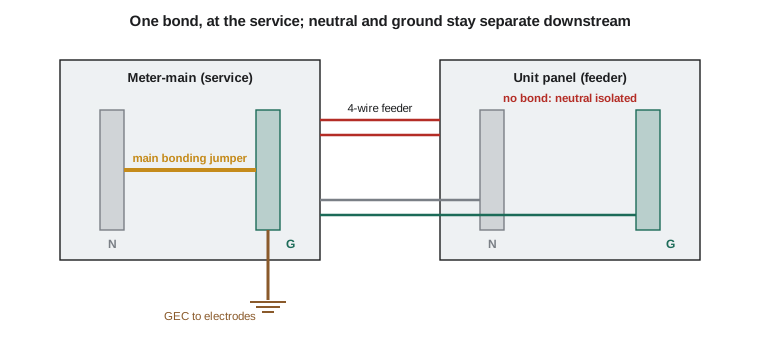
The most important sentence in 250.24 for exam purposes is in 250.24(A)(5): a grounding connection must not be made to any grounded conductor on the load side of the service disconnecting means, except as Article 250 elsewhere permits. That is the rule Tyler was asking about. Downstream of the service disconnect, the grounded conductor and the equipment grounding conductor stay separate all the way to the loads. The permitted exceptions are narrow and specific: separately derived systems in 250.30, separate buildings under the old existing-installation exception in 250.32(B)(1), and the existing range and dryer circuits of 250.140. Each of those is covered later in this course.
What the main bonding jumper does
The main bonding jumper is the link that turns the equipment grounding conductor into an effective ground-fault current path. When a fault in a unit panel puts current on the equipment grounding conductor, that current travels back to the service equipment and needs a way to reach the utility transformer. It cannot use the earth. It crosses the main bonding jumper onto the grounded service conductor, and the grounded service conductor carries it to the transformer. Without the main bonding jumper, the only path from the equipment grounding system to the source would be through the electrodes and the earth, and as Lesson 1 showed, that path carries only a few amperes.
Section 250.24(B) requires the main bonding jumper for a grounded system, and 250.28 tells you what it may be and how big it must be. It must be copper, aluminum, copper-clad aluminum or another corrosion-resistant material. It may be a wire, a bus, a screw or a similar suitable conductor. Where it is a screw only, the screw must be identified with a green finish that is visible with the screw installed. That green screw in a residential panel is a main bonding jumper, which is why it belongs in the service panel and nowhere else.
Why only one bond
Now the answer to Tyler's question. If the grounded conductor and the equipment grounding conductor were bonded together again in each unit panel, the neutral current from 120 volt loads would have two parallel paths back to the service: the neutral conductor and the equipment grounding conductor. Current divides between parallel paths in inverse proportion to their impedance, so a share of the normal neutral current would flow on the equipment grounding conductor, on metal raceways, on panel enclosures, and on any piping or structure bonded to them. The code calls this objectionable current, and 250.6 prohibits arranging the system so it flows.
Objectionable current is not just a theoretical problem. It puts current on metal that people touch, it causes voltage between equipment enclosures, it can trip ground-fault protection on the supply side, it interferes with sensitive electronics, and in a fault on the neutral it can leave metal parts energized at a dangerous voltage. Gloria Haynes, Harlow's chief inspector, still finds subpanels with the bonding screw left in, and she treats it as a serious violation. Lesson 11 returns to this as a common error.
Worked problem
Neutral current on the wrong path
In one unit panel at the fourplex, the bonding screw was left in by mistake. The feeder neutral has a resistance of 0.06 Ω back to the service, and the parallel path through the equipment grounding conductor and metal raceway has 0.09 Ω. The unit's unbalanced neutral current is 40 A. How much of that current flows on the equipment grounding path?
Show solution
- The two paths are in parallel, so current divides in inverse proportion to resistance.
- Share on the grounding path = 0.06 ÷ (0.06 + 0.09) = 0.06 ÷ 0.15 = 0.40.
- Current on the grounding path = 0.40 × 40 = 16 A.
- The neutral itself carries the other 24 A.
Answer: About 16 A of normal neutral current flows on the equipment grounding conductor and raceway, which 250.6 prohibits.
Sizing the main bonding jumper
Section 250.28(D)(1) sizes the main bonding jumper, and since the 2017 edition it does so by sending you to Table 250.102(C)(1). That table gives the minimum bonding jumper size from the size of the largest ungrounded service conductor, or the equivalent area for parallel conductors. For very large services, beyond the last row of the table, the jumper must have an area of at least 12.5% of the area of the largest ungrounded conductor or equivalent area. The rows of the table are your own to read in your copy of the code; the examples below use values stated as this course's examples, and you should confirm each one in your edition.
Three habits make these questions routine. First, find the largest ungrounded service conductor, not the neutral and not the overcurrent device rating. Second, for parallel sets, add the areas of the conductors in one phase to get the equivalent area, using Chapter 9, Table 8 for circular mil areas. Third, check whether the equivalent area is beyond the last row of the table, in which case the 12.5% rule applies.
Worked problem
Main bonding jumper for a single-set service
Ray's crew is installing a 200 A service for a single dwelling with 2/0 AWG copper ungrounded service conductors. This example uses a copper main bonding jumper of 4 AWG for the row that covers 2/0 and 3/0 copper. What size main bonding jumper is required?
Show solution
- Largest ungrounded service conductor: 2/0 AWG copper.
- Find the row covering 2/0 copper in Table 250.102(C)(1); this example uses 4 AWG copper for that row.
- In a panel listed as service equipment, the manufacturer's bonding screw or strap is the main bonding jumper and is designed to meet this requirement.
Answer: 4 AWG copper (check the row in your edition).
Worked problem
Main bonding jumper for parallel service conductors
Delgado Fabrication's new 400 A, 480Y/277 V service uses two parallel sets of 3/0 AWG copper per phase. Chapter 9, Table 8 lists 3/0 at 167,800 circular mils. This example uses 2 AWG copper for the row that covers equivalent areas over 3/0 through 350 kcmil. What size main bonding jumper is required?
Show solution
- Equivalent area of one phase: 2 × 167,800 = 335,600 cmil, or about 336 kcmil.
- That equivalent area falls in the row over 3/0 through 350 kcmil.
- This example uses 2 AWG copper for that row.
Answer: 2 AWG copper (check the row in your edition).
Worked problem
The 12.5% rule for a large service
The Harlow Commons shopping center is getting a 1,200 A service with four parallel sets of 500 kcmil copper per phase. What minimum area must a copper main bonding jumper have?
Show solution
- Equivalent area of one phase: 4 × 500 = 2,000 kcmil.
- That exceeds the last row of the table, so the jumper must be at least 12.5% of the equivalent area.
- 0.125 × 2,000 = 250 kcmil.
Answer: At least 250 kcmil copper.
The grounded conductor must reach the service equipment
Section 250.24(C) adds a rule that surprises some candidates. Even where the loads in a building need no neutral, such as a service that feeds only three-phase motors, the grounded conductor must be run from the utility to each service disconnecting means and bonded to each disconnecting means enclosure. The reason is the same as for the main bonding jumper: the grounded service conductor is the path fault current takes back to the transformer. Without it, there would be no effective ground-fault current path on the service.
The minimum size of that grounded service conductor is again found in Table 250.102(C)(1), from the largest ungrounded service conductor, with the 12.5% rule above the last row. Where the service conductors are run in parallel in separate raceways, 250.24(C)(2) requires a grounded conductor in each raceway, sized from the ungrounded conductors in that raceway, and not smaller than 1/0 AWG. So at Delgado, even if the shop had no 277 volt lighting, each of the two raceways would carry a grounded conductor of at least the size the table gives for one 3/0 set, but not less than 1/0, and the 1/0 floor would control.
A calculator you can edit
The listing below sizes a main bonding jumper for a few services. Its table holds only the rows this lesson's examples use, labeled as this course's illustrative values, plus the 12.5% rule; it is not a copy of Table 250.102(C)(1). Add rows from your own code book to make it complete for your study.
# Rows used in this lesson's examples only (illustrative; check Table 250.102(C)(1)).
ROWS_KCMIL = [(167.8, "4 AWG"), (350, "2 AWG"), (600, "1/0 AWG"), (1100, "2/0 AWG")]

def mbj_size(set_kcmil, sets=1):
    area = set_kcmil * sets
    for limit, size in ROWS_KCMIL:
        if area <= limit:
            return area, size
    return area, f"{0.125 * area:.0f} kcmil minimum (12.5% rule)"

for label, kcmil, sets in [("Dwelling, 2/0", 133.1, 1), ("Delgado, 2 x 3/0", 167.8, 2), ("Commons, 4 x 500", 500, 4)]:
    area, size = mbj_size(kcmil, sets)
print(f"{label}: equivalent {area:.1f} kcmil -> main bonding jumper {size}")Dwelling, 2/0: equivalent 133.1 kcmil -> main bonding jumper 4 AWG Delgado, 2 x 3/0: equivalent 335.6 kcmil -> main bonding jumper 2 AWG Commons, 4 x 500: equivalent 2000.0 kcmil -> main bonding jumper 250 kcmil minimum (12.5% rule)
How the exam tests this lesson
Expect three kinds of questions from this material. Location questions ask where the service grounding connection may be made, or whether a neutral-to-ground connection is permitted in a subpanel. Sizing questions give you a set of service conductors, sometimes in parallel, and ask for the main bonding jumper or the minimum grounded service conductor. System questions describe a voltage and wiring configuration and ask whether it must be grounded under 250.20(B). In all three, read the question for the facts that drive the rule: the number of wires, whether the neutral is used, the largest ungrounded conductor, and whether the location is on the supply or load side of the service disconnect.
Common mistakes
MistakeLeaving the bonding screw or strap installed in a downstream panel.
InsteadBond the grounded conductor to the equipment grounding system only at the service (and at separately derived systems); remove the bond in feeder panels.
MistakeSizing the main bonding jumper from the service overcurrent device rating.
InsteadSize it from the largest ungrounded service conductor using Table 250.102(C)(1), or 12.5% above the last row.
MistakeForgetting to add parallel conductor areas.
InsteadFor parallel sets, add the areas of the conductors in one phase to get the equivalent area before reading the table.
MistakeOmitting the grounded conductor on a service that serves no line-to-neutral loads.
InsteadSection 250.24(C) requires the grounded conductor to be brought to each service disconnecting means as the fault return path.
MistakeAssuming every three-phase system must be grounded.
InsteadA 3-wire 480 V delta with no neutral is not required to be grounded by 250.20(B), though it may be.
Summary and key terms
- Section 250.20(B) requires grounding where the voltage to ground can be held at 150 V or less, for 4-wire wye systems using the neutral, and for 4-wire delta systems using a winding midpoint.
- The service grounding connection is made on the supply side, from the load end of the service conductors to the service disconnect's grounded conductor terminal.
- No grounded conductor-to-ground connection is allowed on the load side of the service disconnect except where Article 250 permits it.
- The main bonding jumper connects the grounded conductor to the equipment grounding system at the service and completes the fault path to the transformer.
- Main bonding jumpers and minimum grounded service conductors are sized from Table 250.102(C)(1), with 12.5% above the last row.
- Bonding the neutral again downstream creates objectionable current, which 250.6 prohibits.
- Main bonding jumper
- The conductor, screw or strap that connects the grounded conductor and the equipment grounding conductor at the service.
- Service disconnecting means
- The equipment that disconnects the building's conductors from the service conductors.
- Objectionable current
- Normal current flowing on grounding and bonding paths because of improper connections.
- Equivalent area
- The combined circular mil area of parallel conductors in one phase.
- High-leg delta
- A 4-wire delta system with one winding center-tapped to provide a neutral.
Practice problems
Work each problem on paper first, then reveal the answer to check.
A service uses 3/0 AWG copper ungrounded conductors. This course's example row for 2/0 and 3/0 copper is 4 AWG. What main bonding jumper is required?
Show answer
4 AWG copper, from the row covering 3/0 copper in Table 250.102(C)(1) (check your edition).
A service has three parallel sets of 600 kcmil copper per phase. Find the minimum main bonding jumper area.
Show answer
Equivalent area 1,800 kcmil, beyond the last row, so 12.5% × 1,800 = 225 kcmil.
Is a 208Y/120 V system required to be grounded? Why?
Show answer
Yes: it can be grounded so the maximum voltage to ground is 120 V, under 150 V, and it is a 4-wire wye using the neutral.
A subpanel's neutral and ground bars are bonded. The neutral path is 0.05 Ω and the grounding path is 0.05 Ω. How much of 30 A of neutral current flows on the grounding path?
Show answer
Equal resistances split the current evenly, so 15 A flows on the grounding path.
Where may the grounding electrode conductor connect to the grounded service conductor?
Show answer
At any accessible point from the load end of the service drop or lateral up to and including the grounded conductor terminal at the service disconnect.
Lesson quiz · 5 questions
Score 60% or more to complete this lesson.
Create a free account to save your progress, take quizzes and earn a certificate.