
MELU-104 · Lesson 11 of 12 · 21 min
Common grounding and bonding errors
▶ Video coming soon A video version of this lesson is on the way.
Gloria Haynes has been Harlow's chief electrical inspector for fourteen years, and when she visited Dana Whitfield's study group she brought a binder of photographs: a subpanel with its bonding screw still in place, a receptacle with a jumper from the neutral screw to the green screw, a parking lot light standard grounded only to a rod, a computer room with its own isolated ground rod, a split bolt joining two pieces of grounding electrode conductor. Every one, she said, was installed by a licensed electrician who believed it was correct. Master exams use exactly these errors, because a master electrician is expected to recognize them on someone else's work and explain why they are wrong. This lesson collects the most common grounding and bonding errors, explains the hazard behind each, and points to the rule that forbids it.
As always, the rules are summarized in our own words, with illustrative values. Confirm each rule in your own adopted edition.
Error 1: a second neutral-to-ground bond
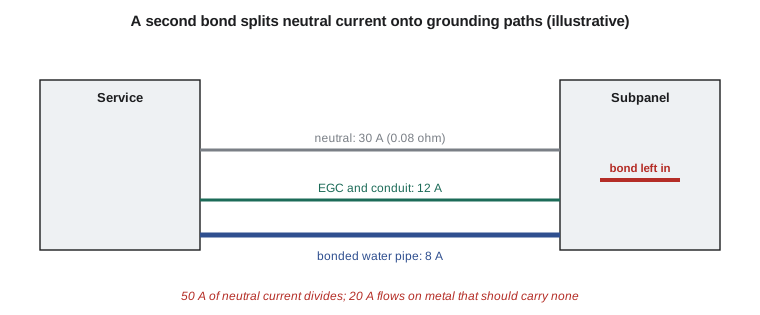
The most common error Gloria finds is a neutral-to-ground bond downstream of the service: the bonding screw left in a subpanel, a jumper between the neutral and ground bars, or a feeder neutral landed on a bonded bar at a separate building. Section 250.24(A)(5) prohibits a grounding connection to the grounded conductor on the load side of the service disconnect, and 250.142(B) prohibits using the grounded conductor to ground equipment on the load side, except as specifically permitted. The hazard, as Lesson 3 showed, is objectionable current: normal neutral current divides between the neutral and every metal path bonded to the equipment grounding system.
That current is more than a nuisance. In a building with a second bond, current flows on metal raceways, water piping, structural steel and communications shields, where it can heat connections, cause shocks between metal parts that should be at the same potential, corrode piping, and trip ground-fault protection on the feeder. And if the feeder neutral ever opens, the second bond turns every metal enclosure on the downstream panel into a return path for the full neutral current.
Worked problem
Current on a water pipe from a second bond
A subpanel at the Harlow Commons has its bonding screw installed. The feeder neutral back to the service has a resistance of 0.08 Ω. A parallel path through the equipment grounding conductor, metal conduit and a bonded copper water line back to the service totals 0.12 Ω. The unbalanced neutral current is 50 A. How much current flows on the parallel path, and what voltage appears along it?
Show solution
- Share on the parallel path = 0.08 ÷ (0.08 + 0.12) = 0.40.
- Current on the parallel path = 0.40 × 50 = 20 A.
- Voltage along the path = 20 × 0.12 = 2.4 V, enough to cause noticeable current through a person in a wet location and to corrode the pipe over time.
Answer: About 20 A flows on the conduit and water piping, with about 2.4 V along the path.
Error 2: the bootleg ground
A bootleg ground is a jumper from the neutral terminal of a receptacle to its equipment grounding terminal, installed so that a three-prong receptacle on a two-wire circuit tests as grounded. Plug-in testers cannot tell the difference, which is why the practice persists. It is prohibited by 250.142(B), and it is genuinely dangerous. If the neutral of that circuit opens anywhere upstream, a loose wire nut, a burned terminal, the metal frame of anything plugged into the receptacle becomes connected through the jumper and the load to the hot conductor. A metal-cased tool or appliance then sits at 120 volts with nothing to trip the breaker.
The code offers two correct fixes for an ungrounded receptacle outlet in an existing building. Section 406.4(D)(2) lets a nongrounding receptacle be replaced with a nongrounding receptacle, a GFCI-type receptacle, or a grounding-type receptacle protected by a GFCI, with the grounding-type receptacles marked No Equipment Ground and no equipment grounding conductor connected between them. Or, under 250.130(C), an equipment grounding conductor may be run from the receptacle to an accessible point on the grounding electrode system, the grounding electrode conductor, the equipment grounding terminal bar in the panel where the circuit originates, an equipment grounding conductor that is part of another branch circuit originating from the same panel, or, for grounded systems, the grounded service conductor within the service equipment enclosure.
Error 3: a rod instead of an equipment grounding conductor
Gloria's parking-lot photograph shows a metal light standard fed by two conductors, with a ground rod at its base and no equipment grounding conductor. The installer thought the rod grounded the pole. As Lesson 1 calculated, a 120 or 277 volt fault through a rod of 25 ohms draws far too little current to trip the breaker, so the pole stays energized until someone touches it. Section 250.4(A)(5) states that the earth is not an effective ground-fault current path, and 250.54 makes the same point about auxiliary electrodes: a supplementary rod at a pole or a piece of equipment is permitted, but the earth may not be used as the sole equipment grounding conductor or effective ground-fault current path. The pole needs an equipment grounding conductor run with the circuit conductors; the rod is optional extra lightning protection.
Error 4: a separate clean ground
Computer rooms, audio studios and medical equipment sometimes come with instructions that ask for a dedicated or isolated ground, and some installers respond by driving a separate rod for that equipment, not bonded to the building's electrode system. This violates 250.50, which requires all electrodes at a building to be bonded together, and 250.58, which requires the same electrode system for all equipment in a building. The hazard is severe. During a lightning strike or a utility fault, the building's electrode system and the separate rod can rise to very different voltages, thousands of volts apart, and the equipment connected to both, through its power supply and its data cables, becomes the path between them.
What the instructions usually mean is an isolated grounding receptacle under 250.146(D). An isolated grounding receptacle has its grounding terminal insulated from its mounting strap, so the equipment's ground connection is made through a separate insulated equipment grounding conductor rather than through the box and raceway. That insulated conductor may pass through panelboards without connecting to their grounding bars, as 250.146(D) and 408.40 permit, and terminate at the applicable derived system or service. But it still ends at the building's grounding system, and the box and raceway still need their own equipment grounding path. Isolated means quieter, not separate.
| Installation | Correct? | Why |
|---|---|---|
| Isolated grounding receptacle with an insulated conductor back to the service or derived system | Yes | Permitted by 250.146(D); still part of one grounding system |
| Separate rod for computer equipment, not bonded to the building's electrodes | No | Violates 250.50 and 250.58; dangerous voltage differences in surges |
| Supplementary rod at a pole, plus an equipment grounding conductor | Yes | Permitted by 250.54 as an auxiliary electrode |
| Rod at a pole as the only grounding | No | Earth is not an effective ground-fault current path |
Error 5: three-wire ranges and dryers in new work
Older homes have ranges and dryers fed by three-wire circuits, two hots and a neutral, with the appliance frame bonded to the neutral. Section 250.140 allows those existing branch circuits to remain, under conditions, including that the grounded conductor is not smaller than 10 AWG copper and the frame bonding follows the appliance instructions. For new branch circuit installations, though, the frames must be connected to an equipment grounding conductor, so the circuit has four wires and the appliance's bonding strap between neutral and frame is removed. A candidate who installs a new three-wire dryer circuit, or who leaves the factory bonding strap in place on a four-wire circuit, has created a load-side neutral-to-ground bond, Error 1 in disguise.
Error 6: splices, sleeves and paint
Several errors involve the physical connections. Grounding electrode conductors spliced with split bolts or mechanical lugs violate 250.64(C), which allows only listed irreversible compression connectors, exothermic welding or busbars. Steel sleeves around grounding electrode conductors bonded at one end only violate 250.64(E) and choke surge current. Painted enclosures where a grounding or bonding connection lands violate 250.12, which requires nonconductive coatings to be removed from threads, contact points and contact surfaces, or connected by fittings designed to make removal unnecessary. Ground clamps exposed to physical damage without protection violate 250.10. Each of these weakens the effective ground-fault current path at the point where it matters most.
Error 7: generators and transfer switches
Portable and standby generators usually ship with the neutral bonded to the frame. When such a generator is connected through a transfer switch that does not switch the neutral, the generator is not separately derived, as Lesson 8 explained, and the generator's bond becomes a second neutral-to-ground connection on the premises, Error 1 again. The fix is to remove the generator's bond, following the manufacturer's instructions, or to use a transfer switch that switches the neutral and treat the generator as separately derived. Exam questions describe the transfer switch and expect you to work out which arrangement is correct.
Error 8: the wrong table
The last error appears more often on exams than in the field: sizing a conductor from the wrong table. Gloria's binder includes a meter-main with a 1/0 copper equipment grounding conductor run to a 400 ampere feeder panel because the installer used Table 250.66; the 400 ampere row of Table 250.122 gives a smaller size in this course's example, so the installation is safe but wasteful. The reverse is worse: a grounding electrode conductor or supply-side bonding jumper sized from Table 250.122 by an overcurrent device rating can be undersized for the service fault current it must carry. Lesson 12 drills the choice of table until it is automatic.
| Error | Rule violated | Hazard |
|---|---|---|
| Second neutral-to-ground bond | 250.24(A)(5), 250.142(B), 250.6 | Objectionable current on metal paths |
| Bootleg ground at a receptacle | 250.142(B) | Frames energized if the neutral opens |
| Rod as the only grounding of equipment | 250.4(A)(5), 250.54 | Fault never clears |
| Separate, unbonded clean ground rod | 250.50, 250.58 | Large voltage differences during surges |
| New three-wire range or dryer circuit | 250.140 | Load-side neutral used for grounding |
| Split bolt splice in a grounding electrode conductor | 250.64(C) | Unreliable fault and surge path |
| Generator bond with a solid-neutral transfer switch | 250.24(A)(5), 250.30 | Second neutral-to-ground bond |
A checker you can edit
The listing below runs a small audit over a list of described installations and flags the errors from this lesson. It is a study aid that encodes the rules as simple yes-or-no checks; extend it with your own scenarios.
def audit(item):
    problems = []
    if item.get("bond_downstream"):
        problems.append("second neutral-to-ground bond (250.24(A)(5))")
    if item.get("rod_only"):
        problems.append("earth used as the fault path (250.4(A)(5))")
    if item.get("separate_rod_unbonded"):
        problems.append("electrode not bonded to building system (250.50)")
    if item.get("new_three_wire_dryer"):
        problems.append("new dryer circuit needs an equipment grounding conductor (250.140)")
    if item.get("split_bolt_gec"):
        problems.append("grounding electrode conductor splice not permitted (250.64(C))")
    return problems or ["no problems found"]

jobs = {
    "Commons subpanel": {"bond_downstream": True},
    "Parking lot pole": {"rod_only": True},
    "Brandt workshop": {},
    "Server room": {"separate_rod_unbonded": True},
}
for name, item in jobs.items():
print(f"{name}: {'; '.join(audit(item))}")Commons subpanel: second neutral-to-ground bond (250.24(A)(5)) Parking lot pole: earth used as the fault path (250.4(A)(5)) Brandt workshop: no problems found Server room: electrode not bonded to building system (250.50)
Common mistakes
MistakeAccepting a plug-in tester's grounded reading as proof of an equipment ground.
InsteadTesters cannot detect a bootleg ground; verify the equipment grounding conductor runs back to the panel.
MistakeTreating an isolated grounding receptacle as permission for a separate ground rod.
InsteadThe insulated conductor still terminates at the building's service or derived system grounding point.
MistakeLeaving the factory neutral-to-frame strap in a dryer connected with a four-wire cord.
InsteadRemove the strap so the neutral and equipment grounding conductor stay separate.
MistakeDriving a rod at a pole light instead of running an equipment grounding conductor.
InsteadRun an equipment grounding conductor with the circuit; a rod may be added only as an auxiliary electrode.
MistakeIgnoring paint under a grounding connection.
InsteadRemove nonconductive coatings at contact points or use fittings designed to cut through them, as 250.12 requires.
Summary and key terms
- A neutral-to-ground bond downstream of the service puts neutral current on metal paths and is prohibited.
- A bootleg ground jumper from neutral to ground at a receptacle can energize equipment frames if the neutral opens.
- The earth, or an auxiliary rod, is never a substitute for an equipment grounding conductor.
- All electrodes at a building must be bonded together; isolated grounding receptacles still terminate in the building's grounding system.
- New range and dryer circuits need an equipment grounding conductor; existing three-wire circuits may remain under 250.140.
- Use only permitted splices, bond ferrous sleeves at both ends, remove paint at connections, and size from the correct table.
- Bootleg ground
- An improper jumper from a receptacle's neutral terminal to its grounding terminal.
- Isolated grounding receptacle
- A receptacle whose grounding terminal is insulated from its strap, grounded by a separate insulated conductor.
- Auxiliary electrode
- An additional electrode connected to equipment, permitted by 250.54 but not relied on as the fault path.
- Objectionable current
- Normal current flowing on grounding or bonding paths because of improper connections.
- Open neutral
- A break in the neutral conductor that can leave loads and frames at unexpected voltages.
Practice problems
Work each problem on paper first, then reveal the answer to check.
A subpanel's neutral path is 0.1 Ω and a parallel grounding path is 0.15 Ω. How much of 40 A of neutral current flows on the grounding path?
Show answer
0.1 ÷ 0.25 = 0.40, so 16 A.
A homeowner replaced two-prong receptacles with three-prong ones and jumpered neutral to ground. Name two correct fixes.
Show answer
Install GFCI protection and mark the receptacles No Equipment Ground under 406.4(D), or run an equipment grounding conductor under 250.130(C).
A data center vendor asks for a separate ground rod for its racks. What is required?
Show answer
Any additional electrode must be bonded to the building's grounding electrode system; isolation is achieved with isolated grounding receptacles and insulated conductors, not separate electrodes.
What is wrong with a new dryer circuit of three conductors with the frame bonded to the neutral?
Show answer
New circuits require an equipment grounding conductor; bonding the frame to the neutral is permitted only for existing circuits under 250.140.
A grounding electrode conductor is spliced with a split bolt. What may be used instead?
Show answer
A listed irreversible compression connector, exothermic welding, or a busbar as 250.64 permits.
Lesson quiz · 5 questions
Score 60% or more to complete this lesson.
Create a free account to save your progress, take quizzes and earn a certificate.