
MELU-104 · Lesson 5 of 12 · 28 min
Sizing grounding electrode conductors
▶ Video coming soon A video version of this lesson is on the way.
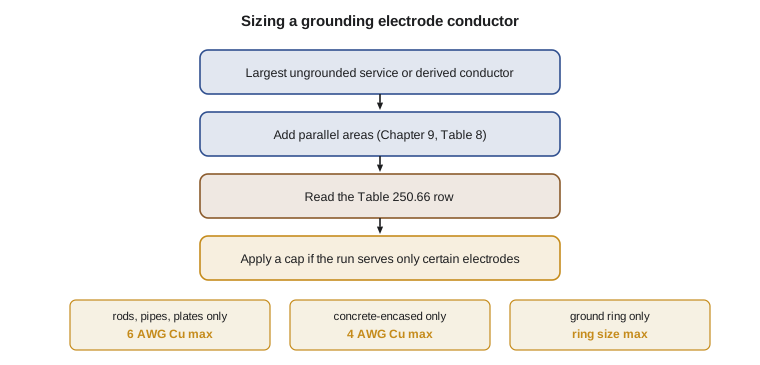
Grounding electrode conductor sizing is the most reliable source of points on a master exam's grounding section, and also one of the most reliable ways to lose them. The method takes thirty seconds once you know it: find the largest ungrounded service conductor, read one row of one table, and then ask whether the conductor goes only to a rod, a concrete-encased electrode or a ground ring, because each of those has a cap. Dana Whitfield missed four sizing questions on her first practice set. Two came from using the service rating instead of the conductor size. One came from forgetting to add parallel conductors. The fourth came from sizing a conductor to a rod at 2 AWG when the code never requires more than 6 AWG for that run. This lesson makes the method automatic.
The rules are in 250.62 through 250.68 of Part III, with Table 250.66 at the center. As always, we describe the table's structure and use illustrative values stated as this course's examples. The table itself is in your code book, and you should confirm every value you use.
Material and the basic sizing rule
Section 250.62 lets the grounding electrode conductor be copper, aluminum, copper-clad aluminum, or the items listed in 250.68(C), such as structural steel and interior water pipe within the limits that section sets. It may be solid or stranded, insulated, covered or bare. Most installations use bare or insulated copper, because aluminum and copper-clad aluminum carry installation restrictions near earth and masonry that this lesson explains later.
Section 250.66 sizes the conductor. The size depends on the size of the largest ungrounded service-entrance conductor, or the equivalent area for parallel conductors, and is read from Table 250.66. The table has columns for copper and for aluminum or copper-clad aluminum service conductors on the left, and for copper and for aluminum or copper-clad aluminum electrode conductors on the right. You find the row that covers your largest ungrounded service conductor and read across to the electrode conductor material you are using. Note what does not appear: the rating of the service overcurrent device. A 400 ampere service can have very different conductors depending on whether they are copper or aluminum, single or paralleled, and the table follows the conductors.
Where service-entrance conductors are run in parallel, you add their areas to find the equivalent area. Where there are multiple sets of service-entrance conductors supplying separate service disconnects, as permitted by 230.40, you use the equivalent area of the largest service-entrance conductor of each set added together. In both cases, Chapter 9, Table 8 gives the circular mil areas you need for AWG sizes.
The caps for rods, concrete-encased electrodes and rings
Section 250.66(A), (B) and (C) put upper limits on the size needed for certain runs. Where the grounding electrode conductor, or the portion of it, or a bonding jumper, connects only to a rod, pipe or plate electrode, it need not be larger than 6 AWG copper or 4 AWG aluminum. Where it connects only to a concrete-encased electrode, it need not be larger than 4 AWG copper. Where it connects only to a ground ring, it need not be larger than the conductor used for the ring.
These caps make physical sense. A rod has a resistance to earth of many ohms, so the current through it is limited by that resistance, and a conductor larger than 6 AWG would never be loaded. The concrete-encased electrode has lower resistance and so gets a slightly larger cap. The caps apply only to the run, or the portion of the run, that goes solely to that electrode. A conductor that continues from the rod to a water pipe, or that serves several electrodes in series, must be sized for the most demanding electrode it serves.
The word only matters on the exam. A question might describe a service with 500 kcmil copper conductors and a grounding electrode conductor that runs to a rod and then on to the metal water pipe. Because the conductor serves the water pipe too, the 6 AWG cap does not apply to the portion between the service and the water pipe, and you size it from the table, perhaps at 1/0 AWG copper. The short jumper from the water pipe connection out to the rod could be capped at 6 AWG.
Worked examples
The examples below use the following illustrative rows, stated as this course's examples for copper service conductors and copper electrode conductors: 2 AWG or smaller gives 8 AWG; 1 or 1/0 AWG gives 6 AWG; 2/0 or 3/0 AWG gives 4 AWG; over 3/0 through 350 kcmil gives 2 AWG; over 350 through 600 kcmil gives 1/0 AWG; over 600 through 1,100 kcmil gives 2/0 AWG; and over 1,100 kcmil gives 3/0 AWG. Look these up in your own table and correct them if your edition differs.
Worked problem
A dwelling service with rods only
Helen Brandt's house on Orchard Lane has a new 200 A service with 2/0 AWG copper service-entrance conductors. The house has a plastic water service and slab footings poured before concrete-encased electrodes were used, so the only electrodes are two driven rods. What size copper grounding electrode conductor is required?
Show solution
- Largest ungrounded service conductor: 2/0 AWG copper. The table row for 2/0 or 3/0 gives 4 AWG copper.
- The conductor runs only to rod electrodes, so 250.66(A) caps it at 6 AWG copper.
- The bonding jumper between the two rods is also capped at 6 AWG copper.
Answer: 6 AWG copper to the rods (the 4 AWG table value is not needed because of the rod cap).
Worked problem
A dwelling service with a water pipe
Suppose the Brandt house instead had a metal underground water service, plus two supplemental rods. The grounding electrode conductor runs from the service to the water pipe, and a bonding jumper runs from the water pipe connection to the rods. Size both.
Show solution
- The conductor to the water pipe serves a water pipe electrode, so no cap applies; the table row for 2/0 copper gives 4 AWG copper.
- The bonding jumper from the water pipe to the rods serves only rods, so it is capped at 6 AWG copper.
Answer: 4 AWG copper to the water pipe; 6 AWG copper from there to the rods.
Worked problem
Parallel conductors at Delgado Fabrication
Delgado's 400 A, 480Y/277 V service uses two parallel sets of 3/0 AWG copper per phase (167,800 cmil each). The building has steel columns in contact with the earth and a concrete-encased electrode in the footings. Size the grounding electrode conductor to the building steel and the bonding jumper to the concrete-encased electrode.
Show solution
- Equivalent area: 2 × 167,800 = 335,600 cmil, about 336 kcmil.
- Row over 3/0 through 350 kcmil gives 2 AWG copper, used for the conductor to the building steel.
- The jumper to the concrete-encased electrode serves only that electrode, so 250.66(B) caps it at 4 AWG copper.
Answer: 2 AWG copper to the steel; 4 AWG copper to the concrete-encased electrode.
Worked problem
A large service
The Harlow Commons 1,200 A service has four parallel sets of 500 kcmil copper per phase, and the grounding electrode conductor runs to the metal water pipe and the building steel. What size copper conductor is required?
Show solution
- Equivalent area: 4 × 500 = 2,000 kcmil.
- That is over 1,100 kcmil, the last row, which this example gives as 3/0 AWG copper.
- Unlike Table 250.102(C)(1), Table 250.66 has a fixed size in its last row rather than a 12.5% rule.
Answer: 3/0 AWG copper.
The last example highlights a contrast that exam writers love. Table 250.66 stops growing at its last row: no matter how large the service, the grounding electrode conductor never needs to exceed the last row's size, because the electrode's resistance limits the current anyway. Table 250.102(C)(1), which sizes main and supply-side bonding jumpers, has a 12.5% rule instead, because those jumpers carry the full fault current back to the source. If you remember why, you will not confuse the two.
| Run of the grounding electrode conductor | Sizing rule |
|---|---|
| To a metal water pipe, building steel or an electrode system including them | Full Table 250.66 value |
| Only to rod, pipe or plate electrodes | Table value, but not larger than 6 AWG copper or 4 AWG aluminum |
| Only to a concrete-encased electrode | Table value, but not larger than 4 AWG copper |
| Only to a ground ring | Table value, but not larger than the ring conductor |
| Bonding jumper between electrodes | Sized as a grounding electrode conductor for the electrodes it connects |
Installation rules for the conductor
Section 250.64 governs installation, and several of its rules appear on exams. Aluminum or copper-clad aluminum grounding electrode conductors must not be in direct contact with masonry or the earth or exposed to corrosive conditions, and outside a building they must not be terminated within 18 inches of the earth. Copper has no such limits, which is one reason it dominates.
Protection depends on size. A 4 AWG copper or aluminum conductor, or larger, must be protected only where it is exposed to physical damage. A 6 AWG conductor that is free from exposure to physical damage may be run along the surface of the building without metal covering or protection, securely fastened to the construction; otherwise it must be protected in rigid metal conduit, intermediate metal conduit, Schedule 80 PVC, reinforced thermosetting resin conduit of the heavy-wall type, electrical metallic tubing or cable armor. Conductors smaller than 6 AWG must always be protected in one of those raceways or armor.
The conductor must be installed in one continuous length without a splice or joint, with three exceptions in 250.64(C): splices made with irreversible compression-type connectors listed as grounding and bonding equipment, splices made by the exothermic welding process, and connections to busbars sized and installed as 250.64(F) describes. Standard split bolts and mechanical lugs used as splices are not on the list.
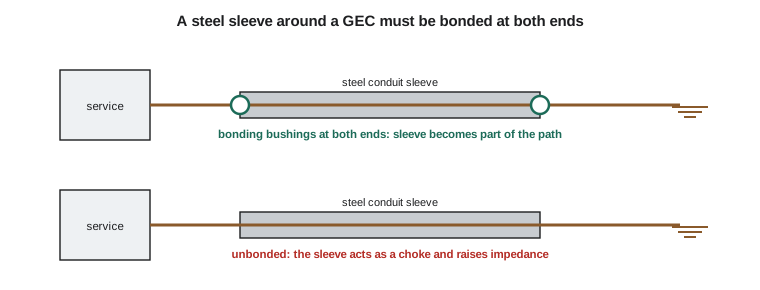
One rule catches experienced electricians. Where a grounding electrode conductor runs in a ferrous metal raceway or enclosure, such as steel conduit, 250.64(E) requires the raceway to be electrically continuous from the point of attachment to the cabinet or equipment to the grounding electrode, and bonded at each end to the conductor inside. The reason is inductance: a steel conduit around a single conductor acts like a choke during a surge or fault, raising the impedance sharply, unless the conduit itself is bonded at both ends so it becomes part of the path. PVC conduit has no such problem, which is why many electricians protect grounding electrode conductors in Schedule 80 PVC.
Multiple disconnects and connections to electrodes
Where a service has more than one disconnecting means in separate enclosures, 250.64(D) offers three ways to make the grounding electrode connection. You may run a common grounding electrode conductor with taps to each enclosure, the common conductor sized for the total service and each tap sized from the conductors serving that enclosure. You may run an individual grounding electrode conductor from each disconnect, each sized from the conductors serving it. Or you may connect at a common location, such as a busbar of at least 1/4 inch by 2 inches, in the service equipment or an accessible wireway.
Section 250.68 adds rules for the connections to electrodes. The connection must be accessible, unless it is to a buried or concrete-encased electrode, in which case it need not be. Bonding jumpers must be installed around insulated joints and around equipment likely to be disconnected for repairs, such as water meters and filters. And 250.70 controls how the connection is made: by exothermic welding, listed lugs, listed pressure connectors, listed clamps or other listed means, never by solder alone, and with no more than one conductor under a ground clamp unless the clamp is listed for more.
A calculator you can edit
The listing below sizes a copper grounding electrode conductor from a set of service conductors and applies the caps. Its table holds this lesson's illustrative rows only; check each row against Table 250.66 before trusting it.
ROWS = [(66.36, "8 AWG"), (105.6, "6 AWG"), (167.8, "4 AWG"), (350, "2 AWG"),
        (600, "1/0 AWG"), (1100, "2/0 AWG"), (10 ** 9, "3/0 AWG")]   # illustrative
ORDER = ["8 AWG", "6 AWG", "4 AWG", "2 AWG", "1/0 AWG", "2/0 AWG", "3/0 AWG"]
CAPS = {"rods only": "6 AWG", "concrete-encased only": "4 AWG"}

def gec(set_kcmil, sets=1, electrode="water pipe or steel"):
    area = set_kcmil * sets
    size = next(s for limit, s in ROWS if area <= limit)
    cap = CAPS.get(electrode)
    if cap and ORDER.index(cap) < ORDER.index(size):
        size = cap
    return area, size

for label, k, n, e in [("Brandt, rods only", 133.1, 1, "rods only"),
                       ("Brandt, water pipe", 133.1, 1, "water pipe or steel"),
                       ("Delgado, steel", 167.8, 2, "water pipe or steel"),
                       ("Delgado, footing", 167.8, 2, "concrete-encased only"),
                       ("Commons, 4 x 500", 500, 4, "water pipe or steel")]:
    area, size = gec(k, n, e)
print(f"{label}: {area:.0f} kcmil -> {size} copper")Brandt, rods only: 133 kcmil -> 6 AWG copper Brandt, water pipe: 133 kcmil -> 4 AWG copper Delgado, steel: 336 kcmil -> 2 AWG copper Delgado, footing: 336 kcmil -> 4 AWG copper Commons, 4 x 500: 2000 kcmil -> 3/0 AWG copper
Common mistakes
MistakeSizing the grounding electrode conductor from the service overcurrent device rating.
InsteadUse the largest ungrounded service conductor or equivalent area in Table 250.66.
MistakeSizing a conductor to rods only at the full table value, such as 2 AWG.
InsteadA run to rods only need not be larger than 6 AWG copper.
MistakeApplying the 6 AWG rod cap to a conductor that continues on to the water pipe.
InsteadThe cap applies only to a run, or portion of a run, that serves rods alone.
MistakeApplying a 12.5% rule to a very large grounding electrode conductor.
InsteadTable 250.66 has a fixed last row; the 12.5% rule belongs to Table 250.102(C)(1) jumpers.
MistakeRunning a grounding electrode conductor in a steel sleeve bonded at one end only.
InsteadFerrous raceways must be bonded at both ends under 250.64(E), or use a nonferrous raceway such as Schedule 80 PVC.
Summary and key terms
- Grounding electrode conductors are sized from Table 250.66 by the largest ungrounded service conductor or the equivalent area of parallel conductors.
- A run to rods, pipes or plates only need not exceed 6 AWG copper; to a concrete-encased electrode only, 4 AWG copper; to a ground ring only, the ring conductor size.
- Table 250.66's last row is a fixed size, unlike the 12.5% rule of Table 250.102(C)(1).
- 6 AWG may run unprotected where not exposed to damage; smaller sizes must be protected; 4 AWG and larger need protection only where exposed to damage.
- The conductor must be continuous, spliced only by listed irreversible compression connectors, exothermic welding or busbars.
- Ferrous raceways around the conductor must be bonded at both ends.
- Grounding electrode conductor
- The conductor connecting the service or system to the grounding electrode system.
- Equivalent area
- The total circular mil area of parallel conductors in one phase.
- Exothermic welding
- A process that fuses conductors to each other or to electrodes with a high-temperature chemical reaction.
- Irreversible compression connector
- A crimped connector that cannot be removed without destroying it, listed for grounding and bonding.
- Bonding bushing
- A conduit fitting with a lug that bonds the raceway to a conductor or enclosure.
Practice problems
Work each problem on paper first, then reveal the answer to check.
A 100 A service uses 4 AWG copper conductors and the electrodes are two rods. This course's row for 2 AWG or smaller is 8 AWG. What copper grounding electrode conductor is required?
Show answer
8 AWG copper from the table; the rod cap of 6 AWG is larger, so it does not reduce it. Protect 8 AWG in raceway or armor.
A service has three parallel sets of 250 kcmil copper. What is the equivalent area and the table row?
Show answer
750 kcmil, in the row over 600 through 1,100 kcmil, which this course's example gives as 2/0 AWG copper.
A conductor runs from the service only to a concrete-encased electrode, and the table value is 1/0 AWG. What size is required?
Show answer
4 AWG copper, the cap in 250.66(B).
May a grounding electrode conductor be spliced with a split bolt?
Show answer
No; only listed irreversible compression connectors, exothermic welding or busbars are permitted.
Why must a steel sleeve around a grounding electrode conductor be bonded at both ends?
Show answer
A ferrous raceway around a single conductor adds inductance that chokes surge and fault current unless it is bonded to become part of the path.
Lesson quiz · 5 questions
Score 60% or more to complete this lesson.
Create a free account to save your progress, take quizzes and earn a certificate.