
MELU-104 · Lesson 2 of 12 · 22 min
Article 250 structure and key definitions
▶ Video coming soon A video version of this lesson is on the way.
On a master exam, grounding questions are almost never hard because the rule is obscure. They are hard because Article 250 is long, its parts look alike, and its defined terms sound alike. Dana Whitfield timed herself finding twenty grounding rules and averaged two minutes and forty seconds per lookup, nearly double her time for other articles. Most of the delay came from starting in the wrong part of the article, or from confusing a grounding electrode conductor with an equipment grounding conductor and following the wrong table. This lesson gives you the map of Article 250 and the vocabulary to use it quickly.
As always, the lesson describes the structure and the meaning of each term in our own words. It does not reproduce the code's definitions or text. Open your own copy of the 2023 NEC to Article 250 and to the definitions in Article 100, and follow along. If your state has adopted the 2026 edition, the structure is largely the same, but the parts covering systems over 1,000 volts have moved out of Article 250 into the new Article 270, and some wording in the general requirements has changed.
The parts of Article 250
Article 250 is divided into parts, each with a theme. Learning the theme of each part is the fastest way to cut your lookup time in half, because once you know a question is about bonding, you go straight to Part V and skip the hundred sections that cannot hold the answer. Here are the parts of the 2023 edition and what each one covers, in plain words.
| Part | Theme | Typical exam topics |
|---|---|---|
| I General | Purpose, performance requirements, connection methods, objectionable current | 250.4 purposes, 250.6 objectionable current, 250.8 connection methods, 250.12 clean surfaces |
| II System Grounding | Which systems must be grounded and how the service and system connections are made | 250.20 and 250.21, 250.24 service connections, 250.28 main bonding jumper, 250.30 separately derived systems, 250.32 separate buildings, 250.36 high-impedance systems |
| III Grounding Electrode System and Grounding Electrode Conductor | Electrodes, their installation, and the conductor that connects to them | 250.50 to 250.53 electrodes, 250.62 to 250.68 conductor material, installation, sizing and connections, 250.70 connection methods |
| IV Enclosure, Raceway and Service Cable Connections | Grounding service raceways and other enclosures | 250.80 and 250.86 |
| V Bonding | Making metal parts continuous and bonding piping and structural metal | 250.92 service bonding, 250.94 intersystem bonding, 250.96 and 250.97, 250.102 jumpers, 250.104 piping and steel, 250.106 lightning protection |
| VI Equipment Grounding and Equipment Grounding Conductors | What must be grounded and which conductors qualify | 250.110 to 250.114, 250.118 types, 250.119 identification, 250.122 sizing |
| VII Methods of Equipment Grounding | How equipment is connected to the grounding system | 250.130 to 250.148, including receptacles, ranges and dryers, and use of the grounded conductor |
| VIII Direct-Current Systems | Grounding of dc systems | 250.160 to 250.169 |
| IX Instruments, Meters and Relays | Grounding of instrument circuits and cases | 250.170 to 250.178 |
| X Systems over 1000 Volts | Grounding for higher-voltage systems (moved to Article 270 in 2026) | 250.180 to 250.194 |
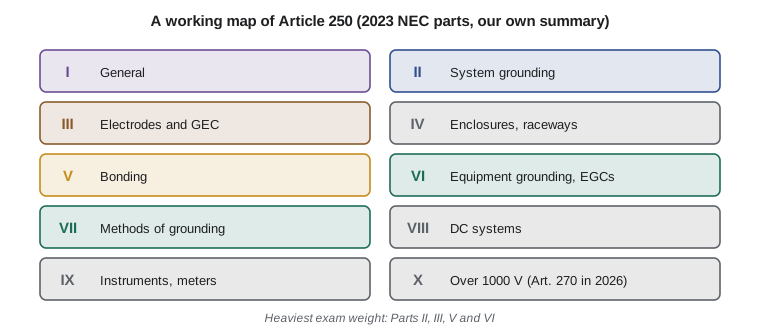
Three parts carry most of the exam weight. Part II answers questions about where and how the system's grounded conductor connects to ground, including services, transformers and separate buildings. Part III answers questions about electrodes and the conductor that runs to them. Part VI answers questions about equipment grounding conductors and what they must be sized at. Part V, on bonding, comes a close fourth. If you tab only four places in Article 250, tab 250.24, 250.52, 250.66 and 250.122, then add 250.30, 250.32, 250.102 and 250.104 as you go.
The conductors that sound alike
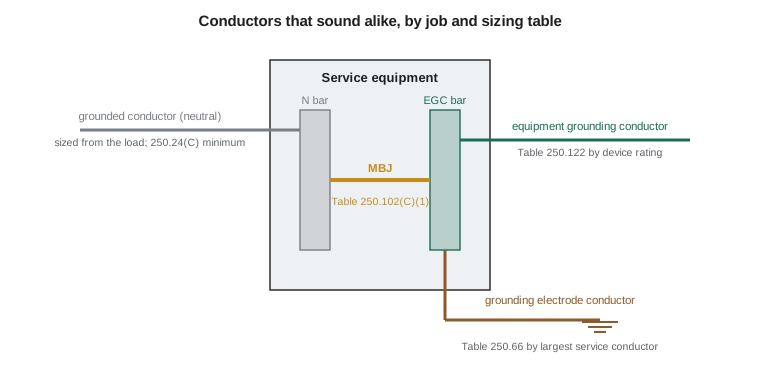
The single largest source of grounding mistakes is confusing the conductors. Their names share the same words in different orders, and each one is sized by a different table. Learn each by its job and its two ends.
The grounded conductor is a circuit conductor that is intentionally grounded. In most systems it is the neutral, the white or gray conductor that carries the unbalanced current of line-to-neutral loads. It is a current-carrying conductor in normal operation. It connects to ground at one place, the service, through the main bonding jumper, or at a separately derived system through the system bonding jumper. It is sized like any other circuit conductor, from the load, with the neutral rules of 220.61 and the minimum sizes in 250.24(C) for the service.
The equipment grounding conductor is the conductive path that connects the normally non-current-carrying metal parts of equipment together and to the system grounded conductor, the grounding electrode conductor, or both. In normal operation it carries no current. During a ground fault it carries the fault current back to the source. Its ends are the equipment at one end and the service or the separately derived system's bonding point at the other. It can be a wire, green, green with yellow stripes, or bare, or it can be a qualifying metal raceway or cable armor listed in 250.118. It is sized by Table 250.122 from the rating of the overcurrent device ahead of the circuit.
The grounding electrode conductor is the conductor that connects the system grounded conductor, or the equipment, to a grounding electrode or to a point on the grounding electrode system. Its ends are the service or separately derived system at one end and the electrode at the other. It is sized by Table 250.66 from the size of the largest ungrounded service or derived conductor, with special limits for rods, concrete-encased electrodes and ground rings.
The bonding jumpers
The bonding jumpers are short conductors with specific jobs, and the exam tests whether you can tell them apart. The main bonding jumper connects the grounded conductor and the equipment grounding conductor at the service. The system bonding jumper does the same thing at a separately derived system, such as a transformer, either at the source or at the first disconnecting means. The supply-side bonding jumper is a conductor on the supply side of a service or of a separately derived system's overcurrent device that keeps metal parts electrically connected, such as the conductor that bonds a transformer enclosure to the first disconnect enclosure. A load-side bonding jumper is the equivalent on the load side of an overcurrent device. And the equipment bonding jumper connects two or more parts of the equipment grounding conductor, such as the jumper around a flexible section of raceway.
Each has a sizing rule. Main and system bonding jumpers and supply-side bonding jumpers are sized from Table 250.102(C)(1), based on the largest ungrounded conductor they serve, with a 12.5% rule for very large services. Load-side bonding jumpers are sized from Table 250.122, based on the overcurrent device. You will practice these in Lessons 3, 6 and 8.
| Conductor or jumper | What it connects | Sized from |
|---|---|---|
| Grounded conductor (neutral) | Circuit conductor, grounded at the service or system bonding point | The load (220.61), with service minimums in 250.24(C) |
| Equipment grounding conductor | Equipment metal parts back to the source bonding point | Table 250.122, by overcurrent device rating |
| Grounding electrode conductor | Service or system to the grounding electrode | Table 250.66, by largest ungrounded conductor |
| Main bonding jumper | Grounded conductor to equipment grounding at the service | Table 250.102(C)(1), via 250.28(D) |
| System bonding jumper | Grounded conductor to equipment grounding at a separately derived system | Table 250.102(C)(1), via 250.30 |
| Supply-side bonding jumper | Metal parts on the supply side of the service or derived system overcurrent device | Table 250.102(C)(1) |
| Load-side bonding jumper | Metal parts on the load side of an overcurrent device | Table 250.122 |
Other terms you must know
Several other defined terms appear in grounding questions. A grounding electrode is a conducting object through which a direct connection to earth is established, such as a rod, a concrete-encased electrode or a metal water pipe in contact with the earth. The grounding electrode system is all the electrodes present at a building bonded together. A separately derived system is an electrical source, other than a service, that has no direct connection from its circuit conductors to the supply conductors of another system, except through grounding and bonding connections. Most transformers that serve premises wiring are separately derived, and so are many generators that switch the neutral.
The intersystem bonding termination is a device that provides a means for connecting bonding conductors for communications systems to the grounding electrode system. The ground-fault current path is any electrically conductive path from the point of a ground fault through normally non-current-carrying conductors, equipment or the earth to the source. Its sibling, the effective ground-fault current path, is the intentionally constructed, low-impedance path you met in Lesson 1. Mark the difference: the ground-fault current path can include the earth, while the effective path cannot.
Finally, two adjectives matter. Solidly grounded means connected to ground without inserting any resistor or impedance device. Impedance grounded, the subject of Lesson 10, means connected through a resistor or reactor. Most premises systems are solidly grounded. High-impedance grounded neutral systems under 250.36 are the main exception on exams.
Section numbering habits
Article 250 follows the code's usual numbering, with sections numbered in steps that leave room for new material, and lettered and numbered subdivisions inside them. A reference such as 250.30(A)(1) means Article 250, section 30, subdivision (A), list item (1). Exam questions sometimes give only a section number and ask what it covers, so knowing the neighborhoods helps: the 20s are system grounding at services and other systems, the 50s and 60s are electrodes and their conductors, the 90s and 100s are bonding, the 110s and 120s are equipment grounding and its conductors, and the 130s and 140s are methods. Learning the neighborhoods is faster than learning every section.
Worked problem
Choosing the right part before opening the book
Marcus reads a practice question: a 75 kVA transformer in the Delgado Fabrication shop feeds a 208Y/120 volt panel. What size conductor connects the transformer's secondary system to the building steel? Which part of Article 250 should he open first, and which table will he probably need?
Show solution
- The transformer is a separately derived system, so the system connection rules are in Part II, at 250.30.
- The conductor that connects the derived system to the building steel is a grounding electrode conductor, which 250.30(A)(5) sends to Table 250.66 in Part III.
- The size depends on the largest ungrounded secondary conductor, which the question would have to give or let you calculate.
Answer: Start at 250.30 in Part II, then size the conductor with Table 250.66 from the largest derived ungrounded conductor.
That two-step routine, deciding the part and then the table, is the habit this course builds. In the worked example, a candidate who saw the word transformer and flipped to Article 450 would waste three minutes. A candidate who saw a grounding electrode conductor but sized it by the transformer's primary overcurrent device, using Table 250.122, would get a wrong answer that is very likely among the choices.
A lookup drill you can edit
The listing below is a tiny lookup helper that maps the conductor named in a question to the table that sizes it. It is not a substitute for the code, but writing it, or reading it, reinforces the pattern. Add the jumpers you meet in later lessons.
SIZED_BY = {
    "grounding electrode conductor": "Table 250.66 (largest ungrounded service or derived conductor)",
    "equipment grounding conductor": "Table 250.122 (rating of the overcurrent device)",
    "main bonding jumper": "Table 250.102(C)(1) through 250.28(D)",
    "system bonding jumper": "Table 250.102(C)(1) through 250.30",
    "supply-side bonding jumper": "Table 250.102(C)(1)",
    "load-side bonding jumper": "Table 250.122",
}

for name in ["equipment grounding conductor", "main bonding jumper", "grounding electrode conductor"]:
print(f"{name}: {SIZED_BY[name]}")equipment grounding conductor: Table 250.122 (rating of the overcurrent device) main bonding jumper: Table 250.102(C)(1) through 250.28(D) grounding electrode conductor: Table 250.66 (largest ungrounded service or derived conductor)
How the exam uses definitions
Definition questions on master exams usually take one of two forms. Some ask directly what a term means or which conductor fits a description, such as the conductor that connects the system to the grounding electrode. Others embed a definition in a scenario: a generator whose transfer switch does not switch the neutral is not a separately derived system, so it does not get a system bonding jumper at the generator. To answer the second type, you must know not just the name of each term but the facts that make something fit it.
Priya Natarajan, Brightwater's estimator, helped Dana build flash cards with the job on the front and the term on the back, rather than the other way round. Within a week Dana could name the conductor from its job in under three seconds, and her grounding lookup time fell to about ninety seconds. The habit pays off again in Lesson 7, where the exam asks you to size an equipment grounding conductor and offers a grounding electrode conductor size as the most attractive wrong answer.
Common mistakes
MistakeSizing an equipment grounding conductor from Table 250.66.
InsteadEquipment grounding conductors are sized from Table 250.122 by the overcurrent device rating.
MistakeSizing a grounding electrode conductor from the overcurrent device rating.
InsteadGrounding electrode conductors are sized from Table 250.66 by the largest ungrounded service or derived conductor.
MistakeCalling the neutral a grounding conductor.
InsteadThe neutral is the grounded conductor, a current-carrying circuit conductor; the equipment grounding conductor normally carries no current.
MistakeConfusing the main bonding jumper with the system bonding jumper.
InsteadThe main bonding jumper is at the service; the system bonding jumper is at a separately derived system.
MistakeLooking for higher-voltage grounding in Article 250 in a 2026 adoption.
InsteadIn the 2026 NEC, grounding for systems over 1,000 V moved to Article 270.
Summary and key terms
- Article 250 is divided into parts by theme: general, system grounding, electrodes, enclosures, bonding, equipment grounding, methods, dc, instruments and higher-voltage systems.
- Most exam questions come from Part II (system grounding), Part III (electrodes), Part V (bonding) and Part VI (equipment grounding).
- The grounded conductor carries current; the equipment grounding conductor carries current only during a fault; the grounding electrode conductor connects to earth.
- Grounding electrode conductors use Table 250.66, equipment grounding conductors and load-side jumpers use Table 250.122, and main, system and supply-side bonding jumpers use Table 250.102(C)(1).
- Decide the part, then the table, before you open the book.
- The definitions themselves are in Article 100; learn each term by the job it does.
- Grounded conductor
- A circuit conductor that is intentionally grounded, usually the neutral.
- Equipment grounding conductor
- The conductive path connecting equipment metal parts to the system grounded conductor or grounding electrode conductor, carrying current during faults.
- Grounding electrode conductor
- The conductor connecting the system or equipment to the grounding electrode system.
- Main bonding jumper
- The connection between the grounded conductor and the equipment grounding conductor at the service.
- System bonding jumper
- The connection between the grounded conductor and the equipment grounding conductor at a separately derived system.
- Separately derived system
- A source other than a service with no direct connection of its circuit conductors to another system's supply conductors, except through grounding and bonding.
Practice problems
Work each problem on paper first, then reveal the answer to check.
Which part of Article 250 covers bonding of metal water piping?
Show answer
Part V, Bonding, at 250.104.
A question asks for the size of the conductor from a service to a ground rod. Which table applies?
Show answer
Table 250.66, with the rod limit in 250.66(A).
A question asks for the size of the green wire in a feeder protected at 200 A. Which table applies?
Show answer
Table 250.122, based on the 200 A overcurrent device.
What is the difference between a ground-fault current path and an effective ground-fault current path?
Show answer
The first is any conductive path a fault might take, including the earth; the second is the intentionally built, low-impedance path that lets the overcurrent device open.
Where are most grounding definitions found in the 2023 NEC?
Show answer
In Article 100, which gathered nearly all definitions in the 2023 edition.
Lesson quiz · 5 questions
Score 60% or more to complete this lesson.
Create a free account to save your progress, take quizzes and earn a certificate.