
MELU-104 · Lesson 1 of 12 · 24 min
Why we ground and why we bond
▶ Video coming soon A video version of this lesson is on the way.
Dana Whitfield had passed MELU-101 and MELU-102 with practice scores in the high eighties, and she expected grounding to be the easy chapter. She had installed hundreds of ground rods and tightened thousands of green screws. Her first timed set of twenty grounding questions came back at 13 out of 20. Ray Ochoa, the owner of Brightwater Electric, looked over the misses and was not surprised. Every one of them, he said, came from the same place: she knew what to install, but she could not always say why the code wanted it, and Article 250 rewards the people who understand the why. A candidate who knows the purpose of each conductor can work out the answer to an unfamiliar question. A candidate who only remembers installations gets lost the first time the question describes something she has not seen.
This course is about Article 250 of the 2023 NEC, Grounding and Bonding, as it is tested on master electrician exams. It covers system grounding, the grounding electrode system, grounding electrode conductors, bonding, equipment grounding conductors, separately derived systems, separate buildings, and ungrounded and high-impedance systems, and it ends with a timed practice set. This first lesson builds the foundation the rest depends on: what grounding does, what bonding does, why the earth is not a fault path, and what the code means by an effective ground-fault current path.
One rule holds throughout the course, as it does in every MELU course. The NEC is a copyrighted standard. These lessons cite article, section and table numbers and explain them in plain words, but they never reproduce the code's text, tables or figures. Every worked example uses our own illustrative values. Keep your own copy of the edition your state adopted open beside you, check every value against it, and check your state and local amendments and your testing vendor's candidate bulletin. Where the 2026 NEC changes something, the lesson says so; in 2026 adoptions, Article 250 covers systems up to 1,000 volts AC and 1,500 volts DC, and the grounding rules for higher voltages move to a new Article 270.
Two words that are not the same
Electricians use grounding and bonding almost interchangeably on the job. The code does not. Grounding means connecting to the earth, or to a conductive body that extends the earth connection. Bonding means connecting metal parts together so they are at the same electrical potential and so they form a continuous, conductive path. A ground rod is about grounding. A bonding jumper around a water meter is about bonding. An equipment grounding conductor, despite its name, does far more bonding than grounding: its main job is to connect the metal frames of equipment back to the source so that a fault can clear.
Article 100 defines the terms precisely, and the master exam expects you to know them. Rather than memorize the code's wording, learn what each one does. Ground is the earth. Grounded means connected to ground or to a conductive body that extends the ground connection. Bonded means connected to establish electrical continuity and conductivity. Effectively grounded and solidly grounded describe how a system's grounded conductor is connected. You will meet the conductor definitions, such as the grounded conductor, the equipment grounding conductor and the grounding electrode conductor, in Lesson 2.
What system grounding does
Section 250.4(A)(1) explains why the code requires most electrical systems to be connected to the earth. The connection limits the voltage that lightning, line surges or unintentional contact with higher-voltage lines can impose on the system, and it stabilizes the voltage to earth during normal operation. Picture a utility transformer on a pole outside the Maple Street fourplex. If a 7,200 volt primary line fell across the 120/240 volt secondary and the secondary were not grounded, the whole secondary system, including the wiring inside the fourplex, could rise toward 7,200 volts above earth. With the secondary grounded at the transformer and at the service, the earth connection helps hold the system near earth potential while the utility's protection clears the fault.
Stabilizing the voltage to earth matters in normal operation too. An ungrounded 120/240 volt system has no fixed relationship to earth. Static charges, capacitive coupling and leakage can let it float to almost any voltage above or below earth. Grounding the neutral fixes the system so that each ungrounded conductor sits at about 120 volts to earth. Insulation, equipment ratings and the safety of anyone who touches a grounded object all depend on that fixed reference.
Note what system grounding does not do. It does not make a fault on the premises wiring clear. That job belongs to the equipment grounding conductor and the bonding, as the next section explains. Candidates who think the ground rod trips the breaker miss a whole family of exam questions.
What equipment grounding and bonding do
Sections 250.4(A)(2) through (A)(5) describe the other half of the job. Normally non-current-carrying metal parts of equipment, such as panel enclosures, motor frames, raceways and luminaire housings, must be connected together and to the supply source in a way that establishes an effective ground-fault current path. Other conductive materials likely to become energized, such as metal piping and structural steel, must be bonded so they cannot hold a dangerous voltage. The purpose is twofold. First, the bonding limits the voltage between metal parts that a person might touch at the same time. Second, it provides a low-impedance path that carries enough fault current to make the overcurrent device open quickly.
Think of what happens when a hot conductor inside the Copper Kettle's walk-in cooler rubs through its insulation and touches the metal housing. If the housing is bonded to the equipment grounding conductor, and the equipment grounding conductor runs back to the service where it joins the grounded conductor through the main bonding jumper, the fault forms a complete circuit of low impedance: hot conductor, housing, equipment grounding conductor, main bonding jumper, grounded service conductor, and back to the transformer. The current is limited only by the impedance of that loop, so it rises to hundreds or thousands of amperes, and the breaker opens in a fraction of a second. The housing never sits at a dangerous voltage for long.
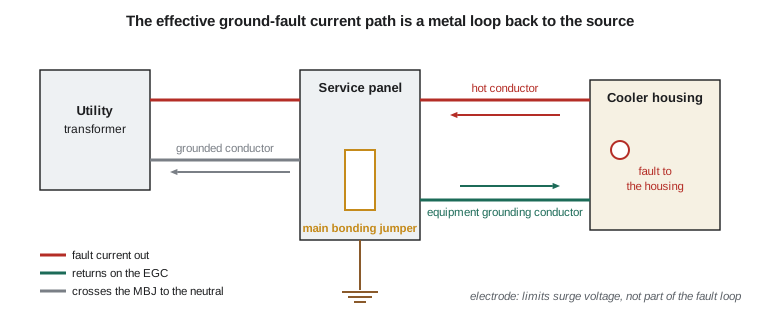
The earth is not a fault path
Section 250.4(A)(5) makes a point that exam writers return to again and again: the earth is not considered an effective ground-fault current path. The reason is simple arithmetic. A single driven rod often has a resistance to earth of 25 ohms or more, and the earth return to the utility transformer adds more. Ohm's law then shows how little current flows when a fault relies on the earth alone. At 120 volts to earth and 25 ohms, the current is 120 divided by 25, or 4.8 amperes. A 20 ampere breaker will never trip on 4.8 amperes. The equipment simply stays energized at a dangerous voltage until someone touches it.
Worked problem
Why a ground rod cannot clear a fault
Tyler Brooks asks why the shed at a customer's house needs an equipment grounding conductor when the shed already has its own ground rod. Suppose a 120 volt fault energizes the metal shed siding, the shed's rod measures 25 ohms, and the utility's grounding at the transformer adds another 5 ohms. How much current flows through the earth, and will a 20 A breaker trip?
Show solution
- Total resistance of the earth path: 25 + 5 = 30 Ω.
- Fault current: I = V ÷ R = 120 ÷ 30 = 4 A.
- A 20 A breaker carries 4 A indefinitely, so it never trips.
- Voltage on the siding: the rod alone drops 4 × 25 = 100 V, so the siding sits about 100 V above the earth around it.
Answer: About 4 A flows, the breaker does not trip, and the siding stays at about 100 V to earth.
Now compare the same fault with an equipment grounding conductor in place. Suppose the hot conductor and the equipment grounding conductor together have a resistance of 0.4 ohms over their length. The fault current becomes 120 divided by 0.4, or 300 amperes, fifteen times the breaker rating. A typical thermal-magnetic breaker opens almost instantly at that current. This comparison is the single most important idea in Article 250, and it explains why the code insists on a metal return path to the source for every circuit.
Bonding limits touch voltage
Even during the short time a fault lasts, and even when no fault exists, bonding keeps metal parts at the same potential. If the cooler housing at the Copper Kettle and the stainless steel prep table beside it are both bonded to the same equipment grounding system, a cook touching both at once feels very little voltage between them, even while the fault current flows. If one of them were bonded and the other were not, the voltage between them could be most of the 120 volts. That is why the code bonds metal piping, structural steel, raceways and enclosures together, even where none of them is intended to carry current. The aim is equal potential everywhere a person can reach.
Bonding also carries lightning and surge currents. When lightning strikes near a building, it can raise the local earth thousands of volts above remote earth for a few microseconds. If the building's electrical system, its communications cables and its metal piping are all bonded together, they rise together, and the voltage between them stays small. If they are not bonded, the voltage difference can arc between systems and destroy equipment or start a fire. The intersystem bonding termination you will meet in Lesson 6 exists for exactly this reason.
Grounded systems and ungrounded systems
Most systems you will see on the exam are grounded systems, where one conductor, usually the neutral, is intentionally connected to earth. Section 250.20 tells you when a system must be grounded, and Lesson 3 covers the details. A few systems are permitted to operate ungrounded, which means no conductor is intentionally connected to earth, and Section 250.4(B) sets out what bonding and grounding those systems still need. An ungrounded system still has its equipment bonded and grounded. What it lacks is the intentional connection of a circuit conductor to earth. The trade-off, which Lesson 10 explores, is that the first ground fault on an ungrounded system does not trip anything, which keeps a process running but leaves a hidden hazard until someone finds and fixes the fault.
| Purpose | Done by | Where in Article 250 |
|---|---|---|
| Limit voltage from lightning, surges and contact with higher voltage | System grounding to the grounding electrode system | 250.4(A)(1), Parts II and III |
| Limit voltage on equipment frames to earth | Equipment grounding | 250.4(A)(2), Part VI |
| Keep metal parts at the same potential | Bonding of equipment and other conductive materials | 250.4(A)(3) and (A)(4), Part V |
| Make overcurrent devices open on a ground fault | Effective ground-fault current path | 250.4(A)(5) |
A calculator you can edit
The listing below compares the fault current through the earth with the current through a metal return path, using the values from this lesson. Change the resistances and run it again. Try a 10 ohm rod, then a 5 ohm rod, and notice that even a very good earth connection cannot trip a 20 ampere breaker on a 120 volt fault. That is the point of the exercise: no achievable earth resistance replaces the equipment grounding conductor.
def fault_current(volts, ohms):
    return volts / ohms

volts = 120
breaker = 20
for label, ohms in [("Earth path, 25 ohm rod plus 5 ohm utility", 30),
                    ("Earth path, 5 ohm rod plus 5 ohm utility", 10),
                    ("Metal path, hot plus EGC", 0.4)]:
    amps = fault_current(volts, ohms)
    trips = "trips" if amps >= 5 * breaker else "does not trip quickly"
print(f"{label}: {amps:.1f} A, {amps / breaker:.1f} times the {breaker} A rating, breaker {trips}")Earth path, 25 ohm rod plus 5 ohm utility: 4.0 A, 0.2 times the 20 A rating, breaker does not trip quickly Earth path, 5 ohm rod plus 5 ohm utility: 12.0 A, 0.6 times the 20 A rating, breaker does not trip quickly Metal path, hot plus EGC: 300.0 A, 15.0 times the 20 A rating, breaker trips
How exam questions test the why
Master exams test this lesson in three common ways. The first is the direct purpose question, such as asking which conductor provides the effective ground-fault current path, or what system grounding is intended to limit. The second is the misconception question, which offers the earth or the grounding electrode as the path that clears a fault and expects you to reject it. The third hides the idea inside a scenario: a detached garage with its own rod but no equipment grounding conductor, a metal pole light grounded only to a rod, or a pump motor whose frame is bonded only to the well casing. In each scenario the right answer recognizes that a metal return path to the source is missing.
Marcus Lee, Dana's study partner, kept missing scenario questions because he answered from habit. He would see a ground rod in the question and assume the installation was grounded properly. Dana suggested a two-question check he now writes in the margin: if this metal part became energized, what path would the current take back to the source, and would that path carry enough current to open the breaker? If the honest answer involves the earth, the installation is not compliant, however many rods it has.
Gloria Haynes, Harlow's chief electrical inspector, uses the same test in the field. When she finds a pole light in a parking lot fed with two conductors and grounded to a rod at its base, she writes it up, and she explains why to the contractor: the rod protects against lightning, but it will not clear a fault, and a customer who touches an energized pole in the rain may not survive long enough for anyone to notice. The code's language is technical, but the hazard it addresses is as plain as that.
One more distinction will save you points later in the course. The grounding electrode conductor connects the system to the earth. The equipment grounding conductor connects equipment back to the source. The main bonding jumper, at the service, is the single point where those two systems meet the grounded conductor. Keep the three straight and most of Article 250 falls into place: electrode conductors are sized by Table 250.66 from the service conductors, equipment grounding conductors by Table 250.122 from the overcurrent device, and bonding jumpers on the supply side by Table 250.102(C)(1). Lesson 12 drills that choice repeatedly.
Common mistakes
MistakeBelieving the ground rod makes the breaker trip on a fault.
InsteadThe equipment grounding conductor and main bonding jumper provide the fault path; the earth cannot carry enough current.
MistakeUsing grounding and bonding as if they meant the same thing.
InsteadGrounding connects to the earth; bonding connects metal parts together into one conductive, equal-potential system.
MistakeTreating a separate building's rod as a substitute for an equipment grounding conductor.
InsteadA local electrode is added to, not used instead of, the equipment grounding conductor run with the circuit.
MistakeThinking an ungrounded system needs no bonding.
InsteadUngrounded systems still bond and ground their equipment; only the intentional connection of a circuit conductor to earth is missing.
MistakeAssuming a low earth resistance makes the earth an acceptable fault path.
InsteadSection 250.4(A)(5) says the earth is not an effective ground-fault current path, whatever its resistance.
Summary and key terms
- Grounding connects to the earth; bonding connects metal parts so they are continuous and at the same potential.
- System grounding limits voltage from lightning, surges and contact with higher-voltage lines and stabilizes voltage to earth.
- Equipment grounding and bonding create an effective ground-fault current path that lets the overcurrent device open quickly.
- The earth is never an effective ground-fault current path, because its resistance limits fault current to a few amperes.
- Bonding keeps touch voltages low during faults and lightning events by holding metal parts at one potential.
- In 2026 NEC adoptions, Article 250 covers systems up to 1,000 V AC and 1,500 V DC; higher-voltage grounding moves to Article 270.
- Grounding
- Connecting to the earth or to a conductive body that extends the earth connection.
- Bonding
- Connecting metal parts so they are electrically continuous and at the same potential.
- Effective ground-fault current path
- A low-impedance, intentionally built path that carries fault current back to the source so the overcurrent device opens.
- System grounding
- The intentional connection of one conductor of a system, usually the neutral, to earth.
- Touch voltage
- The voltage a person can experience between two conductive parts touched at the same time.
- Ungrounded system
- A system with no circuit conductor intentionally connected to earth.
Practice problems
Work each problem on paper first, then reveal the answer to check.
A 120 V fault energizes a metal pole grounded only to a 20 Ω rod, with 5 Ω of utility grounding. Find the fault current.
Show answer
I = 120 ÷ 25 = 4.8 A, far too little to trip a 20 A breaker.
The same fault returns on an equipment grounding conductor, with a loop resistance of 0.3 Ω. Find the fault current.
Show answer
I = 120 ÷ 0.3 = 400 A, twenty times a 20 A rating, so the breaker opens almost instantly.
Name the four purposes of grounding and bonding described in 250.4(A).
Show answer
Limit voltage to earth from lightning, surges and higher-voltage contact; ground equipment; bond equipment and conductive materials; provide an effective ground-fault current path.
Why does the code bond metal water piping even though it carries no current?
Show answer
So it cannot sit at a different voltage from the electrical system's equipment during a fault or a lightning event.
What does an ungrounded system still require, according to 250.4(B)?
Show answer
Its equipment and conductive materials must still be bonded and grounded so a first fault does not leave metal at a dangerous voltage, and a second fault can clear.
Lesson quiz · 5 questions
Score 60% or more to complete this lesson.
Create a free account to save your progress, take quizzes and earn a certificate.