
MELU-104 · Lesson 12 of 12 · 49 min
Grounding and bonding practice set
▶ Video coming soon A video version of this lesson is on the way.
Two weeks before her exam date, Dana Whitfield sat a fresh set of twenty grounding questions under exam conditions: code book open, tabs in place, a basic calculator, and forty minutes on the clock. She finished with six minutes to spare and scored 18 out of 20, up from 13 at the start of this course. Her two misses were both reading errors, not knowledge errors, which Ray Ochoa told her was exactly where she wanted to be. This lesson gives you a set like hers, worked step by step, with a routine for each type of question. Work each problem yourself before reading the solution, time yourself at about two minutes per problem, and check every table value against your own copy of the code, because the values below are this course's illustrative examples, not reproductions of the NEC.
Every grounding question on a master exam falls into one of five families: purpose and definitions, sizing, electrodes, bonding, and special systems such as separately derived systems, separate buildings and ungrounded systems. The routine is the same for each: decide the family, decide the section, decide the table if there is one, then read the question again for the facts that change the answer.
The three-table decision
Most sizing questions turn on choosing the right table, so start with the decision that Lessons 2, 5, 6 and 7 built. If the conductor connects a service or separately derived system to an electrode, it is a grounding electrode conductor, sized from Table 250.66 by the largest ungrounded service or derived conductor, with caps for rods, concrete-encased electrodes and ground rings. If it connects the grounded conductor to the equipment grounding system at a service or derived system, or bonds metal parts on the supply side, it is a main, system or supply-side bonding jumper, sized from Table 250.102(C)(1) by the largest ungrounded conductor, with the 12.5% rule above the last row. If it is an equipment grounding conductor or a load-side bonding jumper, it is sized from Table 250.122 by the overcurrent device rating.
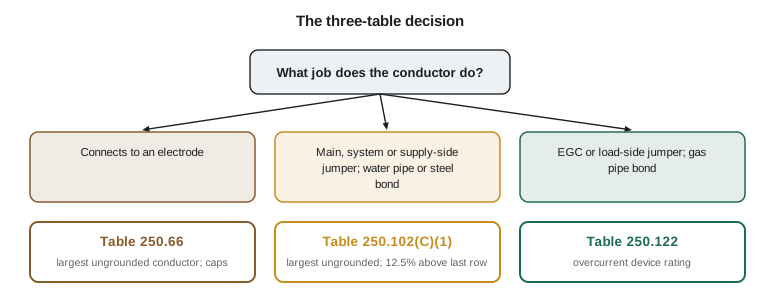
The examples below use these illustrative rows, stated as this course's examples. For Tables 250.66 and 250.102(C)(1), with copper conductors: 2 AWG or smaller gives 8 AWG; 1 or 1/0 gives 6 AWG; 2/0 or 3/0 gives 4 AWG; over 3/0 through 350 kcmil gives 2 AWG; over 350 through 600 kcmil gives 1/0; over 600 through 1,100 kcmil gives 2/0; over 1,100 kcmil gives 3/0 in Table 250.66 and 12.5% of the area in Table 250.102(C)(1). For Table 250.122 with copper: 20 A gives 12 AWG, 60 A gives 10 AWG, 100 A gives 8 AWG, 200 A gives 6 AWG, 300 A gives 4 AWG, 400 A gives 3 AWG, 600 A gives 1 AWG, 800 A gives 1/0 and 1,200 A gives 3/0.
Problems 1 to 5: sizing
Worked problem
Problem 1
A 400 A service has 600 kcmil copper ungrounded conductors, and the grounding electrode conductor runs to the building steel and the metal water pipe. What size copper grounding electrode conductor is required?
Show solution
- Family: sizing. Conductor to electrodes: Table 250.66.
- Largest ungrounded conductor 600 kcmil: row over 350 through 600 kcmil, 1/0 AWG.
- The run serves steel and water pipe, so no cap applies.
Answer: 1/0 AWG copper.
Worked problem
Problem 2
The same 400 A service supplies a feeder to a panel protected at 400 A. What size copper equipment grounding conductor is required for that feeder?
Show solution
- Family: sizing. Equipment grounding conductor: Table 250.122.
- Overcurrent device 400 A: 3 AWG copper in this course's example.
- The 1/0 from Problem 1 is the attractive wrong answer.
Answer: 3 AWG copper.
Worked problem
Problem 3
A service has three parallel sets of 500 kcmil copper per phase. What minimum area is required for a copper main bonding jumper?
Show solution
- Family: sizing. Main bonding jumper: Table 250.102(C)(1).
- Equivalent area: 3 × 500 = 1,500 kcmil, beyond the last row.
- 12.5% × 1,500 = 187.5 kcmil, so the next standard size at least that large, such as 4/0 AWG (211.6 kcmil) or larger, as your conductor table confirms.
Answer: At least 187.5 kcmil, for example 4/0 AWG copper.
Worked problem
Problem 4
A 150 A feeder's ungrounded conductors are increased from 1/0 AWG (105,600 cmil) to 3/0 AWG (167,800 cmil) for voltage drop. What size copper equipment grounding conductor is required?
Show solution
- Table 250.122 for 150 A falls in the 200 A row: 6 AWG (26,240 cmil).
- Ratio: 167,800 ÷ 105,600 = 1.589.
- Required area: 26,240 × 1.589 = 41,700 cmil.
- 4 AWG is 41,740 cmil, just large enough.
Answer: 4 AWG copper.
Worked problem
Problem 5
A grounding electrode conductor from a service with 3/0 copper conductors runs only to two ground rods. What size copper conductor is required?
Show solution
- Table 250.66 row for 3/0: 4 AWG.
- The run serves rods only, so 250.66(A) caps it at 6 AWG.
- 6 AWG is smaller than 4 AWG, so the cap controls.
Answer: 6 AWG copper.
Problems 6 to 9: electrodes and bonding
Worked problem
Problem 6
A new commercial building has footings with 1/2 inch reinforcing steel in contact with the earth, a plastic water service and two driven rods specified on the drawings. Which electrodes must be part of the grounding electrode system?
Show solution
- Family: electrodes. Section 250.50 requires all electrodes present to be used.
- The concrete-encased electrode is present in the new footings, so it must be bonded in.
- The rods are electrodes installed by design, so they are also part of the system.
- The plastic water service is not an electrode.
Answer: The concrete-encased electrode and both rods, bonded together.
Worked problem
Problem 7
A single driven rod at a pump house measures 31 Ω. What does the code require?
Show solution
- Family: electrodes. Section 250.53(A)(2): a single rod over 25 Ω must be supplemented.
- Install a supplemental electrode, such as a second rod at least 6 ft away under 250.53(A)(3).
- No further measurement is required after the supplemental electrode is installed.
Answer: Add a supplemental electrode at least 6 ft away; no retest required.
Worked problem
Problem 8
A 200 A dwelling service has 2/0 copper conductors. The interior metal water piping must be bonded. What size copper bonding jumper is required, and from which table?
Show solution
- Family: bonding. Section 250.104(A) sizes the water piping bond from Table 250.102(C)(1).
- Row for 2/0 copper: 4 AWG.
Answer: 4 AWG copper, from Table 250.102(C)(1).
Worked problem
Problem 9
A 480Y/277 V feeder raceway enters a panelboard through a concentric knockout with its outer rings removed. Is a standard locknut acceptable?
Show solution
- Family: bonding. Over 250 V to ground, 250.97 applies.
- Where concentric knockouts are encountered and the enclosure is not listed for reliable bonding, a method from 250.92(B)(2) through (B)(4), such as a bonding bushing with a jumper, is required.
Answer: No; use a bonding bushing and jumper or another method 250.97 permits.
Problems 10 to 14: special systems
Worked problem
Problem 10
A 112.5 kVA transformer has a 480 V primary and a 208Y/120 V secondary with 350 kcmil copper secondary conductors. The system bonding jumper is in the transformer. Size the system bonding jumper and the grounding electrode conductor.
Show solution
- Family: special systems, 250.30.
- Largest derived ungrounded conductor: 350 kcmil, in the row over 3/0 through 350 kcmil.
- System bonding jumper from Table 250.102(C)(1): 2 AWG copper.
- Grounding electrode conductor from Table 250.66: 2 AWG copper, connected at the same point as the system bonding jumper.
Answer: 2 AWG copper for each.
Worked problem
Problem 11
The same transformer's primary is protected by a 175 A breaker. What size copper equipment grounding conductor is required for the primary feeder?
Show solution
- Primary feeder: Table 250.122 by the primary overcurrent device.
- 175 A falls in the 200 A row: 6 AWG copper.
Answer: 6 AWG copper.
Worked problem
Problem 12
A detached garage is fed by a 100 A feeder of 3 AWG copper with an equipment grounding conductor. The garage panel has a bonding screw installed. What is wrong, and what is the correct grounding electrode conductor size if the garage uses two rods?
Show solution
- Family: separate buildings, 250.32.
- The neutral must not be bonded at the separate building, so the screw must be removed.
- Grounding electrode conductor from Table 250.66 by the 3 AWG feeder conductors: the 2 AWG or smaller row gives 8 AWG, protected because it is smaller than 6 AWG. The rod cap of 6 AWG is larger, so 8 AWG stands.
Answer: Remove the bonding screw; 8 AWG copper grounding electrode conductor, protected.
Worked problem
Problem 13
A plant has a 480 V high-impedance grounded system and wants to add 277 V LED high-bay lighting fed from it. Is that permitted?
Show solution
- Family: special systems, 250.36.
- High-impedance grounded neutral systems may not serve line-to-neutral loads.
- The lighting must be fed from a solidly grounded separately derived system, such as a transformer.
Answer: No; supply the lighting from a solidly grounded derived system.
Worked problem
Problem 14
A standby generator connects through a three-pole transfer switch on a 208Y/120 V system, and the generator ships with its neutral bonded to the frame. What must be done?
Show solution
- Family: special systems. With a solid neutral, the generator is not separately derived.
- Its neutral must not be bonded at the generator, or the premises would have a second neutral-to-ground bond.
- Remove the generator's bond as the manufacturer directs; the system is grounded only at the service.
Answer: Remove the bond at the generator.
Problem 15: a purpose question
Worked problem
Problem 15
A question asks which statement best describes the role of the grounding electrode in a grounded system. The choices mention clearing ground faults, limiting voltage from lightning and surges, carrying neutral current, and reducing voltage drop.
Show solution
- Family: purpose. Section 250.4(A)(1) describes system grounding as limiting voltages imposed by lightning, surges and contact with higher-voltage lines, and stabilizing voltage to earth.
- Clearing ground faults is the job of the equipment grounding conductor and main bonding jumper; the earth is not an effective fault path.
Answer: Limiting voltage from lightning, surges and higher-voltage contact.
Timing and review habits
Dana's timing on this set settled at about ninety seconds per sizing problem and sixty seconds per rule question, leaving time for a full review pass. Her review routine had three checks. First, for each sizing answer, did she use the table that matches the conductor's job? Second, did she add parallel conductors, apply the rod or concrete-encased cap, or apply the 12.5% rule where the question's facts called for it? Third, did the answer make physical sense: a grounding electrode conductor for a dwelling is rarely larger than 4 AWG, and an equipment grounding conductor is never larger than the circuit conductors.
Marcus Lee's weak point was reading. He would see a detail such as rods only, existing installation, or no line-to-neutral loads, and skip past it. On his review pass he now underlines every qualifier in the question stem before checking his answer. Those qualifiers are where exam writers put the difference between the right answer and the attractive wrong one.
One more habit is worth adopting from Gloria Haynes. When a question describes an installation, picture it as an inspector would: trace the neutral current home, trace the fault current home, and look at every electrode and bond. If neutral current can reach metal, there is an extra bond. If fault current must cross the earth, a conductor is missing. If an electrode present at the building is not connected, the grounding electrode system is incomplete. Those three traces answer most scenario questions without a single table lookup.
A drill you can edit
The listing below drills the three-table decision. It describes a series of conductors, decides which table sizes each one, and prints the reasoning. Add your own descriptions from practice questions and see whether your answer matches.
def which_table(job):
    job = job.lower()
    if "electrode" in job and "bond" not in job:
        return "Table 250.66 (largest ungrounded service or derived conductor; check caps)"
    if any(word in job for word in ("main bonding", "system bonding", "supply-side", "water piping", "structural")):
        return "Table 250.102(C)(1) (largest ungrounded conductor; 12.5% above last row)"
    return "Table 250.122 (overcurrent device rating)"

jobs = [
    "conductor from service to electrode at building steel",
    "main bonding jumper in a 400 A service",
    "equipment grounding conductor in a 225 A feeder",
    "supply-side bonding jumper from transformer to panel",
    "bond to interior water piping",
    "load-side jumper around flexible conduit",
]
for j in jobs:
print(f"{j}: {which_table(j)}")conductor from service to electrode at building steel: Table 250.66 (largest ungrounded service or derived conductor; check caps) main bonding jumper in a 400 A service: Table 250.102(C)(1) (largest ungrounded conductor; 12.5% above last row) equipment grounding conductor in a 225 A feeder: Table 250.122 (overcurrent device rating) supply-side bonding jumper from transformer to panel: Table 250.102(C)(1) (largest ungrounded conductor; 12.5% above last row) bond to interior water piping: Table 250.102(C)(1) (largest ungrounded conductor; 12.5% above last row) load-side jumper around flexible conduit: Table 250.122 (overcurrent device rating)
Common mistakes
MistakeAnswering a sizing question before deciding what job the conductor does.
InsteadName the conductor's job first, then choose Table 250.66, 250.102(C)(1) or 250.122.
MistakeSkipping qualifiers such as rods only, existing, or no line-to-neutral loads.
InsteadUnderline every qualifier on the review pass; they usually decide the answer.
MistakeUsing the 12.5% rule for a grounding electrode conductor.
InsteadTable 250.66 has a fixed last row; the 12.5% rule belongs to Table 250.102(C)(1).
MistakeForgetting the primary side of a transformer is an ordinary feeder.
InsteadSize the primary equipment grounding conductor from Table 250.122 by the primary overcurrent device.
MistakeSpending five minutes on one hard question.
InsteadMark it, move on, and return on the review pass; every question is worth the same.
Summary and key terms
- Sort each grounding question into a family: purpose, sizing, electrodes, bonding or special systems.
- The three-table decision settles most sizing questions: electrode conductors by Table 250.66, main, system and supply-side jumpers by Table 250.102(C)(1), equipment grounding conductors and load-side jumpers by Table 250.122.
- Add parallel conductor areas, apply the rod and concrete-encased caps, upsize proportionally, and use 12.5% only where Table 250.102(C)(1) calls for it.
- Use every electrode present, supplement water pipes and high-resistance single rods, and bond piping and steel with the right table.
- Bond separately derived systems at one point, isolate the neutral at separate buildings, and keep line-to-neutral loads off high-impedance systems.
- Time yourself, review for wrong tables and missed qualifiers, and trace neutral and fault current paths on scenario questions.
- Question family
- The category of a grounding question, which tells you where in Article 250 to look.
- Qualifier
- A detail in a question, such as rods only or existing installation, that changes which rule applies.
- Review pass
- A second pass through the exam to check flagged and doubtful answers.
- Three-table decision
- Choosing among Tables 250.66, 250.102(C)(1) and 250.122 by the conductor's job.
- Equivalent area
- The total area of parallel conductors in one phase, used to enter Tables 250.66 and 250.102(C)(1).
Practice problems
Work each problem on paper first, then reveal the answer to check.
A service has two parallel sets of 250 kcmil copper. Size the grounding electrode conductor to building steel and the main bonding jumper.
Show answer
Equivalent area 500 kcmil: row over 350 through 600 kcmil, 1/0 AWG copper for both (check both tables).
A 60 A circuit is run in flexible metal conduit 5 ft long. May the conduit serve as the equipment grounding conductor?
Show answer
No; flexible metal conduit qualifies only for circuits of 20 A or less. Install a 10 AWG copper equipment grounding conductor.
A feeder protected at 1,200 A runs in three parallel raceways. What equipment grounding conductors are required?
Show answer
A 3/0 AWG copper conductor in each raceway, in this course's example.
A shed is fed by two 20 A circuits. Is a grounding electrode required?
Show answer
Yes; the single-circuit exception does not apply to two circuits.
What resistance does a 480Y/277 V high-impedance system need to allow 3 A of fault current?
Show answer
277 ÷ 3 = 92.3 Ω.
Lesson quiz · 5 questions
Score 60% or more to complete this lesson.
Create a free account to save your progress, take quizzes and earn a certificate.