
MELU-101 · Lesson 9 of 12 · 23 min
State and local amendments
▶ Video coming soon A video version of this lesson is on the way.
When Gloria Haynes trains new inspectors in Harlow, she starts with a stack of three documents on the table: the NEC, the state's adopting rule with its amendments, and the city's own electrical ordinance. 'The code is all three of these together,' she tells them. 'If you only read the first one, you'll fail good jobs and pass bad ones.' Master electricians need the same habit. Your license makes you responsible for meeting the code as adopted where the work is done, not the model code as printed. And many state exams include questions on the state's amendments and licensing law alongside the NEC.
What an amendment is
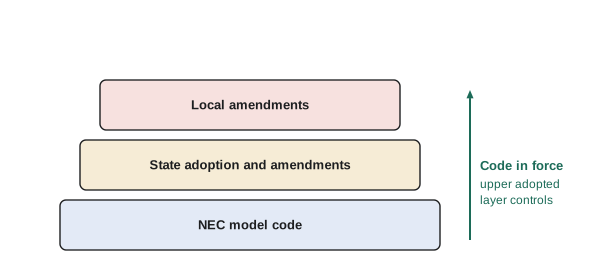
When a state or local government adopts the NEC, it can change it. An amendment might delete a section, add a new requirement, replace a section with different wording, change a number, or delay the effective date of a new rule. The adopting document lists each change, usually by section number. Where an amendment conflicts with the model code, the amendment controls in that jurisdiction.
| Kind of amendment | What it does | Illustrative example (made up) |
|---|---|---|
| Deletion | Removes a model code rule | A new requirement in the model code is deleted because the state considers it too costly |
| Addition | Adds a requirement the model code lacks | A city requires metal raceway for all commercial wiring |
| Replacement | Substitutes different wording or values | A state changes the required burial depth in rocky areas |
| Delayed effective date | Postpones enforcement of a new rule | A new protection requirement takes effect a year after the rest of the code |
| Administrative | Sets permit, inspection, fee and licensing rules | Permit fees, inspection stages, who may pull permits |
Amendments are common and they vary widely. Some states adopt the NEC with only a few administrative changes. Others make dozens of technical changes. Larger cities often have their own electrical codes or long local amendment lists; a few large cities have historically maintained codes quite different from the model code, and electricians who work there must learn the local rules in detail.
Why jurisdictions amend
Amendments usually have practical reasons. A state might delete or delay a new requirement because of cost concerns raised during hearings, because products to meet it are not yet widely available, or because inspectors need time for training. A city might add requirements based on local experience, such as fires traced to a particular wiring method, or to coordinate with its fire code and building code. Some amendments align the electrical code with local utility requirements, for example for service equipment, meter locations and grounding.
Understanding the reason helps you remember the amendment. When Harlow's ordinance requires a disconnect at a specific location on the outside of every new building, Gloria explains that it was adopted at the fire department's request, so firefighters can shut off power quickly. That reason makes the rule easy to remember and easy to apply in unusual cases.
Administrative rules: permits, inspections and licensing
Not every amendment is technical. Adopting documents usually contain the administrative rules that make the code work: who must obtain a permit, which work is exempt, how many inspections are needed and at which stages, how to request an inspection, what happens when work fails, and how to appeal. The NEC itself provides a model set of administrative rules in Informative Annex H, which some jurisdictions adopt, but most write their own.
| Administrative topic | Typical questions on a state exam |
|---|---|
| Permits | Which work needs a permit, who may obtain it, how long it is valid |
| Inspections | Rough-in, service and final inspections, notice periods, reinspection fees |
| Licensing | Experience and hours required for each license, renewal periods, continuing education, reciprocity |
| Supervision | Ratio of apprentices to licensed electricians, what a master must supervise |
| Business | Insurance, bonding, contractor registration, advertising rules |
| Enforcement | Penalties for unlicensed work, complaints, disciplinary action |
Licensing law is almost always state-specific, and it is where your state course in this site's electrical licensing area comes in. For the master exam, read your state's licensing statute and rules at least twice, and make a summary of the numbers that are likely to be tested: hours of experience, renewal periods, continuing education hours, supervision ratios, and the time allowed to notify the board of a change of address or employer.
Finding the code in force
Before starting any job, a master electrician should be able to answer four questions: which edition of the NEC applies, which state amendments apply, which local amendments apply, and who the AHJ is. Priya Natarajan keeps a one-page summary for each jurisdiction where Brightwater works, updated whenever a new edition takes effect. When Brightwater bids a job in a neighboring county, she calls the county building department to confirm.
| Question | Where to find the answer |
|---|---|
| Which NEC edition? | The state adopting rule or statute; the local building department |
| Which state amendments? | The adopting rule, often published by the state electrical board or building code agency |
| Which local amendments? | The city or county ordinance; the building department website or counter |
| Who is the AHJ? | The local building or electrical department, or the state electrical division where there is no local program |
| What permits and inspections? | The administrative chapter of the adopting document |
Edition timing matters. A new edition usually applies to permits applied for after its effective date; work permitted under the previous edition may continue under it. When a project crosses an effective date, confirm with the AHJ which edition governs. In jurisdictions that adopt locally, the edition can change from one city to the next, so a contractor working across a metro area may use two or three editions in a single month.
Worked problem
Two jobs, two editions
Brightwater has two jobs starting the same week: the Copper Kettle in Harlow, and a small office renovation in the neighboring town of Westbrook. Dana asks Priya which code applies to each.
Show solution
- Harlow's building department enforces the state's adopted edition with the state amendments, plus the city's local ordinance.
- Westbrook is in the same state, but Priya's records show it has not yet adopted the state's newest edition for its own permits, because the state allows a transition period.
- The Westbrook permit was applied for before Westbrook's effective date, so the previous edition governs that job.
- Dana notes the differences that matter for the two scopes of work, especially any changed ground-fault and arc-fault protection rules.
Answer: Each job is built to the edition and amendments in force where it is permitted. Dana carries both code books in the truck that month.
Amendments on the exam
How a state exam handles amendments varies. Some exams are written only on the model NEC, and the candidate bulletin says so. Others include questions on state amendments, and the bulletin lists the amendment document as an allowed reference. A few states write their own exams entirely. Your candidate bulletin is the only reliable guide. If the bulletin lists the state amendments as a reference, bring them, tab them, and know where each amended section is in the NEC.
One useful technique is to mark amended sections in your NEC, if your state's book rules allow highlighting. A small mark in the margin of each section the state changed reminds you to check the amendment before answering. Some candidates write the amendment number next to the section, where allowed. Lesson 11 covers what you may and may not write in your exam book.
Working with the AHJ
Amendments and the AHJ's interpretations work together. Even within an adopted code, some decisions are left to the AHJ: approval of equipment, special permission for alternative methods, and interpretation of unclear rules. Many jurisdictions publish their interpretations, policies or bulletins on common questions, and those documents tell you how the code will be enforced locally. Brightwater keeps copies of Harlow's electrical bulletins in the office and reviews them when the city issues a new one.
Gloria's advice to Dana is practical. 'If you think a rule is unclear, call before you build, not after. Bring the section number and a sketch. If I give you an interpretation, ask me to put it in writing or note it on the permit. And if you disagree, the ordinance tells you how to appeal.' A master electrician who handles disagreements calmly and on paper protects the company, the client and the license.
A short case: a local amendment changes the answer
Worked problem
A local requirement for the fourplex
Harlow's ordinance includes an invented local amendment for this course: in new multifamily buildings, each dwelling unit's main disconnect must be located inside that unit, even when the meters are grouped outside. Tyler asks why the Maple Street drawings show breakers both at the meter stack and in each unit.
Show solution
- The model NEC permits several arrangements for multifamily services and feeders, and the meter stack has the service disconnects for the building.
- The local amendment adds a requirement: a main disconnect inside each dwelling unit.
- Each unit's panelboard therefore has a main breaker, in addition to the service disconnects at the meter stack.
- The feeders from the meter stack to each unit must be sized and protected under the NEC as usual; the amendment adds equipment, it does not change the feeder rules.
Answer: The drawings follow the local amendment. Without reading the ordinance, the second set of breakers looks unnecessary.
Keeping track across jurisdictions
For a contractor that works in several cities or counties, keeping track of editions and amendments is a business task as much as a technical one. Priya keeps a simple table for every jurisdiction where Brightwater works: the adopted edition, the effective date, a link to the amendment document, the main local requirements, inspection request procedures, and the names of the inspectors. She updates it whenever a jurisdiction announces a change, and she reviews it with Ray and Dana before bidding work in a new area.
| Jurisdiction | Edition | Notes (illustrative) |
|---|---|---|
| City of Harlow | State-adopted edition | Local ordinance adds an exterior disconnect rule; inspections requested online, 24 hours notice |
| Westbrook | Previous edition until its own effective date | Same state amendments; small department, inspections by phone |
| County (unincorporated areas) | State-adopted edition | State electrical inspectors; longer wait times for inspections |
A master electrician whose name is on the permit is responsible for the work meeting the code in force where it is built. A table like Priya's is cheap insurance against building to the wrong edition, missing a local rule, or failing an inspection for a requirement nobody on the crew knew about. It also helps when training new electricians, because it shows them that the code is not one book but a set of documents that changes from place to place.
Dana adds a column for each jurisdiction's interpretations and bulletins, with the date she last checked them. Two months after she becomes Brightwater's master, the county issues a bulletin on a grounding question that affects a job already underway, and the habit of checking the bulletins catches it before the rough-in inspection.
On the exam itself, licensing law questions are usually among the fastest to answer if you have studied the statute, because they test facts such as hours, periods and ratios rather than lookups and calculations. Dana makes a one-page summary of her state's licensing rules and reads it every few days in the last month. On her real exam, the six licensing questions take her a total of four minutes, which leaves extra time for the load calculations.
Common mistakes
MistakeBuilding to the model NEC without checking the adopted amendments.
InsteadThe code in force is the adopted edition plus state and local amendments; amendments control where they conflict.
MistakeAssuming neighboring cities use the same edition.
InsteadIn local-adoption states, editions and amendments can change at the city line.
MistakeUsing practice questions written for the model code without checking state changes.
InsteadIf your exam includes state amendments, verify surprising answers against them.
MistakeIgnoring the administrative chapter of the adopting document.
InsteadIt sets permits, inspections, licensing and supervision rules that are often tested.
MistakeAccepting a verbal interpretation on an unusual job.
InsteadAsk the AHJ to put interpretations in writing or note them on the permit.
Summary and key terms
- When a state or local government adopts the NEC, it may delete, add, replace or delay rules, and the amendments control in that jurisdiction.
- The code in force at a job is the adopted edition plus every layer of state and local amendments.
- Adopting documents also contain administrative rules for permits, inspections and licensing.
- Before each job, confirm the edition, state amendments, local amendments and the AHJ.
- Your candidate bulletin says whether the exam covers state amendments and which references are allowed.
- Work with the AHJ early and in writing on unusual or unclear situations.
- Amendment
- A change made to a model code by the government that adopts it.
- Adopting document
- The statute, regulation or ordinance that adopts a code and lists amendments.
- Effective date
- The date from which an adopted edition or amendment is enforced.
- Informative Annex H
- A model set of administrative and enforcement rules in the NEC that jurisdictions may adopt.
- Interpretation
- The AHJ's statement of how a rule will be applied.
Practice problems
Work each problem on paper first, then reveal the answer to check.
A state amendment deletes a model code requirement. Must work in that state meet the deleted requirement?
Show answer
No, unless a local amendment or other rule requires it. The adopted code without that requirement is in force.
Where would you look to learn how many inspections a job needs?
Show answer
The administrative chapter of the adopting document or local ordinance, or the building department.
Your exam bulletin lists only the NEC as a reference. Should you study the state amendments for that exam?
Show answer
Not for the code questions, but study the licensing law if the exam has a business and law portion; and learn the amendments for field work.
A project's permit was applied for before a new edition's effective date. Which edition usually applies?
Show answer
The previous edition, though you should confirm with the AHJ.
Name two reasons a jurisdiction might delay a new requirement.
Show answer
Cost concerns, availability of products, or time for inspector and contractor training.
Lesson quiz · 5 questions
Score 60% or more to complete this lesson.
Create a free account to save your progress, take quizzes and earn a certificate.