
MELU-101 · Lesson 12 of 12 · 18 min
Timed code lookup practice
▶ Video coming soon A video version of this lesson is on the way.
Everything in this course comes together under a clock. In week eleven, Dana sits a full practice exam at Brightwater's office on a Saturday morning, with Ray acting as proctor: 100 questions, four hours, her tabbed and highlighted code book, a basic calculator and scratch paper. This last lesson follows that practice exam and the strategies she uses to finish it, then sets out a series of lookup drills you can use in your own preparation. The goal is not to memorize answers but to make finding and reading the rules fast enough that the clock stops being the enemy.
Two passes through the exam
Dana's biggest change since week one is that she no longer works through the exam strictly in order. She uses two passes. On the first pass she answers every question she can answer quickly, roughly within her two-minute stop time, and marks every question that needs a long calculation or a lookup that is not going well. On the second pass she returns to the marked questions with the time she has saved.
| Pass | What to do | Time target (illustrative 4-hour exam) |
|---|---|---|
| First pass | Answer quick questions; for slow ones choose a provisional answer and mark them | About 2.5 hours for 100 questions |
| Second pass | Work the marked questions, longest calculations last | About 1 hour |
| Review | Check flagged answers and any question where you changed your mind | About 20 minutes |
Choosing a provisional answer before marking a question matters. Most computer-based licensing exams count only correct answers and do not deduct for wrong ones, but check your bulletin. If time runs out before you return, a provisional answer has a chance of being right; a blank has none. Ray reminds her of this every time she hesitates: 'Never leave one blank.'
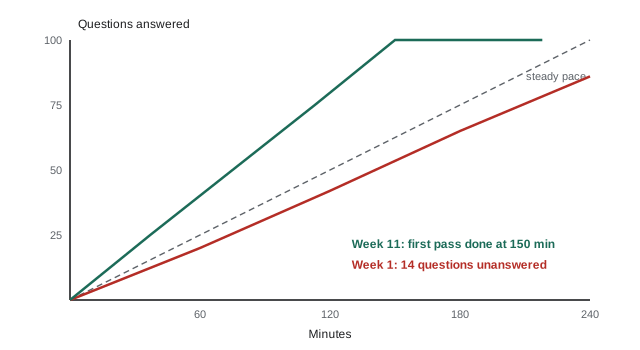
Time checkpoints
Rather than checking the clock after every question, Dana sets checkpoints. On a four-hour, 100-question exam she wants to be at about question 25 after 35 minutes, question 50 after 75 minutes, question 75 after 115 minutes, and finished with the first pass by about 150 minutes. If she is behind at a checkpoint, she tightens her stop time for the next block; if she is ahead, she relaxes slightly.
# Checkpoint plan for an illustrative 4-hour, 100-question exam
total_minutes = 240
first_pass_minutes = 150
questions = 100
checkpoints = [25, 50, 75, 100]
for q in checkpoints:
    minute = first_pass_minutes * q / questions
    print(f"Question {q:3}: by minute {minute:5.1f}")
print("Left for marked questions and review:", total_minutes - first_pass_minutes, "minutes")Question 25: by minute 37.5 Question 50: by minute 75.0 Question 75: by minute 112.5 Question 100: by minute 150.0 Left for marked questions and review: 90 minutes
On exam day Dana writes the checkpoints at the top of her scratch paper before the first question appears. It takes a minute and saves her from either rushing or drifting.
Sorting questions by type
Master exam questions fall into a few types, and each type has a typical time cost. Recognizing the type in the first few seconds lets Dana decide whether to answer now or mark it.
| Question type | Example (made up) | Typical time | First pass? |
|---|---|---|---|
| Definition | Which term describes the conductor to the grounding electrode? | Under 1 minute | Yes |
| Single lookup | Minimum working space depth for a given voltage and condition | 1 minute | Yes |
| Table lookup | Equipment grounding conductor size for a given device rating | 1 to 2 minutes | Yes |
| Rule plus exception | Is a device required when a stated condition exists? | 2 minutes | Usually |
| Two-place lookup | A rule that refers to a table in another article | 2 to 3 minutes | Usually |
| Short calculation | Continuous load on a breaker; conduit fill with same-size conductors | 2 to 3 minutes | Usually |
| Long calculation | A dwelling or commercial service load calculation; a motor feeder | 5 to 10 minutes | Mark for second pass |
Long calculations are worth just as much as definitions on most exams. That is why they belong on the second pass: spending ten minutes on one of them early can cost several quick points later. On her week eleven exam Dana marks nine questions as long calculations and finishes all of them on the second pass.
Lookup drills
Between full practice exams, short drills build speed. Each drill below asks only for the location of the rule, the article, section or table, which is the skill this course teaches. The answers are given with the 2023 numbering; if you use another edition, finding the equivalent location is part of the exercise. Time yourself and aim for under a minute each.
| Drill question | Where to find it (2023 numbering) |
|---|---|
| Minimum working space depth in front of a 480Y/277-volt panel facing a concrete wall | Table 110.26(A)(1) |
| Size of an equipment grounding conductor for a 100-ampere feeder | Table 250.122 |
| Size of a grounding electrode conductor for a service with 3/0 copper conductors | Table 250.66 |
| Maximum number of quarter bends between pull points in EMT | 358.26 |
| Support interval for EMT | 358.30 |
| Minimum cover for rigid metal conduit under a driveway of a one-family dwelling | Table 300.5 |
| Demand load for several household ranges | Table 220.55 (Article 120 in 2026) |
| Full-load current of a three-phase motor of a given horsepower and voltage | Table 430.250 |
| Maximum rating of an inverse time breaker for motor short-circuit and ground-fault protection | Table 430.52 |
| Volume of a standard device box | Table 314.16(A) |
| Allowable conduit fill for three or more conductors | Chapter 9, Table 1 |
| Number of 12 AWG THHN conductors permitted in a given size of EMT | Informative Annex C, EMT table |
| Marking of available fault current at commercial service equipment | 110.24 |
| Standard ampere ratings of fuses and inverse time breakers | 240.6(A) |
| Meaning of in sight from | Article 100 |
Dana runs this drill three times in week ten. Her times go from an average of 48 seconds to 26 seconds. The improvement comes almost entirely from her tabs and from knowing the uniform layout of Chapter 3.
Dana's week eleven results
When Ray scores the practice exam, Dana has 81 correct out of 100, comfortably above the illustrative passing score of 70 to 75, and she finishes with 22 minutes left. Her first-week score was 58 with fourteen questions unanswered. Going through the misses together, they find that six were calculation errors, four were reading errors on negative questions, and nine were questions on topics she has not yet finished in the other core courses: motors, hazardous locations and emergency systems. That tells her exactly what to work on in the last week.
| Measure | Week 1 | Week 11 |
|---|---|---|
| Score out of 100 | 58 | 81 |
| Questions unanswered | 14 | 0 |
| Average lookup time | About 2 minutes 40 seconds | About 55 seconds |
| Reading errors | 13 | 4 |
| Time left at the end | None | 22 minutes |
# Analyze a practice exam: where did the points go?
missed = {"calculation error": 6, "negative question misread": 4,
          "topic not yet studied": 9}
score = 100 - sum(missed.values())
print("Score:", score)
for reason, n in sorted(missed.items(), key=lambda kv: -kv[1]):
    print(f"  {reason:28} {n}")
print("Focus next week on:", max(missed, key=missed.get))Score: 81 topic not yet studied 9 calculation error 6 negative question misread 4 Focus next week on: topic not yet studied
The final week
Dana's last week is lighter than the weeks before it. She finishes the core course topics she flagged, does one more timed practice exam early in the week, and spends the last two days on short drills and rest. Cramming new material the night before an open-book exam tends to blur the structure she has worked so hard to learn.
| Day | Plan |
|---|---|
| 1 to 3 | Finish flagged topics; one full timed practice exam |
| 4 | Review missed questions; adjust tabs if needed |
| 5 | Short lookup drills; check every tab is firmly attached; pack the bag |
| 6 | Light review only; confirm the test center location and arrival time |
| Exam day | Arrive early with ID, admission letter, code book and approved calculator |
Test day
On test day the logistics matter as much as the preparation. Read the admission letter and bulletin again the day before. Bring the required identification, usually a current government-issued photo ID with a signature, and arrive early, because late arrivals may be turned away. Expect staff to inspect your code book for prohibited notes or removable tabs. Most centers provide scratch paper or an erasable board and collect it at the end.
Once the exam starts, write your checkpoints on your scratch paper, take a breath, and begin the first pass. If a question rattles you, mark it and move on; the next one is worth exactly as much. If you notice you are behind at a checkpoint, tighten your stop time rather than panicking. And when you finish the first pass, look at the clock with satisfaction before starting the second: you are where you planned to be.
After the exam, and beyond
Dana passes her real exam three weeks later with an 84. The real work, she says afterward, starts with the license. As Brightwater's master, she is responsible for permits, for supervising journeymen and apprentices, and for knowing when the code changes. The navigation skills from this course turn out to be the ones she uses most: answering a journeyman's question on a job site, checking an inspector's citation, or estimating a job that involves equipment the company has never installed. The other core courses, on load calculations, conductors and protection, grounding, motors, specific occupancies and business law, build on this one, and your state course covers the licensing rules where you work.
Handling hard questions under pressure
Every exam contains a few questions that seem impossible: a topic you never studied, a wording you cannot parse, or a calculation that gives an answer not among the choices. Dana's routine for these is simple. First, eliminate any answer choices she knows are wrong, which often leaves two. Second, pick the better of the remaining choices as a provisional answer. Third, mark the question and move on. On the second pass, if time allows, she rereads the question slowly from the last sentence, which often reveals the word she misread the first time.
When a calculation gives an answer that is not among the choices, the cause is usually one of a handful of common mistakes: a missing demand factor, the wrong voltage, line-to-line instead of voltage to ground, single-phase instead of three-phase, or a unit error. Dana keeps a short checklist of these on her scratch paper and runs through it before redoing the whole calculation. More than half the time, one of the checks finds the error in under a minute.
| Check | Common error it catches |
|---|---|
| Voltage | Line-to-line used where line-to-neutral was needed, or the reverse |
| Phases | Single-phase formula used for a three-phase load |
| Demand factors | A demand factor left out or applied twice |
| Units | Volt-amperes mixed with amperes, feet with inches |
| Rounding | Rounded down where the rule says not less than |
Staying calm is a skill too. If Dana notices her heart rate rising, she sets down her pencil, takes three slow breaths and looks at the clock to confirm she is on schedule. It takes fifteen seconds and, as she puts it afterward, 'buys back the next ten minutes.'
Ray adds one piece of advice from his own exam, decades ago. When you finish the review and still have time left, do not start changing answers at random. Change an answer only if you find a specific reason, such as a misread word or an arithmetic error. Research on multiple-choice exams and Ray's own experience agree: first answers chosen carefully are right more often than second guesses made in a hurry at the end.
Common mistakes
MistakeWorking every question strictly in order.
InsteadUse two passes: quick questions first, long calculations marked for the second pass.
MistakeLeaving marked questions blank.
InsteadChoose a provisional answer before marking, so a guess counts if time runs out.
MistakeChecking the clock after every question.
InsteadSet three or four checkpoints and adjust your stop time at each one.
MistakeSpending the last night learning new topics.
InsteadUse the final days for drills, tab checks and rest; protect the structure you have learned.
MistakeArriving at the test center with removable notes in the book.
InsteadCheck your book against the bulletin rules before you leave home.
Summary and key terms
- Use two passes: answer quick questions first and mark slow ones with a provisional answer.
- Set time checkpoints for the first pass and adjust your stop time at each.
- Recognize question types quickly; long calculations go to the second pass.
- Short lookup drills build speed between full practice exams.
- Analyze practice exams by cause of each miss to plan the next week.
- Prepare test-day logistics in advance: ID, admission letter, approved calculator and a book that meets the rules.
- First pass
- Working through the exam answering quick questions and marking slow ones.
- Provisional answer
- A best guess entered before marking a question for later review.
- Checkpoint
- A planned question number to reach by a set time.
- Lookup drill
- A timed exercise finding the location of rules without answering full questions.
Practice problems
Work each problem on paper first, then reveal the answer to check.
On a 5-hour, 120-question exam you plan a 3-hour first pass. By what minute should you reach question 60?
Show answer
At the halfway point of the first pass: 180 times 60 divided by 120, which is minute 90.
You are behind at the second checkpoint. What should you do?
Show answer
Tighten your stop time for the next block and mark more slow questions for the second pass.
A practice question is a full commercial service load calculation. When should you work it?
Show answer
On the second pass, after answering the quick questions.
Why choose a provisional answer before marking a question?
Show answer
Because most exams do not deduct for wrong answers, so a guess can score if time runs out before you return.
Where is the volume of a standard device box found in the 2023 edition?
Show answer
Table 314.16(A).
Lesson quiz · 5 questions
Score 60% or more to complete this lesson.
Create a free account to save your progress, take quizzes and earn a certificate.