
MELU-101 · Lesson 8 of 12 · 25 min
Reading a section precisely
▶ Video coming soon A video version of this lesson is on the way.
Finding the rule is half the work. The other half is reading it exactly as written. Exam writers know that most candidates read the Code the way they read a newspaper, catching the general idea and moving on, and they write answer choices that reward that habit with the wrong answer. Two choices may differ only in a single word, such as minimum or maximum, and, or, within or beyond. This lesson is about reading like an inspector: every word counts, the parent text applies, and the question's wording matters as much as the Code's.
Why precise reading matters
When Dana reviews her missed questions from week four, she sorts them into three piles: didn't know where to look, found the rule but misread it, and misread the question. The second and third piles together are bigger than the first. 'You know the Code better than you think,' Ray tells her. 'You're just reading it like a journeyman. A journeyman needs the gist. A master signs the permit.'
| Kind of error | Dana's week 4 count | Fix |
|---|---|---|
| Didn't know where to look | 9 | Structure, tabs and the index (lessons 2, 7 and 11) |
| Found the rule but misread it | 7 | Precise reading of the Code (this lesson) |
| Misread the question | 6 | Precise reading of the question (this lesson) |
The words that carry the meaning
A small set of words decides most rules. Learn to slow down every time you see one of them.
| Word or phrase | What it means | Trap to avoid |
|---|---|---|
| shall / shall not | Required / prohibited | Confusing with shall be permitted |
| shall be permitted | Allowed but not required | Treating it as a requirement |
| not less than, minimum, at least | This value or more | Rounding down |
| not more than, maximum, shall not exceed | This value or less | Rounding up |
| within | Inside a distance, measured as the rule says | Measuring from the wrong point |
| and | All items apply | Applying only one item |
| or | Any one item is enough | Requiring all items |
| and/or | Any one or more items | Treating it as either-or |
| unless, except, other than | Introduces an exception | Missing the carve-out |
| approved, identified, listed | Defined terms with specific meanings | Reading them in their everyday sense |
And and or deserve a special mention because the Code uses them in lists all the time. If a rule requires protection for receptacles in locations A, B and C, each of those locations is covered. If a rule allows one of several methods, A, B or C, you may choose any one. Introductory phrases such as all of the following conditions or any of the following tell you directly which applies, but when the list just ends with and or or, the last connecting word governs the whole list.
Measuring words: within, from and to
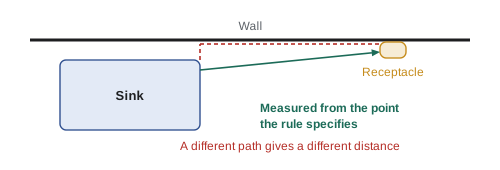
Many rules set distances, and the measuring point is written into the rule. A distance may be measured from the edge of a sink, from the inside wall of a pool, from the floor to the top of a device, horizontally, or along the path of a cord without piercing a wall, floor or doorway. Exam questions often give a distance that would comply if measured one way but not the other.
Worked problem
Where do you measure from?
A practice question asks whether a receptacle 5 feet from a sink requires ground-fault protection under a rule that applies to receptacles within a stated distance of the sink.
Show solution
- The rule applies to receptacles within a stated distance, measured from a specific point.
- Dana reads the rule and finds the distance is measured from the top inside edge of the sink bowl.
- The question says the receptacle is 5 feet from the sink but does not say from which point; the answer choices include one that assumes measurement from the faucet.
- She uses the rule's measuring point and the distance in her edition to decide.
Answer: Measure as the rule says. The answer choice that measures from a different point is the trap.
Parent text and list structure
Lesson 2 showed that a citation such as 210.8(A)(6) narrows a rule step by step. When you read a numbered item, the text above it, in the section and the first-level subdivision, is part of the rule. In 210.8, the section's opening text sets the type of protection and the receptacles it covers; 210.8(A) limits the rule to dwelling units; and only then does item (6) name a location. If a question involves a commercial building, item (6) under subdivision (A) does not apply, however well the location matches, because subdivision (A) is limited to dwelling units. The parallel rules for other than dwelling units are in a different subdivision.
The same discipline applies to the end of a list. A sentence after a numbered list may apply to every item in it, and an exception after the last item may apply only to that item or to the whole list, depending on where it sits and how it is worded. Read the whole structure before deciding.
Reading the question precisely
The question is a text too, and it deserves the same care. Before looking at the answer choices, Dana now does three things. She underlines the occupancy, the voltage and any numbers. She circles any negative word: not, except, least, false. And she rewrites the question in her own words in the margin of her scratch paper, if it is long.
| Question feature | What to look for | Example |
|---|---|---|
| Occupancy | Dwelling, commercial, industrial, health care, hazardous | "In a restaurant kitchen..." means not a dwelling |
| System voltage | Nominal voltage and voltage to ground | "A 480Y/277-volt panel" means 277 volts to ground |
| Negative words | not, except, least, never | "Which is NOT permitted" reverses the usual search |
| Required or permitted | Is the question asking what must be done or what may be done? | "The minimum required" versus "is permitted to be" |
| Edition | Some questions turn on a rule that changed | Answer from the edition named for your exam |
| Units | Feet or inches, amperes or volt-amperes, AWG or kcmil | A depth in inches compared with a table in inches |
Negative questions are the most common reading trap. 'Which of the following is not required?' asks you to find the one answer that is not in the rule. Under time pressure, candidates find the first answer that matches the rule and choose it, which is exactly backwards. When you see not or except in a question, check each answer choice against the rule and mark it yes or no on your scratch paper, then choose the odd one out.
Worked problem
A negative question
Practice question: 'Under 110.26, which of the following is NOT permitted in the required working space in front of a panelboard?' The choices are: an open door of the panelboard swung to 90 degrees; a person standing to operate a breaker; a rolling cart of spare parts parked there; a lighting fixture mounted on the ceiling above the space.
Show solution
- The question is negative: find the one item that is not permitted.
- An open panel door within the space is expected; the space must allow doors to open at least 90 degrees.
- A person standing there is the reason the space exists.
- Storage is prohibited in the working space by 110.26(B), and a parked cart of parts is storage.
- Lighting is actually required for many indoor working spaces, so a fixture above is permitted.
Answer: The rolling cart of parts. Dana marks each choice yes or no before choosing, so the negative cannot trick her.
Numbers, units and arithmetic
Code rules mix units: feet and inches, amperes and volt-amperes, AWG and kcmil, degrees Celsius for insulation and sometimes degrees Fahrenheit in questions. Many wrong answers come from comparing numbers in different units. Convert everything to the unit the rule or table uses before comparing. Remember that kcmil sizes run from 250 upward and are larger than the largest AWG size, 4/0, and that larger AWG numbers mean smaller conductors.
# Convert before you compare
question_depth_in = 1.5 * 12          # the question gives 1.5 feet of cover
rule_minimum_in = 18                  # an illustrative minimum from a table, in inches
print("Cover in inches:", question_depth_in)
print("Meets the minimum?", question_depth_in >= rule_minimum_in)

load_va = 9600                        # a load given in volt-amperes
volts = 240
print(f"Current: {load_va / volts:.1f} A")Cover in inches: 18.0 Meets the minimum? True Current: 40.0 A
When a calculation is involved, write each step on your scratch paper with its unit. It takes a few seconds and it lets you check your work at the end if you have time. More importantly, many answer choices on master exams are the results of common mistakes, such as forgetting to apply a demand factor or using line-to-line voltage instead of voltage to ground, so a careful step-by-step calculation is the only reliable way to avoid them.
Practicing precise reading
Dana and Marcus invent a drill. One of them picks a section, and the other must rewrite it in plain words on an index card without looking, then compare. The differences show exactly which words were skipped. After two weeks Marcus, the faster reader, catches up with Dana on accuracy. 'I was reading the bold title and guessing the rest,' he admits.
| Drill | How it works | What it builds |
|---|---|---|
| Rewrite in plain words | Read a section, close the book, rewrite it, then compare | Noticing every condition and limit |
| Change one word | A partner changes one word in a question; spot it and explain the effect | Sensitivity to shall, or, not, minimum |
| Negative sort | For each answer choice, write yes or no against the rule | Accuracy on not and except questions |
| Parent check | For any numbered item, read the section and subdivision above it aloud | Applying the parent text |
Precise reading in the field
The same discipline pays off long after the exam. When Gloria cites a rule on an inspection, Dana now reads the cited section in full, including the parent text and the exceptions, before deciding whether to correct the work or discuss it. On the Copper Kettle job, an inspection report cites a ground-fault protection rule for a receptacle behind the bar. Reading the full section, Dana confirms the rule applies, because the receptacle is within the stated distance of the bar sink, measured as the rule says. She makes the correction the same day. A week later, on another job, a different citation turns out to rely on a subdivision limited to dwelling units, in a commercial building; she raises it politely with the inspector, who agrees and withdraws it.
Precise reading also protects estimates. A rule that seems to require a costly installation may contain a permissive exception that allows a simpler one, and a rule that seems optional may be made mandatory by a cross-reference. When Priya prices a job, Dana now flags any rule that turns on a single word, so that the estimate reflects what the Code actually requires rather than what the crew is used to doing.
Ray's summary is short: read the whole section, read every word, and read the question as if someone were trying to trick you, because on the exam someone is.
A worked reading exercise
Worked problem
Rewriting a made-up rule in plain words
Marcus gives Dana a made-up rule to practice on: 'Receptacles installed in the locations in (1) through (3) shall have protection of type X, unless supplied by a branch circuit that already provides type X protection. (1) Outdoors (2) Within 6 feet of a sink (3) In unfinished basements.' A question asks whether a receptacle in a finished basement, 4 feet from a laundry sink, on a circuit without type X protection, needs protection.
Show solution
- The list is joined by the structure of the sentence: each location is covered on its own.
- Location (3) does not apply, because the basement is finished.
- Location (2) applies, because the receptacle is within 6 feet of a sink, assuming the rule's measuring point gives the same distance.
- The unless clause does not apply, because the branch circuit does not already provide type X protection.
- One location in the list is enough to require protection.
Answer: Protection is required because of item (2). Reading only item (3), which matches the word basement, would give the wrong answer.
Common mistakes
MistakeReading an item in a list without its parent text.
InsteadThe section and subdivision above a numbered item set conditions, such as occupancy, that apply to it.
MistakeTreating or as and, or and as or, in a list.
InsteadAnd means all items apply; or means any one is enough.
MistakeMeasuring a distance from a convenient point.
InsteadThe rule states where and how to measure; follow it.
MistakeChoosing the first answer that matches the rule on a not question.
InsteadMark each choice yes or no against the rule, then choose the odd one out.
MistakeComparing feet with inches or amperes with volt-amperes.
InsteadConvert to the unit the rule or table uses before comparing.
Summary and key terms
- A small set of words, such as shall, shall be permitted, minimum, maximum, and, or and within, decides most rules.
- Distances are measured from the point and along the path the rule specifies.
- The parent text of a section and subdivision applies to every numbered item beneath it.
- Read the question as carefully as the Code: occupancy, voltage, negatives, required versus permitted, units.
- Write calculations step by step with units; many wrong answers are the results of common errors.
- Practice drills, such as rewriting rules in plain words, build precise reading quickly.
- Parent text
- The text of a section or subdivision that applies to the items beneath it.
- Negative question
- A question asking which choice is not required, not permitted or false.
- Within
- Inside a stated distance, measured from the point the rule specifies.
- kcmil
- Thousand circular mils, the unit for conductor sizes larger than 4/0 AWG.
Practice problems
Work each problem on paper first, then reveal the answer to check.
A rule covers receptacles in locations listed as (1), (2) and (3), joined by and. Does it apply to a receptacle in location (2) only?
Show answer
Yes. Each listed location is covered; and means the rule applies to all of them, so a receptacle in any one of them is included.
A numbered item under a subdivision limited to dwelling units describes a garage. Does it apply to a commercial repair garage?
Show answer
No. The parent subdivision limits the item to dwelling units.
A question gives 2 feet of cover and a table lists a minimum of 24 inches. Does it comply?
Show answer
Yes. 2 feet equals 24 inches, which meets the minimum.
What should you do first when a question contains the word EXCEPT?
Show answer
Recognize that it is a negative question, then mark each choice against the rule and choose the one that does not fit.
Which is larger, 4/0 AWG or 250 kcmil?
Show answer
250 kcmil.
Lesson quiz · 5 questions
Score 60% or more to complete this lesson.
Create a free account to save your progress, take quizzes and earn a certificate.