
MELU-101 · Lesson 4 of 12 · 25 min
Article 110 general requirements
▶ Video coming soon A video version of this lesson is on the way.
If Article 100 is the dictionary of the Code, Article 110 is its rulebook for every job. Its requirements apply to all electrical installations covered by the Code, from a single receptacle in a house to a substation in a factory. Master exams draw on Article 110 heavily, partly because its rules apply everywhere and partly because several of them, especially working space and terminal temperature ratings, involve numbers that are easy to test. Dana tabs Article 110 before any other article in her book, and she reads it from start to finish twice in her first two weeks.
This lesson walks through the sections of Article 110 that master exams use most, in the order they appear. As always, the rules are explained in our own words; read each section in your own code book as you go.
The shape of Article 110
Article 110 is divided into parts. Part I contains general requirements that apply to everything. Part II covers installations of 1000 volts, nominal, or less, and is where the working space rules for most equipment live. Part III covers installations over 1000 volts. Further parts cover tunnel installations and manholes and other enclosures that people can enter. For most master exam questions you will be in Parts I and II.
| Section | Subject (2023) | Why candidates use it |
|---|---|---|
| 110.2 | Approval | Conductors and equipment must be acceptable to the AHJ |
| 110.3 | Examination, identification, installation, use and listing of equipment | Follow the listing and labeling instructions |
| 110.5 | Conductor material | Conductors are copper unless otherwise stated; aluminum sizes are given where permitted |
| 110.7 | Wiring integrity | Completed wiring free of short circuits and unintended ground faults |
| 110.9 | Interrupting rating | Devices that interrupt fault current must be rated for it |
| 110.10 | Circuit impedance, short-circuit current ratings | Equipment must withstand the available fault current |
| 110.12 | Mechanical execution of work | Neat and workmanlike; unused openings closed |
| 110.14 | Electrical connections | Terminations, splices, temperature limits, torque |
| 110.15 | High-leg marking | Marking the higher-voltage conductor of a 4-wire delta |
| 110.16 | Arc-flash hazard warning | Field or factory marking on equipment likely to be worked on energized |
| 110.21 | Marking | Manufacturer markings and field-applied hazard markings |
| 110.22 | Identification of disconnecting means | Every disconnect marked to show its purpose |
| 110.24 | Available fault current | Marking at service equipment in other than dwelling units |
| 110.25 | Lockable disconnecting means | What capable of being locked in the open position means |
| 110.26 | Spaces about electrical equipment | Working space depth, width and height; entrances; dedicated space |
| 110.27 | Guarding of live parts | Live parts guarded against accidental contact |
| 110.28 | Enclosure types | Choosing enclosures for the environment |
Approval and the listing instructions: 110.2 and 110.3
Section 110.2 says that conductors and equipment required or permitted by the Code are acceptable only if approved, and approved, as lesson 3 showed, means acceptable to the authority having jurisdiction. Section 110.3 then tells the AHJ, and you, how to judge equipment. Its first subdivision lists factors to consider, such as suitability for the purpose, mechanical strength, wire-bending space, heating, arcing and classification by type, size and voltage. Listing or labeling is a strong basis for that judgment.
The most important part of 110.3 for everyday work is the rule that listed or labeled equipment must be installed and used in accordance with any instructions included in the listing or labeling. This single sentence makes the manufacturer's installation instructions enforceable. If a luminaire's instructions say it must not be in contact with insulation, if a breaker panel's label lists the only breakers that may be installed in it, or if a heat pump's nameplate gives a maximum overcurrent device rating, those instructions carry the force of the Code. On the exam, an answer that cites the manufacturer's instructions is often correct because of 110.3(B).
Worked problem
The panel label decides
At Delgado Fabrication, the owner bought a box of inexpensive breakers online and asks Dana to install them in the existing panelboard. The breakers are listed, but by a different manufacturer from the panel.
Show solution
- The panelboard is listed, and its label lists the breaker types that may be installed in it.
- Under 110.3(B), the panel must be installed and used according to its listing and labeling instructions.
- A breaker that is listed on its own, but not identified on the panel label as suitable for that panel, does not meet the panel's listing instructions, unless it is a classified breaker evaluated for that panel.
- Dana checks the label and the breaker packaging; neither shows that the breakers are classified for this panel.
Answer: Dana declines to install them and quotes breakers that the panel label permits.
Wiring integrity and conductor material: 110.5 and 110.7
Section 110.5 says that conductors are copper unless the Code says otherwise. When the Code gives a conductor size without saying which metal, it means copper; where aluminum is permitted, a separate size is usually given. Section 110.7 requires completed wiring to be free from short circuits, ground faults and connections to ground other than those the Code requires or permits. Before energizing, the system should be tested to show this. These short sections show up on exams as quick definition-style questions.
Fault current: 110.9, 110.10 and 110.24
Two of the most important safety rules in the Code deal with what happens during a short circuit. Section 110.9 requires equipment intended to interrupt current at fault levels, such as fuses and circuit breakers, to have an interrupting rating at least equal to the current available at its line terminals. Section 110.10 requires the overcurrent devices, the total impedance and the short-circuit current ratings of equipment to be selected and coordinated so that the circuit protective devices can clear a fault without extensive damage to the electrical equipment of the circuit.
Section 110.24 makes the available fault current visible. In other than dwelling units, service equipment must be legibly marked in the field with the maximum available fault current, the date the calculation was done, and the marking must be durable enough for the environment. When changes to the electrical installation affect the available fault current, the marking must be updated. On the Delgado service upgrade, the utility's new transformer raises the available fault current, so Dana's engineer recalculates it and Brightwater updates the label.
| Term | What it means | Section |
|---|---|---|
| Interrupting rating | The highest current a device is intended to interrupt at its rated voltage | 110.9 |
| Short-circuit current rating | The prospective current that equipment can safely withstand when protected by a specified device | 110.10 |
| Available fault current | The largest current that can flow at a point during a fault | 110.24 |
Workmanship and connections: 110.12 and 110.14
Section 110.12 requires electrical equipment to be installed in a neat and workmanlike manner. It also requires unused openings in boxes, raceways, cabinets and equipment cases to be closed with protection substantially equivalent to the wall of the equipment, and it protects internal parts from paint, plaster, cleaners and other contaminants. Exams tend to ask about the unused-openings rule because it has a clear answer.
Section 110.14 covers electrical connections, and two of its subdivisions are heavily tested. The first, 110.14(C), sets temperature limitations: the temperature rating of the conductor used for ampacity must be coordinated so it does not exceed the lowest temperature rating of any connected termination, conductor or device. In practice, this means a conductor with 90-degree insulation cannot be loaded to its 90-degree ampacity if the breaker or lug it lands on is rated only for 75 degrees.
| Situation | General rule in 110.14(C)(1) | Exception |
|---|---|---|
| Circuits rated 100 amperes or less, or conductors 14 AWG through 1 AWG | Use the 60-degree ampacity column | Use 75 degrees if the equipment is listed and identified for it; conductors with higher ratings may be used at the 60 or 75-degree ampacity |
| Circuits rated over 100 amperes, or conductors larger than 1 AWG | Use the 75-degree ampacity column | Use higher only if the equipment is listed and identified for it |
| Separately installed pressure connectors | Use the ampacity at the connector's listed temperature | Not more than the conductor's rating |
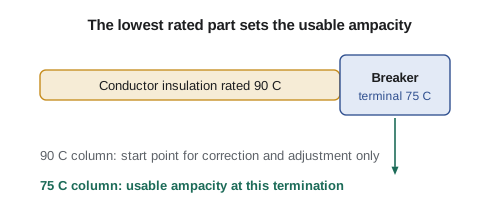
A master-level subtlety: the higher-temperature ampacity of a conductor is still useful. When ampacity must be reduced for high ambient temperature or for more than three current-carrying conductors in a raceway, the adjustment can start from the 90-degree column, as long as the final result does not exceed the termination-limited ampacity. MELU-103 works through those calculations.
The second heavily tested subdivision, 110.14(D), deals with tightening torque. Where the equipment or its instructions give a tightening torque value, connections must be tightened to that value using an approved means, such as a calibrated torque tool, and the 2023 edition kept and refined this requirement. Annex I gives recommended torque values for use where the manufacturer gives none. Loose connections are a leading cause of electrical fires, which is why the rule exists.
Markings: 110.15, 110.16, 110.21 and 110.22
On a 4-wire delta-connected system where the midpoint of one phase winding is grounded, one phase conductor has a higher voltage to ground than the other two. Section 110.15 requires that high leg to be durably marked orange, or by another effective means, wherever a connection is made and the grounded conductor is also present. Other sections specify the high leg's position in panelboards and meter sockets.
Section 110.16 requires equipment such as switchboards, panelboards, industrial control panels and meter socket enclosures in other than dwelling units, where it is likely to need examination, adjustment, servicing or maintenance while energized, to be marked to warn qualified persons of potential arc-flash hazards. For larger service equipment the marking must include more detail, such as the nominal voltage, available fault current, clearing time of the service overcurrent devices and the date the label was applied. Section 110.21 covers manufacturer markings and field-applied hazard markings, and 110.22 requires each disconnecting means to be legibly marked to show its purpose unless the purpose is evident.
Working space: 110.26
Working space is the single most tested topic in Article 110, and Dana practices it until she can answer without opening the book. Section 110.26 requires sufficient access and working space around equipment that is likely to need examination, adjustment, servicing or maintenance while energized. The working space has three dimensions: depth, width and height. It must be kept clear and must not be used for storage.
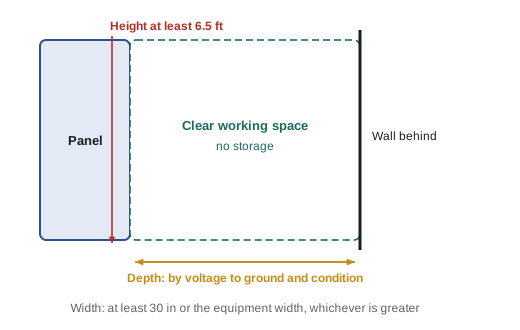
The depth required depends on two things: the nominal voltage to ground and the conditions on the far side of the space. Voltage to ground, not line-to-line voltage, is what counts. A 120/208-volt system has 120 volts to ground; a 480Y/277-volt system has 277 volts to ground. The three conditions describe what the worker could touch behind them: Condition 1 has exposed live parts on one side only and no grounded parts on the other side, or the other side is insulated; Condition 2 has exposed live parts on one side and grounded parts on the other, where concrete, brick or tile walls count as grounded; Condition 3 has exposed live parts on both sides.
| Voltage to ground | Condition 1 | Condition 2 | Condition 3 |
|---|---|---|---|
| 0 to 150 volts | 3 ft | 3 ft | 3 ft |
| 151 volts up to the Part II limit | 3 ft | 3.5 ft | 4 ft |
The width must be at least 30 inches or the width of the equipment, whichever is greater, and the space must allow equipment doors or hinged panels to open at least 90 degrees. The height must be at least 6.5 feet or the height of the equipment, whichever is greater, with limited exceptions for existing dwelling services and small equipment. Separately, 110.26(E) requires dedicated equipment space for switchboards and panelboards: the space directly above and below the equipment, as wide and deep as the equipment, from the floor to 6 feet above the equipment or to the structural ceiling, kept free of foreign piping, ducts and equipment.
For large equipment, 110.26(C)(2) requires an entrance at each end of the working space where the equipment is rated 1200 amperes or more and over 6 feet wide, with exceptions for unobstructed exits and doubled working space. A separate rule, 110.26(C)(3), covers personnel doors near large equipment: within a set distance of the working space they must open in the direction of egress and have listed panic or fire exit hardware. Check the ampere threshold and distance in your edition.
# Minimum working space depth from Table 110.26(A)(1), summarized for Part II systems
def depth_ft(volts_to_ground, condition):
    if volts_to_ground <= 150:
        return 3.0
    return {1: 3.0, 2: 3.5, 3: 4.0}[condition]

jobs = [("Copper Kettle panel, 120/208 V, concrete wall behind", 120, 2),
        ("Delgado switchboard, 480Y/277 V, concrete wall behind", 277, 2),
        ("Delgado MCC facing another MCC, 480Y/277 V", 277, 3)]
for name, vg, cond in jobs:
print(f"{name}: {depth_ft(vg, cond)} ft")Copper Kettle panel, 120/208 V, concrete wall behind: 3.0 ft Delgado switchboard, 480Y/277 V, concrete wall behind: 3.5 ft Delgado MCC facing another MCC, 480Y/277 V: 4.0 ft
Worked problem
Working space at Delgado Fabrication
The new 480Y/277-volt, 800-ampere switchboard at Delgado is 5 feet wide and will face a concrete block wall across an aisle. The owner wants to put a parts shelf against the wall.
Show solution
- Voltage to ground is 277 volts, which is in the 151-volt-and-up row.
- A concrete block wall counts as grounded, and the switchboard has live parts behind its front during servicing, so this is Condition 2.
- Table 110.26(A)(1) gives 3.5 feet for that row and condition.
- The width must be at least the 5-foot width of the switchboard, and the height at least 6.5 feet.
- The switchboard is under 1200 amperes, so a second entrance is not required by 110.26(C)(2).
- A shelf would intrude into the required depth and is storage in the working space, which 110.26(B) prohibits.
Answer: The aisle must be at least 3.5 feet deep, clear of the shelf. Dana marks the floor and moves the shelf to another wall.
Guarding and enclosures: 110.27 and 110.28
Section 110.27 requires live parts of electrical equipment operating at 50 volts or more to be guarded against accidental contact by approved enclosures or by location, such as in a room accessible only to qualified persons, on a suitable balcony or platform, or at a sufficient elevation. Section 110.28 and its table explain enclosure type numbers, such as Type 1 for general indoor use, Type 3R for outdoor rain, and Type 4X for washdown and corrosion. An exam may give an environment and ask which enclosure type is suitable.
Common mistakes
MistakeUsing line-to-line voltage to choose the working space depth.
InsteadTable 110.26(A)(1) is based on nominal voltage to ground: 120 volts for 120/208, 277 volts for 480Y/277.
MistakeTreating a concrete wall as Condition 1 because it has no live parts.
InsteadConcrete, brick and tile walls are considered grounded, so the space is Condition 2.
MistakeLoading a conductor to its 90-degree ampacity because its insulation is rated 90 degrees.
InsteadTerminations limit the usable ampacity under 110.14(C), usually to 60 or 75 degrees.
MistakeThinking manufacturer's instructions are just advice.
InsteadUnder 110.3(B), listed equipment must be installed according to its listing and labeling instructions.
MistakeStoring materials in the working space when the panel is not being serviced.
Instead110.26(B) keeps the working space clear at all times.
Summary and key terms
- Article 110 applies to every installation; Part I is general and Part II covers 1000 volts or less.
- 110.3(B) makes listing and labeling instructions enforceable.
- 110.9 and 110.10 require devices and equipment to be rated for the available fault current; 110.24 requires it to be marked at most non-dwelling services.
- 110.14(C) limits conductor ampacity to the lowest termination temperature rating, usually 60 degrees for 100 amperes or less and 75 degrees above.
- 110.26 sets working space depth by voltage to ground and condition, width of at least 30 inches or the equipment width, and height of at least 6.5 feet.
- Entrances at both ends are required for equipment rated 1200 amperes or more and over 6 feet wide.
- Interrupting rating
- The highest current at rated voltage that a device is intended to interrupt.
- Short-circuit current rating
- The fault current equipment can withstand when protected by a specified device.
- Working space
- The clear space required in front of equipment likely to be serviced while energized.
- Dedicated equipment space
- The space above and below switchboards and panelboards kept free of foreign systems.
- High leg
- The phase conductor with the higher voltage to ground on a 4-wire delta system, marked orange.
- Condition 2
- Working space with exposed live parts on one side and grounded parts, including concrete walls, on the other.
Practice problems
Work each problem on paper first, then reveal the answer to check.
What working space depth is required in front of a 120/240-volt panelboard facing a brick wall?
Show answer
3 feet. The voltage to ground is 120 volts, which is in the 0 to 150-volt row, where all conditions require 3 feet.
A panelboard is 20 inches wide. What is the minimum width of its working space?
Show answer
30 inches, because the width must be at least 30 inches or the equipment width, whichever is greater.
A 480Y/277-volt panel faces another energized panel across an aisle. What depth is required?
Show answer
4 feet, Condition 3 in the 151-volt-and-up row.
Which section requires the high leg of a 4-wire delta to be marked orange?
Show answer
110.15.
Why can't a 90-degree conductor usually be used at its 90-degree ampacity on a 20-ampere branch circuit?
Show answer
Because 110.14(C)(1)(a) limits circuits of 100 amperes or less to the 60-degree ampacity unless the equipment is listed and identified for 75 degrees.
Lesson quiz · 5 questions
Score 60% or more to complete this lesson.
Create a free account to save your progress, take quizzes and earn a certificate.