
MELU-101 · Lesson 6 of 12 · 25 min
Exceptions and informational notes
▶ Video coming soon A video version of this lesson is on the way.
Marcus Lee has a habit that costs him points on every practice test: he finds the rule, sees that it matches the question, and stops reading. Dana, slower but more careful, keeps reading to the end of the section and often finds an exception that changes the answer. In their fourth week of study they compare scores on exception questions. Dana gets eleven of twelve; Marcus gets six. This lesson is about the text that comes after the rule: exceptions, which can change the requirement, and informational notes, which never do.
Three kinds of text: 90.5
Section 90.5 tells you how to read every sentence in the Code. It sorts the text into three kinds. Mandatory rules require or prohibit something and use the words shall or shall not. Permissive rules allow something but do not require it, and use the words shall be permitted or shall not be required. Explanatory material, such as informational notes, explains or gives references but is not enforceable. The informative annexes are a fourth category of nonmandatory material, covered in lesson 5.
| Kind of text | Typical wording | Effect |
|---|---|---|
| Mandatory rule | shall, shall not | Required or prohibited; enforceable |
| Permissive rule | shall be permitted, shall not be required | Allowed, not required; enforceable as a permission |
| Explanatory material | Informational Note | Explains, gives background or references; not enforceable |
| Informative annex | Annex A to K (L in 2026) | Helpful information and examples; not part of the requirements |
The difference between shall and shall be permitted is the source of many exam traps. A question may ask whether something is required, and an answer choice may describe something the Code merely permits. If the rule says a method shall be permitted, the method is an option, not an obligation. If the question asks what is required, a permissive answer is wrong even though the Code mentions it.
Worked problem
Required or permitted?
Practice question: 'A certain wiring method shall be permitted in a particular location.' The question asks: 'Which wiring method is required in that location?' One answer choice is the method named in the permissive rule.
Show solution
- The rule uses shall be permitted, so it is permissive under 90.5.
- A permissive rule allows the method; it does not require it.
- Unless another rule makes that method mandatory, the location may use other permitted methods as well.
- An answer saying that method is required misreads the rule.
Answer: The method is permitted, not required. Read the verb before choosing.
Exceptions: what they are and where they sit
An exception is a statement that changes the rule it follows, for specific conditions. Exceptions appear directly after the rule or subdivision they modify, in a slightly different typeface, and they are labeled Exception, or Exception No. 1, Exception No. 2 and so on when there are several. The placement matters: an exception applies only to the rule immediately before it, not to the whole section or article. An exception following 210.8(A)(5) changes that item only, not the other items in 210.8(A).
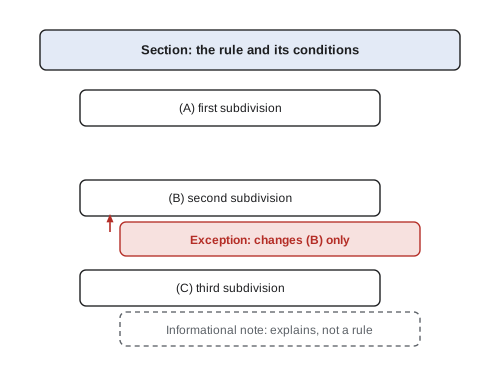
Exceptions themselves come in two kinds, matching the two kinds of rules. A mandatory exception uses shall or shall not, and it replaces the rule with a different requirement when its conditions are met. A permissive exception uses shall be permitted or shall not be required, and it allows you to do something different from the rule but does not require it. Most exceptions in the Code are permissive. When a permissive exception applies, you may still follow the main rule if you prefer; when a mandatory exception applies, you must follow the exception.
| Type of exception | Wording | What it does |
|---|---|---|
| Mandatory | shall, shall not | Replaces the rule with a different requirement under stated conditions |
| Permissive | shall be permitted, shall not be required | Allows an alternative under stated conditions; the main rule may still be followed |
Every exception has conditions, and all of them must be met. Many exceptions apply only to certain occupancies, only where qualified persons service the installation, only to existing installations, or only where some other protection is provided. On the exam, the answer that applies the exception without checking all of its conditions is a common trap.
Exceptions hidden in the text
Not every exception is labeled. Many rules contain their own conditions in the text, introduced by words such as unless, except, other than, where or if. A rule that says something is required unless a stated condition exists works like a rule followed by an exception, and you must read it the same way. Subdivisions that begin with phrases such as 'This requirement shall not apply to' are also exceptions in effect, even though they are not labeled.
| Word or phrase | How it works | Example pattern |
|---|---|---|
| unless | The rule applies except when the condition is true | Required unless listed for the purpose |
| except | Carves something out of the rule | All receptacles except those that are not readily accessible |
| other than | Excludes a category | In other than dwelling units |
| where | The rule applies only when the condition is true | Where installed in wet locations |
| shall not apply | Removes a case from the rule | This requirement shall not apply to existing installations |
The phrase in other than dwelling units deserves special attention because it appears in many important rules, including the arc-flash marking in 110.16 and the available fault current marking in 110.24. It means the rule applies to commercial, industrial and institutional buildings, but not to dwelling units. Read too quickly, it is easy to flip.
Informational notes
Informational notes explain the rule above them, give background, define terms used in a technical sense, or refer to other standards and documents. They are useful, and sometimes they are the fastest way to understand a rule, but they are not enforceable. If an informational note recommends a practice, such as limiting voltage drop to a certain amount, the recommendation is not a Code requirement unless a rule elsewhere makes it one.
Voltage drop is the classic example. Informational notes in the branch circuit and feeder articles suggest limits for voltage drop that provide reasonable efficiency of operation. Because they are notes, the general rules for branch circuits and feeders do not require you to meet those limits. A few specific articles do make voltage drop mandatory for particular equipment, such as fire pumps and certain sensitive electronic equipment, and on an exam you must tell the difference. MELU-103 covers voltage drop calculations.
Worked problem
Is it a requirement?
Marcus picks an answer saying the Code requires feeder voltage drop to be limited to a specific amount. Dana disagrees.
Show solution
- They find the feeder voltage drop guidance in the feeder article.
- The guidance appears in an informational note beneath the rule, not in the rule itself.
- Under 90.5(C), informational notes are explanatory and not enforceable.
- No other section applies a mandatory voltage drop limit to this ordinary feeder.
Answer: The limit is a recommendation, not a requirement. Marcus changes his answer and adds a reminder to his notes: notes are never rules.
Informational notes also often refer you to other standards, such as NFPA 70E for electrical safety in the workplace, NFPA 72 for fire alarm systems, or product standards. These references tell you where to learn more, but the referenced standard is not adopted by the note. A question asking whether the NEC requires compliance with another standard usually turns on whether the reference is in a rule or in a note.
References and cross-references
Many rules refer to other sections, and following the references correctly is part of reading an exception. A rule might say that conductors shall be sized in accordance with another section, or that equipment shall comply with a specific part of an article. Those references are mandatory: the referenced text becomes part of the rule. Section 90.3 also reminds you that Chapter 9 tables apply only where referenced, so a reference is the trigger that brings them in.
Dana uses a simple discipline when a section sends her elsewhere: she puts a finger or a sticky flag on the original page, follows the reference, and comes back to finish reading the original section, including its exceptions. Losing your place after following a reference is a quiet but real cause of wrong answers.
A method for exception questions
Dana's routine for any question that might involve an exception has four steps. First, find the rule that matches the question. Second, read the whole section, including every exception and informational note under the subdivision she is using. Third, for any exception, check every condition against the facts in the question. Fourth, decide whether the exception is mandatory or permissive, and whether the question is asking what is required or what is allowed.
# Does an exception apply? Every condition must be true.
def exception_applies(conditions, facts):
    missing = [c for c in conditions if not facts.get(c, False)]
    return len(missing) == 0, missing

# A made-up exception with three conditions
conditions = ["existing installation", "dwelling unit", "service rated 200 A or less"]
facts = {"existing installation": True, "dwelling unit": True, "service rated 200 A or less": False}

ok, missing = exception_applies(conditions, facts)
print("Exception applies:", ok)
print("Conditions not met:", missing)Exception applies: False Conditions not met: ['service rated 200 A or less']
Worked problem
An exception with a condition the question does not meet
A practice question describes a commercial building where general maintenance staff, not qualified persons, service the equipment, and asks whether a certain protective device may be omitted. A permissive exception in the governing section allows omission where conditions of maintenance and supervision ensure that only qualified persons service the installation.
Show solution
- The general rule requires the device.
- The exception is permissive and has a condition: only qualified persons service the installation.
- The question states that general maintenance staff, not qualified persons, do the servicing.
- The condition is not met, so the exception is not available.
Answer: The device is required. The answer that relies on the exception ignores its condition.
When rules seem to conflict
Sometimes two rules seem to give different answers. The Code's arrangement in 90.3 usually resolves this: a rule in Chapters 5, 6 or 7 that applies to a specific occupancy, piece of equipment or condition supplements or modifies the general rules of Chapters 1 through 4. A specific rule generally takes precedence over a general rule. Within an article, an exception takes precedence over the rule it modifies, for the conditions it states. Where a real conflict remains, the authority having jurisdiction makes the call, and in practice the stricter requirement is usually the safe choice.
| Situation | Which rule controls |
|---|---|
| A Chapter 6 article for special equipment and a general Chapter 2 rule | The Chapter 6 article supplements or modifies the general rule |
| A rule and an exception that follows it | The exception, when all of its conditions are met |
| A rule and an informational note | The rule; the note is not enforceable |
| A rule and an annex example | The rule; the annex only illustrates |
| A state or local amendment and the model Code | The adopted amendment, as covered in lesson 9 |
Exceptions in everyday work
Exceptions are not just exam traps; they are how the Code fits real buildings. Many exceptions exist because a general rule would be impractical or unsafe in a particular situation, and the panel that wrote the rule recognized it. When Dana reviews a set of drawings now, she reads the exceptions to the rules she is applying as a matter of routine, because they sometimes allow a simpler or cheaper installation that is just as safe. On the Delgado job, an exception for industrial installations with qualified maintenance staff lets the engineer choose a different arrangement for one piece of equipment, and Dana documents the conditions on the permit drawings so the inspector can see that each one is met.
Common mistakes
MistakeStopping at the first sentence that matches the question.
InsteadRead the whole section, including exceptions and informational notes beneath the subdivision you are using.
MistakeTreating a permissive rule or exception as a requirement.
InsteadShall be permitted allows something; it does not require it.
MistakeApplying an exception to an entire section.
InsteadAn exception modifies only the rule it immediately follows.
MistakeApplying an exception without checking every condition.
InsteadAll of the stated conditions must be met.
MistakeTreating informational notes, such as voltage drop recommendations, as rules.
InsteadUnder 90.5(C), informational notes are explanatory and not enforceable.
Summary and key terms
- 90.5 sorts the text into mandatory rules (shall), permissive rules (shall be permitted) and explanatory material (informational notes).
- Exceptions follow the rule they modify and apply only to it; they may be mandatory or permissive.
- All conditions of an exception must be met before it applies.
- Words such as unless, except, other than and where create exceptions inside the text of a rule.
- Informational notes, including voltage drop recommendations, are not enforceable.
- Specific rules in Chapters 5 to 7 modify general rules; the AHJ resolves remaining conflicts.
- Mandatory rule
- A rule using shall or shall not; it must be followed.
- Permissive rule
- A rule using shall be permitted or shall not be required; it allows but does not require.
- Exception
- A statement that changes the rule it follows, under stated conditions.
- Informational note
- Explanatory material beneath a rule; not enforceable.
- Cross-reference
- A reference in a rule to another section, which makes the referenced text part of the rule.
Practice problems
Work each problem on paper first, then reveal the answer to check.
A section says a method 'shall be permitted.' A question asks whether the method is required. What is the answer, assuming no other rule applies?
Show answer
No. The rule is permissive; the method is allowed but not required.
An exception follows 210.8(A)(5). Does it change 210.8(A)(7)?
Show answer
No. An exception applies only to the rule it immediately follows.
An informational note recommends a practice. Can an inspector cite the note as a violation?
Show answer
No. Informational notes are not enforceable, though a rule elsewhere might require the same practice.
A permissive exception's conditions are met. Must you use the exception?
Show answer
No. A permissive exception allows an alternative; you may still follow the main rule.
What does the phrase in other than dwelling units mean?
Show answer
The rule applies to buildings and spaces that are not dwelling units, such as commercial and industrial occupancies.
Lesson quiz · 5 questions
Score 60% or more to complete this lesson.
Create a free account to save your progress, take quizzes and earn a certificate.