
MELU-101 · Lesson 3 of 12 · 28 min
Article 100 definitions that decide answers
▶ Video coming soon A video version of this lesson is on the way.
Ray Ochoa has a saying he repeats to every apprentice who argues about a rule: 'Read the definition first.' Half the arguments he has seen on job sites, and a good share of the questions candidates miss on exams, come down to a word that the Code defines more narrowly or more broadly than everyday speech. Is a closet with a sink a bathroom? Is a panel behind a locked door readily accessible? Is a load that runs from 8 a.m. to 11 a.m. continuous? Each of those questions has a definite answer, and the answer is in Article 100.
How definitions work in the NEC
Article 100 is the dictionary of the Code. Its definitions apply wherever the defined term is used, unless an article gives a different meaning for its own purposes. When a defined term appears in a rule, the rule means exactly what the definition says, not what the term means on the street. Exam writers know this, and many questions are built so that the everyday meaning leads to the wrong answer.
In older editions, definitions were split between Article 100, which held terms used in two or more articles, and the second section of individual articles, such as 680.2 for swimming pools or 690.2 for solar photovoltaic systems, which held terms used only in that article. The 2023 edition gathered almost all definitions into Article 100, and many entries now note in parentheses the article or articles where the term is used. If your exam is on 2023 or 2026, there is one place to look. If it is on 2020 or earlier, remember to check the .2 section of the article as well.
Definitions are listed alphabetically, and a defined term often has several related entries that sit together, such as the family of terms beginning with grounding or service. When a question uses a phrase you are not sure about, turning to Article 100 and checking costs twenty seconds. Guessing costs a point.
Access words: accessible, readily accessible and in sight from
Several rules depend on whether equipment can be reached easily. The Code distinguishes two levels. Equipment that is accessible can be approached closely without someone having to remove or damage building finishes, though it may be behind a door or a removable panel. Equipment that is readily accessible can be reached quickly for operation, renewal or inspection without climbing over or removing obstacles, without needing a portable ladder and without needing tools, unless the tools are part of an approved arrangement. A separate definition of accessible applies to wiring methods: they are accessible if they can be reached without damaging the building structure or finish, and concealed if they are hidden by the structure.
| Term | Plain-language meaning | Where it matters |
|---|---|---|
| Accessible (equipment) | Can be reached closely without damaging the building; may need a door to be opened | Many equipment location rules |
| Readily accessible | Can be reached quickly without climbing, ladders, removing obstacles or tools | Service disconnects, overcurrent devices, GFCI reset locations |
| Accessible (wiring methods) | Can be reached without removing or damaging building finish | Junction box access, splices |
| Concealed | Hidden by the building structure or finish | Wiring in walls, above fixed ceilings |
| In sight from | Visible and not more than 50 feet away | Disconnecting means for motors, air-conditioning equipment, appliances |
The term in sight from, also written within sight from or within sight, is one of the most tested definitions on master exams. One piece of equipment is in sight from another if it is visible from it and not more than 50 feet away. Both conditions must be met. A disconnect 30 feet away but hidden behind a wall is not in sight; a disconnect in plain view but 60 feet away is not in sight either. Motor and air-conditioning disconnect rules, covered in MELU-105, depend on this definition.
Worked problem
Is the disconnect readily accessible?
At the Copper Kettle, the landlord wants the new kitchen panelboard installed in a storage room. The door has a lock and the room is often stacked with supply cartons in front of the panel.
Show solution
- Readily accessible means capable of being reached quickly without removing obstacles or climbing.
- A locked door does not by itself make equipment inaccessible; the Code allows locking in many cases where the key is available to authorized people.
- Cartons that must be moved to reach the panel are obstacles, and the working space rules in 110.26 forbid storage in that space anyway.
- The installation can comply, but only if the working space is kept clear.
Answer: The location can work, but the storage in front of the panel must go. Dana adds a note to the job file and asks the landlord to mark the floor.
Approval words: approved, listed, labeled and identified
Four terms describe how equipment is judged acceptable, and exam questions often turn on the differences between them. Approved means acceptable to the authority having jurisdiction. It is the inspector's decision. Listed means the equipment appears on a list published by an organization acceptable to the AHJ, such as a nationally recognized testing laboratory, which has evaluated it and checks production. Labeled means the equipment carries the label, symbol or mark of such an organization. Identified means recognizable as suitable for a specific purpose, function, use, environment or application, often shown by listing or labeling.
| Term | Who decides | Typical evidence |
|---|---|---|
| Approved | The authority having jurisdiction | The inspector accepts the equipment or installation |
| Listed | A testing organization acceptable to the AHJ | The product appears in the organization's published list |
| Labeled | A testing organization acceptable to the AHJ | A mark or label on the product |
| Identified (for a use) | Usually shown by listing or labeling, or by other evaluation | Markings such as suitable for wet locations or for use as service equipment |
These terms connect to one of the most important rules in the Code, 110.3, covered in lesson 4. It requires listed or labeled equipment to be installed and used according to the instructions included in its listing or labeling. Many exam answers depend on the phrase installed in accordance with the manufacturer's instructions, and the authority for that phrase is 110.3(B), not a general idea of good workmanship.
Circuit words: branch circuit, feeder and service
The Code divides the wiring of a building into three systems, and every rule about sizing and protection depends on knowing which one you are dealing with. A branch circuit is the wiring between the final overcurrent device protecting the circuit and the outlets. A feeder is the wiring between the service equipment, or the source of a separately derived system or other supply, and the final branch-circuit overcurrent device. The service is the conductors and equipment that deliver energy from the serving utility to the wiring system of the premises.
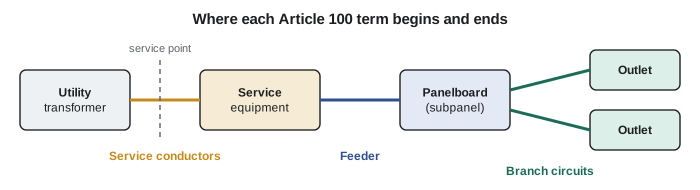
Several related terms locate the boundaries. The service point is where the utility's conductors meet the premises wiring, and the NEC applies on the premises side. Service conductors run from the service point to the service disconnecting means. Branch circuits come in several defined types: an individual branch circuit supplies only one piece of equipment; a general-purpose branch circuit supplies two or more outlets for lighting and appliances; an appliance branch circuit supplies outlets intended for appliances with no permanent lighting; and a multiwire branch circuit has two or more ungrounded conductors with a voltage between them and a grounded conductor with equal voltage to each.
Worked problem
Feeder or branch circuit?
At the Maple Street fourplex, each dwelling unit has its own panelboard, fed from a meter stack and main disconnect on the outside wall. Tyler asks whether the conductors from the meter stack to each unit's panel are branch circuits because they serve only one unit.
Show solution
- The conductors start at the service equipment, the main disconnect at the meter stack.
- They end at each unit's panelboard, which contains the final overcurrent devices for the branch circuits.
- Wiring between the service equipment and the final branch-circuit overcurrent device is, by definition, a feeder.
- Serving only one unit does not change that; the definition depends on where the conductors start and end, not how many loads they serve.
Answer: They are feeders, sized under Articles 215 and 220, not branch circuits.
The grounding family
No group of definitions causes more confusion than the terms built on ground. They sound alike, and the everyday words neutral and ground are used loosely in the field. The Code uses precise terms, and exam questions often depend on telling them apart.
| Term | What it is | Everyday name |
|---|---|---|
| Grounded conductor | A system or circuit conductor that is intentionally grounded | Often called the neutral (it is the neutral only in some systems) |
| Neutral conductor | The conductor connected to the neutral point of a system, intended to carry current under normal conditions | Neutral |
| Equipment grounding conductor | The conductive path that connects normally non-current-carrying metal parts of equipment together and to the system grounded conductor, the grounding electrode conductor or both | The ground wire, the green wire |
| Grounding electrode conductor | The conductor that connects the system grounded conductor or equipment to a grounding electrode | The wire to the ground rod or water pipe |
| Main bonding jumper | The connection between the grounded conductor and the equipment grounding conductor at the service | The bonding screw or strap in the main panel |
| System bonding jumper | The same kind of connection at a separately derived system, such as a transformer | The bonding jumper at the transformer |
| Bonded (bonding) | Connected to establish electrical continuity and conductivity | Bonding |
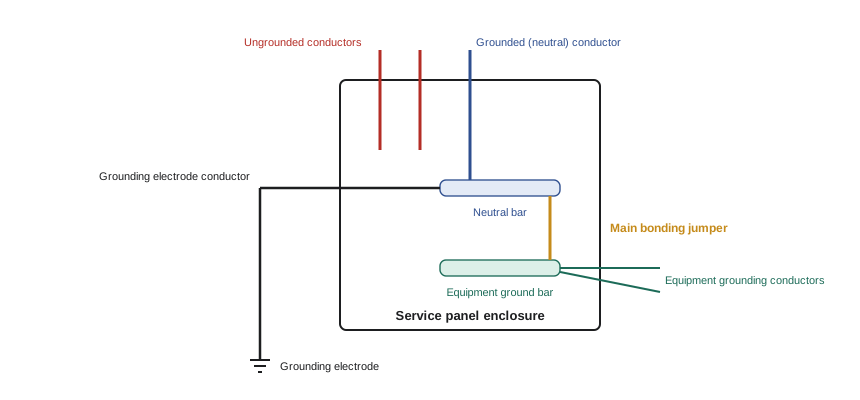
Two common errors are worth naming. First, grounded and grounding are different words: the grounded conductor normally carries current, while an equipment grounding conductor carries current only during a fault. Second, the neutral and the grounded conductor are not always the same thing. In a corner-grounded delta system, one phase conductor is grounded and there is no neutral. On a 120/240-volt single-phase system the grounded conductor is also the neutral. When a question asks about the neutral, check that the system actually has one.
Load words: continuous load, overload and overcurrent
A continuous load is one where the maximum current is expected to continue for three hours or more. The definition is the basis of one of the most used sizing rules in the Code: for most branch circuits and feeders, the overcurrent device must be rated for the noncontinuous load plus 125 out of each 100 parts of the continuous load, which works out to loading a standard breaker to no more than four-fifths of its rating with continuous loads. Store lighting, office lighting, many heating loads and electric vehicle chargers are treated as continuous.
# Continuous load check for a branch circuit (illustrative values)
breaker_amps = 20
continuous_amps = 15.2      # e.g. store lighting that runs all day
noncontinuous_amps = 0.0

required_rating = noncontinuous_amps + 1.25 * continuous_amps
print(f"Required overcurrent device rating: {required_rating:.1f} A")
print("20 A breaker adequate?", breaker_amps >= required_rating)
print(f"Most continuous load on a {breaker_amps} A breaker: {breaker_amps / 1.25:.1f} A")Required overcurrent device rating: 19.0 A 20 A breaker adequate? True Most continuous load on a 20 A breaker: 16.0 A
Overcurrent is any current beyond the rated current of equipment or the ampacity of a conductor, whatever the cause. It includes overload, which is operation in excess of normal rating that would cause damage if it lasted long enough, and short circuits and ground faults, which are faults. The difference matters for motors: Article 430 separates overload protection, sized from the motor nameplate, from short-circuit and ground-fault protection, sized from tables. Knowing the definitions makes that division obvious.
Occupancy and location words
Many rules apply only in certain kinds of places, so the definitions of those places decide whether a rule applies at all.
| Term | Plain-language meaning |
|---|---|
| Dwelling unit | A single unit providing complete and independent living facilities, with permanent provisions for living, sleeping, cooking and sanitation |
| Multifamily dwelling | A building that contains three or more dwelling units |
| Bathroom | An area that includes a basin together with one or more of a toilet, urinal, tub, shower, bidet or similar fixture |
| Kitchen | An area with a sink and permanent provisions for food preparation and cooking |
| Location, damp | Partly protected from weather, or interior places subject to moderate moisture, such as some basements and canopies |
| Location, wet | Exposed to weather, saturated with water, or underground or in concrete in contact with earth |
| Location, dry | Not normally subject to dampness or wetness |
| Qualified person | Someone with skills and knowledge related to the equipment and its operation who has received safety training to recognize and avoid the hazards |
The bathroom definition is a good example of why reading matters. A powder room with a basin and toilet is a bathroom. A laundry room with a utility sink and no other fixture is not, although other rules may still require ground-fault protection near the sink. A hotel suite with a kitchenette may or may not contain a dwelling unit, depending on whether all four provisions, living, sleeping, cooking and sanitation, are permanent. Exam questions are built on exactly these borderline cases.
A method for definition questions
Dana develops a three-step routine. First, underline every noun in the question that might be a defined term. Second, check any term she is not completely sure of in Article 100, with the related entries next to it. Third, reread the question with the definition in mind before looking at the answer choices. The routine adds perhaps thirty seconds to a question and, in her practice tests, removes almost all of her definition errors.
Worked problem
A definition decides the answer
Practice question: a commercial kitchen exhaust fan runs from 6 a.m. to 8 a.m. and again from 11 a.m. to 1:30 p.m. Is it a continuous load?
Show solution
- Continuous load means the maximum current is expected to continue for three hours or more.
- Neither run lasts three hours: the first is two hours and the second two and a half.
- The total of four and a half hours does not matter, because the definition is about the current continuing, not the daily total.
- Unless the design or another rule requires otherwise, the fan is not a continuous load by definition.
Answer: Not continuous by definition. The answer choice that adds the two periods together is the trap.
Common mistakes
MistakeUsing grounded and grounding interchangeably.
InsteadThe grounded conductor is a circuit conductor that normally carries current; the equipment grounding conductor carries current only during a fault.
MistakeTreating a disconnect that is visible but 70 feet away as in sight.
InsteadIn sight requires both visibility and a distance of not more than 50 feet.
MistakeCalling every conductor that serves one load a branch circuit.
InsteadThe definitions depend on where the conductors start and end; wiring from service equipment to a panel is a feeder.
MistakeAdding separate run periods together to decide whether a load is continuous.
InsteadThe maximum current must be expected to continue for three hours or more.
MistakeLooking only in Article 100 when using a 2020 or older code book.
InsteadOlder editions also define terms in the .2 section of individual articles.
Summary and key terms
- Article 100 definitions control the meaning of defined terms wherever they appear; everyday meanings can lead to wrong answers.
- The 2023 edition gathered almost all definitions into Article 100; older editions also use the .2 sections of articles.
- Readily accessible is stricter than accessible; in sight from means visible and not more than 50 feet away.
- Approved is the AHJ's decision; listed and labeled come from testing organizations; identified means recognizable as suitable for a use.
- Branch circuits, feeders and services are defined by where they start and end.
- A continuous load lasts three hours or more at maximum current, which drives the 125 out of 100 sizing rule.
- Readily accessible
- Reachable quickly without climbing, ladders, removing obstacles or tools.
- In sight from
- Visible and not more than 50 feet away.
- Listed
- Included on a list published by a testing organization acceptable to the AHJ.
- Feeder
- Conductors between the service equipment or other source and the final branch-circuit overcurrent device.
- Grounded conductor
- A system or circuit conductor that is intentionally grounded.
- Equipment grounding conductor
- The path that connects non-current-carrying metal parts to the grounded conductor or grounding electrode conductor.
- Continuous load
- A load whose maximum current is expected to continue for three hours or more.
Practice problems
Work each problem on paper first, then reveal the answer to check.
A motor disconnect is visible from the motor and 45 feet away. Is it in sight from the motor?
Show answer
Yes. It is visible and not more than 50 feet away.
A building has two dwelling units. Is it a multifamily dwelling?
Show answer
No. A multifamily dwelling has three or more dwelling units; two units is a two-family dwelling.
What is the most continuous load that may be placed on a 30-ampere breaker under the 125 out of 100 rule?
Show answer
30 divided by 1.25, which is 24 amperes.
Which term describes the conductor from the service neutral bar to the ground rod?
Show answer
The grounding electrode conductor.
A room has a basin and a shower but no toilet. Is it a bathroom under the definition?
Show answer
Yes. A basin with any one of the listed fixtures, such as a shower, makes it a bathroom.
Lesson quiz · 5 questions
Score 60% or more to complete this lesson.
Create a free account to save your progress, take quizzes and earn a certificate.