
MELU-101 · Lesson 2 of 12 · 23 min
Chapters, articles, parts and sections
▶ Video coming soon A video version of this lesson is on the way.
On her first night of study Dana does something she has never done in eleven years of using the Code: she reads the table of contents from beginning to end. It takes forty minutes. By the end she can see the book as a building with floors and rooms, instead of a pile of pages she opens at the place she happens to remember. This lesson walks through that structure, from the nine chapters down to the smallest numbered list item, so that every citation you see becomes an address you can find.
Article 90 and the arrangement of the Code
Article 90, the introduction, does more than state the purpose of the Code. Section 90.3 explains how the chapters relate to each other, and that one section saves more exam time than any other once you understand it. In the 2023 edition the arrangement works like this. Chapters 1 through 4 apply generally to all electrical installations. Chapters 5, 6 and 7 apply to special occupancies, special equipment and special conditions, and they can supplement or modify the general rules in Chapters 1 through 7. Chapter 8 covers communications systems and in the 2023 edition stood largely on its own, applying the earlier chapters only where it referred to them. Chapter 9 contains tables that apply where the rest of the Code refers to them. The informative annexes that follow are not part of the requirements at all; they are there to help you.
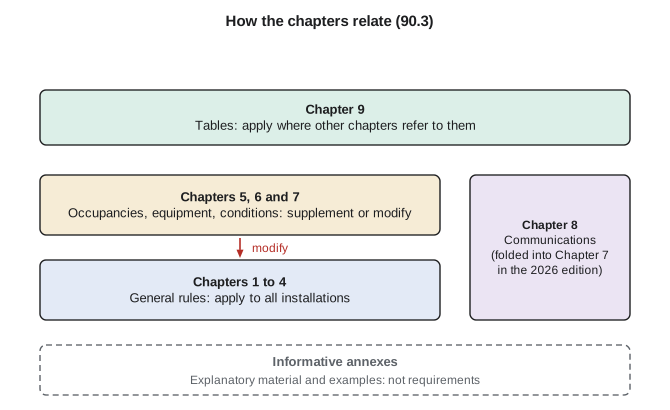
The practical consequence is the most important navigation habit in this course: when an installation is in a special occupancy, uses special equipment or involves a special condition, look in Chapters 5, 6 or 7 first, because a rule there can change what Chapters 1 through 4 would otherwise require. A receptacle near a swimming pool, a branch circuit in a hospital patient room, a sign outline lighting circuit or a fire pump feeder are all governed first by their own articles. If you start in Chapter 2 you may find a correct general rule and still pick the wrong answer.
The 2026 edition changed the wording of 90.3 and moved most of the old Chapter 8 material into Chapter 7, so that communications systems are no longer treated as separate from the rest of the Code, and the titles of Chapters 5, 6 and 7 now say specific rather than special. The idea is the same, general rules first and then the rules that modify them, but if your exam is on 2026 the chapter boundaries you tab will be slightly different. Lesson 10 covers the edition changes in detail.
The nine chapters
You do not need to memorize every article number, but you should know which chapter holds which kind of rule well enough to open the book within a few pages of your target on the first try. Here is the 2023 layout with the articles master candidates use most.
| Chapter | Subject | Articles you will use most |
|---|---|---|
| Introduction | Purpose, scope, arrangement, enforcement | 90 |
| 1 General | Definitions and general installation requirements | 100 Definitions, 110 Requirements for Electrical Installations |
| 2 Wiring and Protection | Circuits, services, overcurrent protection, grounding | 210 Branch Circuits, 215 Feeders, 220 Load Calculations, 225 Outside Circuits, 230 Services, 240 Overcurrent Protection, 250 Grounding and Bonding |
| 3 Wiring Methods and Materials | Conductors, boxes, raceways and cables | 300 General, 310 Conductors, 312 Cabinets, 314 Boxes, 320 to 340 cables, 342 to 362 raceways |
| 4 Equipment for General Use | Cords, switches, receptacles, panelboards, luminaires, appliances, motors, transformers | 400, 404, 406, 408, 410, 422, 424, 430 Motors, 440 Air-Conditioning, 445 Generators, 450 Transformers |
| 5 Special Occupancies | Hazardous locations, health care, assembly, agricultural, marinas, mobile homes | 500 to 516 Hazardous Locations, 517 Health Care, 518 Assembly, 547 Agricultural, 555 Marinas |
| 6 Special Equipment | Signs, elevators, EV charging, pools, solar PV, fire pumps | 600 Signs, 620 Elevators, 625 EV Charging, 680 Pools, 690 Solar PV, 695 Fire Pumps |
| 7 Special Conditions | Emergency and standby systems, interconnected sources, power-limited circuits, fire alarms | 700 Emergency, 701 Legally Required Standby, 702 Optional Standby, 705 Interconnected Sources, 706 Energy Storage, 725 Class 2 and 3, 760 Fire Alarm |
| 8 Communications Systems | Telephone, antennas, coaxial cable, broadband | 800 to 840 |
| 9 Tables | Conduit fill, conductor properties, power source limits | Tables 1, 4, 5, 8 and 9 and the power-limited source tables |
| Informative Annexes | Explanatory material and examples, not requirements | Annex C conduit fill, Annex D calculation examples |
Look at the pattern within Chapters 2 and 3. Chapter 2 moves roughly in the order power flows backwards from the outlet: branch circuits, feeders, load calculations, outside circuits, services, then the protection and grounding that apply to all of them. Chapter 3 begins with general rules for all wiring methods in Article 300 and conductors in Article 310, then boxes and enclosures, then the individual cable and raceway articles in a fixed format. Once you see these patterns you can often guess the right article before you check the contents.
Articles and their parts
Each chapter is divided into articles, and each article covers one subject. Article 250, for example, is all about grounding and bonding. Large articles are divided into parts, numbered with Roman numerals, and the parts give you a second level of address. Article 250 has parts for general requirements, system grounding, the grounding electrode system, enclosure grounding, bonding, equipment grounding conductors and more. Article 230 has parts for overhead and underground service conductors, service-entrance conductors, service equipment, disconnecting means and overcurrent protection.
Parts matter for two reasons. First, they let you narrow your search: if a question is about the service disconnect, you can go straight to the disconnecting means part of Article 230 instead of reading from 230.1. Second, some rules apply only within their own part. A section in one part may begin by saying that the part applies only to certain systems, for example installations over a certain voltage, and that limits every rule that follows. Reading the scope statement at the start of a part is a habit worth building.
| Article | Example of its parts (2023) |
|---|---|
| 230 Services | I General; II Overhead service conductors; III Underground service conductors; IV Service-entrance conductors; V Service equipment, general; VI Service equipment, disconnecting means; VII Service equipment, overcurrent protection (services over 1000 volts were moved to their own article, 235, in the 2023 edition) |
| 250 Grounding and Bonding | I General; II System grounding; III Grounding electrode system and grounding electrode conductor; IV Enclosure, raceway and service cable connections; V Bonding; VI Equipment grounding and equipment grounding conductors; VII Methods of equipment grounding; VIII Direct-current systems; and further parts |
| 430 Motors | I General; II Motor circuit conductors; III Motor and branch-circuit overload protection; IV Motor branch-circuit short-circuit and ground-fault protection; V Motor feeder protection; VI Motor control circuits; VII Motor controllers; IX Disconnecting means; and further parts |
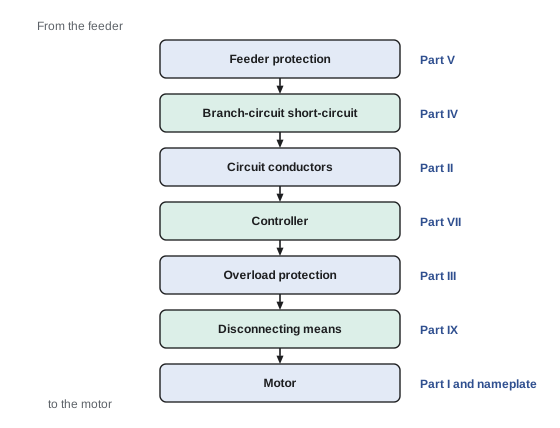
Article 430 is the classic example of a well-organized article. Its parts follow the motor circuit from the feeder down to the motor: feeder protection, branch-circuit short-circuit and ground-fault protection, conductors, the controller, overload protection, the disconnecting means. The article even includes a diagram that shows which part covers which component. Master exams lean heavily on motor questions, and candidates who know the parts of Article 430 can answer most of them in a minute or two. MELU-105 covers motors in depth.
The uniform layout of wiring method articles
The articles in Chapter 3 for individual cables and raceways all follow the same section numbering, which is one of the Code's best navigation aids. The last digits of each section number tell you the subject, whatever the article. Once you learn the pattern for one wiring method, you know where to look in all of them.
| Section ending | Subject | Example in Article 358 (EMT) |
|---|---|---|
| .1 | Scope | 358.1 |
| .6 | Listing requirements | 358.6 |
| .10 | Uses permitted | 358.10 |
| .12 | Uses not permitted | 358.12 |
| .20 | Size (minimum and maximum trade size) | 358.20 |
| .22 | Number of conductors | 358.22 |
| .24 | Bends, how made | 358.24 |
| .26 | Bends, number in one run | 358.26 |
| .30 | Securing and supporting | 358.30 |
| .42 | Couplings and connectors | 358.42 |
| .60 | Grounding | 358.60 |
| .100 and up | Construction specifications | 358.100 |
This is why an experienced candidate can answer 'What is the maximum number of quarter bends between pull points in a run of rigid PVC conduit?' without using the index. The question is about bends in one run, so the section ends in .26, and PVC conduit is Article 352, so the answer is in 352.26. The same logic finds support intervals for EMT in 358.30, or uses not permitted for nonmetallic-sheathed cable in 334.12. Dana writes the pattern on an index card and practices until she no longer needs the card.
# Build a section number from the uniform Chapter 3 layout
articles = {"RMC": 344, "IMC": 342, "PVC": 352, "EMT": 358, "NM cable": 334, "MC cable": 330}
subjects = {"uses permitted": 10, "uses not permitted": 12, "number of conductors": 22,
            "bends in one run": 26, "securing and supporting": 30}

def section(method, subject):
    return f"{articles[method]}.{subjects[subject]}"

for method, subject in [("PVC", "bends in one run"), ("EMT", "securing and supporting"),
                        ("NM cable", "uses not permitted")]:
print(f"{method:9} {subject:24} -> {section(method, subject)}")PVC bends in one run -> 352.26 EMT securing and supporting -> 358.30 NM cable uses not permitted -> 334.12
Sections and their subdivisions
Below the article and part comes the section, the basic unit of a rule. A section number has two pieces separated by a period: the article number and the section number within it. 210.8 is Article 210, section 8. Sections are then divided into lettered and numbered subdivisions, and the format is consistent across the Code.
| Level | Format | Example | Read as |
|---|---|---|---|
| Article | Number | 210 | Article 210, Branch Circuits |
| Section | Article.number | 210.8 | Section 8 of Article 210 |
| First-level subdivision | Capital letter in parentheses | 210.8(A) | Subdivision (A) of 210.8 |
| Second-level subdivision | Number in parentheses | 210.8(A)(6) | Item (6) of 210.8(A) |
| Third-level subdivision | Lowercase letter in parentheses | 110.14(C)(1)(a) | Item (a) of 110.14(C)(1) |
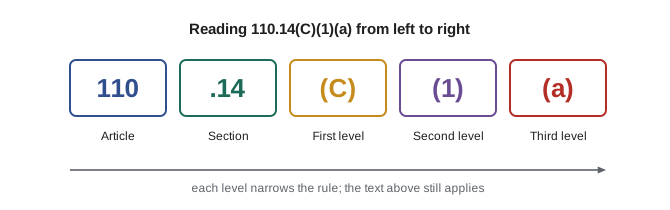
The deeper you go, the narrower the rule. 210.8 covers ground-fault circuit-interrupter protection for personnel in general. 210.8(A) narrows it to dwelling units. 210.8(A)(6) narrows it further to one location within a dwelling unit. When an exam answer cites a subdivision, the parent text above it still applies: the conditions in 210.8 and 210.8(A) are part of the rule in 210.8(A)(6). Lesson 8 returns to this point, because forgetting the parent text is one of the most common reading errors.
Sections also have titles, usually in bold, and many subdivisions have short titles too. The titles are not rules in themselves, but they are excellent signposts. When you scan a long article, read the bold titles and skip the text until a title matches your question.
Lists, tables and figures inside articles
Within sections you will find numbered lists, tables and occasionally figures. A list may mean all of the items apply, or any one of them, and the introductory sentence tells you which: watch for words such as all of the following, any of the following or one of the following. Tables inside an article are numbered after the section that introduces them. Table 110.26(A)(1), for instance, is the table that goes with 110.26(A)(1), and Table 310.16 goes with section 310.16. This makes tables easy to find from their number alone. Figures are numbered the same way and are usually explanatory.
Chapter 9 tables are numbered differently, simply Table 1, Table 4, Table 5 and so on, and they come with notes that are part of the table. Lesson 5 is devoted to tables, including how to read the notes and footnotes that change the meaning of the numbers.
Putting the address system to work
Worked problem
Finding a rule from the address alone
Marcus quizzes Dana: 'On the Copper Kettle job, what governs the working space in front of the new 208-volt panelboard? Give me the article and the subdivision before you open the book.'
Show solution
- Working space is a general requirement for all installations, so it is in Chapter 1.
- Chapter 1 has only two articles; definitions are in Article 100, so general installation requirements are in Article 110.
- Working space is the subject of 110.26, and its first subdivision, (A), covers the dimensions: depth, width and height.
- Depth is the first dimension, so it is 110.26(A)(1), with its table, Table 110.26(A)(1).
Answer: 110.26(A)(1) and Table 110.26(A)(1). Dana opens the book and confirms it in about fifteen seconds.
Worked problem
Using the chapter arrangement to avoid a wrong answer
A practice question asks about the required protection for 125-volt receptacles near an outdoor pool at the Maple Street fourplex. Dana's first instinct is 210.8, the general GFCI section.
Show solution
- A pool is special equipment, so Chapter 6 applies, and pools are covered in Article 680.
- Under 90.3, Chapter 6 can modify the general rules of Chapter 2, so Article 680 must be checked first.
- Article 680 has its own distance and protection rules for receptacles near pools, which go beyond what 210.8 alone would say.
- The correct answer will cite Article 680, with 210.8 as background.
Answer: Start in Article 680 for pool receptacles. The general rule is not wrong, but it is not complete.
Common mistakes
MistakeStarting every search in Chapter 2 because that is where most everyday rules are.
InsteadAsk first whether the installation involves a special occupancy, special equipment or a special condition; if it does, start in Chapters 5, 6 or 7.
MistakeTreating informative annexes as requirements.
InsteadAnnexes are explanatory; they help you apply the Code but do not add requirements.
MistakeReading a subdivision such as 210.8(A)(6) without its parent text.
InsteadThe conditions in 210.8 and 210.8(A) apply to every item beneath them.
MistakeSearching the whole of a long article for a rule.
InsteadUse the part titles to narrow the search, then the bold section titles.
MistakeIgnoring the scope statement at the start of a part.
InsteadSome parts apply only to certain voltages or systems, which limits every rule in them.
Summary and key terms
- Section 90.3 explains the arrangement: Chapters 1 to 4 apply generally, Chapters 5 to 7 supplement or modify, Chapter 9 tables apply when referenced, and annexes are not requirements.
- Each chapter is divided into articles on single subjects; large articles are divided into Roman-numeral parts.
- Chapter 3 wiring method articles share a uniform section numbering, so .10 is uses permitted, .12 uses not permitted, .26 bends and .30 support in every one.
- A citation such as 110.14(C)(1)(a) reads from left to right: article, section, then lettered and numbered subdivisions that narrow the rule.
- Tables inside articles are numbered after their sections; Chapter 9 tables are numbered on their own.
- Knowing the structure lets you open the book near the right page on the first try.
- Article
- A main division of a chapter covering one subject, such as Article 250 Grounding and Bonding.
- Part
- A Roman-numeral division of a large article.
- Section
- The basic numbered rule, written as article number, period, section number.
- Subdivision
- A lettered or numbered division within a section, such as (A), (1) or (a).
- Uniform layout
- The shared section numbering used by the Chapter 3 wiring method articles.
- Informative annex
- Explanatory material after Chapter 9 that is not part of the requirements.
Practice problems
Work each problem on paper first, then reveal the answer to check.
Without opening the book, which section would you expect to cover the number of conductors permitted in rigid metal conduit (Article 344)?
Show answer
344.22, because .22 is number of conductors in the uniform layout.
A question asks about wiring in a hospital patient care space. Which chapter should you check first, and why?
Show answer
Chapter 5, Article 517, because health care facilities are a special occupancy that can modify the general rules.
What does the (6) in 210.8(A)(6) represent?
Show answer
A second-level subdivision: item 6 of subdivision (A) of section 210.8.
Is Annex D, with its load calculation examples, a requirement?
Show answer
No. Informative annexes are explanatory; the requirements are in the articles they illustrate.
Which article would you expect to cover uses not permitted for MC cable, and which section?
Show answer
Article 330, section 330.12.
Lesson quiz · 5 questions
Score 60% or more to complete this lesson.
Create a free account to save your progress, take quizzes and earn a certificate.