
MELU-101 · Lesson 11 of 12 · 20 min
Tabbing and highlighting an exam code book
▶ Video coming soon A video version of this lesson is on the way.
Walk into any master exam testing center and you will see code books bristling with colored tabs. Some candidates have twenty, some have two hundred. A well-tabbed book is the single biggest physical advantage you can bring to an open-book exam, but a badly tabbed one, with so many tabs that none of them stands out, can actually slow you down. This lesson covers what testing centers usually allow, how to plan tabs, how to highlight, and how Dana tabs her own book in week six of her plan.
What is usually allowed
Rules about code books come from your candidate bulletin and the testing vendor, and they differ between states and vendors. The typical pattern is shown below, but treat it as a starting point only. Some candidates have had books confiscated on test day for breaking rules they did not know about, which is a disaster for an open-book exam.
| Item | Typically allowed? | Notes |
|---|---|---|
| Bound, original code book of the named edition | Yes | Photocopies and loose pages are generally not allowed |
| Permanent tabs (adhesive, attached to the page edge) | Usually yes | Usually must be permanently attached and labeled only with section or article numbers or titles |
| Removable sticky notes and flags | Usually no | Often confiscated at check-in |
| Highlighting and underlining | Usually yes | Some vendors limit colors or ban marking in margins |
| Handwritten notes, formulas or answers in the book | Usually no | May lead to removal of the book or disqualification |
| Tabbed book bought pre-tabbed from a publisher | Often yes | Check that the tabs are permanent and contain only allowed text |
| Calculator | Usually an approved non-programmable model | Some centers provide an on-screen calculator |
Read the reference rules in your bulletin before you put a single tab in your book. If anything is unclear, call the testing vendor and write down the date, the name of the person you spoke to and what they said. Dana's bulletin allows permanent tabs labeled with article or section numbers and titles, and highlighting in any color, but no handwritten notes. Those rules shape her whole plan.
Planning tabs: less is more
A tab is useful only if you can find it faster than you could find the page without it. That means tabs must be few enough to read at a glance, organized so that their position tells you something, and labeled clearly. Experienced instructors often suggest somewhere between forty and eighty tabs for a master exam: enough to mark every article you use often and the key tables, not so many that the edge of the book becomes a wall of color.
| Tab level | What it marks | Suggested count |
|---|---|---|
| Chapter tabs | The start of each chapter and the index | About 10 to 11 |
| Article tabs | Articles you use often: 90, 100, 110, 210, 215, 220 (or 120 in 2026), 230, 240, 250, 300, 310, 314, 430, 450, 680, 690, 700 | About 25 to 40 |
| Table tabs | Key tables: 110.26(A)(1), 220.55, 250.66, 250.122, 300.5, 310.16, 314.16(A), 430.52, 430.248, 430.250, Chapter 9 Tables 1, 4, 5, 8, Annex C | About 10 to 20 |
| Special tabs | Your state amendments, Annex D examples, Informative Annex I | About 3 to 5 |
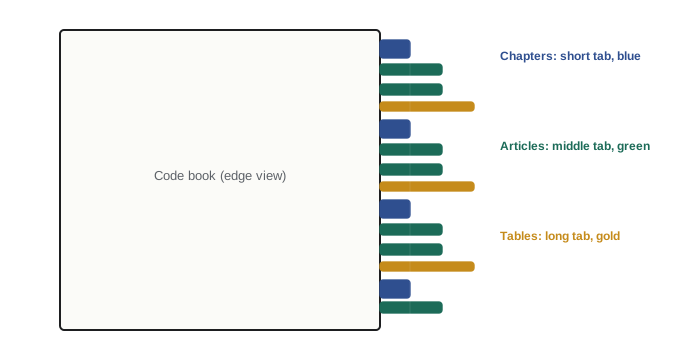
Position and color do much of the work. Dana uses three tab positions along the page edge, high, middle and low, and three colors. Chapter tabs go in the high position in one color. Article tabs go in the middle position in a second color. Table tabs go in the low position in a third color. When she wants Table 250.122, her eyes go straight to the low row of table tabs in Chapter 2, without reading every tab.
Labels should be short and use the Code's numbers and titles, which is usually all the bulletin allows. Writing 250.122 EGC is clear; writing an explanation of how to use the table is a note, and is usually not allowed.
Tabbing in order
Tab from the front of the book to the back, in a single session if possible, so that the spacing along the edge stays even. Put chapter tabs on first, then article tabs, then table tabs. Leave a little room between tabs that are close together so that you can still grip the page. If two tabs would overlap, move one to a different position rather than stacking them.
| Step | What to do |
|---|---|
| 1 | Read your bulletin's reference rules and confirm the edition |
| 2 | Make a tab list from your state exam outline and the tables you use in practice |
| 3 | Choose positions and colors for each level |
| 4 | Tab chapters first, front to back |
| 5 | Tab articles next, in the middle position |
| 6 | Tab tables last, in the low position |
| 7 | Practice lookups for a week and adjust: add tabs you keep wishing for, remove tabs you never use |
Step 7 is where tabbing turns from decoration into a tool. During her timed practice, Dana keeps a tally of the places she looked up more than twice without a tab. At the end of the week she adds tabs for the top items and removes four tabs she never used. Her final count is 62.
Highlighting with a purpose
Highlighting helps when it marks the words that decide answers: the numbers, the limits, the conditions and the exceptions. Highlighting whole paragraphs turns the page into a colored block that hides the important words as well as plain text does. A simple color system helps you read the highlighting at speed.
| Color | Use it for | Example (illustrative) |
|---|---|---|
| Yellow | Numbers and limits: distances, ratings, quantities | A required distance or a maximum number of bends |
| Green | Conditions and scope: where a rule applies | In other than dwelling units; where installed outdoors |
| Pink | Exceptions and prohibitions | The first words of an exception; shall not |
| Blue | Cross-references to other sections and tables | A reference sending you to another section |
Highlight as you study, not all at once. Each time you look up a rule in practice and use it, highlight the deciding words. Over weeks of study, the highlighting builds up exactly where your exam is likely to send you. Dana's book ends up with heavy highlighting in Articles 110, 210, 250 and 430 and almost none in the communications chapter, which matches her state's exam outline.
Pre-tabbed books and tab kits
Publishers and exam prep companies sell tab kits with printed labels, and some sell code books already tabbed. These save time and are usually well designed, but they have drawbacks. A kit is built for an average exam, not your state's outline, and it may include many tabs you will never use. It also takes away one of the best study exercises: deciding what to tab teaches you the structure of the book. A good compromise is to buy a kit for the label quality and use only the tabs that fit your plan.
Worked problem
Choosing tabs from a kit
Marcus buys a tab kit with 140 labels. He wants to use all of them. Dana suggests he try her approach first.
Show solution
- Marcus lists the topics in his state's exam outline and the tables he used in his last three practice exams.
- He selects the kit tabs that match his list: 58 of the 140.
- He adds four custom tabs for his state amendments and two Annex D examples he uses for load calculations.
- After a week of practice he adds three tabs and removes two.
Answer: Marcus ends up with 63 tabs instead of 140, and his lookup times drop because each tab is one he actually uses.
Testing your tabbed book
A tabbed book should be tested like any other tool. Dana uses a simple drill: she picks twenty random article and table numbers, has Marcus read them out, and times how long it takes to open to each one. Her target is under ten seconds for anything tabbed. Anything slower means a tab is in the wrong place, poorly labeled or hidden behind another.
# Tab drill: time to open to each tabbed location (seconds)
drill = {"110.26(A)(1)": 6, "250.122": 7, "Table 310.16": 5, "430.52": 9, "Chapter 9 Table 4": 8,
         "Annex C": 6, "680": 12, "230 Part VI": 14, "314.16": 7, "Annex D": 5}
slow = {k: v for k, v in drill.items() if v > 10}
print(f"Average: {sum(drill.values()) / len(drill):.1f} s")
print("Too slow (fix these tabs):", ", ".join(slow))Average: 7.9 s Too slow (fix these tabs): 680, 230 Part VI
The drill shows Dana that her tab for Article 680 is hidden behind the tab for Article 690, and that she has no tab for the parts of Article 230. She moves one and adds the other, and her times drop under ten seconds for everything.
Caring for your book
A code book that falls apart on exam day is a real risk, especially after weeks of heavy use. Keep the book in a protective cover, do not leave it in a hot truck where adhesive softens, and check that every tab is still firmly attached a few days before the exam. Some candidates buy a second copy for field use so their exam book stays clean and correctly tabbed. Bring the book to the testing center in a way that lets the staff inspect it easily, without loose papers tucked inside.
Tabbing for your state's outline
Most state exam bulletins include a content outline that lists the subject areas tested and roughly how many questions come from each. Those outlines are the best guide to what to tab. If your outline shows a large number of questions on services, feeders and load calculations, those articles and tables deserve the clearest tabs. If it shows only one or two questions on communications systems, a single chapter tab may be enough. Dana's outline lists general knowledge, services and equipment, feeders, branch circuits, wiring methods, grounding and bonding, motors, special occupancies and equipment, and a few questions on her state's licensing law, and she builds her tab list from it.
| Outline area (illustrative) | Approximate share of questions | Tabs Dana gives it |
|---|---|---|
| General knowledge and definitions | About a tenth | Articles 90, 100, 110 and Table 110.26(A)(1) |
| Services, feeders and load calculations | About a fifth | Articles 215, 220, 230 with its parts, and key load tables |
| Branch circuits and wiring methods | About a fifth | Articles 210, 300, 310, 314 and the main wiring method articles |
| Grounding and bonding | About a tenth | Article 250 with its parts, Tables 250.66 and 250.122 |
| Motors and transformers | About a tenth | Articles 430 and 450 and the motor tables |
| Special occupancies and equipment | About a fifth | Articles 500, 517, 680, 690, 695, 700 |
| State licensing law | A few questions | Her state amendments and licensing rules, if allowed |
An outline also helps you decide where to stop. Candidates sometimes keep adding tabs for rare topics, hoping to cover everything, and end up with a book that is slower for the common questions. Ray's advice is to tab for the questions that will certainly appear and rely on the index for the rest.
When the tabs are done, Dana does one last check that is easy to forget: she flips through the whole book page by page, looking for anything that might break the bulletin rules, such as a pencil note from her study sessions, a receipt used as a bookmark, or a removable flag left on a page. On exam day the staff spend only a minute or two inspecting each book, and a single stray note can cause a delay or worse. She erases two margin notes she had forgotten about and removes a business card tucked inside the back cover.
Common mistakes
MistakeTabbing before reading the bulletin's reference rules.
InsteadRead the rules first; some vendors confiscate books with prohibited tabs or notes.
MistakePutting on as many tabs as possible.
InsteadFewer, well-placed tabs are faster; plan by level, position and color.
MistakeWriting explanations or formulas on tabs.
InsteadLabels are usually limited to section numbers and titles; notes are usually prohibited.
MistakeHighlighting whole paragraphs.
InsteadHighlight the deciding words: numbers, conditions, exceptions and references.
MistakeNever testing the tabs.
InsteadRun a timed drill and fix any tab that takes more than about ten seconds to use.
Summary and key terms
- Your bulletin and testing vendor set the rules for tabs, highlighting and notes; read them before marking your book.
- Plan tabs in levels, chapters, articles and tables, using position and color to tell them apart.
- Aim for a manageable number of tabs, often forty to eighty for a master exam, based on your state outline and practice.
- Highlight the words that decide answers with a consistent color system, building it up as you study.
- Test your tabbed book with timed drills and adjust.
- Protect the book and check the tabs before exam day.
- Permanent tab
- A tab attached firmly to the page edge, as most bulletins require.
- Tab level
- A group of tabs for the same kind of location, such as chapters, articles or tables.
- Tab kit
- A commercial set of printed tab labels for a code edition.
- Tab drill
- A timed exercise opening the book to tabbed locations.
Practice problems
Work each problem on paper first, then reveal the answer to check.
Your bulletin allows permanent tabs labeled with section numbers. May you write the steps of a load calculation on a tab?
Show answer
No. That is a note, not a section number or title, and notes are usually prohibited.
A tab takes you 15 seconds to use in a drill. What should you do?
Show answer
Move it, relabel it or make it more visible so it can be used in under about ten seconds.
Why use different positions for chapter, article and table tabs?
Show answer
So you can find the right level of tab at a glance by its position, without reading every label.
Your tab kit has 150 labels. How should you decide which to use?
Show answer
Select those that match your state exam outline and your practice lookups, then adjust after timed practice.
What should you highlight in a rule?
Show answer
The deciding words: numbers and limits, conditions and scope, exceptions and prohibitions, and cross-references.
Lesson quiz · 5 questions
Score 60% or more to complete this lesson.
Create a free account to save your progress, take quizzes and earn a certificate.