
MELU-101 · Lesson 5 of 12 · 25 min
Using the tables and informative annexes
▶ Video coming soon A video version of this lesson is on the way.
A large share of master exam questions end with a number: an ampacity, a conductor size, a burial depth, a box volume, a motor current, a number of conductors in a conduit. Almost all of those numbers come from tables. The tables themselves are easy to read once you have found the right one; the difficulty is choosing the right table, reading the right column, and applying the notes and footnotes that change what the numbers mean. This lesson covers how the Code's tables are organized and a method for reading any of them, plus the informative annexes that can save minutes on calculation questions.
To respect the NFPA's copyright, the sample tables in this lesson are made up for teaching. They have the same structure as real Code tables, but the numbers are not the Code's. Use your own code book for real values.
Two kinds of tables
The Code has two families of tables. Article tables appear inside the articles and are numbered after the section that introduces them, so Table 310.16 belongs to section 310.16 and Table 250.122 belongs to section 250.122. Chapter 9 tables are collected at the end of the Code and numbered simply Table 1, Table 2 and so on, with notes that are part of the tables. Article tables answer questions about one subject; Chapter 9 tables mostly support calculations that several articles refer to, such as conduit fill and conductor properties.
| Table | Subject | Typical exam use |
|---|---|---|
| 110.26(A)(1) | Working space depth | Depth from voltage to ground and condition |
| 220.12 and the dwelling unit lighting rule in 220.14 | General lighting loads by occupancy and for dwelling units | Starting point for load calculations (moved to Article 120 in 2026) |
| 220.55 | Demand loads for household cooking appliances | Range and cooktop demand in dwelling calculations |
| 250.66 | Grounding electrode conductor size | Sizing from the largest service conductor |
| 250.122 | Equipment grounding conductor size | Sizing from the overcurrent device rating |
| 300.5 | Minimum cover for underground wiring | Burial depth by wiring method and location |
| 310.16 | Ampacities of insulated conductors in raceway, cable or earth | Conductor ampacity at 60, 75 and 90 degrees |
| 314.16(A) and (B) | Box volumes and volume per conductor | Box fill calculations |
| 430.248 and 430.250 | Full-load current of single-phase and three-phase motors | Starting point for motor circuit sizing |
| 430.52 | Maximum rating of motor branch-circuit protective devices | Short-circuit and ground-fault protection |
| Chapter 9, Table 1 | Allowable conduit fill | The share of a conduit that conductors may occupy |
| Chapter 9, Tables 4 and 5 | Conduit dimensions and conductor dimensions | Detailed conduit fill calculations |
| Chapter 9, Table 8 | Conductor properties | Conductor area and DC resistance for voltage drop |
| Chapter 9, Table 9 | AC resistance and reactance | More precise voltage drop calculations |
A method for reading any table
Dana's practice tests show that her table mistakes fall into a few types: the wrong table, the wrong column, the wrong row, or a note she did not read. She builds a five-step routine to catch all of them.
| Step | Question to ask | Typical mistake it prevents |
|---|---|---|
| 1. Title | Is this the table for my situation, including the conditions in the title? | Using a free-air ampacity table for conductors in a raceway |
| 2. Notes above and below | Do any notes, footnotes or references change the values? | Missing a footnote that limits small conductors |
| 3. Column | Which column matches my material, temperature rating or wiring method? | Reading the copper column for aluminum conductors |
| 4. Row | Which row matches my size, rating or quantity, and do I round up or down? | Picking the next smaller size when the rule says not less than |
| 5. Sanity check | Does the answer make sense compared with what I see in the field? | Choosing an answer off by one row |
The routine looks slow written down, but with practice it takes well under a minute.
Steps 1 and 2 are where most points are lost. Titles carry conditions. An ampacity table may apply only to a certain number of current-carrying conductors and a certain ambient temperature, with other situations handled by correction and adjustment factors in other sections. Notes and footnotes can limit values, refer you to another section, or add a condition. In Chapter 9 the notes to Table 1 are part of the table and contain rules you need for almost every conduit fill question.
Columns: material, temperature and method
Many tables have parallel sets of columns. Ampacity tables are divided by conductor material, copper on one side and aluminum or copper-clad aluminum on the other, and within each material by insulation temperature rating, typically 60, 75 and 90 degrees Celsius. Burial depth tables have a column for each wiring method. Motor tables have columns for voltage. Choosing a column is the step where field habit most often betrays a candidate: in the field, most electricians work with copper at 75 degrees, and their eyes go to that column automatically.
| Size | Copper 60 C | Copper 75 C | Copper 90 C | Aluminum 60 C | Aluminum 75 C | Aluminum 90 C |
|---|---|---|---|---|---|---|
| Size A | 11 | 13 | 15 | 9 | 11 | 12 |
| Size B | 16 | 19 | 22 | 13 | 15 | 17 |
| Size C | 22 | 27 | 31 | 17 | 21 | 24 |
| Size D | 30 | 36 | 41 | 24 | 28 | 32 |
Worked problem
Reading the sample table
Using the sample table above, what is the usable ampacity of a Size C aluminum conductor with 90-degree insulation on a circuit whose terminations are rated 75 degrees?
Show solution
- Step 1: the sample table is for conductors in raceway under standard conditions; assume those apply.
- Step 2: no notes change the value here.
- Step 3: the material is aluminum, so use the aluminum columns. The terminations limit the temperature to 75 degrees, as lesson 4 explained for 110.14(C).
- Step 4: read the Size C row in the aluminum 75-degree column: 21.
- Step 5: the 90-degree value of 24 is larger, as expected, but the termination limits the usable value.
Answer: 21 amperes in this made-up table. The 90-degree value would be used only as the starting point for any correction or adjustment.
Rows: rounding and the words that control it
Rows are where rounding happens. A table might list conductor sizes, overcurrent device ratings or quantities, and your calculated value will often fall between two rows. The Code's wording tells you which way to go. Not less than, minimum and at least mean you go to the next larger row. Not more than, maximum and shall not exceed mean you stay at or below. A few tables, such as the motor branch-circuit protection table, are accompanied by rules that allow the next higher standard rating in some cases; those permissions are in the text of the section, not in the table.
Two common table structures need special care. In tables sized by the overcurrent device, such as the equipment grounding conductor table, each row covers a range of ratings, and the device rating, not the load, selects the row. In tables sized by the largest conductor, such as the grounding electrode conductor table, each row covers a range of conductor sizes, and for parallel conductors you use the equivalent area of the parallel set. Read the column headings carefully to see which input the table wants.
# Choosing a row when a value falls between rows ('not less than' means round up)
standard_ratings = [15, 20, 25, 30, 35, 40, 45, 50, 60, 70, 80, 90, 100]

def next_up(value):
    return next(r for r in standard_ratings if r >= value)

def next_down(value):
    return max(r for r in standard_ratings if r <= value)

calc = 42.5
print("Minimum device (not less than):", next_up(calc))
print("Largest device not exceeding:", next_down(calc))Minimum device (not less than): 45 Largest device not exceeding: 40
Chapter 9 and its notes
Chapter 9 Table 1 sets the share of a conduit's cross-section that conductors may fill: one share for a single conductor, a smaller share for two conductors, and a middle share for three or more. The notes to Table 1 contain rules you will need constantly: how to count an equipment grounding conductor, when a short nipple may be filled more fully, how to handle cables, and when to round up the number of conductors. Tables 4 and 5 give the dimensions you need to work out the actual areas: Table 4 for the internal area of each trade size of each type of conduit, and Table 5 for the area of each conductor size with each insulation type. Table 8 gives the area and DC resistance of bare conductors, which you use for voltage drop.
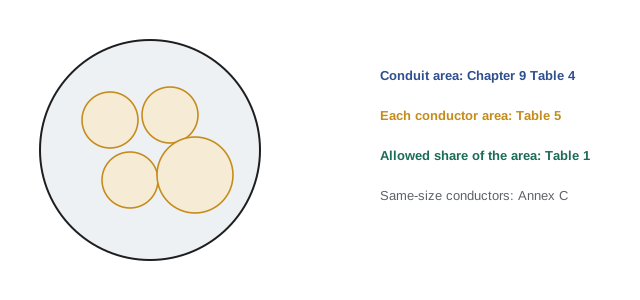
For conductors of the same size and type, Annex C does the conduit fill arithmetic for you: it gives the maximum number of conductors of each size and insulation type in each trade size of each kind of conduit. On an exam, a question asking how many 10 AWG THHN conductors fit in a given EMT size can be answered in seconds from Annex C. Mixed sizes require the long method with Tables 4 and 5.
Worked problem
The long method, with made-up numbers
A conduit has an internal area of 0.86 square inch in Table 4's column for its trade size. Three conductors with an area of 0.0211 square inch each and one with an area of 0.0507 square inch are to be installed. The allowable fill for three or more conductors, from Table 1, is taken here as a share of 0.4 of the area. Does it fit?
Show solution
- Allowable area: 0.86 times 0.4 is 0.344 square inch.
- Conductor area: 3 times 0.0211 is 0.0633, plus 0.0507, gives 0.114 square inch.
- 0.114 is well under 0.344, so the conductors fit with room to spare.
- In a real question, take the conduit area from Table 4 and each conductor area from Table 5 for its exact insulation type.
Answer: It fits: 0.114 square inch used of 0.344 allowed. (All numbers here are illustrative.)
The informative annexes
The informative annexes after Chapter 9 are not requirements, but several of them are excellent study and exam tools. Annex D is the most valuable for master candidates: it contains worked examples of load calculations for one-family dwellings by the standard and optional methods, multifamily dwellings, stores, industrial feeders, motor circuits and more. When you are learning load calculations, working through the Annex D examples side by side with the articles is one of the best ways to learn the order of operations.
| Annex | Subject | Use for a master candidate |
|---|---|---|
| A | Product safety standards | Which standards apply to listed products |
| B | Application information for ampacity calculation | Engineering supervision method for ampacity |
| C | Conduit and tubing fill tables for conductors of the same size | Fast answers to same-size conduit fill questions |
| D | Examples | Worked load and motor calculations to study from |
| E | Types of construction | Building construction types referenced in wiring method rules |
| F | Availability and reliability for critical operations power systems | Background for Article 708 |
| G | Supervisory control and data acquisition | Background for some industrial systems |
| H | Administration and enforcement | A model set of rules a jurisdiction can adopt for permits and inspections |
| I | Recommended tightening torque tables | Torque values when the manufacturer gives none |
| J | ADA standards for accessible design | Mounting heights and reach ranges |
| K | Use of medical electrical equipment in dwellings and residential board-and-care occupancies | Background for home medical equipment |
Remember that an annex example can only show one way of applying the rules; when an exam question differs from the example in a detail, the articles control. And because annexes are not requirements, an answer choice that says the annex requires something is usually wrong.
Practice: one question, every step
Worked problem
A burial depth question
Practice question: what is the minimum cover for rigid metal conduit buried under a lawn at the Maple Street fourplex, carrying a 120/240-volt feeder to a detached garage?
Show solution
- Subject: minimum cover for underground wiring, which is section 300.5 and its table.
- Title check: the table gives minimum cover in inches for different wiring methods and locations, and its notes explain how cover is measured and when it may be reduced.
- Column: rigid metal conduit has its own column, separate from direct-buried cable and from nonmetallic raceways.
- Row: the location is a lawn not under a building, driveway or slab, so it is the general row for locations not specified elsewhere.
- Read the value in your own book, then check the notes for any reduction or increase that applies.
Answer: The answer comes from the rigid metal conduit column in the general location row of Table 300.5. Dana finds it in under 40 seconds and notes that the value for direct-buried cable in the same row is very different.
Common mistakes
MistakeReading the 75-degree copper column out of habit.
InsteadChoose the column from the material, the termination temperature and the wiring method in the question.
MistakeIgnoring the notes to Chapter 9 Table 1.
InsteadThe notes are part of the table and contain the rules for grounding conductors, nipples, cables and rounding.
MistakeSelecting the equipment grounding conductor from the load current.
InsteadTable 250.122 is entered with the rating of the overcurrent device ahead of the circuit.
MistakeUsing Annex C for conductors of mixed sizes.
InsteadAnnex C is for conductors of the same size and type; mixed sizes need Tables 4 and 5.
MistakeTreating an Annex D example as a requirement.
InsteadAnnexes illustrate the rules; the articles control when details differ.
Summary and key terms
- Article tables are numbered after their sections; Chapter 9 tables are numbered on their own and their notes are part of them.
- Read every table with a routine: title, notes, column, row, sanity check.
- Columns are chosen by material, temperature rating, wiring method or voltage; rows by size, rating or quantity.
- Not less than means round up to the next row; not more than means stay at or below.
- Conduit fill uses Chapter 9 Tables 1, 4 and 5 together; Annex C covers same-size conductors directly.
- Annex D's worked examples are a valuable study tool but are not requirements.
- Article table
- A table inside an article, numbered after its section, such as Table 310.16.
- Chapter 9 table
- A table at the end of the Code used for calculations referenced from several articles.
- Footnote
- A note attached to a table entry that limits or explains it.
- Annex C
- Informative tables of the maximum number of same-size conductors in each conduit size.
- Annex D
- Informative worked examples of load and motor calculations.
- Standard ampere ratings
- The list of standard fuse and circuit breaker ratings in 240.6(A).
Practice problems
Work each problem on paper first, then reveal the answer to check.
Which table is entered with the rating of the overcurrent device to size an equipment grounding conductor?
Show answer
Table 250.122.
A question asks how many 12 AWG THHN conductors fit in a given trade size of EMT. Where is the fastest answer?
Show answer
Annex C, in the EMT table, because all the conductors are the same size and type.
In a sample conduit with an internal area of 1.20 square inches and an allowable share of 0.4, what conductor area is allowed?
Show answer
1.20 times 0.4, which is 0.48 square inch.
Your calculation gives 37 amperes and the rule says the device must be not less than that value. Using the illustrative list of ratings, what device rating do you choose?
Show answer
40 amperes, the next standard rating up.
Are the notes to Chapter 9 Table 1 requirements?
Show answer
Yes. The notes are part of the table.
Lesson quiz · 5 questions
Score 60% or more to complete this lesson.
Create a free account to save your progress, take quizzes and earn a certificate.