
MELU-101 · Lesson 1 of 12 · 24 min
How the NEC is written and adopted by states
▶ Video coming soon A video version of this lesson is on the way.
Every master electrician exam in the United States is, at its heart, a test of one book: the National Electrical Code. You may also be tested on theory, business law, your state's licensing rules and calculations, but almost every question leads back to a rule in the Code, and the candidates who pass are the ones who can find that rule quickly and read it correctly. This course is about exactly that skill. It does not try to teach you to wire a building; if you are preparing for a master exam you already know how to do that. It teaches you how the book is built, how its rules are worded, how it becomes law where you work, and how to move through it fast enough to finish a timed, open-book exam with time to spare.
The NEC is a copyrighted document published by the National Fire Protection Association, and this course respects that. You will see article, section and table numbers cited throughout, with the rules explained in plain language and worked examples built on our own illustrative numbers. You will not see the Code's wording or its tables reproduced here. That is not a limitation for exam preparation, because the exam lets you bring the book itself. What you need from a course is a map of the book and a method for using it, and that is what the next twelve lessons provide. Keep your own copy of the edition your state has adopted open beside you as you work.
Meet Dana and Brightwater Electric
The course follows one candidate through her preparation. Dana Whitfield is a journeyman electrician with eleven years in the trade, most of them with Brightwater Electric, a small contractor in Harlow, a fictional mid-size city of about 180,000 people. Brightwater does light commercial work, multifamily buildings and the occasional small industrial job. The owner, Ray Ochoa, holds the master license that qualifies the company to pull permits, and he plans to retire in about two years. He has asked Dana to earn her master license so that she can take over as the firm's qualifying electrician.
| Person | Role | Part in the course |
|---|---|---|
| Dana Whitfield | Journeyman electrician, Brightwater Electric | The master candidate; we follow her study plan and her mistakes |
| Ray Ochoa | Owner and master electrician, Brightwater | Her mentor; explains how the license is used in a business |
| Marcus Lee | Journeyman at Lakeside Electric | Dana's study partner; fast with the index, sometimes careless with wording |
| Tyler Brooks | Second-year apprentice, Brightwater | Asks the questions Dana has stopped asking herself |
| Priya Natarajan | Estimator and office manager, Brightwater | Handles permits, bids and license paperwork |
| Gloria Haynes | Chief electrical inspector, City of Harlow | The authority having jurisdiction; explains how the Code is enforced locally |
Three Brightwater jobs come up again and again: the Maple Street fourplex, four new dwelling units under one roof; the Copper Kettle, a restaurant fit-out in the Harlow Commons strip mall on a 120/208-volt three-phase supply; and Delgado Fabrication, a small machine shop that needs a larger 480Y/277-volt service and several motor circuits. Each job gives Dana real reasons to look things up, which is the best way to learn where things are.
What the NEC is and who writes it
The NEC is a consensus standard. That means it is written by committees of volunteers who represent the different groups that have a stake in electrical safety: contractors, electrical inspectors, manufacturers, testing laboratories, utilities, insurers, labor organizations, engineers and users such as large facility owners. The NFPA manages the process, but it does not write the rules on its own, and no single interest group can control a committee. That balance is one reason the Code is trusted and so widely adopted.
The work is divided among code-making panels, each responsible for a group of articles. One panel might handle grounding and bonding, another wiring methods, another hazardous locations. A correlating committee sits above the panels and makes sure the whole document fits together: that terms are used consistently, that one article does not contradict another, and that the style rules are followed. When you notice that a term means the same thing everywhere in the book, you are seeing the correlating committee's work.
The purpose of the NEC is stated in its introduction, Article 90, and it is narrower than many people assume. The Code exists to safeguard people and property from the hazards that come from using electricity, chiefly shock and fire. It is not a design manual, and it is not a guide to efficient or convenient installations. Article 90 says plainly that following the Code gives an installation that is essentially free from hazard, but not necessarily efficient, convenient or adequate for good service or future expansion. Exam writers like this point, and so should you, because it explains why the Code often sets a minimum and leaves the rest to the designer.
The three-year revision cycle
A new edition of the NEC is published every three years. The 2017, 2020, 2023 and 2026 editions are the ones you are most likely to meet in practice, and each one changes hundreds of rules. The revision process is open to anyone. It runs in two main stages, and knowing them helps you understand why the Code reads the way it does.
| Stage | What happens | Who takes part |
|---|---|---|
| Public input | Anyone may submit a proposed change, with a reason and the suggested new wording | Electricians, inspectors, manufacturers, engineers, members of the public |
| First draft meetings | Each code-making panel reviews the inputs for its articles and votes; the results become the first draft | Code-making panels |
| Public comment | Anyone may comment on the first draft, supporting it or asking for revisions | The same broad public |
| Second draft meetings | Panels act on the comments; the correlating committee resolves conflicts | Code-making panels and the correlating committee |
| Technical meeting and appeals | NFPA members can raise certain motions; appeals go to the Standards Council | NFPA members, Standards Council |
| Issue | The new edition is issued and published, ready for adoption | NFPA |
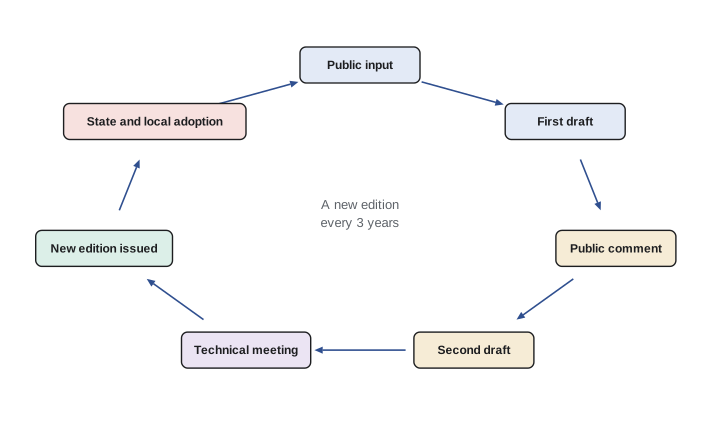
Because every change has a written reason, the reasons are a useful study tool. Many publishers produce books and articles that summarize the changes in each edition. You do not need to read the official records to pass an exam, but when a rule seems strange, learning why it was added usually makes it easier to remember.
From model code to law: adoption
Here is the point that surprises many electricians: on its own, the NEC is not law. It is a model code, a document that governments can choose to adopt. It becomes enforceable only when a state, county or city adopts it by statute, regulation or ordinance. Until then it is simply a very influential book.
Adoption happens in several ways. In many states the legislature or a state agency, such as a building code council, electrical board or department of labor, adopts a specific edition statewide, often with a list of amendments. In some states there is no statewide electrical code for every building, and adoption is left to cities and counties, so neighboring towns can be on different editions. Some states adopt the NEC through a broader building code package, because the International Residential Code and International Building Code refer to the NEC for electrical work. Federal facilities and some special occupancies have their own rules on top of all this.
| Adoption pattern | How it works | What it means for you |
|---|---|---|
| Statewide adoption | A state agency or the legislature adopts one edition, usually with amendments, for the whole state | One edition applies almost everywhere; check the state amendments |
| Local adoption | Cities and counties adopt their own edition and amendments | The edition can change when you cross a city line; ask each authority |
| Mixed | A statewide minimum, with local authorities allowed to add stricter amendments | Know both layers; the stricter local rule usually controls |
| Through a building code | The building code adopted for the state or city refers to a specific NEC edition | Read the building code adoption to learn which NEC edition applies |
Adoption takes time. A state might start its review after a new edition is issued, hold hearings, write amendments and set an effective date a year or more later. Some states move to each new edition within a year or two; others skip an edition or stay on an older one for years. As a result, at any moment in the United States, electricians are working under several different editions. For an exam candidate, the edition that matters is the one your licensing authority names for the exam, which may not be the newest one. Some licensing boards had already moved their exams to the 2026 edition by late 2026, while many others were still testing on 2023 or even 2020.
The authority having jurisdiction
Once the Code is adopted, someone has to enforce it. The NEC calls that person or organization the authority having jurisdiction, almost always shortened to AHJ. In Harlow the AHJ for most buildings is the city's building department, where Gloria Haynes is the chief electrical inspector. In other places it might be a state electrical division, a county, a fire marshal, an insurance inspector, or the owner's own engineer on a large industrial site.
Article 90 gives the AHJ real powers. The AHJ interprets the rules, decides whether equipment and materials are approved, and can grant special permission for alternative methods when the same level of safety is achieved, usually in writing. When the Code says something must be acceptable to the authority having jurisdiction, or approved, it is handing that decision to the inspector. That is why experienced contractors talk to the inspector early on unusual jobs rather than arguing after the fact.
Gloria puts it this way when Dana asks her about the exam: 'The exam tests whether you can find and read the rule. Out here, I also want you to understand why the rule exists, because then you will make the same call I would make when the book doesn't spell it out.' That combination, knowing the text and understanding the purpose, is exactly what a master license is meant to certify.
Why a master license exists
Licensing structures differ from state to state, but most follow a ladder. An apprentice works under supervision while completing classroom hours. A journeyman, after a set number of years and hours and an exam, can work without direct supervision but usually cannot run a business or take responsibility for permits. A master electrician, or in some states an electrical contractor or administrator, has more experience, has passed a harder exam and can take legal responsibility for electrical work: pulling permits, supervising journeymen and apprentices, and often qualifying a company to operate.
| Level | Typical requirements | Typical privileges |
|---|---|---|
| Apprentice | Registered with the state or a program; classroom hours each year | Works under the supervision of a licensed electrician |
| Journeyman | Several years and thousands of hours of experience, plus an exam | Works without direct supervision under a contractor |
| Master | More experience, often including time as a journeyman, plus a harder exam | Plans and supervises work, pulls permits, often qualifies a business |
| Contractor | In some states a separate business license, with insurance, bonding and sometimes a business and law exam | Bids and contracts for electrical work |
Master exams are harder than journeyman exams in a few predictable ways. There are more calculation questions, especially service and feeder load calculations, motor circuits and voltage drop. There are more questions on commercial and industrial occupancies, hazardous locations, emergency systems and other specific equipment. There are more questions that require you to combine two or three rules. And the time limit, though often generous on paper, is tight once you account for the lookups. Lessons 7, 11 and 12 of this course are about working at exam speed.
How the exam treats the Code
Most state master exams are given by a testing company such as PSI, Prometric or Pearson VUE, in a test center on a computer, though a few states run their own. The details vary, and you must read your own candidate bulletin, but the typical pattern looks like this. Treat the numbers as an illustration, not as your state's official rules.
| Feature | Typical arrangement |
|---|---|
| Format | Multiple choice, delivered on a computer at a test center |
| Length | Roughly 80 to 100 questions |
| Time | Roughly 3 to 5 hours, sometimes split into a code portion and a business and law portion |
| References | Open book: the bound edition of the NEC named in the bulletin, sometimes with other listed references |
| Book rules | Permanent tabs and highlighting usually allowed; loose notes, sticky notes and handwritten pages usually not |
| Calculator | A basic or approved calculator; some centers provide one on screen |
| Passing score | Commonly 70 or 75 correct out of each 100 |
Texas is a useful real example. Its licensing agency gives electrician exams through PSI, states that the examinations are open book, requires a score of 70 or better, and by late 2026 named the 2026 edition of the NEC as the reference. Other states differ on every one of those points, which is why each state program in this site's electrical licensing area has its own course. This course and the other core courses teach what is common to all of them.
Open book does not mean easy. The trap is that candidates who know the book is available stop learning where things are. With about two to three minutes per question, there is no time to read an article from the beginning. The candidates who pass can turn to the right article in seconds, find the right section in under a minute, and read the words carefully enough to choose between two answers that look almost the same.
# How much time do you have per question?
exam_minutes = 4 * 60      # an illustrative 4-hour exam
questions = 100
review_minutes = 20        # keep time to revisit flagged questions

per_question = (exam_minutes - review_minutes) / questions
print(f"Minutes per question: {per_question:.1f}")
print(f"Seconds per question: {per_question * 60:.0f}")Minutes per question: 2.2 Seconds per question: 132
With an illustrative four-hour, 100-question exam and twenty minutes held back for review, Dana has about 2.2 minutes per question. Some questions, such as a definition or a single dimension, take thirty seconds. A dwelling load calculation can take eight minutes. The budget is an average, and it only works if the easy questions really are fast. That is the theme of this whole course: make the common lookups automatic so that time is available for the hard ones.
Dana's starting point
Dana takes a practice exam in her first week, before studying, to find out where she stands. She scores 58 out of 100 and runs out of time with fourteen questions unanswered. When she and Marcus go through it together, a pattern appears. She knew the answers to most of the questions she missed in the field: what size equipment grounding conductor to run, how much clearance to leave in front of a panel, when a receptacle needs ground-fault protection. What she lost was time, searching for rules she knew existed but could not find quickly, and points, misreading a few questions that turned on a single word such as 'not' or 'minimum'.
That is the most common starting profile for experienced journeymen, and it is good news, because both problems respond quickly to practice. Dana sets herself a twelve-week plan of eight to ten hours a week. The first four weeks are about the structure of the book and its language, which is lessons 2 through 8 of this course. The middle weeks are about the calculations and specific occupancies covered in the other core courses. The last weeks are timed practice with a tabbed book.
| Weeks | Focus | Course |
|---|---|---|
| 1 to 4 | Code structure, definitions, Article 110, tables, exceptions, the index, precise reading | MELU-101 (this course) |
| 5 to 7 | Load calculations, conductors and overcurrent protection, grounding and bonding | MELU-102 to MELU-104 |
| 8 to 9 | Motors, transformers and specific occupancies | MELU-105 and MELU-106 |
| 10 | Business, law and your state's licensing rules | MELU-107 and your state course |
| 11 to 12 | Full timed practice exams; review of missed questions | All courses |
Common mistakes
MistakeAssuming the newest edition of the NEC is the one on your exam.
InsteadRead the candidate bulletin. Your exam uses the edition your licensing authority names, which is often one edition behind the newest.
MistakeTreating the NEC as a design guide that guarantees a good installation.
InsteadArticle 90 says the Code sets minimum requirements for safety, not efficiency, convenience or future expansion.
MistakeThinking the NEC is law everywhere because it is a national code.
InsteadIt becomes law only when a state or local government adopts it, often with amendments.
MistakeArguing with the inspector about a rule that says the authority having jurisdiction decides.
InsteadWhere the Code says approved or acceptable to the authority having jurisdiction, the inspector has the final word; talk early.
MistakeRelying on open book instead of learning where things are.
InsteadThere are only a couple of minutes per question; fast navigation is the main exam skill.
Summary and key terms
- The NEC is a consensus standard published by the NFPA and revised every three years by code-making panels and a correlating committee.
- Its purpose, stated in Article 90, is practical safeguarding of people and property from electrical hazards; it sets minimums, not design goals.
- It becomes law only when adopted by a state or local government, often with amendments and an effective date well after publication.
- The authority having jurisdiction enforces the Code locally, interprets it, approves equipment and can grant special permission.
- Master exams are usually open book, timed and computer based; the edition and rules come from your state's candidate bulletin.
- Fast navigation and careful reading, not memorization, are the skills that decide most exam results.
- NFPA
- The National Fire Protection Association, which publishes the NEC and manages its revision process.
- Code-making panel
- A committee responsible for revising a group of NEC articles.
- Correlating committee
- The committee that coordinates the panels and keeps the whole Code consistent.
- Model code
- A code written for governments to adopt; it has no legal force until adopted.
- Adoption
- The act of a state or local government making a code edition enforceable, often with amendments.
- Authority having jurisdiction (AHJ)
- The organization, office or person responsible for enforcing the Code and approving installations.
- Candidate information bulletin
- The document from a licensing board or testing vendor that sets the rules, references and content of an exam.
Practice problems
Work each problem on paper first, then reveal the answer to check.
Your state adopted a new edition with an effective date next January, but your exam bulletin names the previous edition. Which edition should you study for the exam?
Show answer
The edition named in the bulletin. Study the new edition for field work after it takes effect, but sit the exam with the edition the bulletin requires.
A client asks whether a Code-compliant installation will be adequate for a planned expansion. What does Article 90 suggest you tell them?
Show answer
That the Code sets minimum safety requirements and does not ensure the installation is adequate for future expansion; capacity for growth is a design decision.
An exam is 4.5 hours long with 90 questions. If you keep 30 minutes for review, how many minutes do you have per question?
Show answer
(270 minus 30) divided by 90, about 2.7 minutes per question.
Name two ways the NEC can become law in a state.
Show answer
Statewide adoption by a state agency or legislature, local adoption by cities and counties, or adoption through a building code that references the NEC.
Who decides whether a piece of equipment is approved under the NEC?
Show answer
The authority having jurisdiction.
Lesson quiz · 5 questions
Score 60% or more to complete this lesson.
Create a free account to save your progress, take quizzes and earn a certificate.