
MELU-101 · Lesson 7 of 12 · 23 min
The index and fast lookup methods
▶ Video coming soon A video version of this lesson is on the way.
In week three Dana times herself on fifty lookups chosen at random from a question bank. Her average is 2 minutes 40 seconds per lookup, longer than her whole time budget per question. Marcus, who has used the index for years, averages 55 seconds. When Dana watches him work, she sees that he is not reading faster; he is choosing better places to start. This lesson covers the three ways into the Code, the table of contents, the index and your own knowledge of the structure, and how to pick the fastest one for each question.
Three ways in
Every lookup starts with a decision about where to open the book. You have three choices, and the best candidates switch between them without thinking.
| Method | Best for | Weakness |
|---|---|---|
| Structure (your mental map and tabs) | Topics you know well: working space, branch circuits, grounding, motors, a wiring method | Fails when you guess the wrong article |
| Table of contents | Knowing the subject but not the article; finding a part within a large article | Lists articles and parts, not individual rules |
| Index | Specific items, unusual equipment, terms you have never looked up | Uses the Code's own terms, which may not match your words |
The structure method is fastest when it works, which is why lessons 2 and 11 spend so much time on it. If a question is about the working space in front of a panel, a candidate who knows Article 110 can open to 110.26 directly. The table of contents is the next step when you know the subject area but not the article, for example a question about elevators or carnivals. The index is for everything else, and for many questions about specific items it is the fastest of all.
How the index is organized
The index at the back of the NEC lists terms alphabetically with subentries beneath them, and each entry points to one or more article, section or table numbers. It is detailed, with thousands of entries, and it cross-references related terms with see and see also entries. Learning to use it well is mostly learning to think in the Code's vocabulary.
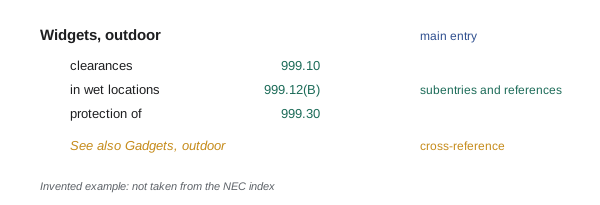
| Index feature | What it does | How to use it |
|---|---|---|
| Main entry | A term in the Code's vocabulary | Start with the most specific noun in the question |
| Subentry | A narrower aspect of the main term | Scan the subentries for the condition or location in the question |
| Reference | Article, section or table number | Go straight to the most specific reference listed |
| See | The term is indexed under a different word | Follow it; nothing is listed here |
| See also | Related entries elsewhere | Check them if the first entry does not answer the question |
The key skill is choosing the entry word. The index is built around the Code's nouns: things such as boxes, receptacles, conductors, motors, services, swimming pools and grounding electrodes. Questions are written in exam language, which often uses a verb or a field term. Translate the question into the most specific Code noun before you open the index. A question about how deep to bury a cable becomes cover requirements or underground wiring; a question about plugging in a hair dryer near a tub becomes receptacles in bathrooms.
| The question says | Try these index words |
|---|---|
| How deep to bury | Underground wiring; cover requirements; direct burial |
| How far apart to strap | Securing and supporting; the specific wiring method |
| How big a ground wire | Equipment grounding conductors; grounding electrode conductors |
| How much room in front of the panel | Working space; spaces about electrical equipment |
| Can I put a light in the closet | Luminaires, clothes closets; clothes closets |
| Do I need a GFI | Ground-fault circuit interrupters; the location, such as bathrooms or kitchens |
| How many wires in this box | Boxes, fill; box fill calculations |
| Power to a hot tub | Spas and hot tubs; swimming pools, fountains and similar installations |
The table of contents as a fast map
The table of contents lists every article and every part, with page numbers. For a subject you know but cannot place, it is often faster than the index, because the list is short enough to scan in seconds and the part titles show you where within a large article to look. Dana discovers that for questions about large articles such as 230, 250, 430 and 517, opening the table of contents first, finding the right part, and then opening to the part's first page beats both guessing and the index.
Worked problem
Table of contents beats the index
Practice question: a building has a service rated 1200 amperes on a 480Y/277-volt system. What additional protection does the Code require for the service disconnect? (The answer involves ground-fault protection of equipment.)
Show solution
- Dana knows the subject is the service and its overcurrent protection, so Article 230 applies.
- The table of contents shows Article 230 Part VII, Service Equipment, Overcurrent Protection.
- She opens to the first page of Part VII and scans the bold section titles.
- Ground-fault protection of equipment is a section in that part, with conditions based on voltage and service disconnect rating.
- Elapsed time: about 50 seconds, compared with almost two minutes the week before using the index.
Answer: Go to Part VII of Article 230, find the ground-fault protection of equipment section, and check its voltage and ampere conditions in your edition.
Strategies that save time
Marcus and Dana trade techniques over several study nights and settle on a handful that make the biggest difference.
- Start specific. Look up the most specific noun in the question. Swimming pool receptacles is faster than receptacles, and receptacles is faster than outlets.
- Use the first good reference. When an index entry lists several references, pick the one that best matches the question, go there, and come back only if it is wrong.
- Read the bold titles first. Once you are in the right article, scan the bold section and subdivision titles rather than reading text.
- Know the tables by number. Many questions can be answered from a table, and tables are numbered after their sections, so knowing the section number means knowing the table number.
- Use the uniform layout. For Chapter 3 wiring methods, the section number tells you the subject, as lesson 2 showed.
- Set a stop time. If a lookup passes two minutes, mark the question, choose your best answer, and move on. Come back with the time you saved on easy questions.
That last strategy is the hardest to follow. Candidates hate leaving a question unfinished, especially one they feel they should know. But the exam rewards total correct answers, not the satisfaction of finishing each one. A question that takes eight minutes costs four easier questions you may not reach.
Measuring your lookup speed
Dana tracks her lookup times in a simple log. Each practice session she records the question topic, the method she used, and how long it took. After a week the pattern is clear: index lookups for unfamiliar terms are fast, structure lookups for familiar topics are fastest, and her worst times come from starting in the wrong article and refusing to switch.
# Dana's lookup log for one practice session (times in seconds)
log = [("working space", "structure", 22), ("pool receptacles", "index", 48),
       ("service GFP", "contents", 51), ("box fill", "structure", 35),
       ("carnival rides", "index", 70), ("motor overloads", "structure", 40),
       ("burial depth", "index", 44), ("EMT support", "structure", 18)]

by_method = {}
for topic, method, secs in log:
    by_method.setdefault(method, []).append(secs)
for method, times in sorted(by_method.items()):
    print(f"{method:10} average {sum(times) / len(times):5.1f} s over {len(times)} lookups")
print(f"Overall average {sum(s for *_, s in log) / len(log):.1f} s")contents average 51.0 s over 1 lookups index average 54.0 s over 3 lookups structure average 28.8 s over 4 lookups Overall average 41.0 s
By the end of week five her average lookup is down to 62 seconds, close to Marcus's. More important, her slowest lookups are now under two minutes, which means she is no longer losing whole blocks of time to single questions.
Lookups that need two places
Master exam questions often require two lookups: a rule and a table, a definition and a rule, or a general rule and a specific one that modifies it. Plan both before you start. For a question on the equipment grounding conductor for a feeder in parallel, for example, you know you will need the equipment grounding conductor table and the section on parallel conductors. Finding both before reading in detail saves you from reading one, losing your place, and starting again.
Worked problem
A two-place lookup
Practice question: what is the minimum size copper equipment grounding conductor for a branch circuit protected by a 60-ampere breaker to the Copper Kettle's walk-in cooler?
Show solution
- The size of an equipment grounding conductor is set by Table 250.122, entered with the rating of the overcurrent device.
- Dana also checks 250.122(B), because if the ungrounded conductors were increased in size for voltage drop, the equipment grounding conductor would have to be increased proportionally.
- The question gives no increase in the ungrounded conductors, so the table value applies directly.
- She reads the copper column in the row covering a 60-ampere device.
Answer: Read the copper size for a 60-ampere device in Table 250.122, with no proportional increase because the circuit conductors were not upsized.
When the index lets you down
Sometimes you cannot find a term in the index, usually because the question uses a word the Code does not. When that happens, try a synonym, try the location instead of the equipment, or go to the table of contents and think about which chapter would hold the topic. For special equipment and occupancies, Chapters 5, 6 and 7 have relatively few articles, and scanning their titles is quick.
| Problem | What to try next |
|---|---|
| The word is not in the index | A synonym in Code language, or the location instead of the equipment |
| The entry has many subentries | Scan for the condition, occupancy or voltage in the question |
| The reference leads to a general rule | Check whether a specific article in Chapters 5 to 7 modifies it |
| You find two possible sections | Read the scope of each; the narrower one usually applies |
| You are past two minutes | Mark the question, choose your best answer, and move on |
Building a personal lookup list
By week six, Dana has a list of about forty lookups she meets again and again in practice questions, each with its location in her book. She does not memorize the answers, because the exam lets her bring the book, but she does memorize the locations. When a question on the equipment grounding conductor for a feeder appears, her hand goes to the Table 250.122 tab without thinking. When a question on the number of service disconnects appears, she opens to the disconnecting means part of Article 230. The list becomes the backbone of her tabs in lesson 11.
| Common lookup | Location (2023 numbering) |
|---|---|
| Working space depth | Table 110.26(A)(1) |
| Equipment grounding conductor size | Table 250.122 |
| Grounding electrode conductor size | Table 250.66 |
| Conductor ampacity | Table 310.16 |
| Burial depth | Table 300.5 |
| Box fill volume per conductor | Table 314.16(B) |
| Motor full-load current, three phase | Table 430.250 |
| Standard overcurrent device ratings | 240.6(A) |
A personal list is different from a memorized answer key. Code values change between editions, and a location you have practiced finding is still useful when the number in the table changes. Make your list in your own handwriting as you study, then check every entry against the edition named in your bulletin before you build your tabs.
Marcus adds one more idea from his years of using the index: when two index entries both seem to fit, go to the one with the fewer references. A short entry usually points straight to a specific rule, while a long one is a general topic that will need more scanning. It is not always right, but it is right often enough to save time.
Common mistakes
MistakeLooking up the general word in the question, such as outlets or wires.
InsteadTranslate the question into the most specific Code noun first, such as swimming pool receptacles.
MistakeReading every reference under an index entry.
InsteadGo to the best match first and return only if it does not answer the question.
MistakeRefusing to leave a question you feel you should know.
InsteadSet a stop time, mark the question, and come back if time allows.
MistakeIgnoring the table of contents.
InsteadFor large articles, the part titles in the contents are often the fastest route.
MistakeLosing your place on two-step questions.
InsteadPlan both lookups before reading in detail, and keep a finger on the first page.
Summary and key terms
- There are three ways into the Code: your knowledge of the structure, the table of contents and the index.
- Structure is fastest for familiar topics; the contents for large articles and their parts; the index for specific items and unfamiliar terms.
- The index uses the Code's nouns, so translate exam language into Code language first.
- See and see also entries redirect you; follow them rather than giving up.
- Track your lookup times and set a stop time of about two minutes per question.
- Plan both lookups for questions that need a rule and a table, or a general and a specific rule.
- Index
- The alphabetical list of terms at the back of the Code, pointing to article, section and table numbers.
- Main entry
- A term in the index under which subentries are listed.
- Subentry
- A narrower aspect of a main entry, such as a location or condition.
- See also
- An index cross-reference to related entries.
- Stop time
- A personal time limit after which you mark a question and move on.
Practice problems
Work each problem on paper first, then reveal the answer to check.
A question asks how deep to bury PVC conduit under a parking lot. Which index words would you try?
Show answer
Underground wiring, cover requirements, or the rigid PVC conduit article, leading to Table 300.5.
You know a question is about emergency systems but not the article. What is the fastest route?
Show answer
The table of contents, Chapter 7, where Article 700 covers emergency systems.
An index entry lists six references. What should you do?
Show answer
Pick the reference that best matches the question, go there, and return only if it is wrong.
Your lookup has taken 2 minutes 30 seconds and you are not close. What should you do?
Show answer
Mark the question, choose your best answer, and move on.
Why is translating exam language into Code nouns important?
Show answer
Because the index is organized around the Code's own terms, which often differ from field or exam wording.
Lesson quiz · 5 questions
Score 60% or more to complete this lesson.
Create a free account to save your progress, take quizzes and earn a certificate.