
MELU-101 · Lesson 10 of 12 · 20 min
Changes in the 2023 edition and what the 2026 edition brings
▶ Video coming soon A video version of this lesson is on the way.
Every three years the NEC changes, and every three years a group of exam candidates loses points because they studied the wrong edition, or because their field habits come from an older one. Dana learned the trade on the 2014 and 2017 editions and has worked under 2020 and 2023 since. Some of what she knows by heart has moved or changed. This lesson covers how to study edition changes efficiently, the broad changes in the 2023 edition, and the larger reorganization in the 2026 edition, so that you can work confidently whichever edition your exam names.
The changes summarized here are the broad structural ones that affect navigation. Each edition also makes hundreds of technical changes to specific rules, which the other core courses cover where they matter. Always confirm details in your own copy of the edition you are using.
How to study edition changes
Publishers and training organizations produce summaries of significant changes for each edition, and many code books are available in an edition that marks changed text. Those marks are useful for experienced electricians, because they show exactly where habits may be out of date. The most efficient approach is to study the edition named in your bulletin as if it were new, then use a change summary to find the places where your field habits differ from it.
| Kind of change | Example | Effect on you |
|---|---|---|
| Relocation | A section or article moves to a new number | Your tabs and memorized numbers are wrong; rule may be unchanged |
| Revision | Wording or values change | The answer to a familiar question may change |
| New requirement | A rule is added for new equipment or new hazards | New questions you have not seen before |
| Deletion | A rule or article is removed | An answer that used to be right may now be wrong |
| Editorial | Lists, definitions or terms are reformatted | Easier reading, but different layout |
Relocations cause the most trouble for experienced candidates. A rule may be unchanged in substance but sit at a new section number, so a candidate who knows the old number confidently opens the book to the wrong place. When you switch editions, build your tabs from scratch rather than copying an old book's tabs.
The 2023 edition: broad changes
The 2023 edition continued several long-running trends and made a few structural changes that matter for navigation.
- Definitions consolidated. Almost all definitions were gathered into Article 100, with many entries noting the article where the term is used. In earlier editions, many terms were defined in the .2 section of individual articles. If you learned to look up pool or solar terms in 680.2 or 690.2, look in Article 100 instead.
- Higher voltage thresholds. Many rules that used to divide installations at 600 volts now divide them at 1000 volts, continuing a change begun in earlier editions, and material for higher-voltage installations was gathered into separate articles, such as Article 235 for branch circuits, feeders and services over 1000 volts and Article 245 for their overcurrent protection.
- Power-limited circuits reorganized. The rules for Class 1, Class 2 and Class 3 circuits were reorganized into separate articles, with general cable rules collected in one article and Class 2 and Class 3 circuits remaining in Article 725.
- Personnel protection expanded. The ground-fault circuit-interrupter and arc-fault circuit-interrupter requirements continued to grow to more locations and equipment, a trend in every recent edition.
- Emerging technologies. Rules for energy storage systems, interconnected power sources, electric vehicle charging and power-over-Ethernet style systems continued to develop.
None of these change how you read the Code, but each one changes where you look or what answer is current. If your exam is on 2023 and you learned on 2017, the consolidated definitions and the reorganized power-limited articles are the first places to retrain your hands.
The 2026 edition: a larger reorganization
The 2026 edition made more structural changes than any edition in years, and it signaled even bigger ones to come. Trade press coverage in 2026 highlighted these points.
| Change in 2026 | What it means for navigation |
|---|---|
| Load calculations moved from Article 220 to Article 120 | Every load calculation lookup moves from Chapter 2 to Chapter 1; re-tab the load calculation article |
| Energy management systems moved to Article 130 | Another Chapter 1 addition |
| Material for over 1000 volts AC or 1500 volts DC gathered into Articles 265 through 270 | Medium-voltage rules are in one place instead of several |
| Section 90.3 revised so Chapter 8 no longer stands apart from Chapters 1 through 7; much of its material moved into Chapter 7 | Communications systems are now treated like other systems; the old Chapter 8 is much smaller |
| New Article 206 for control and signaling circuits that are not power limited, and Article 624 for EV charging equipment outside Article 625 | New articles to find in the contents |
| Articles 770, 805 and 840 deleted; their material relocated | Old numbers for optical fiber and some communications articles no longer exist |
| Chapter titles for Chapters 5, 6 and 7 use specific rather than special | Same idea, new wording in 90.3 and the contents |
| Long sentences broken into lists; OCPD used for overcurrent protective device; more DC rules throughout | Easier reading, but layouts differ from 2023 |
| Informative Annex L added to preview a reorganization planned for the 2029 edition | The nine-chapter layout is expected to expand in the next edition |
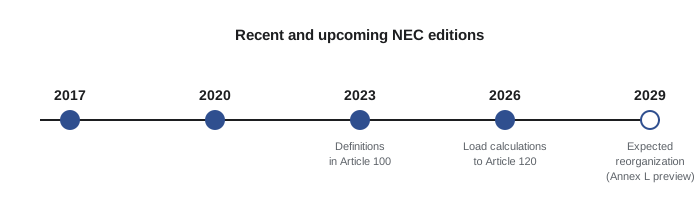
The move of load calculations from Article 220 to Article 120 is the single change most likely to affect a master exam, because load calculations are a large part of every master exam. Candidates moving from 2023 to 2026 have to retrain the reflex of opening to Article 220, and the section numbers they use within it change too. MELU-102 covers load calculations and notes the numbering in both editions.
The 2026 changes to Chapter 8 matter less for most master exams, which have few communications questions, but they matter for candidates who also work on low-voltage systems. And Annex L is a signal to plan ahead: the expected 2029 reorganization into many more chapters will change navigation more than any edition so far.
Which edition will your exam use?
Licensing boards move to new editions on their own schedules. Some move within a year of a state adopting a new edition; others wait for the testing vendor to rewrite the question bank. By late 2026 some boards, such as the Texas licensing agency, named the 2026 edition for their electrician exams, while many others still tested on 2023 or 2020. The edition named in your bulletin on the day you test is the one that counts.
Worked problem
Choosing what to study
Dana plans to test in about three months. Her state adopted the 2023 edition, and the board has announced that exams will move to the 2026 edition on a date about five months away.
Show solution
- The bulletin in force when she tests will name the 2023 edition, because she will test before the change date.
- She studies and tabs the 2023 edition for the exam.
- She reads a summary of 2026 changes so she is ready for field work when the state adopts it, but does not let it distract her before the exam.
- If her exam date slips past the change date, she must switch books and re-tab, so she books her exam early to avoid that risk.
Answer: Study the 2023 edition and book the exam before the switch date. A slipped exam date is the biggest risk.
# Which edition applies on test day? (illustrative dates)
from datetime import date

exam_date = date(2027, 2, 15)
switch_date = date(2027, 4, 1)      # the board's announced change to the 2026 edition
edition = "2023" if exam_date < switch_date else "2026"
print("Study edition:", edition)
print("Days of margin before the switch:", (switch_date - exam_date).days)Study edition: 2023 Days of margin before the switch: 45
Keeping field habits current
For a master electrician, keeping up with the Code is a career-long task. Most states require continuing education for license renewal, often including a set number of hours on Code changes in each renewal cycle. Brightwater sends its electricians to a Code update class each time the state adopts a new edition, and Ray keeps a list of the changes that affect the company's typical work: dwelling GFCI and AFCI locations, service disconnect rules, and the equipment the company installs most often.
| Habit | Why it helps |
|---|---|
| Attend a Code update class for each new edition | Learn the changes that matter for your work from someone who has studied them |
| Keep a list of changes that affect your typical jobs | Fast reference for estimating and planning |
| Re-tab your book for each new edition | Avoid opening to old section numbers |
| Read the AHJ's bulletins after a new adoption | Learn how the new rules will be enforced locally |
| Track continuing education hours | Meet license renewal requirements on time |
Using a change summary efficiently
Dana's approach to the 2023 changes is a good model. She buys a change summary book for the edition named in her bulletin and goes through it with two highlighters: one color for changes that affect the kind of work Brightwater does, and another for changes that are likely to be tested, such as new numbers, new locations requiring protection, and relocated sections. Then she does a quick lookup drill on the relocated sections only, so her hands learn the new locations. The whole exercise takes about six hours over two weeks.
| Category | What Dana does with it |
|---|---|
| Relocated sections | Lookup drill until the new location is automatic |
| Changed values or limits | Highlight the new values in her book |
| New requirements for common work | Add to Brightwater's list of changes for estimating |
| New articles for new technologies | Read the scope and skim the structure |
| Editorial changes | Note only where they change the layout she tabs |
The same approach will work for the 2026 edition when her state adopts it. Because the 2026 changes are more structural, she expects to spend more time on lookup drills and re-tabbing, especially for load calculations in their new Article 120 and for the reorganized medium-voltage and communications material. Ray, who has seen more editions than he cares to count, has a simple rule: 'Every new book is a new book. Learn it like the first one.'
One more point is worth remembering for the exam. Exam question banks are revised when a board changes editions, but practice question books may lag behind. When a practice question's answer seems wrong for your edition, check whether the rule changed; you may have found an out-of-date question rather than a gap in your knowledge.
What does not change
For all the churn between editions, the core of the Code is remarkably stable. The purpose in Article 90, the arrangement of general and specific chapters, the meaning of the defined terms, the habits of reading shall and shall be permitted, the role of the AHJ and the importance of following listing instructions have been the same for decades. The methods in this course, from reading tables to following exceptions, work in every edition. That is why Dana spends most of her study time on method and structure and a smaller share on memorizing specific changes: the method will still work in 2029, when the book may look very different.
Edition changes also have a human side. Inspectors, contractors and engineers all learn a new edition at the same time, and there is usually a period after adoption when interpretations settle. Gloria tells Dana that in the first months after Harlow adopts a new edition, she expects more questions from contractors and is more willing to discuss unclear new rules. A master electrician who reads the changes early, asks good questions and documents the answers is a welcome partner during that period.
Common mistakes
MistakeCopying tabs from an old code book into a new edition.
InsteadRe-tab each new edition from scratch, because sections move.
MistakeStudying the newest edition when the bulletin names an older one.
InsteadStudy the edition named in the bulletin on your test date.
MistakeLooking for article definitions in .2 sections in the 2023 or 2026 edition.
InsteadAlmost all definitions are in Article 100 in recent editions.
MistakeOpening to Article 220 for load calculations in a 2026 code book.
InsteadIn 2026, load calculations moved to Article 120.
MistakeAssuming a rule is unchanged because its section number is the same.
InsteadCheck change summaries for revised wording and values.
Summary and key terms
- Each edition relocates, revises, adds and deletes rules; relocations cause the most navigation errors.
- The 2023 edition consolidated definitions in Article 100, continued the move to 1000-volt thresholds, reorganized power-limited circuits and expanded personnel protection.
- The 2026 edition moved load calculations to Article 120, gathered medium-voltage rules in Articles 265 to 270, folded most of Chapter 8 into Chapter 7, added new articles and previewed a 2029 reorganization in Annex L.
- Your exam uses the edition named in your bulletin on your test date.
- Re-tab each new edition and keep field habits current with update classes and continuing education.
- Relocation
- A rule moved to a new section or article number, often with its substance unchanged.
- Change summary
- A publication listing significant changes in a new edition.
- Annex L
- An informative annex in the 2026 edition previewing a planned reorganization for 2029.
- Continuing education
- Training required for license renewal, often including Code update hours.
Practice problems
Work each problem on paper first, then reveal the answer to check.
In the 2026 edition, where are dwelling load calculations?
Show answer
In Article 120, moved from Article 220.
Your old 2017 book has definitions for pools in 680.2. Where would you look in the 2023 edition?
Show answer
Article 100, where almost all definitions were consolidated.
Your exam is in four months; the board switches to a new edition in six months. Which edition should you study?
Show answer
The current edition named in the bulletin, and book the exam before the switch date.
Why should you re-tab a new edition rather than copy old tabs?
Show answer
Because sections and articles move between editions.
What does Annex L in the 2026 edition signal?
Show answer
A planned reorganization of the Code into more chapters in the 2029 edition.
Lesson quiz · 5 questions
Score 60% or more to complete this lesson.
Create a free account to save your progress, take quizzes and earn a certificate.