
LES-205 · Lesson 9 of 12 · 20 min
Missing and murdered Indigenous people
▶ Video coming soon A video version of this lesson is on the way.
When Danielle Pelletier came to the front counter of the Port Ardent Police Department at 14:10 on Saturday, February 7, she had been calling her sister for a day and a half. She told the officer at the counter, Officer Josh Kerr, that Tara had not answered calls or messages since Thursday evening, that Tara had never gone more than a few hours without texting her, and that Tara's partner, Ryan Coulter, had told her on the phone that Tara had 'taken off' after an argument and would come back when she cooled down. Kerr, eight months out of the academy, wrote down the details. Then he told Danielle that adults have the right to go missing, that most missing adults turn up within a day or two, and that if Tara had not come home by Monday she should come back.
Danielle did not leave. She told Kerr that two weeks earlier she had seen bruises on Tara's upper arms, that Tara had told her Coulter had taken her bank card and checked her phone, and that Tara had once said, half-joking, 'If anything happens to me, it was him.' Kerr added those details to the report and promised to pass it to his sergeant. At 14:50, Sergeant Lisa Haddad, reviewing new reports, read it, walked out to the counter where Danielle was still waiting, apologized for the wait and told her that the service was treating Tara's disappearance as high risk. Desjardins tells the class that the forty minutes between those two moments are what this lesson is about.
Kerr is not a villain in this story, Desjardins says. He followed a common, mistaken habit: assuming that an adult who has argued with a partner has probably just left, and waiting to see. That habit is wrong for any missing person who is at risk. For Indigenous women, girls and Two-Spirit people, inquiries in both countries have found that the same habit, repeated thousands of times, has been part of a national crisis.
The scale of the crisis
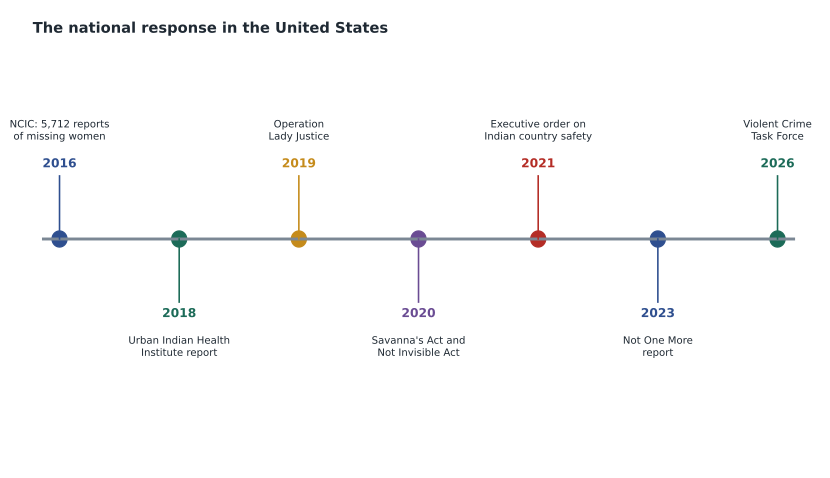
For years, there was no reliable national count of missing and murdered Indigenous people in the United States. In 2016, the FBI's National Crime Information Center recorded 5,712 reports of missing American Indian and Alaska Native women and girls, but only 116 of them had been logged in the Justice Department's National Missing and Unidentified Persons System. A 2018 report by the Urban Indian Health Institute, which looked at 71 cities, found 506 cases of missing and murdered Indigenous women and girls, and found that many had been misclassified, never entered in databases or never recorded as Native at all. Homicide is one of the leading causes of death for young Native women, and studies in several states have found that Native people go missing and are killed at rates far above their share of the population.
Some cases became national symbols. In 2017, Savanna LaFontaine-Greywind, a 22-year-old citizen of the Spirit Lake Nation who was eight months pregnant, was murdered in Fargo, North Dakota, by a neighbor who cut her baby from her body; the baby survived. Her death led directly to Savanna's Act. In 2017, Ashley Loring HeavyRunner, a 20-year-old Blackfeet woman, went missing in Montana; her family organized many of the searches themselves, and she has never been found. Families across Indian country describe similar experiences: reports that were not taken seriously, searches that started late, confusion over which agency was responsible, and long silences from investigators.
Federal laws and commissions
Congress responded with two laws signed on October 10, 2020. Savanna's Act requires the Justice Department to develop guidelines for responding to cases of missing and murdered Native Americans, in consultation with tribes, to improve data collection and access to national databases, and to report statistics each year. The Not Invisible Act created a joint commission of federal officials, tribal leaders, law enforcement and survivors to recommend improvements; its final report, Not One More, was released in November 2023 and called for more resources for tribal justice systems, better coordination and data, and support for families. Executive orders in 2019, which created a task force known as Operation Lady Justice, and in 2021, on improving public safety and criminal justice for Native Americans, directed federal agencies to make the issue a priority.
Federal agencies have created specialized capacity. The BIA Office of Justice Services formed a Missing and Murdered Unit in 2021, the Justice Department placed coordinators for missing and murdered Indigenous persons in U.S. Attorney's offices across the country, and the FBI has assigned resources to the issue. Many states have created task forces or offices, including Minnesota, which opened an Office for Missing and Murdered Indigenous Relatives in 2021, and several states, including California and Washington, have created alert systems for missing Indigenous people similar to Amber Alerts. In May 2026, the Interior Department launched an Indian Country Violent Crime Task Force, building on the earlier work of Operation Lady Justice. Advocates have welcomed the attention but say that families still meet the same problems on the ground, and that commitments often do not outlast funding cycles or changes of administration.
| Problem the inquiries found | What it looked like | What police should do instead |
|---|---|---|
| Stereotypes and dismissal | "She's probably partying"; "she's done this before" | Assess risk on the facts; never assume a lifestyle |
| Delay | Waiting 24 or 48 hours before acting | Act at once; there is no waiting period in law or good practice |
| Poor communication with families | Families not told what is being done, or told nothing at all | One named contact, regular updates, honest explanations |
| Jurisdictional confusion | Cases passed between agencies | One lead agency from the first hour, with partners informed |
| Missing data | Indigenous identity not recorded; deaths misclassified | Ask and record identity respectfully; investigate deaths thoroughly |
Why Indigenous women and Two-Spirit people are at such risk
Researchers, the Not Invisible Act Commission and tribal advocates have linked the violence to the history covered in Lessons 2 and 3 and to present-day conditions: poverty, inadequate housing and services, the trauma of boarding schools and child removal, the arrival of large temporary workforces near some reservations during energy booms, trafficking, and attitudes that treat Native women as less valuable. Jurisdictional gaps add a special risk: until recently, tribes could not prosecute non-Native men who assaulted Native women on reservations, and offenders knew it. As Lesson 1 noted, most Native victims of violence have been harmed by at least one non-Native perpetrator. Most homicides are committed by people the victims know, including partners and family members.
Jesse Morningstar says that in his community, every family he knows has a name. 'You see them on posters, on red dresses hung in the trees in May, at the walks,' he says. 'So when someone's daughter doesn't come home, nobody thinks she's just partying. They think about all the others. That's why the families get angry when an officer tells them to wait. They've seen what waiting costs.'
Red dresses and remembrance
May 5 is observed by many tribes and communities, and has been proclaimed in recent years by presidents and many states, as a National Day of Awareness for Missing and Murdered Indigenous Persons. Red dresses, which began with an art installation by the Métis artist Jaime Black in Canada in 2010, are now hung on trees and fences across Indian country to mark the women and girls who have been lost, and red handprints over the mouth are a common symbol of the silence around the crisis. Several agencies, including the Port Ardent department, now take part in May 5 walks and vigils with Native families.
Worked problem
Was Tara Pelletier at high risk?
Haddad uses the department's missing person risk assessment, which asks about vulnerability, threats, the circumstances of the disappearance and whether the behavior is out of character. Using the facts Danielle gave, how should Tara's case be assessed?
Show solution
- Out of character: Tara had never gone more than a few hours without contacting her sister; silence for about 42 hours is a strong indicator.
- Threat: there were signs of intimate partner violence, including bruising, financial control and monitoring of her phone.
- Statement of fear: Tara had said that if anything happened to her, it would be her partner.
- Circumstances: the last person known to have seen her was the partner, after an argument, and he was minimizing her absence.
- Vulnerability: as an Indigenous woman experiencing partner violence, she belongs to a group the inquiries identified as at elevated risk, though the assessment rests on the specific facts above.
Answer: Every factor points the same way: high risk, requiring an immediate response. None of the facts was hidden; they were all in the first report. What was missing at 14:10 was the habit of assessing risk instead of assuming the explanation offered by the person who may be the source of the danger.
Haddad tells the class what she said to Kerr afterwards. 'I didn't yell at him,' she says. 'I asked him what he'd have done if Danielle had told him her sister was a nurse from the suburbs with a partner who'd hit her. He thought about it and said he'd have called me straight away. I said, then that's what you do every time. He hasn't made that mistake since.'
Counting, identity and the first entry
Haddad tells the class that the data problems the inquiries found begin at the front counter. If an officer does not ask whether a missing person is Indigenous, the record will not show it, and the case will not be counted. If an officer writes a vague description, enters the wrong date of birth or delays entering the case in NCIC and NamUs, other officers who encounter the person will not know she is missing. If a death is classified as an accident without a full investigation, it will never appear in homicide statistics. Each of these errors is small on one file. Repeated across a country, they are part of the reason families say their relatives were made invisible. Accurate, prompt and respectful records are not paperwork; they are part of protecting people.
The Not One More report also drew attention to particular risks: trafficking of Native women and girls, including near large temporary work camps; the dangers faced by Two-Spirit and transgender Native people, whose cases had often not been recognized at all; and the lack of safe transportation and services in many rural areas. It recommended that agencies train officers to recognize trafficking, that tribes have access to national databases and that families have a single point of contact in every case. Agencies that understand these patterns can work with tribes and urban Native organizations on prevention and can recognize the signs of exploitation when they meet a young person on the street.
What families say helps
Families who have lived through a disappearance describe the same few things that helped them. An officer who came to the house quickly and took them seriously. A single person who called them back, every time, even when there was nothing new. Honest answers, including 'I don't know' and 'I can't tell you that yet, and here is why'. Being asked what they knew about their relative's friends, habits and places, and seeing that information used. Being allowed to bring an elder, a friend or an advocate. Being told before the media when there was news. And, when the news was the worst, being told in person, with care, by someone who knew the case. Desjardins tells the class that none of these things costs money. They are matters of habit and respect, and every officer can practice them from the first day.
Common mistakes
MistakePolice must wait 24 or 48 hours before taking a missing adult report.
InsteadThere is no waiting period; risk is assessed immediately and action taken accordingly.
MistakeAn adult who has argued with a partner has probably just left.
InsteadAn argument with a partner who may be abusive is a risk factor, not an explanation.
MistakeThe federal laws of 2020 solved the problem.
InsteadAdvocates say families still meet delays, confusion and silence on the ground.
MistakeViolence against Indigenous women is mainly committed by strangers.
InsteadMost homicides are committed by people the victims know, though Indigenous women are also overrepresented among victims of strangers.
Summary and key terms
- In 2016, NCIC recorded 5,712 reports of missing Native women and girls, only 116 of which were in NamUs.
- Savanna's Act and the Not Invisible Act of 2020 and the Not One More report of 2023 set out federal responses.
- Federal units, state task forces, alert systems and the 2026 Interior task force have added capacity.
- Risk comes from history, present-day conditions and attitudes, and most homicides are committed by people victims know.
- Every missing person report must be assessed for risk at once, without assumptions about lifestyle or culture.
- Savanna's Act
- The 2020 federal law requiring guidelines, data and consultation with tribes on missing and murdered Native Americans.
- Not Invisible Act
- The 2020 federal law that created a joint commission on violent crime against Native people; its report, Not One More, came out in 2023.
- NamUs
- The National Missing and Unidentified Persons System, a national database of missing and unidentified persons cases.
- 2SLGBTQQIA+
- Two-Spirit, lesbian, gay, bisexual, transgender, queer, questioning, intersex, asexual and others; used by the National Inquiry and many communities.
- Two-Spirit
- A term used by many Indigenous people for a person who embodies both masculine and feminine spirits, or for Indigenous people with diverse gender identities and sexual orientations.
- Risk assessment
- A structured review of the facts of a missing person report to decide how urgent the response must be.
Practice problems
Work each problem on paper first, then reveal the answer to check.
What did a comparison of NCIC and NamUs records for 2016 show?
Show answer
NCIC held 5,712 reports of missing Native women and girls, but only 116 were logged in NamUs.
Name the two federal laws signed on October 10, 2020.
Show answer
Savanna's Act and the Not Invisible Act.
Name three patterns the inquiries found in police responses.
Show answer
Any three of: stereotypes and dismissal, delay, poor communication with families, jurisdictional confusion, missing data and misclassified deaths.
Which facts in Danielle's report made Tara's case high risk?
Show answer
Behavior out of character, signs of partner violence and control, her statement of fear, and the circumstances of her last contact with the partner.
Lesson quiz · 5 questions
Score 60% or more to complete this lesson.
Create a free account to save your progress, take quizzes and earn a certificate.