
LES-205 · Lesson 12 of 12 · 20 min
Capstone: reviewing the Pelletier and Beaudry files
▶ Video coming soon A video version of this lesson is on the way.
For the last class, Desjardins hands each student a binder with the two complete files: the missing person report, the investigation notes and the court documents in the Pelletier case, and the arrest report, release documents, pre-sentence report and sentencing transcript in the Beaudry case. Sergeant Haddad, Sergeant Keeshig and Elder Shawanda join the class. The task is the one officers perform in a formal case review: build an accurate timeline, identify what went well and what went wrong, find the root causes rather than only the symptoms, and recommend practical changes, each with someone responsible for it.
Desjardins sets out the rules for the review. It is about systems and decisions, not about blaming individuals; the officer at the counter and the officer who made the arrest are both treated as people who did their best with the habits and guidance they had. Every finding must be supported by the record. And the review must ask what the families and the community would say, not only what the department thinks. 'If Danielle Pelletier and Kyle's grandmother read your review,' he says, 'would they recognize what happened to them?'
The Pelletier file: timeline
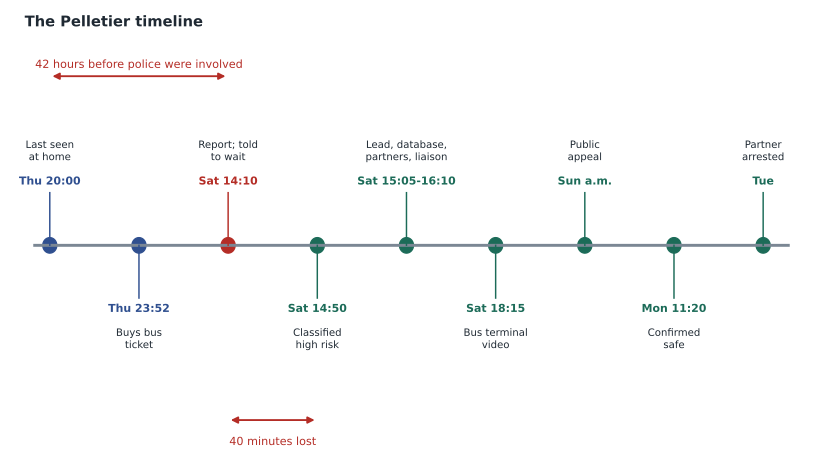
Linh Tran and Priya Sandhu build the timeline of the missing person case from the notes. Tara was last seen at home at about 20:00 on Thursday, February 5, after an argument in which Coulter strangled her against the hallway wall. She bought a bus ticket at 23:52 and left at 00:10. Danielle tried to reach her all day Friday and came to the station at 14:10 on Saturday. The report was taken and the family was told to wait until Monday. Danielle stayed and added the facts that showed risk, and at 14:50 the case was classified high risk. From there, the timeline shows a lead investigator at 15:05, database entry at 15:10, the call to the Nimkii Bay tribal police at 15:20, a family liaison at 15:30, the phone request at 16:10 and the bus terminal video at 18:15. The public appeal went out on Sunday morning, Tara was confirmed safe at 11:20 on Monday and Coulter was arrested on Tuesday.
What went well and what went wrong
The class finds much that went well. Once the risk was recognized, the response was fast and complete: every basic step was taken within about eighty minutes. The emergency request to the phone carrier produced the key lead within hours. The partnership with the Nimkii Bay tribal police worked because the two sergeants knew each other. The family had one contact who kept them informed, and cultural support was offered and accepted. The officers at Coulter's door recorded exactly what they saw and heard without confrontation. The approach to shelters protected Tara's safety and privacy. And when Tara was found, police respected her choices.
The class also finds what went wrong. The forty minutes at the counter were the most visible failure, and only Danielle's persistence prevented a delay of up to two days. Desjardins asks the students to look further back. Why did Danielle wait 42 hours before coming in? The notes from Morin record the answer: Danielle had heard from relatives that police in Port Ardent did not take Indigenous women seriously, and she was afraid of being told to wait, which is exactly what happened. Marco DiSanto points out that the first officers who spoke to Coulter could not have known about the bus video, but that nothing in the file shows anyone asked Coulter for Tara's phone and bank card, which he controlled; the review recommends adding financial and technological control to the risk questions.
| Finding | Root cause | Recommendation | Responsible |
|---|---|---|---|
| Family told to wait at the counter | Habit and lack of guidance for front-line officers | Supervisor risk review of every report within 15 minutes (adopted) | Patrol operations inspector |
| Family waited 42 hours to report | Lack of trust built over many years | Community outreach on how to report a missing person, with the family's permission to use this case | Indigenous liaison officer and advisory circle |
| Financial and phone control not asked about | Risk questions did not cover coercive control | Add coercive control questions to the risk assessment | Major crime unit and domestic violence coordinator |
| Joint case relied on personal relationships | Protocol did not cover missing persons | Rewrite the protocol to cover shared missing person cases (adopted) | Deputy chief, with the Nimkii Bay chief of police |
| Identity not recorded consistently | No field in the report | Record Indigenous identity and nation by asking (adopted) | Records manager |
The Beaudry file
Jesse Morningstar and Amara Okafor lead the review of the Beaudry file. They find that the arrest was lawful and well handled: Okeke and Reyes separated the parties, got the injured man to hospital, recorded the evidence that Hale had shoved Kyle first and noted Kyle's cooperation and his concern for his grandmother. The decision to hold Kyle for his initial appearance was within the law, but the reasons recorded, an address on the reservation and two old probation violations, were weak. The release conditions required him to stay in Ohio, away from his grandmother and his job, and to abstain from alcohol, which he told his lawyer he could not do without treatment; he was lucky not to violate them before his plea. The sentence, with supervision transferred to Michigan and the Nimkii Bay Healing to Wellness Court, connected him with his family and treatment.
Amara raises the victim's perspective. Trevor Hale's statement described three weeks off work, numbness in his face, fear of going out at night and anger that nobody had told him about the plea until the day before. The class agrees that the victim's experience was the weakest part of the file: the officers had treated him well at the scene, but no one had kept him informed afterwards. The prosecutor's victim-witness program had a contact for him but had used it only twice. Elder Shawanda says that in her community's way of thinking, a response that helps Kyle but leaves Hale angry and forgotten has not finished its work. The review recommends that officers make sure every victim of violence is referred to victim services and knows who to call, and that the department check that referrals lead to contact.
| Finding | Recommendation | Responsible |
|---|---|---|
| Weak reasons recorded for holding Kyle | Guidance and training on release decisions and on home communities as addresses | Training unit |
| Conditions that set up a breach | Officers recommend only necessary, realistic conditions and note addiction where known | Court liaison sergeant |
| Victim not kept informed | Confirm victim services referral and contact for every violent offense | Victim services coordinator |
| Community options not known to arresting officers | Pocket guide to diversion, urban Native and tribal programs | Indigenous liaison officer |
Scoring the response
Desjardins asks the class to score both files using a simple rubric that the department uses in case reviews: ten areas, each scored 0 for poor, 1 for partly met and 2 for fully met. The areas are risk recognition, speed of response, investigation, partnership with tribal police and other agencies, family or victim communication, cultural support, respect for rights and privacy, accuracy of records, fairness of release decisions and use of community options. The scores are meant to start a discussion, not to grade anyone.
Worked problem
Scoring the two files
For the Pelletier file, the class scores risk recognition 1, speed of response 2, investigation 2, partnership 2, family communication 2, cultural support 2, rights and privacy 2, records 1, release decisions 2 and community options 2. For the Beaudry file, the class scores risk recognition 2, speed 2, investigation 2, partnership 1, victim communication 0, cultural support 1, rights 2, records 1, release decisions 0 and community options 2. What is each total out of 20, and what is the difference?
Show solution
- Pelletier: 1 + 2 + 2 + 2 + 2 + 2 + 2 + 1 + 2 + 2 = 18.
- Beaudry: 2 + 2 + 2 + 1 + 0 + 1 + 2 + 1 + 0 + 2 = 13.
- Difference: 18 minus 13 is 5.
- Lowest areas: risk recognition and records in Pelletier; victim communication and release decisions in Beaudry.
Answer: The Pelletier file scores 18 of 20 and the Beaudry file 13 of 20. The scores point to the same lesson from different directions: the response was strongest where people followed clear procedures and weakest where officers relied on habit, whether at the front counter or in the release decision, and where nobody owned the follow-up.
What the families said
Haddad shares what the two families said when the department asked them, as part of the real review, what they would want officers to learn. Danielle Pelletier said: 'Believe us the first time. We know our sisters.' Kyle's grandmother, Ruth Beaudry, said: 'He did something wrong and he knew it. What helped was that nobody treated him like he was nothing.' Trevor Hale, asked the same question, said: 'Call me back.' Desjardins writes the three sentences on the board and leaves them there for the rest of the class.
What the course has been about
Desjardins closes the course by returning to the six principles from Lesson 1: respect for self-determination, history that explains the present, knowledge of the law, taking every report seriously, relationships before crises, and cultural humility. Each of them appeared in the two files. Self-determination meant working with the Nimkii Bay tribal police, the tribal court and its Healing to Wellness program as partners. History explained Danielle's 42-hour delay and Kyle's family's experience with institutions. Knowing the law meant knowing how to obtain emergency phone records, how jurisdiction would have worked on the reservation and how release decisions are made. Taking reports seriously was what the counter failed to do and the sergeant did. Relationships before crises were what made the call between Haddad and Keeshig work. And cultural humility was asking Danielle what support she wanted rather than deciding for her.
Keeshig speaks last. He tells the students that most of them will never work in Indian country, but every one of them will meet Indigenous people on calls, as victims, witnesses, suspects, colleagues and neighbors. 'You'll forget the case names,' he says. 'Try not to forget the knock on the door, the forty minutes at the counter and the grandmother in the hallway. If you remember those, you'll figure out the rest.' Elder Shawanda then asks the students to stand, and she offers a few words in Anishinaabemowin, which she translates afterwards: she wishes them a good path, and asks them to walk it in a good way.
Following up and reporting back
A review is only useful if its recommendations are carried out. Desjardins asks the class how the department will know, a year from now, whether the changes worked. The students propose measures for each recommendation: the time from every missing person report to a supervisor's risk review, the share of reports with identity recorded, the number of victims of violence who confirm they were contacted by victim services, and a repeat of the community survey. They agree that the results should be reported, in plain language, to the Indigenous advisory circle and to the Nimkii Bay community, not only to the chief. Haddad says the department has agreed to do exactly that, and to return to the Nimkii Bay hall in a year to report.
Elder Shawanda says that this is the part of the review her community cares about most. 'People have heard a lot of promises,' she says. 'What they want is for you to come back and tell them what you did, and what you didn't do, and why. If you do that, even when the news isn't good, they'll start to believe you.'
Amara Okafor adds that the two files show something the statistics in Lesson 7 cannot: how a single decision feels to the people on the other side of it. A family told to wait, a young man held because his address was on a reservation, a victim who heard nothing for months. 'None of it was dramatic,' she says. 'That's what scares me. It's all stuff I could do on an ordinary Tuesday without noticing.' Desjardins tells her that noticing is the point of the course.
Common mistakes
MistakeA case review should identify who was at fault.
InsteadIt examines systems and decisions, finds root causes and assigns recommendations to people responsible for carrying them out.
MistakeIf a missing person is found safe, the response was a success.
InsteadA good outcome can hide delays and gaps that would be fatal in another case.
MistakeHelping an Indigenous offender is the whole of a fair response.
InsteadVictims, including non-Indigenous victims, must also be informed, supported and heard.
MistakeScores in a rubric are grades for officers.
InsteadThey are a way to start a discussion about where practice can improve.
Summary and key terms
- A case review builds an accurate timeline, identifies strengths and failures, finds root causes and assigns recommendations with owners.
- In the Pelletier file, the response after risk was recognized was fast and complete, but 40 minutes were lost at the counter and 42 hours before the family felt able to report.
- In the Beaudry file, the arrest and sentence were sound, but the release reasons were weak, conditions set up a breach and the victim was not kept informed.
- The families asked officers to believe them, to treat people with dignity and to call back.
- The six principles of the course appeared throughout both files.
- Case review
- A structured examination of how a case was handled, focused on systems, root causes and practical improvements.
- Root cause
- The underlying reason a problem occurred, as opposed to its immediate symptoms.
- Rubric
- A scoring guide that rates performance in defined areas against stated standards.
Practice problems
Work each problem on paper first, then reveal the answer to check.
What four things does a formal case review do?
Show answer
Builds an accurate timeline, identifies what went well and what went wrong, finds root causes and recommends changes with someone responsible for each.
What was the root cause of the 42-hour delay before Danielle reported Tara missing?
Show answer
Lack of trust: she had heard that police did not take Indigenous women seriously and feared being told to wait.
Why did the review recommend adding coercive control to the risk questions?
Show answer
Because no one asked Coulter about Tara's phone and bank card, which he controlled, and such control is a sign of danger.
What did the victim in the Beaudry case ask officers to learn?
Show answer
"Call me back": keep victims informed after the scene.
Lesson quiz · 5 questions
Score 60% or more to complete this lesson.
Create a free account to save your progress, take quizzes and earn a certificate.