
LES-205 · Lesson 10 of 12 · 19 min
Responding to missing person reports and violence
▶ Video coming soon A video version of this lesson is on the way.
Once Sergeant Haddad classified Tara Pelletier's disappearance as high risk at 14:50 on Saturday, February 7, the Port Ardent Police Department moved quickly. By 15:05, Detective Carla Whitlock of the major crime unit had been assigned as the lead investigator. By 15:10, Tara's details were entered in the National Crime Information Center as a missing person. By 15:20, Haddad had phoned Sergeant Keeshig on the Nimkii Bay reservation, who sent an officer to check Tara's mother's and grandmother's houses. And by 15:30, Officer Grace Morin had been assigned as the family's liaison officer and was sitting with Danielle in a quiet interview room, explaining what would happen next.
Desjardins walks the class through the next two days, step by step. 'This file went well,' he says. 'Not because anyone did anything brilliant, but because once the risk was recognized, people did the basic things, in the right order, quickly, and told the family what they were doing. That's what the families who spoke to the inquiries asked for. It isn't complicated. It's just not always done.'
The first hours
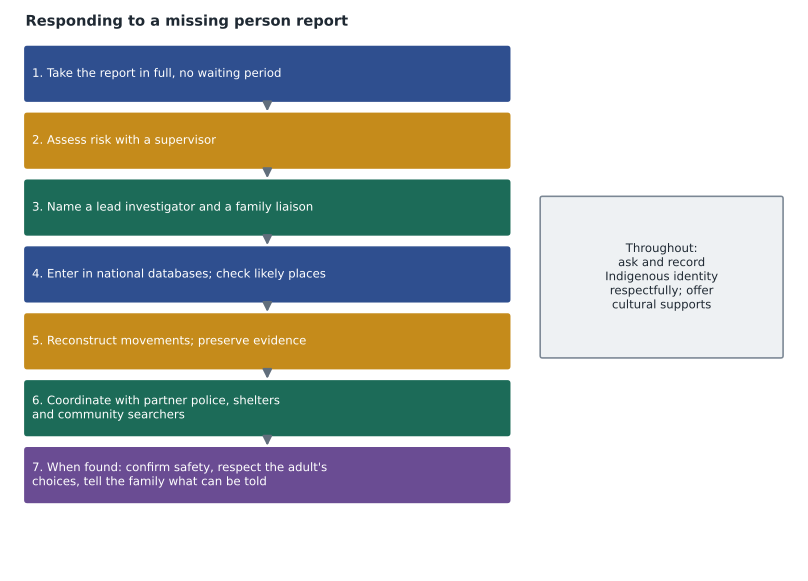
Good practice in a high-risk missing person case starts with a few things that must happen at once. The report is taken in full, without waiting periods, and the person is entered in national databases so that any officer who encounters them will know. A supervisor reviews the risk. A lead investigator is named. Places the person may be are checked: home, family, friends, hospitals, shelters and holding cells. The last known movements are reconstructed from witnesses, phone and financial records and video. Evidence that may disappear, such as video that is overwritten after a few days, is preserved. And the family is given one named contact, who will keep them informed.
Federal law lets phone companies and other service providers disclose records to police voluntarily in an emergency involving danger of death or serious physical injury, under 18 U.S.C. section 2702, and police may also seek court orders and warrants. Many agencies have written procedures for these emergency requests, which must be justified in writing. In Tara's case, Detective Whitlock made an emergency request to Tara's carrier at 16:10, explaining the signs of partner violence and her statement of fear, and received her phone's recent location history within an hour.
| Time on Saturday | Action |
|---|---|
| 14:50 | Supervisor reviews the report and classifies the case as high risk |
| 15:05 | Lead investigator assigned |
| 15:10 | Tara entered in NCIC as a missing person |
| 15:20 | Nimkii Bay tribal police asked to check family homes |
| 15:30 | Family liaison officer assigned to Danielle |
| 15:40 | Officers speak with Ryan Coulter at the home |
| 16:10 | Emergency request for phone location records |
| 16:30 | Nimkii Bay reports Tara is not at either family home |
| 17:30 | Phone records show last connection near the bus terminal on Thursday at 23:40; video requested |
| 18:15 | Bus terminal video shows Tara alone buying a ticket at 23:52 Thursday |
At the house, two officers spoke with Ryan Coulter at 15:40. He repeated that Tara had left after an argument on Thursday night and said he did not know where she was. He declined to let the officers look inside without a warrant, which was his right. The officers noticed a broken lamp in the hallway and a small dark stain on the carpet that could have been anything, and they wrote down exactly what they saw and what he said. They did not argue with him or accuse him. Whitlock later said their notes were among the most useful pieces of evidence in the file, because they recorded his account before he knew what the police already knew.
At 18:15, the bus terminal video changed the direction of the case. It showed Tara, alone, in a hooded coat, buying a ticket with cash at 23:52 on Thursday and boarding a bus to Detroit at 00:10. The image was clear enough to show bruising on the side of her neck. Whitlock now had a strong reason to believe Tara had left on her own, very likely fleeing violence, and a strong reason to fear for her if Coulter found her first. The investigation shifted from searching for a person who might be in danger anywhere to finding a person who was probably safe somewhere, and who might not want to be found by everyone.
Families, liaison and culture
The families who spoke to the inquiries asked for the same things again and again: to be believed, to be told what was being done, to have one person to call, to be treated with respect and to have their knowledge used. Morin's role as liaison officer was to provide exactly that. She gave Danielle her direct number, called her with an update every few hours, explained honestly what the police could and could not share, and asked what the family knew that the police might not. Danielle told her about friends of Tara's that no one else had mentioned and about a women's shelter Tara had once said she would go to in Detroit if she ever needed to.
Morin also asked Danielle whether the family wanted cultural support. Danielle asked for Elder Marion Shawanda, who had traveled down from Nimkii Bay, to be with her, and Morin arranged for the elder to sit in on the updates. A victim advocate from an urban Native service organization in Toledo also joined the family. Desjardins stresses that these supports are offered, not imposed. Some Indigenous families want an elder or a cultural support worker present; others do not, or have their own people; some want a support worker from outside the community because news travels fast at home. The rule is the same as in Lesson 1: ask, listen and offer choices.
By Saturday evening, the Nimkii Bay community had organized its own search: volunteers walking the roads around the reserve, a community social media group with two thousand members and a phone tree. Haddad and Keeshig agreed that Keeshig would liaise with the volunteers, share what could be shared, and make sure that any information they found reached Whitlock. Haddad says that community searches can help or harm an investigation, depending on whether police work with them. 'If you ignore them, they'll do it without you, and you'll miss things,' she says. 'If you work with them, you get a hundred extra pairs of eyes and a family that trusts you.'
Shelters, privacy and the right to be found safe
Domestic violence shelters protect the confidentiality of the people who stay in them, because the people looking for a woman may include the person she has fled. Shelters generally will not confirm whether a particular person is staying with them. Whitlock knew this, and on Saturday night she contacted the coordinator of the regional coalition of domestic violence programs and asked her to circulate a message to shelters in Detroit and nearby: police were concerned for Tara's safety, did not need to know her location, and asked only that any shelter where she might be staying let her know that police and her sister wanted to confirm she was safe, and give her Whitlock's number.
On Sunday morning, after discussing it with Danielle and the elder, the service issued a public appeal with Tara's photograph, describing her as a missing woman the police wanted to confirm was safe, without mentioning partner violence. On Monday, February 9, at 11:20, a shelter worker called Whitlock: Tara had seen the appeal, was safe and was willing to speak to police by video, with a shelter advocate present. At 13:00, Tara spoke with Whitlock and Morin for forty minutes. She told them that on Thursday night Coulter had strangled her against the hallway wall during an argument and smashed the lamp, that she had waited until he fell asleep and then walked to the bus terminal, and that she did not want him to know where she was.
Desjardins says the next decisions are where respect for an adult's choices matters most. Tara was an adult who had left on her own; she was entitled to privacy about where she was. The police told Danielle that Tara had been found safe and was well, and passed on a message from Tara, but did not tell anyone, including her family, where she was. The public appeal was withdrawn with a statement that she had been found safe, and NCIC was updated. Tara decided, after talking with the shelter advocate, that she wanted Coulter charged.
On Tuesday, February 10, Coulter was arrested for strangulation under Ohio Revised Code section 2903.18, the offense Ohio created in 2023, and for criminal damaging. At his initial appearance, the court issued a protection order forbidding any contact with Tara. Whitlock arranged for Tara to be connected with the county prosecutor's victim-witness program and with the shelter's legal advocate for the court process, and for Danielle to get the support she needed. Strangulation is one of the strongest known predictors that an abuser will later kill a partner, which is why both countries have made it a specific offense and why risk assessment tools ask about it.
Worked problem
How long did each stage take?
Tara was last seen at home at about 20:00 on Thursday, February 5. Danielle reported her missing at 14:10 on Saturday. The case was classified high risk at 14:50. The bus terminal video was found at 18:15 on Saturday, and Tara was confirmed safe at 11:20 on Monday, February 9. How long did each stage take?
Show solution
- Last seen to report: from Thursday 20:00 to Saturday 14:10 is 42 hours and 10 minutes.
- Report to high-risk classification: 14:10 to 14:50 is 40 minutes.
- Classification to the key video: 14:50 to 18:15 is 3 hours and 25 minutes.
- Classification to confirmation of safety: from Saturday 14:50 to Monday 11:20 is 44 hours and 30 minutes.
- Total from last seen to confirmed safe: from Thursday 20:00 to Monday 11:20 is 87 hours and 20 minutes.
Answer: Once the risk was recognized, the critical lead was found in under three and a half hours. The longest delay in the case, more than 42 hours, came before the police were involved at all, and it was the family's fear that they would not be taken seriously that made Danielle wait as long as she did. A service that is trusted gets called sooner.
Responding to violence: what victims need
Many Indigenous victims of violence never report it, for reasons that include distrust of police, fear of the offender, fear that children will be taken, the closeness of small communities and past experiences of not being believed. When they do report, the quality of the first response shapes whether they will ever report again. Trauma-informed practice, which officers learn in other courses, applies with particular force: give the person control where possible, explain each step, allow a support person, avoid repeated retelling, and be patient with inconsistencies that trauma often causes. Tribal victim services, funded in part by the federal Office for Victims of Crime and the Office on Violence Against Women, and urban Native organizations can offer culturally grounded support.
Where an offense occurs in Indian country, the right agencies must be notified early, as Lesson 5 explained. A tribe that exercises special tribal criminal jurisdiction under the Violence Against Women Act may prosecute a non-Native abuser, and tribal police and prosecutors should be part of the case from the start. Federal agencies, including the FBI and the BIA's Missing and Murdered Unit, can provide resources, and the Justice Department's missing and murdered Indigenous persons coordinators can help connect agencies and families.
Common mistakes
MistakeFamilies should be kept at a distance so that they do not interfere.
InsteadFamilies should have one named contact, regular updates and a real role in sharing what they know.
MistakeWhen a missing adult is found, the family is entitled to know where she is.
InsteadAn adult who left on her own is entitled to privacy; police confirm she is safe and pass on messages.
MistakeShelters should tell police whether a woman is staying with them.
InsteadShelters protect confidentiality; police can ask them to pass a message instead.
MistakeCultural supports should be provided to every Indigenous family.
InsteadThey should be offered; some families want them, some want others, and the choice is theirs.
Summary and key terms
- High-risk missing person cases require immediate database entry, a supervisor's review, a lead investigator, checks of likely places, reconstruction of movements, preservation of evidence and a family liaison.
- Federal law allows emergency disclosure of records by service providers when there is danger of death or serious injury.
- Families need to be believed, informed and involved; cultural supports should be offered, not imposed.
- Shelter confidentiality and an adult's right to privacy must be respected when a missing person is found.
- Strangulation is a strong predictor of later homicide and is a specific offense in both countries.
- Emergency disclosure
- The voluntary release of records by a service provider to police under 18 U.S.C. section 2702 when there is danger of death or serious injury.
- Section 2903.18
- The Ohio Revised Code section, enacted in 2023, that makes strangulation a specific offense.
- Family liaison officer
- An officer assigned to keep a missing person's or victim's family informed and to be their single point of contact.
- Trauma-informed practice
- An approach that recognizes the effects of trauma and gives victims control, explanation and support.
- Found safe
- The status of a missing adult who has been located and confirmed safe, whose location may remain private if they wish.
Practice problems
Work each problem on paper first, then reveal the answer to check.
List five things that should happen in the first hours of a high-risk missing person case.
Show answer
Any five of: full report with no waiting period, database entry, supervisor's risk review, lead investigator, checks of likely places, reconstruction of movements, preservation of evidence, family liaison, coordination with partners.
How can police obtain phone records quickly in a missing person emergency?
Show answer
Through an emergency request to the provider under 18 U.S.C. section 2702, justified in writing, or through court orders and warrants.
Why did police not tell Tara's family where she was?
Show answer
Because she was an adult who had left on her own, fleeing violence, and was entitled to privacy; police confirmed she was safe and passed on her message.
Why is strangulation treated as a specific offense?
Show answer
Because it is one of the strongest predictors that an abuser will later kill a partner.
Lesson quiz · 5 questions
Score 60% or more to complete this lesson.
Create a free account to save your progress, take quizzes and earn a certificate.