
LES-205 · Lesson 6 of 12 · 19 min
Tribal police, the BIA and cross-deputization
▶ Video coming soon A video version of this lesson is on the way.
The class spends a day on the Nimkii Bay reservation, an hour's drive north of Port Ardent across the Michigan line, arranged through the college and the tribe. Sergeant Keeshig meets them at the police building, a converted tribal office with four holding cells, a sally port and a wall of photographs of every officer who has served since the department was founded. 'Fourteen officers,' he says, 'to cover about 2,400 people, 180 square kilometers of land and water, and every kind of call you can imagine, twenty-four hours a day. We're the police, the ambulance until it gets here, the mental health team, the search and rescue and the youth counselor. And we're everybody's cousin.'
Desjardins asks the students to keep a list during the day of everything that is the same as policing in Port Ardent and everything that is different. By the end of the visit, the 'same' list has the law, the training, the radios and most of the calls. The 'different' list includes distance from backup, the size of the population, the officers' relationships with nearly everyone they meet, the role of elders, the way funding works, and the history that every officer carries into every house.
How tribal policing developed
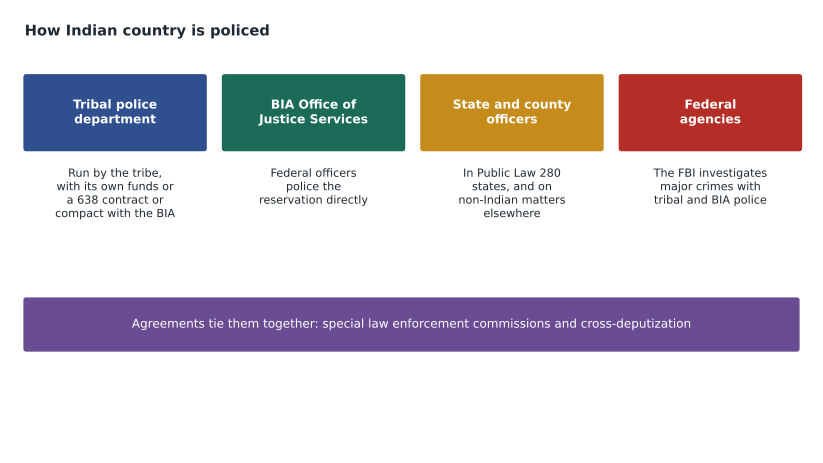
Tribal policing grew out of the Indian police of the reservation era, who answered to federal agents, but it has been transformed by the policy of self-determination. The Indian Self-Determination and Education Assistance Act of 1975 allowed tribes to take over federal programs, including policing, through contracts, often called 638 contracts after the law's public law number, and later through self-governance compacts. Today, some tribes run their own police departments with their own funds, many run departments funded through 638 contracts or compacts with the Bureau of Indian Affairs, and on other reservations the BIA's Office of Justice Services provides police directly. In Public Law 280 states, state and county officers also have jurisdiction, and some tribes rely mainly on them.
The Bureau of Justice Statistics' census of tribal law enforcement found that in 2018, 234 tribally operated law enforcement agencies were operating in the United States, up from 178 in 2008, alongside 23 agencies run directly by the BIA. Tribally operated agencies employed 3,834 full-time sworn officers; about half of them were American Indian or Alaska Native. Most tribal agencies are small, and many cover very large areas: some reservations in the West are larger than several states, and a single officer on patrol may be an hour or more from the nearest backup. The Nimkii Bay Tribal Police Department, with fourteen officers, is a medium-sized agency by tribal standards.
Authority, commissions and cross-deputization
A tribal officer's authority has several sources, and agreements tie them together. Tribal law gives authority over tribal matters and over Indians. Under Cooley, tribal officers may stop and detain non-Indians on reservation highways when they have reasonable grounds and hand them over. To enforce federal law, the BIA issues Special Law Enforcement Commissions, which allow qualified tribal officers to make arrests and investigate as federal officers for federal crimes in Indian country. To enforce state law, tribes and counties or states may sign cross-deputization agreements, under which tribal officers can enforce state law and county deputies can enforce tribal law, so that whoever arrives first can act.
Cross-deputization has advantages that Sergeant Keeshig describes from experience. Before Nimkii Bay signed its agreement with the county, a tribal officer who stopped a non-Native drunk driver could only hold him until a deputy arrived, which on a winter night could take an hour; now the tribal officer can arrest and charge under state law. The agreement also lets county deputies respond to emergencies on the reservation when no tribal officer is close. Agreements depend on trust, and they have to be renegotiated when sheriffs, councils or state laws change. Some states, such as Arizona, recognize qualified tribal officers as state peace officers by statute; in others, everything depends on local agreements.
Federal law has also expanded tribal authority directly. Under the Violence Against Women Act Reauthorization Act of 2013, participating tribes could exercise special domestic violence criminal jurisdiction over non-Indians who committed domestic or dating violence or violated protection orders against Indian victims in Indian country. The 2022 reauthorization, effective October 1, 2022, broadened this to special tribal criminal jurisdiction over a longer list of covered crimes: assault of tribal justice personnel, child violence, dating violence, domestic violence, obstruction of justice, sexual violence, sex trafficking, stalking and violation of a protection order. Tribes that exercise it must provide defendants with protections similar to those in state courts, including licensed defense counsel, a law-trained judge and juries that do not exclude non-Indians. More than thirty tribes had implemented the jurisdiction by 2022, and more have since.
Policing from inside the community
Keeshig describes what makes policing in his community different. Most of his officers are Nimkii Bay citizens or are married into the community, and they police people they grew up with, coached, dated or went to school with. That makes some things easier: officers know who lives where, who is likely to be at a party, which family has a grandmother everyone listens to. It makes other things harder: arresting a cousin, investigating a friend's son, testifying against an elder's grandchild. 'You never go off duty here,' he says. 'You go to the store, somebody tells you about a problem. You go to a funeral, somebody wants to talk about a case.'
The service works closely with elders. An elders' advisory circle meets with the chief of police every month, and an elder is called to many calls involving young people, mental health crises and family disputes. The department's officers attend ceremonies and community events, run a youth program, and help with the land-based summer camp Jesse Morningstar has worked at. Keeshig says many incidents that would end in charges in a city are handled in Nimkii Bay through family meetings, referrals to the community's healing program or the youth justice committee. 'We still lay charges,' he says. 'Assaults, impaired driving, drugs, anything with a victim who wants it. But we start by asking what will make this stop.'
The challenges are real. Most tribal agencies have far fewer officers per resident and per square mile than comparable off-reservation agencies, and federal funding has long fallen short of the need, as the BIA itself has reported to Congress. Recruitment is hard, because tribal agencies compete with state and city departments that pay more. Officers deal with high rates of trauma, addiction and suicide in the communities they serve, often among people they know, and burnout is common. Since 2015, the Justice Department's Tribal Access Program has helped tribes connect to national criminal justice databases such as the National Crime Information Center, which many could not use before, so that tribal protection orders and warrants can be seen by officers anywhere. In May 2026, the Interior Department launched an Indian Country Violent Crime Task Force, led by the BIA Office of Justice Services with federal, tribal and state partners, to coordinate enforcement against violent crime and drug trafficking.
Worked problem
How many officers does 24-hour coverage take?
Nimkii Bay wants at least two officers on duty at all times, on three eight-hour shifts a day. Each officer works about 1,600 hours of patrol a year once vacation, training, court and sick time are taken out. How many officers does minimum patrol coverage require, and what does that leave from 14 officers?
Show solution
- Hours to cover in a year: 24 hours times 365 days is 8,760 hours.
- Two officers at all times doubles that: 8,760 times 2 is 17,520 officer-hours.
- Officers needed: 17,520 divided by 1,600 is about 10.95, so 11 officers.
- Officers left for investigations, supervision, the youth program and community work: 14 minus 11 is 3.
Answer: Eleven officers are needed just to keep two cars on the road around the clock, leaving three for everything else. One serious investigation, one officer on long-term leave or one resignation stretches the service to the limit. This is why stable funding and recruitment matter so much, and why outside services that ask a small First Nations or tribal department for help with a shared case should expect to bring resources, not only requests.
Working with tribal police
Haddad, who has worked many joint files with the Nimkii Bay department, gives the class her own rules. First, treat them as colleagues with full authority, not as a small-town helper; they have the same training and often more experience with the kind of call you are on. Second, call early, including on cases that may only possibly involve their community, because they will know things you do not. Third, share information both ways, and follow up when a case they helped with is resolved. Fourth, respect their way of doing things in their community, including the involvement of elders and family, even when it takes longer than you are used to. Fifth, never go into the community on duty without letting them know, unless an emergency makes it impossible.
Desjardins adds that non-Indigenous services also have a responsibility to change. Many state and local agencies near reservations, and city departments with large urban Native populations, now have tribal liaison officers, advisory councils with tribal and urban Native leaders, training developed with tribes and agreements with tribal police. These are not substitutes for First Nations and tribal control of policing, but they make the partnership work.
| Same as in Port Ardent | Different at Nimkii Bay |
|---|---|
| Federal and state criminal law, where they apply | Distance from backup and specialized units |
| Basic and advanced police training | Officers who know almost everyone they meet |
| Radios, cars, body-worn cameras | An elders' advisory circle and elders on calls |
| Most kinds of calls | Funding through federal contracts and grants |
| Notes, reports and court | Many incidents handled through community processes |
At the end of the day, Keeshig drives the class to the lake, where the community's summer camp runs. He points to the dock where, two summers ago, officers and volunteers searched for three days for a teenager who had gone missing in a canoe. The teen was found alive on an island, cold and frightened. 'Half the people on that search were relatives,' he says. 'The other half were people who'd been arrested by us at some point. Nobody cared about that for three days. That's what community policing means here.'
Alaska and the Public Law 280 states
Alaska presents a different picture. It is a Public Law 280 state, so the state has criminal jurisdiction over most crimes in Native villages, but many villages are reachable only by air and have no full-time law enforcement at all. The state's Village Public Safety Officer program, created in 1979, places trained officers in some villages, but many positions are unfilled, and in 2019 the U.S. Attorney General declared a law enforcement emergency in rural Alaska and released emergency funding. The 2022 Violence Against Women Act reauthorization created a pilot program allowing Alaska tribes to exercise special tribal criminal jurisdiction over non-Natives for covered crimes. In the lower 48 Public Law 280 states, such as California and Minnesota, tribes have long reported that county sheriffs, who have jurisdiction, give reservations too little attention, and many tribes in those states have built their own police departments to fill the gap.
Desjardins says the common thread is that communities policed by people who do not know them, who are far away or who are spread too thin are less safe, and that the answer has nearly always been the same: more control, and more resources, in the hands of the community itself. 'Nobody in Nimkii Bay wants worse policing in the name of self-determination,' Keeshig adds. 'They want good policing that belongs to them.'
Common mistakes
MistakeTribal police are informal security guards.
InsteadThey are law enforcement agencies with trained officers, operating under tribal law and federal commissions and agreements.
MistakeEvery tribal officer can enforce state law.
InsteadState law enforcement depends on state statute or cross-deputization agreements, which vary.
MistakeA small department can easily absorb outside requests.
InsteadMinimum 24-hour coverage can take most of a small department's officers; partners should bring resources.
MistakeCommunity processes are a way of avoiding the law.
InsteadSerious offenses and victims who want charges are dealt with through the courts; community processes address causes and minor matters.
Summary and key terms
- Tribes run police departments under their own authority and through 638 contracts and compacts; the BIA polices some reservations directly.
- In 2018 there were 234 tribally operated agencies with 3,834 full-time sworn officers, plus 23 BIA agencies.
- Special Law Enforcement Commissions and cross-deputization agreements give tribal officers federal and state authority.
- VAWA 2013 and 2022 restored tribal jurisdiction over non-Indians for covered crimes, effective October 1, 2022.
- Small departments face recruitment, distance and funding challenges, and work best with partners who treat them as equals.
- 638 contract
- A contract under the Indian Self-Determination and Education Assistance Act of 1975 that lets a tribe run a federal program, such as policing.
- Special Law Enforcement Commission
- A BIA commission that lets a qualified tribal officer enforce federal law in Indian country.
- Cross-deputization
- An agreement under which tribal, county or state officers may enforce each other's laws.
- Special tribal criminal jurisdiction
- The jurisdiction over non-Indians for covered crimes that VAWA 2022 recognized for participating tribes.
- Elders' advisory circle
- A group of elders who advise a police service on its priorities, practices and relationships with the community.
Practice problems
Work each problem on paper first, then reveal the answer to check.
What is a 638 contract?
Show answer
A contract under the 1975 self-determination act that lets a tribe run a federal program such as policing.
What does a Special Law Enforcement Commission allow?
Show answer
It lets a qualified tribal officer enforce federal law in Indian country.
How many officers does two-officer, 24-hour coverage need if each officer gives 1,600 patrol hours a year?
Show answer
About 11: 8,760 hours times 2 is 17,520, divided by 1,600 is about 10.95.
Name three of Haddad's rules for working with tribal police.
Show answer
Any three of: treat them as full colleagues, call early, share information both ways, respect their ways in their community, notify before entering on duty.
Lesson quiz · 5 questions
Score 60% or more to complete this lesson.
Create a free account to save your progress, take quizzes and earn a certificate.