
LES-205 · Lesson 2 of 12 · 20 min
Colonization, removal, allotment and boarding schools
▶ Video coming soon A video version of this lesson is on the way.
Kyle Beaudry's file contains a line that Desjardins asks the class to read aloud. It comes from the bail hearing in January, where Kyle's lawyer told the court that his grandmother, Ruth Beaudry, was sent to a church-run boarding school in northern Michigan for eight years, and that his mother had been placed in non-Native foster care at the age of four, before the Indian Child Welfare Act was passed. Priya Sandhu asks what any of that has to do with a fight outside a bar in 2026. Desjardins says that by the end of the course she will be able to answer the question herself, and that the answer starts with history.
Elder Marion Shawanda returns for this class. She tells the students that history is not an abstract subject in her community. 'Every family I know has someone who went to those schools,' she says. 'My mother went. My uncles went. Some of them came home and some of them didn't. When you talk about this, you are talking about people's grandparents.' She asks the students to listen to the history in that spirit, and to remember that the communities she comes from survived it, kept their languages and ceremonies alive where they could, and are rebuilding.
Before the newcomers
Long before Europeans arrived, the lands that became the United States were home to hundreds of nations with their own governments, laws, economies and diplomatic systems. The Haudenosaunee Confederacy united several nations under the Great Law of Peace, which some historians believe influenced the framers of the Constitution. The Cherokee, Muscogee and other southeastern nations had towns, councils and systems of clan law. Anishinaabe nations around the Great Lakes, including the Ojibwe, Odawa and Potawatomi, organized society through clans with responsibilities for leadership, protection, healing and teaching. Nations made treaties with each other and resolved disputes through processes that emphasized restoring relationships. These systems of law and order are part of the reason that, as Lesson 8 shows, peacemaking and restorative approaches are not new ideas for Native communities.
Treaties and the early republic
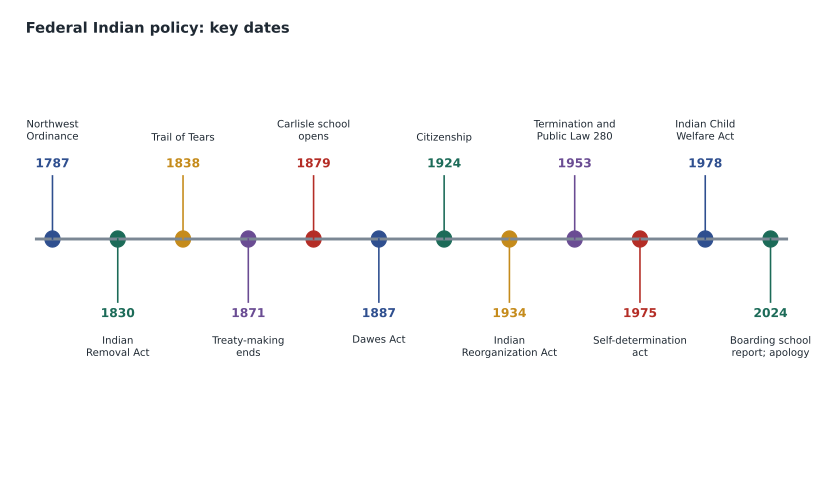
In the colonial period and the early republic, the British, French and then the United States depended on Native nations as trading partners and military allies, and dealt with them as nations through treaties. The Northwest Ordinance of 1787 promised that the 'utmost good faith shall always be observed toward the Indians; their lands and property shall never be taken from them without their consent.' Between 1778 and 1871, the United States made about 370 ratified treaties with tribal nations, most of them involving the cession of land in exchange for promises of reserved homelands, protection, payments, services and the right to continue hunting and fishing. In 1871 Congress ended treaty-making, but existing treaties remained in force, and many are enforced in court today.
The promises were often broken. Treaties were signed under pressure, ratified by the Senate with changes that the tribes had not agreed to, or ignored when settlers wanted land. Federal Indian agents and the army enforced the reservation system. Many reservations were reduced again and again as land was taken for railroads, mining and settlement. The Nimkii Bay Band's reservation in Michigan, Jesse Morningstar tells the class, is a fraction of the land its 1836 and 1855 treaties described, and its citizens' rights to hunt and fish in the ceded territory, which Lesson 4 discusses, come from those treaties.
Removal and the reservation era
In 1830, Congress passed the Indian Removal Act, which authorized the president to negotiate the removal of eastern nations to lands west of the Mississippi. In Worcester v. Georgia (1832), the Supreme Court held that Georgia's laws had no force within the Cherokee Nation, but the decision was not enforced. In 1838 and 1839 the army forced about 16,000 Cherokee people to leave their homes, and an estimated 4,000 died on the journey that Cherokee people call the Trail Where They Cried, now known as the Trail of Tears. The Muscogee, Choctaw, Chickasaw and Seminole nations suffered similar removals. In the West, the reservation system confined nations to small areas, and violence against Native people, such as the massacres at Sand Creek in 1864 and Wounded Knee in 1890, was rarely punished.
In 1887, the General Allotment Act, often called the Dawes Act, divided many reservations into individual allotments, usually 160 acres for a family head, and declared the remaining land surplus and open to settlers. Allotment was meant to turn Native people into individual farmers and to break up tribal governments. Its effect was a catastrophic loss of land: tribal landholdings fell from about 138 million acres in 1887 to about 48 million acres by 1934, much of it desert or otherwise hard to farm. Allotment also created the checkerboard pattern of land ownership found on many reservations today, with tribal trust land, individual Native allotments and land owned by non-Native people side by side. As Lesson 5 shows, that pattern makes criminal jurisdiction very complicated.
Boarding schools
Federal Indian boarding schools were at the heart of the policy of assimilation. In 1879, Richard Henry Pratt, an army officer, opened the Carlisle Indian Industrial School in Pennsylvania, summing up its purpose in a phrase that has become notorious: 'Kill the Indian in him, and save the man.' Over the following decades, the federal government operated or supported hundreds of boarding schools, many run by churches, and in the late 1800s Congress authorized the withholding of rations and other support from families who refused to send their children. In Michigan, the schools included the federal Mount Pleasant Indian Industrial Boarding School, which operated from 1893 to 1934, and church schools that continued much later. The Department of the Interior's Federal Indian Boarding School Initiative found that between 1819 and 1969 the system included 417 federal schools in 37 states or then-territories.
Children were forbidden to speak their languages, had their hair cut, were given new names and were cut off from their families, sometimes for years. Many were poorly fed and housed, worked long hours under the label of vocational training, and died of diseases such as tuberculosis. Physical, emotional and sexual abuse was common. Volume II of the Interior Department's investigation, released on July 30, 2024, found that at least 973 American Indian, Alaska Native and Native Hawaiian children died while attending the schools, and identified at least 74 marked and unmarked burial sites at 65 school sites; the report described these figures as minimums. On October 25, 2024, at the Gila River Indian Community in Arizona, President Joe Biden issued a formal apology on behalf of the United States for the federal Indian boarding school policy.
Federal policy then moved through several further stages. The Indian Citizenship Act of 1924 made all Native people born in the United States citizens. The Indian Reorganization Act of 1934 ended allotment and encouraged tribes to adopt written constitutions. From 1953, Congress pursued termination, ending federal recognition of more than a hundred tribes and transferring criminal jurisdiction over many reservations to states through Public Law 280, which Lesson 5 covers. A federal relocation program encouraged Native people to move to cities such as Chicago, Denver and Los Angeles. From the 1960s and 1970s, policy shifted toward self-determination, with the Indian Civil Rights Act of 1968, the Indian Self-Determination and Education Assistance Act of 1975 and the American Indian Religious Freedom Act of 1978, which ended the long period in which many ceremonies had been banned or discouraged.
Child removal and the Indian Child Welfare Act
Boarding schools were not the only way children were taken. By the 1970s, studies found that between 25 and 35 in 100 of Native children were being separated from their families by state child welfare agencies and private adoption, most of them placed with non-Native families. Congress responded with the Indian Child Welfare Act of 1978, which gives tribes jurisdiction over many child custody cases involving their citizens and sets placement preferences for extended family and tribal communities. In Haaland v. Brackeen (2023), the Supreme Court rejected a constitutional challenge to the Act. Officers who respond to calls involving Native children, such as a welfare check or an arrest of a parent, should know that the Act may apply and that the child's tribe may have a role.
Intergenerational trauma
The effects of these policies did not end when the schools closed. Researchers and communities describe intergenerational trauma: harm that passes from one generation to the next. Children who grew up in institutions without their families often did not learn parenting from their own parents. Many survivors carried the effects of abuse into adulthood, sometimes through addiction, depression or violence, and their children grew up with those effects. Communities lost languages, ceremonies and the authority of elders. Researchers have linked these experiences to higher rates of poverty, poor health, suicide, substance use and contact with the justice system in many Indigenous communities.
Desjardins is careful with this point. Intergenerational trauma does not mean that Indigenous people are damaged or destined for trouble; most Indigenous people never come into conflict with the law, and many of the strongest people in any community are survivors and their children. Nor does history excuse harm done to others; the man whose cheekbone Kyle Beaudry broke is a real victim. What history does is explain patterns that are otherwise hard to understand, and it helps officers, prosecutors and judges choose responses that address causes rather than only symptoms. That is the reason many tribal courts build healing and culture into their responses, which Lesson 8 covers in detail.
| Policy | What it did | Effects seen today |
|---|---|---|
| Removal and reservations | Forced nations from their homelands and confined them to small areas | Loss of land, economic base and self-government |
| Boarding schools | Separated children from families, languages and cultures | Lost languages, trauma passed through families, distrust of institutions |
| Allotment | Broke up tribal land into individual parcels and sold the surplus | Checkerboard land and jurisdictional confusion |
| Child removal before 1978 | Placed children with non-Indigenous families | Lost identity and family ties; high numbers of children in care |
Worked problem
Building a family timeline
Kyle Beaudry's defense investigator builds a timeline from interviews. His grandmother Ruth was born in 1953 and was at a church boarding school from age 6 to 14. His mother, Carol, was born in 1974 and was placed in foster care at age 4. Kyle was born in 2005. In which years was Ruth at the school, when was Carol placed, and how old was Ruth when Kyle was born?
Show solution
- Ruth's school years run from her sixth to her fourteenth birthday: 1953 + 6 = 1959 to 1953 + 14 = 1967.
- Carol was placed in 1974 + 4 = 1978, the year Congress passed the Indian Child Welfare Act, which came too late to change her case.
- Ruth was 2005 - 1953 = 52 years old when Kyle was born.
- Three generations, two removals: the grandmother taken to school, the mother taken into care, and Kyle raised partly by his grandmother after his mother struggled with addiction.
Answer: Ruth was at the school from 1959 to 1967; Carol was placed in 1978; Ruth was 52 when Kyle was born. The timeline shows how two separate government policies reached the same family within one lifetime, which is the kind of background a defense lawyer may present at sentencing.
Why police need to know this history
The next lesson looks at the role police played in this history: the Indian police of the reservation era enforced the agents' rules and took children to boarding schools, and federal officers and the army enforced removal. For many families, the uniform is still associated with the day a child was taken. Sergeant Keeshig says he has met elders who will not open the door to an officer they do not know, and parents who panic when a police car pulls into the driveway, because the last time that happened in their family a child disappeared. 'You can't fix that on one call,' he says. 'But you can avoid making it worse, and over time you can be the reason it changes.'
Marco DiSanto asks whether it is fair to hold today's officers responsible for things done a century ago. Keeshig says nobody is asking him to apologize for his great-grandfather. 'What I'm asking is that you understand why somebody is afraid of you,' he says. 'If a woman won't talk to you, or a family gets angry the minute you arrive, history might be part of the reason. If you know that, you slow down, you explain yourself, you bring someone they trust. If you don't know it, you think they're being difficult, and you push, and then it goes wrong.'
Common mistakes
MistakeBoarding schools ended long ago and have nothing to do with families today.
InsteadThe federal system ran until 1969 and some schools continued later; survivors and their children are alive today.
MistakeAllotment and removal are only history.
InsteadThe checkerboard land pattern created by allotment still shapes criminal jurisdiction today.
MistakeIntergenerational trauma means Indigenous people are destined for trouble.
InsteadMost Indigenous people never come into conflict with the law; history explains patterns, it does not predict individuals.
MistakeUnderstanding history excuses crime.
InsteadHistory explains causes and helps choose responses that work; victims' harm remains real.
Summary and key terms
- Native nations had their own governments and laws before settlement; the United States made about 370 ratified treaties with them before 1871.
- Removal, the reservation system and the Dawes Act of 1887 took most Native land and created the checkerboard pattern of ownership.
- The federal boarding school system included 417 schools; at least 973 children died, and the United States apologized in October 2024.
- Child welfare removals led to the Indian Child Welfare Act of 1978, upheld in 2023.
- Intergenerational trauma helps explain present-day patterns, including contact with the justice system, without predicting any individual's life.
- Dawes Act
- The General Allotment Act of 1887, which divided reservations into individual allotments and opened the rest to settlers.
- Termination
- The federal policy of the 1950s and 1960s that ended recognition of more than a hundred tribes.
- Indian Child Welfare Act
- The 1978 federal law that gives tribes a role in custody cases involving their children and sets placement preferences.
- Intergenerational trauma
- Harm from historical events and policies that is passed from one generation to the next through families and communities.
- Assimilation
- A policy aimed at ending the existence of Indigenous peoples as distinct peoples by absorbing them into the settler society.
Practice problems
Work each problem on paper first, then reveal the answer to check.
What did the Dawes Act do to tribal land?
Show answer
It divided reservations into individual allotments and sold the surplus, reducing tribal land from about 138 million to about 48 million acres by 1934.
What did Volume II of the boarding school investigation find?
Show answer
At least 973 children died at 417 federal schools, with at least 74 burial sites at 65 school sites.
What is intergenerational trauma?
Show answer
Harm from historical policies, such as school removal, that passes from one generation to the next through families and communities.
Why should officers understand this history?
Show answer
Because it explains fear and distrust of police, helps officers avoid making things worse, and supports responses that address causes.
Lesson quiz · 5 questions
Score 60% or more to complete this lesson.
Create a free account to save your progress, take quizzes and earn a certificate.