
LES-205 · Lesson 7 of 12 · 20 min
Overrepresentation: the evidence and its causes
▶ Video coming soon A video version of this lesson is on the way.
At 01:40 on Sunday, January 18, Officers Femi Okeke and Sofia Reyes arrived outside the Anchor Tavern on Kingsway to find a man sitting on the curb holding his face and a crowd around a second man, Kyle Beaudry, who was being held against a wall by two bouncers. Witnesses said the two men had argued inside, that the other man had shoved Kyle in the parking lot and that Kyle had then punched him twice. The injured man, a 31-year-old named Trevor Hale, was taken to hospital with a broken cheekbone. Kyle, who had been drinking, was arrested for assault, and Okeke noted that he was polite, frightened and kept asking whether his grandmother would be told.
Desjardins asks the class to look at what happened next and to keep it in mind through this lesson. Kyle was held overnight until his initial appearance in Port Ardent Municipal Court on Monday, rather than released on a summons, because his only address was on the reservation in Michigan, he had a record for two probation violations from three years earlier and the officer believed he might not appear. At the hearing, he was released on a bond with conditions, including a ban on drinking alcohol and a requirement to stay in Ohio, with a cousin, until his next court date. None of these decisions was unusual or obviously wrong. Desjardins says that is exactly the point: overrepresentation is built from many ordinary decisions, each of which seems reasonable on its own.
What the numbers show
Native people are overrepresented in many parts of the American justice system. At the end of 2022, the Bureau of Justice Statistics reported that American Indian and Alaska Native adults were imprisoned in state and federal prisons at a rate of 1,042 per 100,000, compared with 229 per 100,000 for white adults, more than four times as high. The disparities are largest in states with large Native populations, such as South Dakota, North Dakota, Montana and Alaska. Because the federal government prosecutes major crimes in Indian country, Native people also appear in the federal system far more than their share of the population would suggest: in the 2023 fiscal year, American Indian and Alaska Native people accounted for 44 in 100 of federal arrests for murder and 34 in 100 of federal arrests for assault.
Federal prosecution matters because federal sentences are often longer than state sentences for similar conduct, and because federal courts are usually far from the reservation. A Native person who commits an assault on a reservation in a non-Public Law 280 state may be tried in federal court, where the median prison term for Native defendants in 2023 was 37 months and 88 in 100 of those convicted received a prison-only sentence, while a non-Native person who does the same thing just outside the reservation boundary may be tried in a state court with a wider range of options. Researchers and the Indian Law and Order Commission have called this one of the most unfair features of the system. Young Native people are also overrepresented in juvenile detention in many states.
The other half: victimization
Native people are also much more likely than others to be victims of crime. A 2016 National Institute of Justice study based on a national survey found that more than four in five American Indian and Alaska Native women and men had experienced violence in their lifetime, that more than half of the women had experienced sexual violence, and that most victims had been harmed by at least one non-Native perpetrator. Homicide is among the leading causes of death for young Native women and men. Lesson 9 looks at the crisis of missing and murdered Indigenous people.
Jesse Morningstar makes the point that connects the two halves. 'The same families show up in both columns,' he says. 'My cousin who got arrested for fighting and my aunt who got beaten by her husband are from the same house. If you only see one column, you think we're criminals. If you only see the other, you think we're victims. We're people living with a lot of harm, and the system mostly shows up after it's happened.'
Why it happens
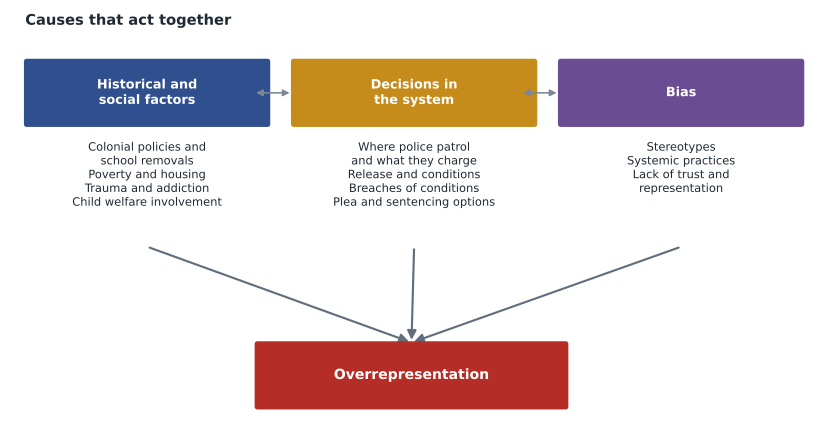
Desjardins sorts the explanations researchers and inquiries have offered into three groups, which work together rather than in competition. The first group is historical and social: the effects of colonial policies, residential and boarding schools and child removal described in Lesson 2, together with poverty, overcrowded housing, unemployment, lower levels of formal education, poor health, addiction and exposure to violence. These factors are strongly associated with offending and victimization in every population, and they are far more common in many Indigenous communities because of history. They explain a great deal, but not all, of the gap.
The second group is the set of decisions the justice system makes. Where police patrol, which calls they respond to and how quickly, whether they warn, divert or charge, and which charges they lay all shape who enters the system. Pretrial decisions shape who stays in custody: Native defendants are more likely to be held, and more likely to be released with conditions that are hard to meet, such as staying away from the reservation where their family lives or abstaining from alcohol. Violations of release and probation conditions then become new grounds for detention and a record that makes the next decision harder; in the federal system, supervision violations were the most common reason Native people were arrested in 2023. Plea bargaining, sentencing options, mandatory minimum penalties and the choice of federal rather than state or tribal court shape who goes to prison and for how long.
The third group is bias, both individual and systemic. Individual bias includes stereotypes that officers, lawyers, judges or jurors may hold, often without being aware of them, such as the assumption that an Indigenous person who has been drinking is more dangerous, or that an Indigenous woman who has gone missing has simply run off. Systemic bias includes practices that disadvantage Indigenous people even when nobody intends it, such as using a fixed address or employment as a reason to release, which counts against people who move between communities, or a lack of Indigenous people among police, prosecutors, judges and jurors. Federal and state commissions, including the Indian Law and Order Commission and state task forces on missing and murdered Indigenous people, have identified similar patterns in American systems.
| Stage | How a gap can grow | What officers control |
|---|---|---|
| Patrol and calls | More enforcement in some neighborhoods; slower response to others | Equal attention to victims; avoiding stops based on assumptions |
| Charging and diversion | Fewer warnings and referrals; more charges, including minor ones | Warnings, citations and referrals to diversion and tribal programs |
| Release from the scene | Held for court because of address or history | Releasing on a citation or summons when the law allows |
| Bail and conditions | More conditions that are easy to breach | Recommending only conditions that are necessary and realistic |
| Breaches and new charges | Records built from administration of justice offenses | Using discretion on technical breaches with no new harm |
What police can do
Desjardins is clear that police did not create overrepresentation alone and cannot end it alone. But police make many of the first decisions, and research on discretion shows that small changes at the front end can have large effects later. Ohio law and court rules give police and courts discretion that can be used the same way: officers may issue a citation or summons rather than arrest for many misdemeanors, and Ohio's criminal rules require courts to impose the least restrictive conditions that will reasonably assure appearance and public safety. Keeshig adds that officers can also make sure the decisions they do make are fair, explained and recorded, and that victims in Indigenous communities get the same quality of response as anyone else.
Several practical steps follow. Officers can use warnings, cautions and referrals for minor offenses where the law allows, including referrals to diversion programs, urban Native service organizations and, where a tribe has one, tribal programs that accept referrals. They can avoid treating a home community as no fixed address. They can recommend conditions that are necessary rather than habitual, recognizing that a total ban on alcohol for a person with an addiction may simply set up a breach. They can use discretion on breaches that involve no new harm. They can make sure that reports by Indigenous victims are taken and investigated with the same care as any other. And they can support the recruitment of Indigenous officers and civilian staff, so that the service reflects the community it polices.
Worked problem
Releasing Kyle: what the officer could have weighed
Looking back at Kyle's arrest, Okeke asks whether Kyle could have been released on a summons rather than held for his initial appearance. Kyle had no pending charges, two probation violations from three years earlier and an address at his grandmother's house on the Nimkii Bay reservation in Michigan. The victim had a serious injury. What factors bear on release?
Show solution
- The offense: an assault causing serious injury must be taken seriously, and the victim's safety considered; the two men did not know each other, and there was no ongoing threat.
- The law: release on a summons or citation is possible for many offenses, and Ohio rules call for the least restrictive conditions at the court stage.
- Attendance: an address in a home community is a real address; his grandmother could be reached, and his family confirmed where he would stay.
- History: two breaches of conditions three years ago, with no new offenses, are weak evidence that he would not attend court.
- Conditions: if release was appropriate, the conditions should be few and realistic, such as no contact with the victim and staying away from the tavern.
Answer: Reasonable officers could differ about release by the police on a charge involving a serious injury, and holding Kyle for a hearing was within the law. But treating Nimkii Bay as no fixed address and the old breaches as proof of flight risk would have been mistakes. Writing down the real reasons for the decision, and the information that supported release, would have helped the court and been fairer to Kyle.
Marco DiSanto asks whether all this means officers should treat Indigenous suspects more leniently. Desjardins says no. It means officers should make decisions based on the facts of each case, be aware of the ways ordinary practices can disadvantage people who live differently, and use the discretion the law already gives them with care. 'Fairness is not leniency,' he says. 'It's getting the decision right for this person, this victim and this offense, instead of applying a habit that was built for someone else.'
Priya Sandhu, who asked in Lesson 2 what Kyle's grandmother had to do with a bar fight, says she is starting to see the connection. Desjardins tells her the next lesson will make it explicit, because judges in many tribal courts build exactly that kind of history into their response, and American defense lawyers raise it at sentencing in state and federal courts.
Data and its limits
Statistics on overrepresentation are powerful, but Desjardins warns the class about their limits. Many records do not show Indigenous identity, or record it inconsistently, because officers guessed from appearance or did not ask. Native people are often misclassified as white or Hispanic in police, court and death records, and tribal records are not always included in national systems, so many figures undercount Native people as victims and as defendants. Figures also differ depending on whether they count admissions, people in custody on a given day or people ever incarcerated in a year. Officers who use such figures should say what they measure, and should never use them to judge an individual. The figures describe the system's outcomes, not the character of any person who appears in them.
Common mistakes
MistakeOverrepresentation simply reflects higher crime rates.
InsteadSocial factors explain much of it, but decisions in the justice system and bias also play a large part.
MistakeIndigenous people appear in the justice system only as offenders.
InsteadThey are also far more likely to be victims, often in the same families and communities.
MistakeA home address on a reservation is the same as no fixed address.
InsteadIt is a real address; treating it as none disadvantages people who move between communities.
MistakeAddressing overrepresentation means being lenient.
InsteadIt means making fact-based, fair decisions and using existing discretion with care.
Summary and key terms
- At the end of 2022, Native adults were imprisoned at 1,042 per 100,000, compared with 229 for white adults.
- Federal jurisdiction over major crimes puts Native people in federal courts, where sentences are often longer.
- Indigenous people are also far more likely to be victims of violence.
- Causes include historical and social factors, decisions at every stage of the system and individual and systemic bias.
- Police can use warnings and referrals, release fairly, recommend realistic conditions, use discretion on breaches and treat Indigenous victims with equal care.
- Supervision violation
- A breach of the conditions of pretrial release, probation or supervised release, which can lead to arrest and imprisonment.
- Overrepresentation
- A group's share of a population, such as people in custody, being larger than its share of the general population.
- Systemic bias
- Practices or rules that disadvantage a group even when no individual intends to discriminate.
- Administration of justice offense
- An offense such as breaching a release condition or failing to appear, which arises from the justice process itself.
Practice problems
Work each problem on paper first, then reveal the answer to check.
How did the 2022 imprisonment rate of Native adults compare with that of white adults?
Show answer
1,042 per 100,000 compared with 229, more than four times as high.
Name the three groups of causes of overrepresentation.
Show answer
Historical and social factors, decisions in the justice system and bias.
Why do conditions such as a total ban on alcohol contribute to overrepresentation?
Show answer
They are easy to breach, especially for people with addictions, and breaches become new charges and records.
Name three things police can do.
Show answer
Any three of: use warnings and referrals, release fairly, treat home communities as real addresses, recommend realistic conditions, use discretion on breaches, investigate Indigenous victims' reports with equal care, support Indigenous recruitment.
Lesson quiz · 5 questions
Score 60% or more to complete this lesson.
Create a free account to save your progress, take quizzes and earn a certificate.