
LES-205 · Lesson 8 of 12 · 20 min
Tribal courts, state courts and alternatives
▶ Video coming soon A video version of this lesson is on the way.
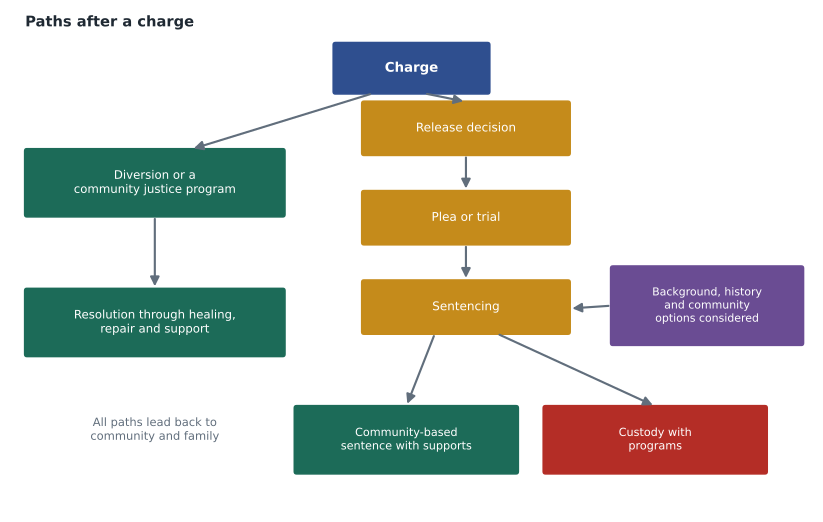
On Thursday, April 16, Kyle Beaudry stood before Judge Martin Reyes in Port Ardent Municipal Court to be sentenced for assault, a first-degree misdemeanor under Ohio law, to which he had pleaded guilty in March. The county prosecutor had considered a felony charge of felonious assault because of the broken cheekbone, but reduced it in light of the evidence that Hale had shoved Kyle first. On the bench were a pre-sentence investigation report, a letter from the Nimkii Bay Band's tribal court describing a healing program Kyle could join, a letter from his grandmother and Trevor Hale's victim impact statement. Officer Okeke sat at the back of the courtroom because he wanted to see how the case ended.
Desjardins says this lesson is about what happens to Indigenous people in the courts, and about the alternatives that Indigenous communities have built. Police are not the decision-makers at these stages, but what they write, what they recommend and how they treat accused people and victims shapes the decisions, and officers who understand the court process make better decisions at the front end.
Tribal courts
More than 400 tribal justice systems operate in the United States. Most tribes with courts have created them under their own constitutions and codes, often modeled partly on state courts and partly on their own traditions; some reservations still use Courts of Indian Offenses, sometimes called CFR courts, run under federal regulations. Tribal courts hear criminal cases against Indians, civil cases, child welfare cases under the Indian Child Welfare Act, protection orders and, for tribes that exercise it, special tribal criminal jurisdiction over non-Indians. The Nimkii Bay Tribal Court has a chief judge, an associate judge, a prosecutor, a public defender, a probation officer and a Healing to Wellness Court that meets every Tuesday.
Tribal courts' sentencing powers are limited by federal law. The Indian Civil Rights Act of 1968 limited tribal court sentences to six months in jail and a 500-dollar fine for any one offense; Congress raised the limit to one year and 5,000 dollars in 1986. The Tribal Law and Order Act of 2010 allowed tribes to impose sentences of up to three years for a single offense, and up to nine years in total in one proceeding, with fines of up to 15,000 dollars, but only if they provide added protections: a licensed defense lawyer at the tribe's expense for indigent defendants, a judge with legal training who is licensed to practice law, published criminal laws and rules, and a record of the proceedings. Tribes that exercise special tribal criminal jurisdiction over non-Indians under the Violence Against Women Act must provide similar protections.
Healing to Wellness Courts and peacemaking
Healing to Wellness Courts are tribal versions of drug courts, combining court supervision with treatment, culture and community. Since the late 1990s, with federal support, more than a hundred tribes have created them. Participants appear regularly before the judge, are tested for drugs and alcohol, attend treatment and often take part in ceremonies, talking circles, mentoring by elders and land-based activities. Many tribes also run peacemaking programs based on their own traditions, in which a peacemaker brings together the people involved in a dispute, their families and community members to talk through the harm and agree on a way forward. The Navajo Nation created its Peacemaker Court in 1982, and peacemaking is now used in many tribal courts and some state courts.
In Ohio, Kyle's case was handled under the ordinary state rules for misdemeanor sentencing, which require the court to consider the nature of the offense, the offender's history, character and condition, the risk of reoffending, the needs of the victim and the offender's ability to make restitution. There is no Ohio equivalent of Canada's Gladue principle, and courts in the United States do not generally treat a defendant's Native heritage as a sentencing factor in itself. But Kyle's lawyer presented his family history, his grandmother's years at a boarding school, his mother's foster care, his own drinking from age 15 and the suicide of a close friend at 17, as part of his history and condition. She also presented his strengths: steady seasonal work, his bond with his grandmother, two years helping coach youth hockey with Jesse Morningstar and his request for treatment. And she presented the letter from the Nimkii Bay Tribal Court, which offered to accept Kyle into its Healing to Wellness program if the Ohio court allowed him to serve community control in Michigan.
Federal court and the disparity problem
The disparity between federal and state outcomes is one of the most serious concerns in Indian country. When a Native person on a reservation in a non-Public Law 280 state commits a serious assault, the case usually goes to federal court, where federal sentencing guidelines and the absence of many state diversion and probation options often produce longer prison terms than a state court would impose for the same conduct a short distance away. The U.S. Sentencing Commission's Tribal Issues Advisory Group examined these concerns in a 2016 report and recommended changes, including better consideration of tribal court sentences and tribal programs. Federal judges must consider the history and characteristics of the defendant under 18 U.S.C. section 3553(a), and defense lawyers often present the kind of family history described in Kyle's case. Jury selection also matters: federal juries are drawn from whole districts, so a jury hearing a reservation case may include few or no Native jurors.
State courts, treatment and alternatives
Ohio courts have many specialized dockets, including drug, mental health and veterans' courts, certified by the Supreme Court of Ohio, and community control, Ohio's term for probation, can include treatment, electronic monitoring and community service. Urban Native organizations in several Ohio cities offer culturally grounded programs, such as talking circles and wellness programs, that courts and probation officers can use. Desjardins notes that cooperation between state courts and tribal courts across state lines is less common than it should be, and Judge Reyes's willingness to consider the Nimkii Bay program was unusual. 'It took two phone calls,' Keeshig says. 'Most judges never make the first one.'
Restorative processes depend on the victim's choice. In Kyle's case, the Nimkii Bay program offered a peacemaking session that Trevor Hale could join by video, but Hale declined; he said he was still angry and did not want to face the man who broke his face. His choice was respected, and his victim impact statement was read in court instead. Desjardins stresses that no victim should ever be pressured into a restorative process, and that a good program protects victims' safety and choices as carefully as it supports offenders.
The sentence
Judge Reyes imposed a jail term of 180 days, with 177 days suspended and credit for the three days Kyle had already served, and two years of community control, with conditions to complete alcohol treatment, have no contact with Hale and pay restitution of 1,450 dollars for Hale's lost wages not covered by insurance. He agreed to the transfer of supervision to Michigan under the interstate compact that governs probation transfers, and noted that the Nimkii Bay Healing to Wellness Court had agreed to accept Kyle. 'You are not going to jail today,' he told Kyle, 'because I think your best chance of not coming back here is at home, with your family and that program. If I am wrong, you will come back here, and the sentence I have suspended will be waiting.'
Worked problem
Working out the sentence
Kyle's jail term is 180 days with 177 suspended and credit for 3 days served, and he is on community control for 24 months. He is to pay 1,450 dollars in restitution in equal monthly payments over the first 12 months. How many days must he still serve now, and what is each monthly payment, to the nearest dollar?
Show solution
- Days imposed and not suspended: 180 minus 177 is 3 days.
- Credit for time served: 3 days, so 3 minus 3 is 0 days left to serve.
- Restitution: 1,450 divided by 12 is about 120.83, so about 121 dollars a month.
- If he violates community control, the court may impose some or all of the 177 suspended days.
Answer: Kyle has no days left to serve, but he carries 177 suspended days for two years, and pays about 121 dollars a month for the first year. The suspended time is what gives community control its force.
What police should take from this
Desjardins draws three lessons for officers. First, the information officers record follows the case all the way through. Okeke's report described the shove that started the fight, Kyle's cooperation and his question about his grandmother, and the prosecutor relied on it when deciding to charge a misdemeanor. An officer who leaves out mitigating facts, or who writes a report full of assumptions, can make a fair outcome harder. Second, officers can ask, respectfully and as a matter of routine, whether an accused person is Indigenous, so that the court and support services know; self-identification should never be assumed from appearance. Third, police can support community options by making referrals, by helping programs with information, and by treating diversion and community sentences as legitimate outcomes rather than failures.
Okeke tells the class that he spoke briefly with Kyle's grandmother in the hallway after the sentencing. 'She thanked me for being decent to him the night he was arrested,' he says. 'I didn't do anything special. I just didn't treat him like garbage. I was surprised how much that mattered to her.'
Protection orders and full faith and credit
Protection orders matter as much as prosecutions. Under the Violence Against Women Act's full faith and credit provision, 18 U.S.C. section 2265, a protection order issued by a tribal court must be enforced by every state and by other tribes as if it had been issued by their own courts, and a state order must be enforced in Indian country. An Ohio officer who meets a man covered by a Nimkii Bay Tribal Court protection order must enforce it, even if it has not been registered in Ohio and even if the officer has never seen a tribal court order before. Since the Tribal Access Program, many tribal orders are entered in national databases, but officers should also accept a valid paper copy. Release conditions that forbid contact with a victim must be explained clearly to the accused and to the victim, who should be told what to do if they are breached.
Desjardins adds that officers' notes and testimony matter in these cases as in any other. An officer who records exactly what a victim said, the injuries seen and the state of the scene gives the court what it needs to protect the victim and to sentence fairly. An officer who writes a vague or dismissive report may leave a dangerous person free and a victim without protection.
Children, families and the Indian Child Welfare Act
Courts deal with Native children in another way that officers need to understand. The Indian Child Welfare Act applies when a child who is a member of a tribe, or eligible for membership, is the subject of a foster care placement, termination of parental rights or adoption. Under section 1922 of the Act, officers and child welfare workers may remove a Native child from a parent in an emergency to prevent imminent physical damage or harm, but the removal must end as soon as the emergency is over, and the child's tribe must be involved in what happens next. Officers who arrest a parent or respond to a call involving Native children should ask whether the children are tribal members, tell child welfare workers what they learn, and avoid promising families outcomes that only the courts can decide.
Haddad adds a point that applies in both kinds of case. When an officer arrests a parent, a grandparent or the person caring for children, the way the children are looked after in the next hour matters to the family for years. Asking who in the family can care for the children, letting the parent explain to them what is happening where it is safe to do so, and calling a relative before calling child welfare, when the law and safety allow, are small choices that can prevent the kind of memory Haddad described in Lesson 3.
Common mistakes
MistakeTribal courts can impose any sentence they choose.
InsteadFederal law limits tribal sentences to one year, or up to three years per offense and nine in total if added protections are provided.
MistakeState courts must apply a special rule for Native defendants.
InsteadThere is no such rule; background is considered through ordinary sentencing factors.
MistakeRestorative processes require the victim to take part.
InsteadParticipation is always the victim's choice, and good programs protect victims' safety.
MistakeWhat police write matters only until the charge is laid.
InsteadReports and synopses shape release, charging and sentencing decisions throughout the case.
Summary and key terms
- More than 400 tribal justice systems hear criminal cases against Indians and many other matters.
- The Indian Civil Rights Act and the Tribal Law and Order Act limit tribal sentences, with enhanced sentencing available if protections are provided.
- Healing to Wellness Courts and peacemaking combine accountability with treatment, culture and community.
- Federal prosecution of reservation crimes can produce longer sentences than state courts impose for similar conduct.
- Police reports, respectful questions about identity and support for community options all affect fair outcomes.
- Healing to Wellness Court
- A tribal court program, similar to a drug court, that combines supervision with treatment, culture and community.
- Peacemaking
- A traditional process in which a peacemaker brings together those involved in a dispute and their families to talk through the harm and agree on a way forward.
- Community control
- Ohio's term for probation and other community sanctions.
- Restorative justice
- An approach that responds to harm by bringing together those affected to repair it, rather than only punishing the offender.
Practice problems
Work each problem on paper first, then reveal the answer to check.
What sentence limits apply in tribal court?
Show answer
One year and 5,000 dollars per offense under the Indian Civil Rights Act, or up to three years per offense and nine in total under the Tribal Law and Order Act if added protections are provided.
What is a Healing to Wellness Court?
Show answer
A tribal program like a drug court that combines court supervision with treatment, culture and community support.
Why must restorative processes respect the victim's choice?
Show answer
Because forcing a victim to take part can harm them again; good programs protect victims' safety and choices.
Name two ways police can support fair outcomes at court.
Show answer
Any two of: accurate, complete reports including mitigating facts; asking respectfully about identity; making referrals; treating community options as legitimate.
Lesson quiz · 5 questions
Score 60% or more to complete this lesson.
Create a free account to save your progress, take quizzes and earn a certificate.