
LES-205 · Lesson 1 of 12 · 22 min
Tribal nations in the United States: peoples, governments and the starting point for justice
▶ Video coming soon A video version of this lesson is on the way.
Professor Ray Desjardins does not begin this course himself. For the first class he has asked Jesse Morningstar, who is Anishinaabe and grew up on the Nimkii Bay reservation in Michigan, to introduce two guests. The first is Elder Marion Shawanda, who sits at the front of the room with a small bundle of sage and a shell she does not light, because the college has not yet finished the policy that will let her. She speaks for a few minutes about where the students are sitting, whose land it was before the college was built, and what it means to listen with the whole of yourself rather than only the ears. The second guest is Sergeant Paul Keeshig of the Nimkii Bay Tribal Police Department, who has twenty years of service, the last twelve in his own community.
Keeshig tells the class that he wants to start with a confession. 'When I was a young officer,' he says, 'I thought my job was the same as any officer's job, just in a smaller place. It took me years to understand that I was working inside a relationship that was older than my police service, older than the state and older than the country. Every call I take carries that relationship with it. If you remember one thing from this course, remember that.' Desjardins thanks both guests and says that the course will try to do what Keeshig describes: to help future officers understand the history, law and relationships that shape every contact between police and Indigenous people, and to turn that understanding into better, fairer and safer police work.
The two cases that run through the course
The course follows two files from the Port Ardent Police Department, in Ohio, in the winter of 2026. In the first, on Saturday, February 7, Danielle Pelletier came to the front counter of the downtown station at 14:10 to report that her younger sister, Tara, aged 24, had not been heard from since Thursday evening. Tara is a citizen of the Nimkii Bay Band of Anishinaabe, a federally recognized tribe whose reservation lies in Michigan, about two hours north, and she lives in Port Ardent with her partner, Ryan Coulter, who told Danielle that Tara had 'taken off'. The way that report was first received, and then corrected, is the subject of several lessons. In the second file, Kyle Beaudry, aged 20, also a Nimkii Bay citizen, was arrested in the early hours of Sunday, January 18, after a fight outside a bar on Kingsway in which another man suffered a broken cheekbone. Kyle's case follows the path from arrest to sentencing in an Ohio court, and the course uses it to compare how state courts and tribal courts deal with Native defendants.
Desjardins explains that neither case is unusual. Police services handle missing person reports and bar fights every week. What makes the files worth studying is that the same ordinary calls can go very differently depending on whether the officers understand the people involved, the history that shapes their reactions, the law that applies to them, and the services that exist to help. 'None of this is about treating Indigenous people as a special category of problem,' he says. 'It is about doing the job properly for everyone, which means knowing what properly looks like here.'
Who are Native peoples in the United States?
The United States recognizes Native nations as political communities with their own governments. As of early 2026 there are 575 federally recognized tribes, after Congress recognized the Lumbee Tribe of North Carolina in December 2025. Federal recognition establishes a government-to-government relationship with the United States; more than 220 of the recognized tribes are Alaska Native villages and other tribes in Alaska. Several states also recognize tribes that do not have federal recognition. In the 2020 census, about 3.7 million people identified as American Indian or Alaska Native alone, and about 9.7 million identified as American Indian or Alaska Native alone or in combination with another race. The Native population is younger on average than the population as a whole.
These numbers hide enormous diversity. Native nations range from the Navajo Nation, with more than 400,000 enrolled citizens and a reservation larger than several states, to small rancherias in California and villages in Alaska with a few hundred members. They speak more than 150 Indigenous languages, many now spoken mainly by elders, and they have their own histories, governments, laws, ceremonies and relationships to the land. Officers who learn to say 'Native Americans' as if it described one group with one culture have learned the wrong lesson.
Where people live matters too. Most Native people in the United States, roughly seven in ten, live in cities and towns rather than on reservations or other tribal lands. Ohio has no federally recognized tribe and no reservation within its borders, but it has urban Native communities in Cleveland, Columbus, Toledo and smaller cities like Port Ardent, made up of citizens of many nations. Many urban Native people move between the city and their tribal homelands for school, work, family and ceremony. Tara Pelletier is one of them: she moved to Port Ardent at 19 for a college program, works at a grocery store and drives home to Nimkii Bay most long weekends.
Words matter
Jesse Morningstar tells the class that the words officers use are noticed, remembered and repeated in communities. A report that describes someone as 'a native female' or uses an outdated or insulting term tells the family more about the officer than about the person who is missing. Desjardins agrees and adds that words in reports also travel: they are read by prosecutors, judges, journalists and, years later, by the person described. The safest habit is to ask people how they identify and to use the name of the specific nation when it is known.
| Term | How it is used |
|---|---|
| American Indian and Alaska Native | The terms used in federal law and the census; many people prefer their nation's name |
| Native American, Native | Common general terms; Native is widely used by Native people themselves |
| Indian | A legal term in federal law, as in Indian country and the Indian Civil Rights Act; avoid it otherwise unless people use it themselves |
| Tribal citizen or enrolled member | A person enrolled under a tribe's own citizenship rules; each tribe decides who belongs |
| Alaska Native | The Indigenous peoples of Alaska, including Inupiat, Yupik, Aleut, Tlingit, Haida and Athabascan peoples |
| Tribal nation, tribe | The political community; using the nation's own name, such as the Cherokee Nation, is best |
Keeshig adds a practical point. 'On a call, nobody expects you to know every nation's name,' he says. 'But they expect you to ask, to write it down properly and to spell it right. If someone tells you they're from Nimkii Bay, don't write "a reservation up north". That's somebody's home.'
Nations, not minorities
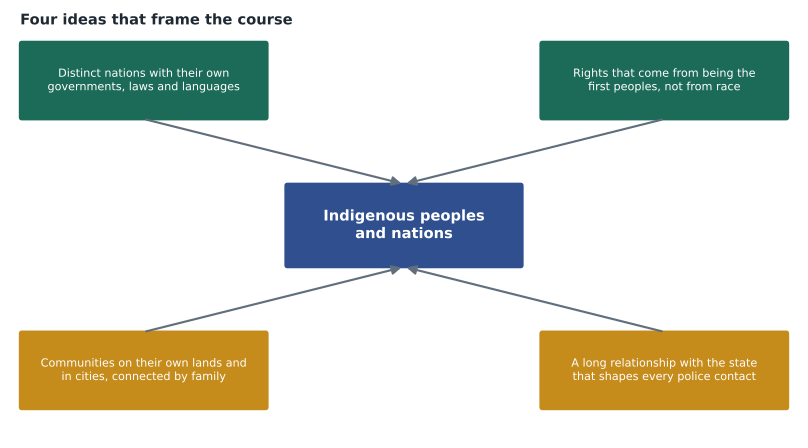
The most important idea in this course is that Native nations are not simply one more minority group. They are sovereign governments that existed before the United States, and their status is recognized in the Constitution, which gives Congress power to regulate commerce 'with the Indian Tribes', in hundreds of treaties, and in two centuries of court decisions. In Morton v. Mancari (1974), the Supreme Court held that federal laws treating tribal members differently are based on their political status as citizens of tribal nations, not on race. Tribal governments make laws, run courts and police departments, and decide who their citizens are. These are political and legal relationships, not matters of race or culture alone.
This matters for policing in three ways. First, it means that different laws and different police may have authority depending on where a call happens and who is involved, which is the subject of Lesson 5, on the jurisdictional maze in Indian country. Second, it means that Indigenous communities have their own institutions, including tribal police, tribal courts and tribal governments, which officers should work with as equals rather than as helpers. Third, it means that the long history of the state's treatment of Indigenous peoples, including the role police played in it, is not a story about the past. It shapes the trust, fear and expectations that people bring to every contact with police today.
Over-policed and under-protected
Desjardins writes a phrase on the board that the class will hear many times: over-policed and under-protected. It sums up what reports, inquiries and research have found again and again. Indigenous people are more likely than others to be stopped, arrested, charged, held in custody before trial and imprisoned. At the same time, they are more likely to be victims of violent crime, and when they are victims, their reports have too often been dismissed, delayed or poorly investigated. Both halves of the phrase are real, and they reinforce each other. A community that has seen its young men arrested again and again and its missing women ignored has little reason to call the police, and a police service that rarely hears from a community has little chance of protecting it.
Lesson 7 looks closely at the evidence of overrepresentation. To give the class a sense of its size, Desjardins puts up one figure from a 2016 National Institute of Justice study: more than four in five American Indian and Alaska Native women had experienced violence in their lifetime, and most of those who had experienced violence had been harmed by at least one non-Native perpetrator. Lesson 9 looks at missing and murdered Indigenous people, and Lesson 7 at the overrepresentation of Native people in jails and prisons.
Linh Tran asks whether the course will spend all its time on problems. Keeshig answers before Desjardins can. 'No,' he says. 'You'll hear about some of the worst things that have happened, because you need to know them. But you'll also hear about communities that run their own police, their own courts and their own healing programs, and about officers who built real relationships. The point isn't to make you feel guilty. The point is to make you useful.'
The principles that run through the course
Six principles appear in every lesson. The first is respect for self-determination: Indigenous nations have the right to govern themselves, and police work best when they support community institutions rather than replace them. The second is that history explains the present: officers cannot understand a family's reaction to a uniform, or a community's silence, without knowing what came before. The third is knowing the law: who has authority, which rights apply and which services exist. The fourth is taking every report seriously, especially reports of missing and harmed people, because the cost of delay has been measured in lives.
The fifth principle is relationships before crises: trust is built at community events, at schools, through regular contact with the Nimkii Bay tribal police and tribal government and through follow-up after calls, not in the middle of an emergency. The sixth is cultural humility rather than cultural stereotypes: officers should learn about the communities they serve, but they should never assume that a person holds particular beliefs, speaks a particular language or wants a particular kind of help because they are Indigenous. The right approach is to ask, to listen and to offer choices.
| Principle | In practice |
|---|---|
| Respect self-determination | Work with tribal police, courts and governments as partners |
| History explains the present | Understand why people may fear or distrust police, and do not take it personally |
| Know the law | Know tribal sovereignty, Indian country jurisdiction and the federal laws that apply |
| Take every report seriously | Act on missing person and violence reports without assumptions about lifestyle or culture |
| Relationships before crises | Build contacts and trust through ordinary, regular contact |
| Cultural humility | Ask, listen and offer choices; never assume |
What the course is not
Desjardins is careful to set limits. This is not a course in Indigenous spirituality, and officers should not try to perform ceremonies or speak for communities. Elders, knowledge keepers and community members are the right people to teach those things, in their own way and their own time. Nor is it a course that will make anyone an expert on all Indigenous nations. What it can do is give officers the history and law they need, the habits that make contact respectful and effective, and the humility to know what they do not know.
Elder Shawanda adds a final point before she leaves. She says that many people in her community have stories about police, some good and many painful, and that the students will be part of those stories whether they like it or not. 'You will be talked about at kitchen tables,' she says. 'What do you want them to say?'
Worked problem
Writing the first line of a report respectfully
Officer Josh Kerr, on the front counter, begins his entry for Danielle Pelletier's report with: "Native female, 24, from up north, reportedly left her boyfriend." How should it read?
Show solution
- Identify the person by name and age first, as for any missing person: Tara Pelletier, 24.
- Record identity in the person's own terms, if relevant: a citizen of the Nimkii Bay Band of Anishinaabe, as her sister states.
- Replace vague, dismissive phrases with facts: last seen Thursday, February 5, at about 20:00 at her home address in Port Ardent.
- Record the reporting person's concerns accurately rather than the partner's explanation as if it were fact: the sister reports that Tara has not answered calls or messages and that this is out of character.
- Note who gave each piece of information, including the partner's statement that she "took off".
Answer: "Tara Pelletier, 24, a citizen of the Nimkii Bay Band of Anishinaabe, reported missing by her sister Danielle Pelletier. Last seen Thursday, February 5, 2026, about 20:00, at her residence in Port Ardent. Has not answered calls or messages since; sister states this is out of character. Partner Ryan Coulter told the sister that Tara left on her own." The facts are the same, but the record now treats Tara as a person and the report as serious.
How the course is organized
Lessons 2 to 4 cover the history and law that frame everything else: colonization, removal, allotment and boarding schools; the long history of policing and Native nations, from the Indian police of the 1870s to Standing Rock; and tribal sovereignty, the Marshall trilogy and federal Indian law. Lessons 5 and 6 cover criminal jurisdiction in Indian country and the tribal police, Bureau of Indian Affairs officers and cross-deputization agreements that enforce it. Lessons 7 and 8 cover overrepresentation and the courts, including tribal courts and the Tribal Law and Order Act. Lessons 9 and 10 cover missing and murdered Indigenous people and how police should respond to reports. Lesson 11 covers building trust and community safety, and Lesson 12 is a capstone review of the Pelletier and Beaudry files.
Common mistakes
MistakeIndigenous people are one group with one culture.
InsteadThere are 575 federally recognized tribes, plus state-recognized tribes, each with its own history, government and language.
MistakeIndigenous rights are a form of special treatment based on race.
InsteadTribal status is political: tribes are sovereign governments, and Morton v. Mancari held that laws based on tribal membership are not racial classifications.
MistakeMost Native people live on reservations.
InsteadMost live in cities and towns, and many move between the city and home communities.
MistakeCultural knowledge means knowing what an Indigenous person believes or wants.
InsteadCultural humility means asking, listening and offering choices, never assuming.
Summary and key terms
- The course follows two Port Ardent files: the report that Tara Pelletier was missing and the arrest and prosecution of Kyle Beaudry.
- There are 575 federally recognized tribes; about 3.7 million people identified as American Indian or Alaska Native alone in 2020, and 9.7 million alone or in combination.
- Indigenous peoples are nations with political and legal rights, not simply a minority group.
- Indigenous people are over-policed and under-protected, and the two halves of that pattern reinforce each other.
- The six principles are self-determination, history, law, taking reports seriously, relationships before crises and cultural humility.
- Federal recognition
- The formal acknowledgment by the United States of a tribe as a sovereign nation with a government-to-government relationship.
- Morton v. Mancari
- The 1974 Supreme Court decision holding that laws treating tribal members differently rest on political status, not race.
- Over-policed and under-protected
- The pattern of Indigenous people being more often stopped, charged and jailed while their reports as victims are too often dismissed.
- Cultural humility
- An approach that recognizes the limits of one's own knowledge, asks rather than assumes and treats the other person as the expert on their own life.
Practice problems
Work each problem on paper first, then reveal the answer to check.
What does the phrase over-policed and under-protected describe?
Show answer
Indigenous people being more often stopped, charged and jailed, while their reports as victims are too often dismissed or poorly investigated.
Why are laws based on tribal membership not racial classifications?
Show answer
Because, as Morton v. Mancari held, they rest on the political status of citizens of sovereign tribal nations.
Name three of the six principles of the course.
Show answer
Any three of: self-determination, history explains the present, know the law, take every report seriously, relationships before crises, cultural humility.
How should an officer record a person's Indigenous identity in a report?
Show answer
In the person's own terms, using the specific nation's name when it is known and relevant, and asking when unsure.
Lesson quiz · 5 questions
Score 60% or more to complete this lesson.
Create a free account to save your progress, take quizzes and earn a certificate.