
LES-205 · Lesson 9 of 12 · 20 min
Missing and murdered Indigenous women, girls and 2SLGBTQQIA+ people
▶ Video coming soon A video version of this lesson is on the way.
When Danielle Pelletier came to the front counter of the Port Ardent Police Service at 14:10 on Saturday, February 7, she had been calling her sister for a day and a half. She told the officer at the counter, Constable Josh Kerr, that Tara had not answered calls or messages since Thursday evening, that Tara had never gone more than a few hours without texting her, and that Tara's partner, Ryan Coulter, had told her on the phone that Tara had 'taken off' after an argument and would come back when she cooled down. Kerr, eight months out of the academy, wrote down the details. Then he told Danielle that adults have the right to go missing, that most missing adults turn up within a day or two, and that if Tara had not come home by Monday she should come back.
Danielle did not leave. She told Kerr that two weeks earlier she had seen bruises on Tara's upper arms, that Tara had told her Coulter had taken her bank card and checked her phone, and that Tara had once said, half-joking, 'If anything happens to me, it was him.' Kerr added those details to the report and promised to pass it to his sergeant. At 14:50, Sergeant Lisa Haddad, reviewing new reports, read it, walked out to the counter where Danielle was still waiting, apologized for the wait and told her that the service was treating Tara's disappearance as high risk. Desjardins tells the class that the forty minutes between those two moments are what this lesson is about.
Kerr is not a villain in this story, Desjardins says. He followed a common, mistaken habit: assuming that an adult who has argued with a partner has probably just left, and waiting to see. That habit is wrong for any missing person who is at risk. For Indigenous women, girls and Two-Spirit people, inquiries in both countries have found that the same habit, repeated thousands of times, has been part of a national crisis.
The scale of the crisis
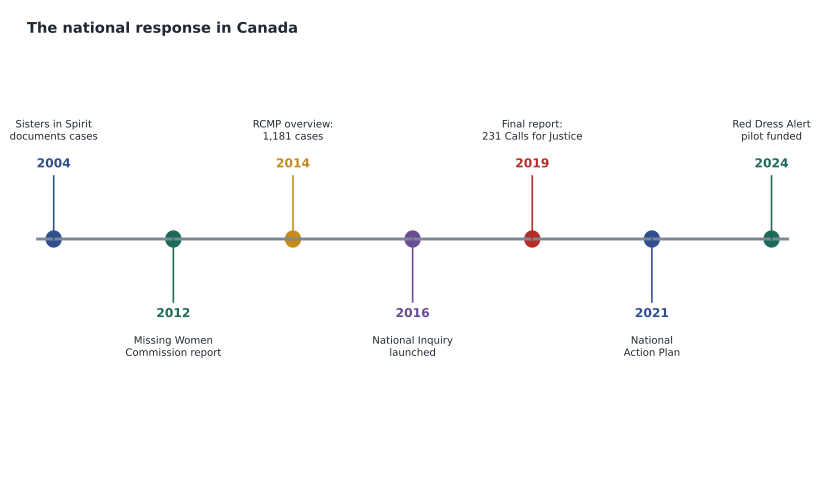
In 2014, the RCMP published an operational overview of missing and murdered Aboriginal women, the first national count. It identified 1,181 Indigenous women and girls who had been murdered or gone missing between 1980 and 2012: 1,017 homicide victims and 164 missing women. Indigenous women made up about 4 in 100 of the female population but about 16 in 100 of female homicide victims over that period, and the share was rising. Families and Indigenous organizations, including the Native Women's Association of Canada, which had documented hundreds of cases through its Sisters in Spirit research, said the real number was much higher, because police data often did not record Indigenous identity and because many deaths had been classified as accidents or suicides without adequate investigation.
Some cases became national symbols. Along Highway 16 in northern British Columbia, which became known as the Highway of Tears, many women and girls, most of them Indigenous, went missing or were murdered over decades; an RCMP project examined 18 of the cases. In Vancouver, Robert Pickton was convicted in 2007 of murdering six women from the Downtown Eastside, many of them Indigenous, and charged in the deaths of many more; the 2012 report of the Missing Women Commission of Inquiry found that police failures, including the failure to take reports from marginalized women seriously, had allowed him to keep killing. In Winnipeg, the death of fifteen-year-old Tina Fontaine, whose body was found in the Red River in 2014, after she had been in contact with police and child welfare workers, led to renewed calls for a national inquiry. In 2024, a Winnipeg man was convicted of murdering four First Nations women, and after a long campaign by their families, governments funded a search of a landfill for the remains of two of them.
The National Inquiry
In September 2016, the federal government launched the National Inquiry into Missing and Murdered Indigenous Women and Girls. Over more than two years, it heard from more than 2,000 family members, survivors, knowledge keepers and experts. Its final report, Reclaiming Power and Place, was released on June 3, 2019. It concluded that the violence amounted to a race-based genocide of Indigenous peoples, rooted in colonial structures and policies, and that persistent and deliberate human and Indigenous rights violations were the root cause. It made 231 Calls for Justice, directed at governments, institutions, industries and all Canadians. The report uses the term 2SLGBTQQIA+, for Two-Spirit, lesbian, gay, bisexual, transgender, queer, questioning, intersex, asexual and others, to include people whose experiences of violence had often been ignored.
Many Calls for Justice are directed at police. They call for police services to establish standardized protocols for missing persons cases, to take every report seriously and act on it immediately, to communicate regularly and respectfully with families, to recruit Indigenous officers and staff, to provide training developed with Indigenous communities, to fund Indigenous police services properly and to ensure independent civilian oversight. Governments responded with a National Action Plan in June 2021 and a Federal Pathway. Progress has been slow. A federal tracking tool reported in June 2025 that only 2 of the Calls for Justice had been fully completed, with 136 under way and 82 not yet started. In 2024, the federal budget funded the co-development of a Red Dress Alert, an alert system for missing Indigenous women, girls and Two-Spirit people; a Manitoba-based organization was chosen to lead the work, and the pilot was continuing in 2026.
| Problem the inquiries found | What it looked like | What police should do instead |
|---|---|---|
| Stereotypes and dismissal | "She's probably partying"; "she's done this before" | Assess risk on the facts; never assume a lifestyle |
| Delay | Waiting 24 or 48 hours before acting | Act at once; there is no waiting period in law or good practice |
| Poor communication with families | Families not told what is being done, or told nothing at all | One named contact, regular updates, honest explanations |
| Jurisdictional confusion | Cases passed between agencies | One lead agency from the first hour, with partners informed |
| Missing data | Indigenous identity not recorded; deaths misclassified | Ask and record identity respectfully; investigate deaths thoroughly |
Why Indigenous women and Two-Spirit people are at such risk
The National Inquiry and researchers have linked the violence to the history covered in Lessons 2 and 3 and to present-day conditions: the loss of women's traditional roles and status under the Indian Act, the trauma of residential schools and child removal, poverty and inadequate housing, which push some women to move to cities or travel by hitchhiking, the overrepresentation of Indigenous children in care, gaps in services in remote communities, the sexual exploitation of young people, and attitudes that treat Indigenous women as less valuable. Young people leaving care and women moving between communities and cities are especially vulnerable. Most homicides of Indigenous women are committed by people the victims know, including partners and family members, but Indigenous women are also overrepresented among victims of strangers and serial offenders.
Jesse Morningstar says that in Nimkii Bay, every family he knows has a name. 'You see them on posters, on red dresses hung in the trees in May, at the walks,' he says. 'So when someone's daughter doesn't come home, nobody thinks she's just partying. They think about all the others. That's why the families get angry when an officer tells them to wait. They've seen what waiting costs.'
Red dresses and remembrance
May 5 is observed in Canada as Red Dress Day, the National Day of Awareness for Missing and Murdered Indigenous Women, Girls and Two-Spirit People. The red dresses began with the REDress Project, an art installation by Métis artist Jaime Black, first shown in 2010, in which empty red dresses hung in public places to mark the absence of the women and girls who had been lost. Many police services, including Port Ardent's, now take part in Red Dress Day events with families and communities. Sergeant Keeshig says that officers who attend those events, and listen, learn more than any training can teach them.
Worked problem
Was Tara Pelletier at high risk?
Haddad uses the service's missing person risk assessment, which asks about vulnerability, threats, the circumstances of the disappearance and whether the behaviour is out of character. Using the facts Danielle gave, how should Tara's case be assessed?
Show solution
- Out of character: Tara had never gone more than a few hours without contacting her sister; silence for about 42 hours is a strong indicator.
- Threat: there were signs of intimate partner violence, including bruising, financial control and monitoring of her phone.
- Statement of fear: Tara had said that if anything happened to her, it would be her partner.
- Circumstances: the last person known to have seen her was the partner, after an argument, and he was minimizing her absence.
- Vulnerability: as an Indigenous woman experiencing partner violence, she belongs to a group the inquiries identified as at elevated risk, though the assessment rests on the specific facts above.
Answer: Every factor points the same way: high risk, requiring an immediate response. None of the facts was hidden; they were all in the first report. What was missing at 14:10 was the habit of assessing risk instead of assuming the explanation offered by the person who may be the source of the danger.
Haddad tells the class what she said to Kerr afterwards. 'I didn't yell at him,' she says. 'I asked him what he'd have done if Danielle had told him her sister was a nurse from the suburbs with a partner who'd hit her. He thought about it and said he'd have called me straight away. I said, then that's what you do every time. He hasn't made that mistake since.'
Counting, identity and the first entry
Haddad tells the class that the data problems the inquiries found begin at the front counter. If an officer does not ask whether a missing person is Indigenous, the record will not show it, and the case will not be counted. If an officer writes a vague description, enters the wrong date of birth or delays entering the case in CPIC, other officers who encounter the person will not know she is missing. If a death is classified as an accident without a full investigation, it will never appear in homicide statistics. Each of these errors is small on one file. Repeated across a country, they are part of the reason families say their relatives were made invisible. Accurate, prompt and respectful records are not paperwork; they are part of protecting people.
The National Inquiry also drew attention to particular risks: the sexual exploitation and trafficking of young Indigenous women and girls, often recruited from care or from remote communities moving to cities; the dangers faced by Two-Spirit and transgender Indigenous people, whose cases had often not been recognized at all; and the lack of safe transportation in many regions, which leaves women hitchhiking. Police services that understand these patterns can work with community organizations on prevention, such as safe transportation programs and outreach to youth leaving care, and can recognize the signs of exploitation when they meet a young person on the street.
What families say helps
Families who have lived through a disappearance describe the same few things that helped them. An officer who came to the house quickly and took them seriously. A single person who called them back, every time, even when there was nothing new. Honest answers, including 'I don't know' and 'I can't tell you that yet, and here is why'. Being asked what they knew about their relative's friends, habits and places, and seeing that information used. Being allowed to bring an elder, a friend or an advocate. Being told before the media when there was news. And, when the news was the worst, being told in person, with care, by someone who knew the case. Desjardins tells the class that none of these things costs money. They are matters of habit and respect, and every officer can practise them from the first day.
Common mistakes
MistakePolice must wait 24 or 48 hours before taking a missing adult report.
InsteadThere is no waiting period; risk is assessed immediately and action taken accordingly.
MistakeAn adult who has argued with a partner has probably just left.
InsteadAn argument with a partner who may be abusive is a risk factor, not an explanation.
MistakeThe National Inquiry's work is finished and its Calls for Justice have been implemented.
InsteadBy June 2025 only 2 of the 231 Calls for Justice had been fully completed.
MistakeViolence against Indigenous women is mainly committed by strangers.
InsteadMost homicides are committed by people the victims know, though Indigenous women are also overrepresented among victims of strangers.
Summary and key terms
- The RCMP counted 1,181 missing and murdered Indigenous women and girls between 1980 and 2012; families say the true number is higher.
- Inquiries, including the Missing Women Commission and the National Inquiry, found police failures that included dismissal, delay and poor communication.
- The National Inquiry reported in 2019 with 231 Calls for Justice, many directed at police; progress has been slow.
- Risk comes from history, present-day conditions and attitudes, and most homicides are committed by people victims know.
- Every missing person report must be assessed for risk at once, without assumptions about lifestyle or culture.
- Calls for Justice
- The 231 recommendations of the National Inquiry into Missing and Murdered Indigenous Women and Girls.
- Red Dress Alert
- A proposed alert system for missing Indigenous women, girls and Two-Spirit people, funded for co-development in 2024.
- 2SLGBTQQIA+
- Two-Spirit, lesbian, gay, bisexual, transgender, queer, questioning, intersex, asexual and others; used by the National Inquiry and many communities.
- Two-Spirit
- A term used by many Indigenous people for a person who embodies both masculine and feminine spirits, or for Indigenous people with diverse gender identities and sexual orientations.
- Risk assessment
- A structured review of the facts of a missing person report to decide how urgent the response must be.
Practice problems
Work each problem on paper first, then reveal the answer to check.
What did the RCMP's 2014 operational overview find?
Show answer
1,181 Indigenous women and girls murdered or missing from 1980 to 2012: 1,017 homicides and 164 missing.
How many Calls for Justice did the National Inquiry make, and when did it report?
Show answer
231, in its final report of June 3, 2019.
Name three patterns the inquiries found in police responses.
Show answer
Any three of: stereotypes and dismissal, delay, poor communication with families, jurisdictional confusion, missing data and misclassified deaths.
Which facts in Danielle's report made Tara's case high risk?
Show answer
Behaviour out of character, signs of partner violence and control, her statement of fear, and the circumstances of her last contact with the partner.
Lesson quiz · 5 questions
Score 60% or more to complete this lesson.
Create a free account to save your progress, take quizzes and earn a certificate.