
LES-205 · Lesson 3 of 12 · 19 min
Policing and Native nations: from the Indian police to Standing Rock
▶ Video coming soon A video version of this lesson is on the way.
Sergeant Lisa Haddad of the Port Ardent Police Department, who has worked with the class in several courses, joins Sergeant Paul Keeshig for this lesson. She begins by describing a call she took as a young officer, sixteen years ago, to a house where an Indigenous grandmother was caring for three grandchildren. A neighbor had complained about noise. When Haddad knocked, the grandmother opened the door, saw the uniform, and began to shake. 'I thought she was hiding something,' Haddad says. 'She wasn't. Her own mother had told her, when she was small, that if police came to the door the children would be taken. She'd been afraid of that knock for sixty years. I didn't understand that for a long time, and I handled it badly.'
Desjardins says the lesson is about why that knock carries so much weight. Police were not bystanders in the history covered in the last lesson. They were often the people who carried out the policies, and in some cases they used force against Indigenous people defending their land, their children or their way of life. That history is remembered in communities, and it shapes how people respond to officers today. Understanding it is not a matter of blaming today's officers; it is a matter of understanding the starting point.
The Indian police and the reservation era
In 1878, Congress began funding Indian police forces on reservations, recruited from the tribes themselves but answerable to the federal Indian agent. In 1883, the Secretary of the Interior created Courts of Indian Offenses, with judges appointed by agents, and a Code of Indian Offenses that made it a crime to hold the Sun Dance and other ceremonies, to practice traditional medicine or to follow traditional marriage customs. The Indian police enforced the agents' rules, took children to boarding schools, arrested people for practicing their religion and kept people on reservations. The arrangement placed Native officers in an impossible position between their own people and the government, and some of them paid for it with their lives.
The best-known event of the period shows how the arrangement worked. On December 15, 1890, Indian police at the Standing Rock Agency, acting on the agent's orders, went to arrest the Hunkpapa Lakota leader Sitting Bull, whom the government feared would support the Ghost Dance movement. In the struggle that followed, Sitting Bull was killed, along with several of his supporters and several of the Indian police officers. Two weeks later, on December 29, the army's Seventh Cavalry killed about 250 to 300 Lakota men, women and children at Wounded Knee Creek in South Dakota. The ceremonies the Code of Indian Offenses had criminalized were not protected until 1934, and full legal protection for traditional religious practice came only with the American Indian Religious Freedom Act of 1978.
Through the twentieth century, federal policy continued to shape policing. When the relocation program brought tens of thousands of Native people to cities in the 1950s and 1960s, many found themselves policed heavily for public drinking, vagrancy and minor offenses. In 1968, the American Indian Movement was founded in Minneapolis, partly to respond to police treatment of Native people in the city, and its first projects included patrols that followed police cars and recorded arrests. Sergeant Keeshig says that the elders he grew up with had seen all of it. 'We had good officers too, Native and non-Native,' he says. 'But the people remember the knock.'
Confrontations: Wounded Knee and after
In 1973, members of the American Indian Movement and Oglala Lakota residents occupied the town of Wounded Knee on the Pine Ridge Reservation in South Dakota, protesting the tribal government and the federal government's failure to honor treaties. The FBI, the U.S. Marshals Service and BIA police surrounded the town, and the siege lasted 71 days. Two Native men were killed and a U.S. marshal was paralyzed by gunfire. The years after the siege brought violence on the reservation, and in 1975 two FBI agents and a Native man were killed in a shootout there. Leonard Peltier was convicted of killing the agents in a trial that many people, including some who did not dispute the convictions, criticized; in January 2025, President Joe Biden commuted his sentence to home confinement.
Many confrontations since have involved land and treaty rights. From 2016 to 2017, members of the Standing Rock Sioux Tribe and thousands of supporters gathered in North Dakota to oppose the Dakota Access Pipeline, which they said threatened their water supply and sacred sites. State and local law enforcement, assisted by agencies from several states and by private security, made more than 750 arrests over the months of the protest. Officers used pepper spray, rubber bullets and, on the night of November 20, 2016, water cannons in freezing temperatures. The protest became a national symbol, and critics, including civil liberties groups and tribal leaders, raised questions about the use of force, the role of private security and communication with the tribe.
Since then, reviews and police leaders have drawn the same lessons that Canadian inquiries drew from confrontations there. Protests about land and treaty rights are rooted in long-standing grievances that police cannot solve. The aim should be peaceful resolution through communication, patience and negotiation, with officers who understand tribal sovereignty and treaty rights and who keep in constant contact with tribal leaders. Agencies that build relationships with tribal governments before a crisis are much better placed to keep a protest peaceful than agencies that meet tribal leaders for the first time across a police line.
Under-protection and broken trust
Some of the most damaging failures have involved not force but neglect. For decades, families in Native communities have reported that police were slow to respond, that reports of missing relatives were dismissed, that violent deaths were too quickly classified as accidents and that cases were dropped when jurisdiction was unclear. The Indian Law and Order Commission, created by the Tribal Law and Order Act, reported in 2013 that the jurisdictional system in Indian country was failing to keep Native communities safe and recommended returning much more authority to tribes. In cities, Native people have described being over-policed for minor offenses and ignored when they were victims.
Those experiences are why many Native families do not expect help when they call. Jesse Morningstar tells the class that when a cousin of his went missing, the family spent the first two days calling three different agencies, each of which said the case belonged to someone else. 'Everyone was polite,' he says. 'Nobody was in charge. By the time someone took it on, we'd already organized our own search.' Desjardins says that experience, multiplied across thousands of families, is what the phrase under-protected means.
Federal agencies and many police leaders have acknowledged these failures, and several states have created units and task forces on missing and murdered Indigenous people, which Lesson 9 covers. Keeshig says acknowledgments matter, but they are measured against the next call. 'Every officer who does it right is part of the apology,' he says. 'Every officer who does it wrong cancels it out.'
What the history teaches police
Desjardins asks the class to draw lessons from the history, and the students produce a list that he sorts into four themes. The first is that police have often been used to carry out government policies against Indigenous peoples, and officers should be alert when an order appears to put them on one side of a political or land dispute. The second is that force used against Indigenous people defending land or rights has repeatedly made situations worse and left lasting damage. The third is that neglect can be as harmful as force: slow responses, dismissed reports and poor investigations have cost lives and trust. The fourth is that trust rebuilt slowly can be lost quickly.
| Theme | Historical example | Lesson for today |
|---|---|---|
| Police as instruments of policy | Enforcing the Code of Indian Offenses | Know the law and the rights involved; ask hard questions about orders that target a community |
| Force in land disputes | Wounded Knee and Standing Rock | Communication, patience and negotiation; minimal force; liaison with leaders |
| Neglect and poor investigation | Missing relatives passed between agencies | Take every report seriously; investigate deaths thoroughly; someone must own the case |
| Trust is fragile | Families who no longer call | Every contact counts; follow up; explain decisions |
Haddad adds that the history also includes officers who did it differently, and that their example matters. She describes the Nimkii Bay tribal police, whose officers are mostly from the community, speak with elders before major decisions, and handle many incidents through the community's own processes rather than through arrests. 'They have the same law we do,' she says. 'But they start from inside the relationship instead of outside it. That changes everything.'
Worked problem
Applying the lessons of Standing Rock to a road blockade
At 06:30 on a Monday in March, about twenty Nimkii Bay citizens block a county road near the reservation, where a company is surveying a pipeline route through treaty-ceded territory, saying they were not consulted. The company asks the county sheriff to remove them immediately. What principles should guide the first hours?
Show solution
- Establish facts first: who is present, whether anyone is in danger, whether there is a court order, and what the protesters are asking for.
- Treat it as a dispute about rights and land, not simply a traffic problem; officers cannot resolve the underlying grievance.
- Make early contact with the Nimkii Bay tribal government and tribal police, through an officer who knows them, and keep that line open.
- Keep the scene safe, manage traffic, and avoid shows of force such as tactical units in view, which signal confrontation.
- If a court order is obtained, plan its enforcement with time, communication and minimal force, and keep commanders accountable for every decision.
Answer: Time, communication and respect for rights are the tools that work. Pressure for a quick result, which the company and sometimes politicians will apply, is exactly what the inquiries identified as a cause of disaster. The officers' job is to keep people safe and keep talking while the parties and the courts address the dispute.
Why it matters on an ordinary call
Most officers will never police a blockade. But the same history shapes ordinary calls: the grandmother who shakes when an officer knocks, the young man who refuses to answer questions because his uncle was beaten in a cell, the family that does not report a missing daughter for two days because they assume no one will care. Keeshig says the officers who do well in his community are the ones who expect that reaction and do not take it personally. 'Introduce yourself. Tell them why you're there. Tell them what happens next. Ask if they want someone with them. Then do what you said you'd do,' he says. 'It sounds simple. It is simple. It's also rare.'
Haddad agrees, and she ends by returning to the grandmother at the door. Years later, she says, she was called to the same house when one of the grandchildren, by then a teenager, was the victim of an assault. This time she sat at the kitchen table, explained every step, and brought a victim services worker the family knew. 'She remembered me,' Haddad says. 'She told me I'd been rude the first time. Then she gave me a cup of tea and told me everything I needed to know.'
Common mistakes
MistakePolice history with Indigenous peoples is mainly about protests.
InsteadMuch of the damage came from enforcing everyday policies, such as passes and school removals, and from neglect of victims.
MistakeStanding Rock was simply a public order problem.
InsteadIt was a dispute about water, land and treaty rights that police could not solve with force.
MistakeA community's distrust is personal hostility toward the officer.
InsteadIt is usually rooted in history; officers who expect it and stay respectful can change it over time.
MistakeApologies by police leaders settle the past.
InsteadTrust is rebuilt, or lost, on each call.
Summary and key terms
- The Indian police of the reservation era enforced the agents' rules, the bans on ceremony and boarding school attendance.
- Wounded Knee in 1973 and Standing Rock in 2016 and 2017 showed how land and treaty disputes escalate when force replaces communication.
- Neglect, slow responses and confusion over jurisdiction have left many Native families without help.
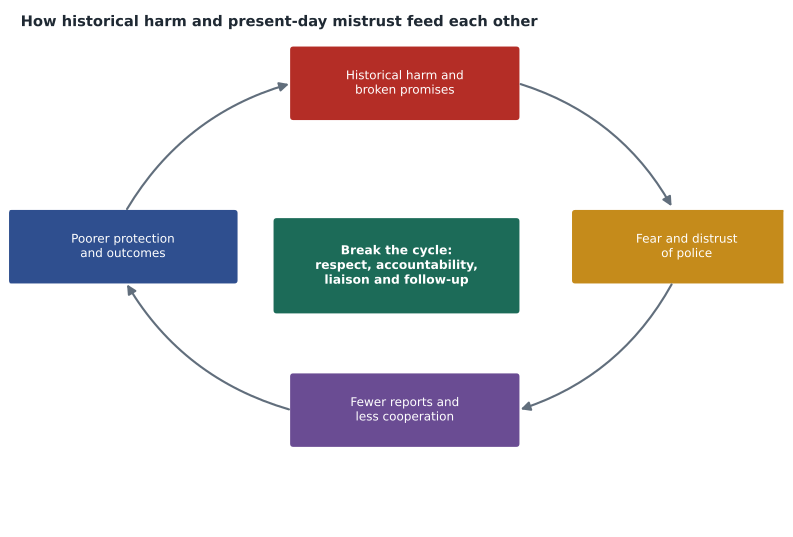
- Historical harm and present-day mistrust form a cycle that respectful, accountable policing can break.
- Ordinary calls carry the same history, and simple habits of explanation and follow-up make a difference.
- Courts of Indian Offenses
- Courts created by the Interior Department in 1883, with agent-appointed judges, to enforce rules that included bans on ceremonies.
- American Indian Movement
- An organization founded in Minneapolis in 1968, partly in response to police treatment of Native people.
- Indian Law and Order Commission
- A commission created by the Tribal Law and Order Act, which reported in 2013 that the Indian country justice system was failing tribes.
- Liaison officer
- An officer assigned to maintain communication and relationships with a community or its leaders, especially during a dispute or critical incident.
- Legitimacy
- The public's belief that police authority is fair and deserves to be obeyed.
Practice problems
Work each problem on paper first, then reveal the answer to check.
What role did the Indian police play in the reservation era?
Show answer
They enforced the agents' rules, including bans on ceremonies, took children to boarding schools and kept people on reservations.
What happened at Wounded Knee in 1973?
Show answer
AIM members and Oglala residents occupied the town, and a 71-day siege by federal agencies followed, with two Native men killed.
Name the four themes Desjardins drew from the history.
Show answer
Police as instruments of policy, force in land disputes, neglect and poor investigation, and the fragility of trust.
What should guide the first hours of a blockade?
Show answer
Facts first, early contact with community leaders through a liaison, safety and traffic management without shows of force, and patience while the dispute is addressed.
Lesson quiz · 5 questions
Score 60% or more to complete this lesson.
Create a free account to save your progress, take quizzes and earn a certificate.