
LES-205 · Lesson 4 of 12 · 19 min
Tribal sovereignty: the Marshall trilogy, treaties and federal Indian law
▶ Video coming soon A video version of this lesson is on the way.
On the first warm weekend in November, Jesse Morningstar went hunting with his uncle on ceded treaty land near the Nimkii Bay reservation, and on the way home they were stopped by a state conservation officer who saw a deer in the back of the truck. The officer was polite, checked their identification and asked a few questions, and then let them go. Jesse tells the class that his uncle has been stopped like that many times, and that the outcome has not always been so quiet. 'Sometimes they knew the treaty,' he says. 'Sometimes they didn't, and they seized the deer and the rifle, and my uncle went to court to prove a right his grandfather had.' Desjardins says this lesson is about the law that answers the officer's question.
Tribal sovereignty is not a matter of culture or courtesy. It is a legal principle as old as the United States, recognized in the Constitution, in treaties and in two centuries of Supreme Court decisions. Officers meet it most often in questions of jurisdiction, which Lesson 5 covers, and in hunting, fishing and land disputes, but it also shapes the authority of tribal governments, tribal police and tribal courts.
The Marshall trilogy
In three decisions between 1823 and 1832, Chief Justice John Marshall set out the basic framework of federal Indian law. In Johnson v. M'Intosh (1823), the Court adopted the doctrine of discovery, holding that European discovery gave the discovering nation, and later the United States, the exclusive right to acquire Native land, leaving tribes a right of occupancy. In Cherokee Nation v. Georgia (1831), the Court described tribes as 'domestic dependent nations' whose relationship with the United States 'resembles that of a ward to his guardian'. In Worcester v. Georgia (1832), the Court held that the Cherokee Nation was a distinct political community in which the laws of Georgia 'can have no force', and that relations with tribes belonged to the federal government. Together the three cases established that tribes are sovereign governments, that states generally lack authority over them, and that the federal government has a special relationship with them.
Marshall's framework has been both a protection and a burden. The doctrine of discovery, which the Vatican formally repudiated in 2023, has been criticized as a legal justification for taking Native land. The ward-guardian language was later used to justify federal control over tribal affairs. But the core idea of Worcester, that tribes are governments with their own territory and their own laws, survived, and it is the foundation of tribal police and courts today. Sergeant Keeshig tells the class that every time a state officer asks him by what authority he stops a non-Native driver on the reservation, the answer starts in 1832.
Plenary power, the trust responsibility and reserved rights
Over time, the Supreme Court held that Congress has plenary power over Indian affairs. In United States v. Kagama (1886), it upheld the Major Crimes Act, which extended federal criminal law to serious crimes by Indians in Indian country. In Lone Wolf v. Hitchcock (1903), it held that Congress could abrogate a treaty without the tribe's consent. At the same time, the courts developed the federal trust responsibility, a legal obligation of the United States to protect tribal lands, resources and self-government, which agencies such as the Bureau of Indian Affairs are supposed to carry out. Courts also read treaties in the way the tribes would have understood them and resolve ambiguities in their favor.
A key principle is that treaties are not grants of rights to tribes but grants of rights from tribes, which reserved everything they did not give away. In United States v. Winans (1905), the Court held that a treaty right to fish at usual and accustomed places allowed Yakama fishers to cross private land to reach them. In United States v. Washington (1974), often called the Boldt decision, a federal court held that treaty tribes in Washington State were entitled to up to half of the harvestable fish. In Minnesota v. Mille Lacs Band of Chippewa Indians (1999), the Court held that hunting, fishing and gathering rights reserved in an 1837 treaty survived. In Michigan, federal court decrees recognize the fishing rights in the Great Lakes, and the inland hunting and fishing rights, reserved by the 1836 Treaty of Washington, and tribes regulate their own members' harvest under those decrees.
| Case | Year | What it held |
|---|---|---|
| Johnson v. M'Intosh | 1823 | Discovery doctrine; tribes keep a right of occupancy |
| Cherokee Nation v. Georgia | 1831 | Tribes are domestic dependent nations |
| Worcester v. Georgia | 1832 | State laws have no force in tribal territory; relations are federal |
| United States v. Kagama | 1886 | Upheld the Major Crimes Act under congressional power |
| United States v. Winans | 1905 | Treaties reserve rights the tribes did not give away |
| United States v. Wheeler | 1978 | Tribal criminal jurisdiction over members is inherent sovereignty |
| Santa Clara Pueblo v. Martinez | 1978 | Tribes decide their own membership; limited federal review under ICRA |
| Minnesota v. Mille Lacs Band | 1999 | Treaty hunting and fishing rights survived |
Inherent sovereignty and civil rights in tribal government
The Supreme Court has repeatedly held that tribes retain inherent sovereignty, the powers they had as independent nations except where Congress or the tribes' dependent status has removed them. In United States v. Wheeler (1978), the Court held that a tribe's prosecution of its own member is an exercise of its own sovereignty, not federal power, so a later federal prosecution for the same conduct did not violate double jeopardy. In Santa Clara Pueblo v. Martinez (1978), it held that tribes decide their own membership. Because tribes are not created by the Constitution, the Bill of Rights does not bind them directly; instead, the Indian Civil Rights Act of 1968 applies most of its protections to tribal governments, including protection against unreasonable searches and seizures, the right to counsel at the defendant's own expense in most cases, and limits on punishment, with review in federal court mainly through habeas corpus.
The UN Declaration on the Rights of Indigenous Peoples
In 2007, the UN General Assembly adopted the United Nations Declaration on the Rights of Indigenous Peoples, which sets out minimum standards for the survival, dignity and well-being of Indigenous peoples, including rights to self-determination, to their lands and resources, and to free, prior and informed consent on matters affecting them. The United States voted against it in 2007 and announced its support in 2010, describing it as an aspirational statement rather than a binding legal document. The Declaration is not enforceable in American courts, but tribes, advocates and some federal agencies cite it as a standard, and several states and cities have referred to it in policies on consultation with tribes.
Linh Tran asks whether the Declaration changes what officers do on the street. Desjardins says not directly; it does not change the Criminal Code or give officers new powers. But it shapes the direction of law and policy, and it gives Indigenous communities a standard against which to measure the government's conduct, including its policing. Lesson 6 shows how tribal police departments have grown out of the same principle of self-determination.
Rights on the ground: what officers do
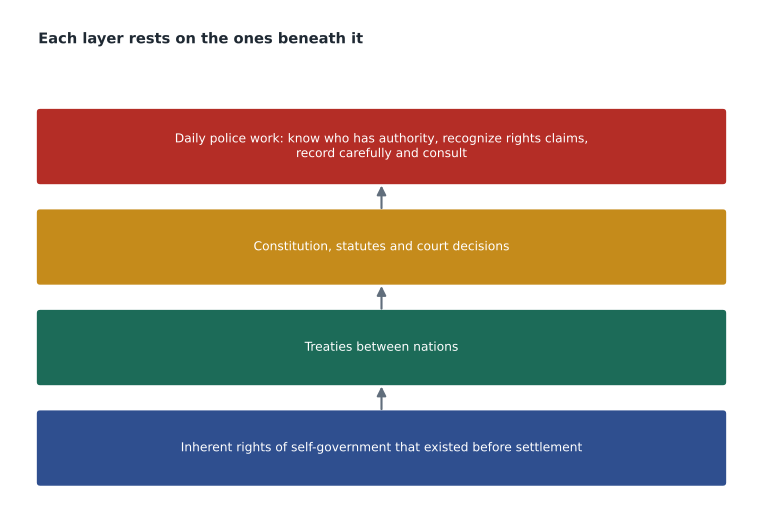
For most officers, rights questions arise in three kinds of situation. The first is harvesting: hunting, fishing, trapping and gathering, where a person may have a right that ordinary seasons, licenses or limits do not reach. The second is land and protest: blockades and occupations, where the underlying dispute is often about rights or consultation. The third is jurisdiction: whether a First Nation or tribe's own laws and police have authority, which Lesson 5 covers. In each case, the officer's job is not to decide the legal question on the spot, but to recognize it, handle the encounter safely and respectfully, record the facts carefully and consult people who know.
For harvesting calls, officers should know that tribal citizens may have treaty rights to hunt, fish and gather both on the reservation and in ceded territory, and that those rights are usually regulated by the tribe itself or by an intertribal body under court decrees and agreements. A tribal citizen hunting under tribal regulations may be acting lawfully even outside the state season. Officers who come across such cases should identify the people involved, ask for tribal identification and any tribal harvest license, note any claim of rights, and contact a conservation officer or the tribe's conservation department. Safety laws, such as those on carrying loaded firearms in a vehicle, still apply. Ohio officers will rarely meet these questions, because no reservation or reserved off-reservation treaty harvest right is currently recognized in the state, but Port Ardent officers who hunt or fish across the line in Michigan, or who work with Michigan agencies on Lake Erie, should know that the rules there are different.
Worked problem
A hunter stopped on a county road in Michigan
At 17:40 on a Saturday in November, a county deputy near the Nimkii Bay reservation stops a pickup for a burned-out headlight. In the bed is a freshly killed white-tailed deer. The driver, a man of about 50, says he is a Nimkii Bay citizen hunting under a tribal license in the ceded territory. The state firearm season has closed. What should the deputy do?
Show solution
- Deal with the reason for the stop, the headlight, in the ordinary way.
- Check safety: is any firearm in the vehicle unloaded and cased as the law requires? Safety laws apply to everyone.
- Ask respectfully about the deer and record the answers: who hunted it, where and when; ask to see tribal identification and the tribal harvest license or tag.
- Recognize that tribal regulations may permit the harvest; do not seize the deer on the assumption that it was taken unlawfully.
- Contact the state conservation officer or the tribe's conservation department, report the facts, and follow their direction.
Answer: The headlight is handled, the firearm is checked, and the rights question is recognized and passed to the people trained to deal with it. The deer stays with the hunter unless there is a clear reason to act. The officer's notes record exactly what was said, which protects everyone if the matter goes further.
Jesse says that the officer who stopped him and his uncle did almost exactly that. 'He asked, he wrote it down, he made a call, and he said have a good night,' he says. 'Took twelve minutes. My uncle said it was the first time in years he didn't feel like a criminal.'
Why rights matter beyond the law
Sergeant Keeshig ends the lesson by connecting rights to trust. For many people in his community, he says, hunting and fishing are not hobbies but ways of feeding their families, keeping their culture alive and teaching their children. When an officer treats a lawful harvest as a crime, the community hears that the government still does not respect its treaties. When an officer recognizes the right, even if the details have to be sorted out by someone else, the community hears that things may be changing. 'You don't have to be a lawyer,' he says. 'You just have to know that the question exists, and treat the person in front of you like they might be right.'
Common mistakes
MistakeTribes received their rights from the United States in treaties.
InsteadTreaties were grants from tribes, which reserved the rights they did not give away.
MistakeState laws apply on reservations in the same way as anywhere else.
InsteadWorcester and later cases hold that state authority in Indian country is limited and depends on federal law.
MistakeAn officer must decide on the spot whether a harvesting right applies.
InsteadThe officer's job is to recognize the question, handle the encounter safely, record the facts and consult the right people.
MistakeThe UN Declaration is binding law in American courts.
InsteadIt is a non-binding standard, though it influences policy.
Summary and key terms
- The Marshall trilogy established that tribes are sovereign domestic dependent nations and that state laws generally have no force in their territory.
- Congress has plenary power over Indian affairs, but the federal trust responsibility and the reserved rights doctrine protect tribal lands and rights.
- Tribes keep inherent sovereignty, including criminal jurisdiction over members, and the Indian Civil Rights Act applies most Bill of Rights protections to them.
- The United States supports the UN Declaration as an aspirational standard.
- Officers should recognize rights questions, handle encounters safely, record carefully and consult those who know.
- Inherent sovereignty
- The governmental powers tribes held as independent nations and still keep, except where Congress has removed them.
- Plenary power
- The broad authority of Congress over Indian affairs recognized by the Supreme Court.
- Trust responsibility
- The legal obligation of the United States to protect tribal lands, resources and self-government.
- Treaty right
- A right set out in a treaty between Indigenous nations and the government, interpreted as the nations would have understood it.
- UN Declaration on the Rights of Indigenous Peoples
- The 2007 UN declaration setting minimum standards for the rights of Indigenous peoples.
Practice problems
Work each problem on paper first, then reveal the answer to check.
What did Worcester v. Georgia decide?
Show answer
That the Cherokee Nation was a distinct political community in which Georgia's laws had no force, and that relations with tribes are federal.
What is the reserved rights doctrine?
Show answer
The principle that treaties were grants from the tribes, which reserved all rights they did not give away.
What three kinds of situation most often raise rights questions for officers?
Show answer
Harvesting, land and protest disputes, and jurisdiction.
What should an officer do when a hunter claims a treaty right?
Show answer
Handle the original matter, check safety, record the facts and the claim respectfully, avoid seizing on assumption and consult a conservation officer.
Lesson quiz · 5 questions
Score 60% or more to complete this lesson.
Create a free account to save your progress, take quizzes and earn a certificate.