
LES-205 · Lesson 5 of 12 · 20 min
Criminal jurisdiction in Indian country: the jurisdictional maze
▶ Video coming soon A video version of this lesson is on the way.
At 01:15 on a Sunday in December, Sergeant Paul Keeshig of the Nimkii Bay tribal police stopped a car on a state highway that runs through the reservation, after watching it weave across the center line. The driver, a non-Native man from a nearby town, smelled of alcohol and had an open bottle on the seat. Keeshig tells the class that he had three questions in his head at that moment: who is this man, where exactly am I standing, and what am I allowed to do? 'In most places, an officer only has to think about the first one,' he says. 'In Indian country, the answers to all three decide whose case it is.'
Desjardins says that jurisdiction is the part of this course where small mistakes can have large consequences. An officer who acts without authority may produce evidence that is excluded, an arrest that is unlawful or a prosecution that collapses. An officer who wrongly believes they have no authority may walk away from a victim. In the United States, criminal jurisdiction in Indian country depends on where the crime happened, whether the suspect is Indian, whether the victim is Indian, what the crime was and which state the land is in. Scholars call it a jurisdictional maze, and Congress's own commission described it as a system that fails Native communities.
What is Indian country?
Federal law defines Indian country in 18 U.S.C. section 1151 as including all land within the limits of an Indian reservation, including land owned by non-Indians and rights-of-way such as highways running through it; dependent Indian communities, such as the Pueblos of New Mexico; and Indian allotments still held in trust. In McGirt v. Oklahoma (2020), the Supreme Court held that the Muscogee (Creek) reservation had never been disestablished by Congress and therefore remained Indian country, a decision that, together with later cases about other nations, meant that much of eastern Oklahoma, including most of Tulsa, is Indian country for criminal law purposes. Ohio has no reservations and no Indian country, so the state has criminal jurisdiction over everyone in Port Ardent, Native or not.
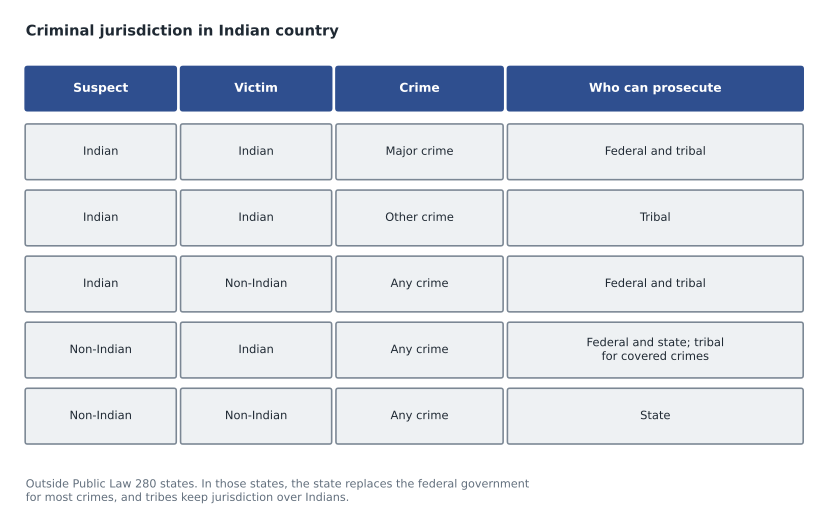
Within Indian country, criminal jurisdiction is divided among three sovereigns: the tribe, the federal government and, in some cases, the state. Which of them can prosecute depends first on the Indian status of the suspect and the victim. For criminal law purposes, a person is generally treated as Indian if they have some Indian ancestry and are recognized as Indian by a tribe or the federal government, usually through enrollment. In United States v. Antelope (1977), the Court held that this classification rests on political status, not race. Officers should never decide a person's status from appearance; they should ask, and record what they are told, and check enrollment when it matters.
The Supreme Court's 1978 decision in Oliphant v. Suquamish Indian Tribe held that tribes have no inherent criminal jurisdiction over non-Indians. In Duro v. Reina (1990), it held that tribes also lacked jurisdiction over Indians who were not members of the prosecuting tribe; Congress reversed that decision in 1990 and 1991 by recognizing tribes' inherent power to prosecute all Indians, and the Court upheld the change in United States v. Lara (2004). The Violence Against Women Act reauthorizations of 2013 and 2022 restored tribal jurisdiction over non-Indians for certain crimes, as Lesson 6 explains.
The federal statutes
Three federal statutes do most of the work. The General Crimes Act, 18 U.S.C. section 1152, sometimes called the Indian Country Crimes Act, extends federal criminal law to Indian country for crimes between Indians and non-Indians, but not for crimes by one Indian against another, or by an Indian who has already been punished by the tribe. The Major Crimes Act, 18 U.S.C. section 1153, passed in 1885 after the Supreme Court held in Ex parte Crow Dog (1883) that federal courts could not try a Lakota man for killing another, gives federal courts jurisdiction over a list of serious crimes committed by Indians in Indian country, including murder, manslaughter, kidnapping, maiming, felony sexual abuse, felony assault, arson, burglary and robbery. The Assimilative Crimes Act, 18 U.S.C. section 13, lets federal prosecutors borrow state criminal laws to fill gaps in federal law.
States generally have no criminal jurisdiction in Indian country unless Congress has given it to them. The main exception is Public Law 280, passed in 1953, which transferred federal criminal jurisdiction over most or all of Indian country to six mandatory states, California, Minnesota, Nebraska, Oregon, Wisconsin and, from 1958, Alaska, with a few reservations excluded, and allowed other states to assume it. Since 1968, states may assume such jurisdiction only with tribal consent, and some states have returned it. Tribes keep their own concurrent jurisdiction over Indians in Public Law 280 states, and under the Tribal Law and Order Act of 2010 they may ask the federal government to resume concurrent jurisdiction as well. Michigan is not a Public Law 280 state, so on the Nimkii Bay reservation, crimes involving Indians are handled by the tribe and the federal government.
Recent Supreme Court decisions
Two recent decisions have changed the map. In Oklahoma v. Castro-Huerta (2022), the Supreme Court held that states have concurrent jurisdiction with the federal government to prosecute crimes committed by non-Indians against Indians in Indian country, unless Congress has said otherwise; before then, most courts had treated those crimes as exclusively federal. In United States v. Cooley (2021), the Court held that a tribal police officer may stop and temporarily detain a non-Indian on a public highway within a reservation, and search for evidence, when the officer has reasonable grounds to believe the person may violate state or federal law, so that the person can be turned over to the proper authorities. Long before both decisions, United States v. McBratney (1882) had held that crimes by non-Indians against non-Indians in Indian country, and many victimless crimes by non-Indians, belong to the state.
Jesse Morningstar raises a concern that many tribal communities share. When a serious crime happens on the reservation, it is often investigated by the FBI and prosecuted by a U.S. Attorney's office that may be hundreds of miles away, and federal prosecutors have historically declined a large share of Indian country cases, especially sexual assault cases, for reasons that include distance, evidence problems and resources. The Tribal Law and Order Act now requires federal prosecutors to report declination data. Desjardins says this is one reason tribes have pushed for more of their own jurisdiction, and why tribal and federal officers who coordinate early, as Lesson 6 discusses, make such a difference.
| Situation | Who can prosecute | Notes |
|---|---|---|
| Assault in Port Ardent, Ohio, by a Nimkii Bay citizen | State of Ohio | No Indian country in Ohio; state law applies to everyone |
| Robbery on the reservation by a Nimkii Bay citizen against a non-Indian | Federal (Major Crimes Act) and tribal | Federal and tribal prosecutions are both possible |
| Simple assault on the reservation by one Indian against another | Tribal | Not on the major crimes list |
| Domestic violence on the reservation by a non-Indian against a Nimkii Bay citizen | Federal, state (after Castro-Huerta) and tribal if implementing special jurisdiction | Coordination is essential |
| Theft on the reservation by a non-Indian against a non-Indian | State | McBratney rule |
When a case crosses the boundary
Many of the hardest cases are not about a single location. Tara Pelletier lived in Port Ardent, but her family and many of her friends were on the Nimkii Bay reservation in Michigan, and she might have gone there. When Danielle reported her missing, the case belonged to the Port Ardent Police Department, because Tara was last seen in the city, and Ohio law applied to anything that had happened there. But the first useful calls were to Michigan: to the Nimkii Bay tribal police, who could check her mother's house and her grandmother's, and to people on the reservation who might have heard from her. Port Ardent and the Nimkii Bay department have no formal agreement, because they are in different states, but Haddad and Keeshig have each other's phone numbers, and the national missing person system, which Lesson 10 describes, lets both agencies see the same record.
If it had turned out that Tara had been harmed on the reservation, the case would have depended on who harmed her. A crime by Ryan Coulter, who is not Native, against Tara, who is, would fall to the federal government under the General Crimes Act, to the state of Michigan after Castro-Huerta and, for domestic violence, possibly to the tribe. Keeshig says the most important thing in a shared case is that nobody waits for the jurisdiction question to be settled before acting. 'It gets answered in the first hour, by the supervisors, on the phone,' he says. 'It doesn't get to be the reason a search starts late. That has happened to too many families.'
The status of tribal police officers
Tribal police officers' authority comes from their tribe's law over tribal matters and Indians, and from Cooley over non-Indians on reservation roads. To enforce federal law, many tribal officers hold Special Law Enforcement Commissions issued by the Bureau of Indian Affairs, which give them the authority of federal officers for federal crimes in Indian country. To enforce state law, they may need a cross-deputization agreement with a county sheriff or recognition under state law; states differ widely, and some recognize tribal officers as state peace officers while others do not. These arrangements, which Lesson 6 covers, are what make a tribal officer's authority in a given situation clear.
Practical rules for officers
Sergeant Keeshig gives the class five rules for officers who work near Indian country. First, know where the boundaries are; on a checkerboard reservation, a field may be Indian country and the house next to it may not be. Second, ask about status respectfully and record the answer; never guess from appearance. Third, know your agreements: whether you hold a cross-deputization or a special law enforcement commission, which Lesson 6 explains, and what it allows. Fourth, preserve evidence and notify the right agencies early; when in doubt about which sovereign will prosecute, investigate as if all of them might. Fifth, when a case crosses a boundary, such as a missing person from Port Ardent who may have gone home to the reservation, treat the tribal police as a full partner from the start.
Worked problem
Sorting out four cases on the reservation
Sergeant Keeshig asks the class to decide who can prosecute four cases on the Nimkii Bay reservation in Michigan: (a) the non-Native drunk driver he stopped on the state highway; (b) a Nimkii Bay citizen who assaults another Nimkii Bay citizen, causing a minor injury; (c) a Nimkii Bay citizen who breaks into a non-Native-owned store on the reservation; (d) a non-Native man who assaults his Nimkii Bay partner in their home on the reservation.
Show solution
- (a) A non-Indian suspect with no Indian victim: the state of Michigan prosecutes. Under Cooley, Keeshig may detain him and turn him over to state officers.
- (b) Indian against Indian, not a major crime: the tribe prosecutes in tribal court.
- (c) Burglary by an Indian is on the Major Crimes Act list: the federal government can prosecute, and so can the tribe.
- (d) Non-Indian against Indian: federal prosecution under the General Crimes Act, state prosecution after Castro-Huerta, and tribal prosecution if Nimkii Bay exercises special jurisdiction over domestic violence under the Violence Against Women Act.
- In each case, the first officer preserves evidence and notifies every agency that may have jurisdiction.
Answer: The answers are state; tribal; federal and tribal; and federal, state and possibly tribal. The same reservation can involve three sovereigns in one night, and the officer's first job in every case is the same: protect people, preserve evidence and notify the right agencies.
Linh Tran says she is relieved she will be working in Ohio, where there is no Indian country. Keeshig laughs. 'The people move,' he says. 'Tara Pelletier lives in Port Ardent and goes home to Nimkii Bay. Kyle Beaudry grew up with us and got arrested in your city. If something happens to one of our citizens up there, or one of yours comes to us, you'll be on the phone with me. Better to know how it works before that call.'
Desjardins adds a point about attitude. An officer who treats the edge of a reservation as the edge of their responsibility will fail people on both sides of it, and so will an officer who treats the reservation as a place where nobody's rules apply. The law is complicated but knowable, and the officer's job is to know it well enough to protect people and to call the right partners.
Common mistakes
MistakeTribal police have no authority over non-Indians.
InsteadUnder Cooley, tribal officers may detain non-Indians on reservation highways and turn them over; under VAWA, tribes may prosecute non-Indians for covered crimes.
MistakeA person's Indian status can be judged from appearance.
InsteadStatus depends on ancestry and recognition by a tribe or the federal government; officers should ask and record.
MistakeCastro-Huerta made state law apply to every crime in Indian country.
InsteadIt held only that states share jurisdiction over crimes by non-Indians against Indians.
MistakeJurisdictional questions can be sorted out later.
InsteadEvidence must be preserved and agencies notified early, because the wrong assumption can sink a case.
Summary and key terms
- Indian country includes reservations, dependent Indian communities and trust allotments; Ohio has none.
- Tribes may prosecute Indians; Oliphant removed jurisdiction over non-Indians except as Congress has restored it.
- The General Crimes Act, Major Crimes Act and Public Law 280 divide jurisdiction among federal, tribal and state governments.
- Castro-Huerta gave states concurrent jurisdiction over non-Indian crimes against Indians, and Cooley confirmed tribal officers' power to detain non-Indians on reservation highways.
- Officers should know the boundaries, the agreements and the people, preserve evidence and notify early.
- Indian country
- Land defined in 18 U.S.C. section 1151: reservations, dependent Indian communities and trust allotments.
- Major Crimes Act
- The 1885 federal law giving federal courts jurisdiction over listed serious crimes by Indians in Indian country.
- Public Law 280
- The 1953 federal law that gave certain states criminal jurisdiction over Indian country within their borders.
- Police of jurisdiction
- The police service or agency responsible for policing a particular area.
- Fresh pursuit
- The continuous pursuit of a suspect from the place of an offense, which may lawfully cross jurisdictional boundaries.
Practice problems
Work each problem on paper first, then reveal the answer to check.
What three things decide who can prosecute a crime in Indian country?
Show answer
Where it happened, the Indian status of the suspect and victim, and the type of crime, together with whether the state is a Public Law 280 state.
What did Oklahoma v. Castro-Huerta decide?
Show answer
That states share jurisdiction with the federal government over crimes by non-Indians against Indians in Indian country.
What did United States v. Cooley decide?
Show answer
That tribal officers may stop, detain and search non-Indians on public highways within a reservation when they have reasonable grounds, and turn them over to the proper authorities.
What is the first job of an officer when jurisdiction is unclear?
Show answer
Protect people, preserve evidence and notify every agency that may have jurisdiction.
Lesson quiz · 5 questions
Score 60% or more to complete this lesson.
Create a free account to save your progress, take quizzes and earn a certificate.