
LES-205 · Lesson 8 of 12 · 20 min
Bail, Gladue and Indigenous people in the courts
▶ Video coming soon A video version of this lesson is on the way.
On Thursday, June 11, Kyle Beaudry stood before Justice Helen Marchand in the Ontario Court of Justice in Port Ardent to be sentenced for assault causing bodily harm, to which he had pleaded guilty in April. On the desk in front of the judge was a 22-page Gladue report prepared by a caseworker at the Port Ardent Indigenous Justice Centre, a victim impact statement from Trevor Hale and a pre-sentence report from probation services. Constable Okeke, who had been subpoenaed for the plea but not needed, sat at the back of the courtroom because he wanted to see how the case ended.
Desjardins says this lesson is about what happens to Indigenous people in the courts, and about the alternatives that Indigenous communities have built. Police are not the decision-makers at these stages, but what they write, what they recommend and how they treat accused people and victims shapes the decisions, and officers who understand the court process make better decisions at the front end.
The Gladue principles
Section 718.2(e) of the Criminal Code, added in 1996, says that all available sanctions other than imprisonment that are reasonable in the circumstances and consistent with the harm done to victims or to the community should be considered for all offenders, 'with particular attention to the circumstances of Aboriginal offenders'. In R. v. Gladue (1999), the Supreme Court of Canada held that the provision is remedial: it was enacted to address the serious problem of overrepresentation of Indigenous people in prisons, and to encourage judges to take a different approach to sentencing Indigenous offenders. Judges must consider the unique systemic or background factors that may have played a part in bringing the offender before the court, and the types of sentencing procedures and sanctions that may be appropriate because of the offender's Indigenous heritage or connection, including restorative approaches.
In R. v. Ipeelee (2012), the Court reaffirmed Gladue, noting that overrepresentation had grown worse in the years since. It held that an offender does not need to prove a direct causal link between systemic factors and the offence, that the principles apply to all Indigenous offenders, including those convicted of serious offences, and that a failure to apply them is an error of law. The Court said that judges must take judicial notice of matters such as the history of colonialism, displacement and residential schools and how that history continues to translate into lower educational attainment, lower incomes, higher unemployment, higher rates of substance abuse and suicide and higher levels of incarceration. Gladue does not mean that Indigenous offenders automatically receive lighter sentences. For serious violent offences, a prison sentence may still be the only fit sentence. What changes is that the judge must look at the person in full before deciding.
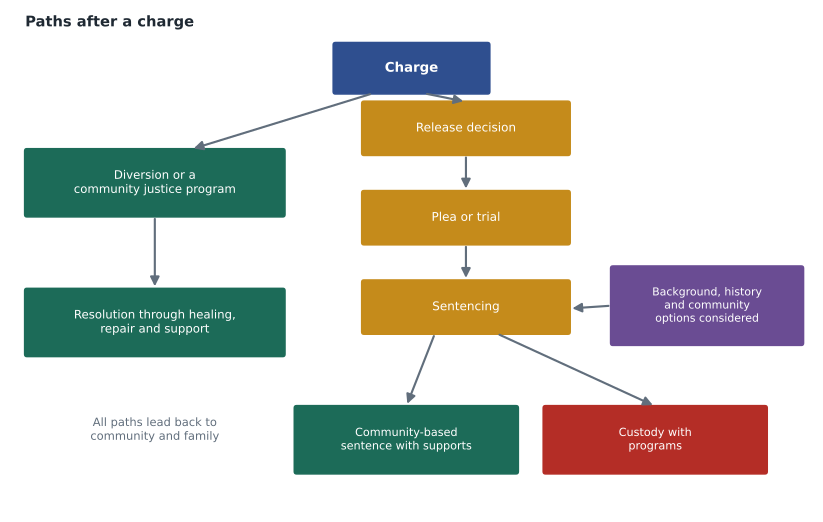
Gladue reports and Gladue courts
A Gladue report is a pre-sentence report, prepared by a trained caseworker, usually from an Indigenous organization, that gives the court detailed information about the offender's background and community and about culturally appropriate options. It is based on interviews with the offender, family members, elders and community workers and on records. In Ontario, Aboriginal Legal Services in Toronto pioneered the reports, and Legal Aid Ontario funds Gladue writers across the province. Gladue information is also used at bail hearings, at parole hearings and in other decisions. In 2001, Toronto opened the first Gladue court at Old City Hall, and many cities now have Indigenous Peoples' Courts, where Indigenous court workers, elders and community agencies help the court find options that address the causes of offending.
Kyle's report ran through his life in detail. It described his grandmother's eight years at residential school, his mother's removal into care at four, her return to Nimkii Bay at 19 and her struggles with addiction. It described Kyle's childhood split between his mother's apartment in Port Ardent and his grandmother's house, his years as a promising hockey player, his drinking from age 15, the suicide of a close friend when he was 17 and the two breaches of probation for missing curfew that followed a theft conviction at 17 and were dealt with in youth court. It also described his strengths: steady seasonal work with a contractor, a strong bond with his grandmother, two years helping coach the youth hockey team with Jesse Morningstar and his own request for treatment. It set out options, including Nimkii Bay's healing program, a residential treatment program for Indigenous men and a land-based program run by the community.
Bail, juries and the trial process
Gladue's concerns apply at bail too. Since 2019, section 493.2 of the Criminal Code has required police officers, justices and judges to give particular attention to the circumstances of Indigenous accused when making release decisions. Courts have held that this means considering how systemic factors may affect the accused's ability to meet conditions, and avoiding conditions that set people up to fail. Jury selection has also been a concern. Indigenous people have long been underrepresented on jury rolls; a 2013 report by former Supreme Court justice Frank Iacobucci found serious problems in Ontario, and in R. v. Kokopenace (2015) the Supreme Court considered the representativeness of a jury roll in a case involving a man from Grassy Narrows First Nation. After the 2018 trial in the death of Colten Boushie, in which defence counsel used peremptory challenges to exclude visibly Indigenous potential jurors, Parliament abolished peremptory challenges in 2019, and the Supreme Court upheld the change in 2021.
Restorative and community justice
Many Indigenous communities run their own justice programs, often funded under the federal Indigenous Justice Program and provincial programs, which take referrals from police before charge, from Crown attorneys after charge and from courts at sentencing. They use processes such as healing circles, sentencing circles and family group conferences, in which the offender, the victim if they wish, family members, elders and community members discuss the harm and agree on how to repair it. The idea has deep roots in Indigenous law, and Canadian courts have used sentencing circles since the early 1990s, beginning with R. v. Moses in the Yukon in 1992. Nimkii Bay's healing program takes about forty referrals a year, most of them for youth and minor adult offences, and the Port Ardent Indigenous Justice Centre runs a court worker program and a diversion program for urban Indigenous people.
Restorative processes depend on the victim's choice. In Kyle's case, the healing program offered a circle with Trevor Hale, but Hale declined; he said he was still angry and did not want to sit in a room with the man who broke his face. His choice was respected, and his victim impact statement was read in court instead. The Gladue caseworker included his views in the report, and the program designed a circle without him, with Kyle, his grandmother, an elder and his coach. Desjardins stresses that no victim should ever be pressured into a restorative process, and that a good program protects victims' safety and choices as carefully as it supports offenders.
The sentence
Justice Marchand gave reasons that ran to about twenty minutes. She described the injury and its effect on Hale, who had missed three weeks of work and still had numbness in his face, and said that violence of this kind, outside a bar, must be denounced. She then went through the Gladue report, noting the residential school and child welfare history, Kyle's age, his lack of adult convictions, his work, his remorse and his plan. She imposed a conditional sentence of eight months, to be served in Nimkii Bay under a curfew for the first four months, with conditions to complete the healing program and alcohol treatment, followed by twelve months' probation, and she ordered restitution of 1,450 dollars for Hale's lost wages not covered by insurance. 'You will not go to jail today,' she told Kyle. 'That is not because what you did was minor. It is because the court believes there is a better way to make sure it does not happen again, and you have shown you are willing to take it.'
Worked problem
Working out the sentence
Kyle's conditional sentence is 8 months, with a curfew for the first 4 months, followed by 12 months of probation. He is to pay 1,450 dollars in restitution in equal monthly payments over the probation period. How long is he under court supervision in total, and what is each monthly payment, to the nearest dollar?
Show solution
- Conditional sentence: 8 months, served in the community.
- Probation after it: 12 months.
- Total supervision: 8 + 12 = 20 months.
- Restitution: 1,450 divided by 12 is about 120.83, so about 121 dollars a month.
Answer: Kyle is under supervision for 20 months and pays about 121 dollars a month. A breach of the conditional sentence can lead to the rest of it being served in custody, so the conditions matter as much as the length.
What police should take from this
Desjardins draws three lessons for officers. First, the information officers record follows the case all the way through. Okeke's synopsis described the shove that started the fight, Kyle's cooperation and his question about his grandmother, and the Crown relied on it when it agreed to a resolution. An officer who leaves out mitigating facts, or who writes a synopsis full of assumptions, can make a fair outcome harder. Second, officers can ask, respectfully and as a matter of routine, whether an accused person is Indigenous, so that the court and support services know; self-identification should never be assumed from appearance. Third, police can support community options by making referrals, by helping programs with information, and by treating diversion and community sentences as legitimate outcomes rather than failures.
Okeke tells the class that he spoke briefly with Kyle's grandmother in the hallway after the sentencing. 'She thanked me for being decent to him the night he was arrested,' he says. 'I didn't do anything special. I just didn't treat him like garbage. I was surprised how much that mattered to her.'
Indigenous court workers and protection orders
Many Indigenous accused meet the court system first through an Indigenous court worker, funded through the federal-provincial Indigenous Courtwork Program, who explains the process, helps the accused find a lawyer and connects them with services, and can tell the court about programs that might be appropriate. Officers who arrest an Indigenous person can help by telling them that court workers exist and how to reach them. Courts and police must also take protection seriously when the victim is Indigenous: an emergency intervention order or peace bond made to protect a woman in Nimkii Bay is enforceable everywhere in Ontario, and Port Ardent officers must check CPIC for orders and enforce them in the city as they would any other. Release conditions that forbid contact with a victim must be explained clearly to the accused and to the victim, who should be told what to do if they are breached.
Desjardins adds that officers' notes and testimony matter in these cases as in any other. An officer who records exactly what a victim said, the injuries seen and the state of the scene gives the court what it needs to protect the victim and to sentence fairly. An officer who writes a vague or dismissive report may leave a dangerous person free and a victim without protection.
Young people and the courts
The same principles apply to young people. Section 38(2)(d) of the Youth Criminal Justice Act requires youth justice courts to consider all available sanctions other than custody that are reasonable, with particular attention to the circumstances of Aboriginal young persons, and section 3 of the Act stresses respect for cultural differences and the involvement of families and communities. Extrajudicial measures, such as warnings, cautions and referrals, which police can use before any charge, are often the most effective response for young Indigenous people who come into conflict with the law, especially when they connect the young person with family, elders and community programs. Jesse Morningstar notes that Kyle's first contact with the justice system, at 17, ended with probation conditions he could not keep; a referral to Nimkii Bay's youth justice committee might have produced a different path.
Haddad adds a point that applies in both kinds of case. When an officer arrests a parent, a grandparent or the person caring for children, the way the children are looked after in the next hour matters to the family for years. Asking who in the family can care for the children, letting the parent explain to them what is happening where it is safe to do so, and calling a relative before calling child welfare, when the law and safety allow, are small choices that can prevent the kind of memory Haddad described in Lesson 3.
Common mistakes
MistakeGladue means Indigenous offenders get lighter sentences.
InsteadGladue requires judges to consider background and alternatives; for serious violence, prison may still be the fit sentence.
MistakeAn offender must prove that residential schools caused the offence.
InsteadIpeelee held that no direct causal link is required.
MistakeRestorative processes require the victim to take part.
InsteadParticipation is always the victim's choice, and good programs protect victims' safety.
MistakeWhat police write matters only until the charge is laid.
InsteadReports and synopses shape release, charging and sentencing decisions throughout the case.
Summary and key terms
- Section 718.2(e) and R. v. Gladue require judges to consider the systemic and background factors affecting Indigenous offenders and appropriate alternatives to prison.
- Ipeelee held that no causal link need be proved and that the principles apply to all Indigenous offenders, including for serious offences.
- Gladue reports, Gladue courts and Indigenous Peoples' Courts bring background and community options before the court; section 493.2 applies the same concern at bail.
- Community justice programs and sentencing circles offer restorative alternatives, always subject to the victim's choice.
- Police reports, respectful questions about identity and support for community options all affect fair outcomes.
- Gladue principles
- The requirement, from section 718.2(e) and R. v. Gladue, that sentencing judges consider the circumstances of Indigenous offenders and alternatives to prison.
- Gladue report
- A pre-sentence report prepared by a trained caseworker on an Indigenous offender's background, community and culturally appropriate options.
- Conditional sentence
- A sentence of imprisonment of less than two years served in the community under strict conditions.
- Restorative justice
- An approach that responds to harm by bringing together those affected to repair it, rather than only punishing the offender.
Practice problems
Work each problem on paper first, then reveal the answer to check.
What two things must a judge consider under Gladue?
Show answer
The unique systemic or background factors that may have brought the offender before the court, and the sentencing procedures and sanctions that may be appropriate because of the offender's Indigenous heritage.
What did R. v. Ipeelee add?
Show answer
That no causal link need be proved, that the principles apply to all Indigenous offenders including for serious offences, and that failing to apply them is an error of law.
Why must restorative processes respect the victim's choice?
Show answer
Because forcing a victim to take part can harm them again; good programs protect victims' safety and choices.
Name two ways police can support fair outcomes at court.
Show answer
Any two of: accurate, complete reports including mitigating facts; asking respectfully about identity; making referrals; treating community options as legitimate.
Lesson quiz · 5 questions
Score 60% or more to complete this lesson.
Create a free account to save your progress, take quizzes and earn a certificate.