
LES-205 · Lesson 6 of 12 · 19 min
First Nations and Inuit police services
▶ Video coming soon A video version of this lesson is on the way.
The class spends a day at Nimkii Bay First Nation, an hour's drive north of Port Ardent. Sergeant Keeshig meets them at the police building, a converted band office with four holding cells, a sally port and a wall of photographs of every officer who has served since the department was founded. 'Fourteen officers,' he says, 'to cover about 2,400 people, 180 square kilometres of land and water, and every kind of call you can imagine, twenty-four hours a day. We're the police, the ambulance until it gets here, the mental health team, the search and rescue and the youth counsellor. And we're everybody's cousin.'
Desjardins asks the students to keep a list during the day of everything that is the same as policing in Port Ardent and everything that is different. By the end of the visit, the 'same' list has the law, the training, the radios and most of the calls. The 'different' list includes distance from backup, the size of the population, the officers' relationships with nearly everyone they meet, the role of elders, the way funding works, and the history that every officer carries into every house.
How First Nations policing developed
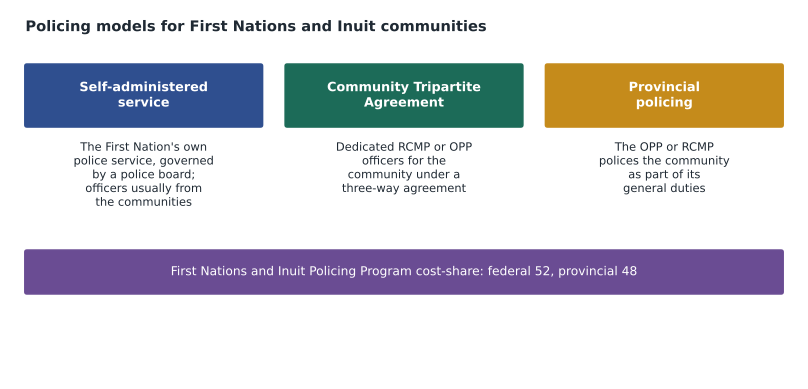
Until the 1960s, most First Nations were policed by the RCMP or provincial police, with little or no role for the communities themselves. From the late 1960s, band constables were appointed in some communities, with limited powers and training. In 1991, the federal government created the First Nations Policing Program, now called the First Nations and Inuit Policing Program, to fund policing that was professional, dedicated and responsive to the communities served. The costs are shared, with the federal government paying 52 in 100 and the province or territory 48 in 100. As of 2024 to 2025, the program supported policing in more than 435 First Nations and Inuit communities, about 65 in 100 of such communities in Canada.
The program has two main models. Under self-administered agreements, a First Nation or a group of First Nations establishes its own police service, governed by a police board or commission, with its own officers, who are usually from the communities they serve. Under Community Tripartite Agreements, the RCMP, or in Ontario sometimes the OPP, provides a dedicated group of officers to a community, in addition to the provincial or territorial policing that would exist anyway. Ontario has several self-administered services, including the Nishnawbe Aski Police Service, which serves dozens of communities in the far north and is the largest First Nations police service in the country, as well as services such as Treaty Three Police, the Anishinabek Police Service, Six Nations Police and the Akwesasne Mohawk Police Service. Other First Nations in Ontario are policed by the OPP, often through officers assigned specifically to them.
Funding, status and the essential service question
For most of its history, the First Nations and Inuit Policing Program has been a program, not a law. Funding has come through agreements that must be renewed every few years, and First Nations police services have long said they receive less per officer than comparable non-Indigenous services, that they cannot plan or pay competitive salaries, and that they lack money for buildings, cells, equipment and specialized units. Coroners' inquests into deaths in First Nations police cells and federal audits have documented these problems. In 2024, the Supreme Court of Canada held, in a case brought by the Pekuakamiulnuatsh First Nation of Mashteuiatsh, that Quebec had breached its duty to act in good faith and with the honour of the Crown in its handling of the community's policing agreement.
In 2019, the federal government committed to co-developing legislation that would recognize First Nations policing as an essential service, putting funding on a stable legal footing. The government shared proposed elements of the legislation with First Nations in September 2024, but by late 2025 the bill had still not been introduced in Parliament, and the National Chief of the Assembly of First Nations was again calling publicly for it. Ontario has taken a separate route. Under the Community Safety and Policing Act, 2019, in force since April 1, 2024, a First Nation may ask the Solicitor General to constitute a First Nation police board, bringing its service under the same provincial statute, standards and funding framework as other police services. In December 2024, the Nishnawbe Aski Police Service Board became the first to be constituted under the Act.
Sergeant Keeshig says the choice to opt in is a serious one for each community. Joining the provincial framework brings more secure funding and the same legal standing as other services, but it also means accepting provincial standards and oversight, which some communities see as a step away from their own jurisdiction over policing. 'Some nations want the framework,' he says. 'Some want their own law. Most want to be asked.' Nimkii Bay's police board is studying the question, with community meetings planned for the spring.
Policing from inside the community
Keeshig describes what makes policing in his community different. Most of his officers are Nimkii Bay members or are married into the community, and they police people they grew up with, coached, dated or went to school with. That makes some things easier: officers know who lives where, who is likely to be at a party, which family has a grandmother everyone listens to. It makes other things harder: arresting a cousin, investigating a friend's son, testifying against an elder's grandchild. 'You never go off duty here,' he says. 'You go to the store, somebody tells you about a problem. You go to a funeral, somebody wants to talk about a case.'
The service works closely with elders. An elders' advisory circle meets with the chief of police every month, and an elder is called to many calls involving young people, mental health crises and family disputes. The department's officers attend ceremonies and community events, run a youth program, and help with the land-based summer camp Jesse Morningstar has worked at. Keeshig says many incidents that would end in charges in a city are handled in Nimkii Bay through family meetings, referrals to the community's healing program or the youth justice committee. 'We still lay charges,' he says. 'Assaults, impaired driving, drugs, anything with a victim who wants it. But we start by asking what will make this stop.'
The challenges are real. Recruitment is hard: First Nations services compete with larger services that pay more, and officers who leave take years of community knowledge with them. Housing for officers who come from outside is scarce. Backup can be far away; in many fly-in communities in the north, it may be a plane ride. Officers deal with high rates of trauma, addiction and suicide in the communities they serve, often among people they know, and burnout is common. Keeshig says the solutions his service has found include recruiting from the community's own young people, partnering with the college on a cadet program and building time for officers to take part in ceremony and land-based healing themselves.
Worked problem
How many officers does 24-hour coverage take?
Nimkii Bay wants at least two officers on duty at all times, on three eight-hour shifts a day. Each officer works about 1,600 hours of patrol a year once vacation, training, court and sick time are taken out. How many officers does minimum patrol coverage require, and what does that leave from 14 officers?
Show solution
- Hours to cover in a year: 24 hours times 365 days is 8,760 hours.
- Two officers at all times doubles that: 8,760 times 2 is 17,520 officer-hours.
- Officers needed: 17,520 divided by 1,600 is about 10.95, so 11 officers.
- Officers left for investigations, supervision, the youth program and community work: 14 minus 11 is 3.
Answer: Eleven officers are needed just to keep two cars on the road around the clock, leaving three for everything else. One serious investigation, one officer on long-term leave or one resignation stretches the service to the limit. This is why stable funding and recruitment matter so much, and why outside services that ask a small First Nations or tribal department for help with a shared case should expect to bring resources, not only requests.
Working with First Nations police
Haddad, who has worked many joint files with the Nimkii Bay department, gives the class her own rules. First, treat them as colleagues with full authority, not as a small-town helper; they have the same training and often more experience with the kind of call you are on. Second, call early, including on cases that may only possibly involve their community, because they will know things you do not. Third, share information both ways, and follow up when a case they helped with is resolved. Fourth, respect their way of doing things in their community, including the involvement of elders and family, even when it takes longer than you are used to. Fifth, never go into the community on duty without letting them know, unless an emergency makes it impossible.
Desjardins adds that non-Indigenous services also have a responsibility to change. Many large services, including the OPP, the RCMP and several city services, now have Indigenous liaison units or Indigenous policing bureaus, advisory councils of elders and community members, cultural training developed with communities and protocols with First Nations police services. These are not substitutes for First Nations and tribal control of policing, but they make the partnership work.
| Same as in Port Ardent | Different at Nimkii Bay |
|---|---|
| The Criminal Code and police powers | Distance from backup and specialized units |
| Basic and advanced police training | Officers who know almost everyone they meet |
| Radios, cars, body-worn cameras | An elders' advisory circle and elders on calls |
| Most kinds of calls | Funding through agreements, not a guaranteed budget |
| Notes, reports and court | Many incidents handled through community processes |
At the end of the day, Keeshig drives the class to the lake, where the community's summer camp runs. He points to the dock where, two summers ago, officers and volunteers searched for three days for a teenager who had gone missing in a canoe. The teen was found alive on an island, cold and frightened. 'Half the people on that search were relatives,' he says. 'The other half were people who'd been arrested by us at some point. Nobody cared about that for three days. That's what community policing means here.'
Inuit and Métis communities
Inuit communities face particular challenges. In Nunavut, policing is provided by the RCMP, and few officers are Inuit or speak Inuktitut, so many officers serve short postings in communities whose language, culture and history they do not know. The Qikiqtani Truth Commission, created by Inuit in the Baffin region, reported in 2010 on the role of the RCMP in the government's actions of the 1950s and 1960s, including the killing of sled dogs and the relocation of families, which Inuit remember as acts that destroyed their way of life; in 2019 the federal government apologized. In Nunavik, in northern Quebec, the Nunavik Police Service is run by the regional government created under the James Bay and Northern Québec Agreement. Métis people mostly live in cities and towns and are policed by the ordinary police of those places, though the Métis Settlements in Alberta have their own governments and work with the RCMP.
Desjardins says the common thread is that communities policed by people who do not know them, who are far away or who are spread too thin are less safe, and that the answer has nearly always been the same: more control, and more resources, in the hands of the community itself. 'Nobody in Nimkii Bay wants worse policing in the name of self-determination,' Keeshig adds. 'They want good policing that belongs to them.'
Common mistakes
MistakeFirst Nations police services are informal community patrols.
InsteadThey are police services with trained officers and full police powers, governed by police boards.
MistakeFirst Nations policing is guaranteed by law as an essential service.
InsteadIt has been a funded program; federal essential service legislation had not been introduced by late 2025, though Ontario now offers a statutory framework.
MistakeA small department can easily absorb outside requests.
InsteadMinimum 24-hour coverage can take most of a small department's officers; partners should bring resources.
MistakeCommunity processes are a way of avoiding the law.
InsteadSerious offences and victims who want charges are dealt with through the courts; community processes address causes and minor matters.
Summary and key terms
- The First Nations and Inuit Policing Program, created in 1991, cost-shares policing 52 federal and 48 provincial and supported more than 435 communities in 2024 to 2025.
- Communities are policed by self-administered services, Community Tripartite Agreements or provincial police.
- Federal essential service legislation has been promised but not introduced; Ontario's 2019 Act lets First Nations opt into a provincial framework, as NAPS did in 2024.
- In 2024 the Supreme Court held that Quebec breached the honour of the Crown in a policing agreement with Mashteuiatsh.
- Small departments face recruitment, distance and funding challenges, and work best with partners who treat them as equals.
- First Nations and Inuit Policing Program
- The federal program, created in 1991, that cost-shares dedicated policing for First Nations and Inuit communities.
- Self-administered police service
- A police service established and governed by a First Nation or group of First Nations.
- Community Tripartite Agreement
- An agreement among Canada, a province or territory and a First Nation for dedicated RCMP or provincial police officers.
- Elders' advisory circle
- A group of elders who advise a police service on its priorities, practices and relationships with the community.
Practice problems
Work each problem on paper first, then reveal the answer to check.
What are the two main models under the First Nations and Inuit Policing Program?
Show answer
Self-administered police services and Community Tripartite Agreements.
What does Ontario's Community Safety and Policing Act allow a First Nation to do?
Show answer
Ask the Solicitor General to constitute a First Nation police board, bringing its service into the provincial framework.
How many officers does two-officer, 24-hour coverage need if each officer gives 1,600 patrol hours a year?
Show answer
About 11: 8,760 hours times 2 is 17,520, divided by 1,600 is about 10.95.
Name three of Haddad's rules for working with First Nations police.
Show answer
Any three of: treat them as full colleagues, call early, share information both ways, respect their ways in their community, notify before entering on duty.
Lesson quiz · 5 questions
Score 60% or more to complete this lesson.
Create a free account to save your progress, take quizzes and earn a certificate.