
LES-205 · Lesson 5 of 12 · 20 min
Jurisdiction and law enforcement in First Nations communities
▶ Video coming soon A video version of this lesson is on the way.
At 01:15 on a Sunday in December, a Port Ardent patrol car followed a speeding pickup north on the road out of the city. The pickup crossed onto Nimkii Bay First Nation land two kilometres later, and the Port Ardent officer, Constable Femi Okeke, radioed the Nimkii Bay Anishinaabe Police Service, which had a car three minutes away. The driver pulled into a driveway on the reserve and ran inside. Okeke tells the class that he had three questions in his head at that moment: whose call is this, what law applies, and what am I allowed to do? He got the answers right, he says, because two years earlier Sergeant Keeshig had sat him down and explained them.
Desjardins says that jurisdiction is the part of this course where small mistakes can have large consequences. An officer who acts without authority may produce evidence that is excluded, an arrest that is unlawful or a prosecution that collapses. An officer who wrongly believes they have no authority may walk away from a victim. In Canada, the rules are simpler than in the United States, because the Criminal Code applies everywhere, but they still involve several layers of law and several possible police services.
Which laws apply on reserves
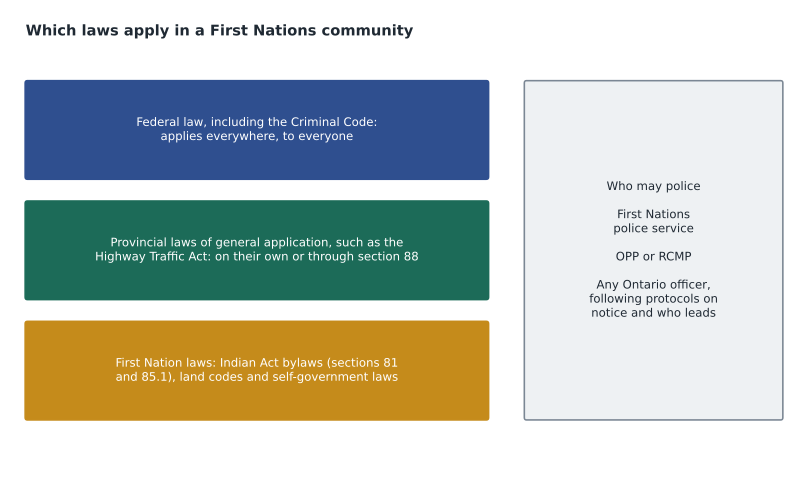
The Criminal Code and other federal laws, such as the Controlled Drugs and Substances Act, apply everywhere in Canada, including on reserves, to everyone, Indigenous or not. Provincial laws of general application, such as the Highway Traffic Act, the Liquor Licence and Control Act and the Mental Health Act, also apply on reserves, either on their own or through section 88 of the Indian Act, which makes them apply to 'Indians' except where they conflict with a treaty, the Indian Act or a law made under it. In practice, a driver who speeds or drives impaired on a reserve road commits the same offences as on any other road, and the same police powers apply.
On top of federal and provincial law, First Nations may make their own laws. Section 81 of the Indian Act allows band councils to pass bylaws on matters such as traffic, the prevention of disorderly conduct and nuisances, trespass, the observance of law and order and the residence of band members and others on the reserve; section 85.1 allows bylaws on intoxicants. Many First Nations also have land codes under the Framework Agreement on First Nation Land Management Act, child and family laws under the 2019 federal Act, and in some cases self-government laws that replace parts of the Indian Act. Nimkii Bay, for example, has bylaws on curfews for young people, on trespass by non-members and on the sale of alcohol, which the Nimkii Bay police enforce.
Bylaws have long posed an enforcement problem. Federal prosecutors have often declined to prosecute bylaw offences, and the Indian Act did not clearly say who should, so many bylaws went unenforced. Some First Nations now hire their own prosecutors, and federal and provincial governments have worked with communities on enforcement and prosecution protocols. Sergeant Keeshig says Nimkii Bay's bylaws work best not through prosecutions at all, but through the community's own processes: a talk with the family, a meeting with elders, a referral to the youth program. 'Most of the time the bylaw is the reason for the conversation,' he says, 'not the reason for a charge.'
Who polices First Nations communities
First Nations communities in Ontario are policed in one of several ways. Some, like Nimkii Bay, have a self-administered First Nations police service, governed by a police board and funded under agreements with the federal and provincial governments. Others are policed by the Ontario Provincial Police, either directly or through agreements under which the OPP provides officers dedicated to a community. In other provinces, the RCMP plays the role the OPP plays in Ontario, including through Community Tripartite Agreements. Inuit communities in Nunavut are policed by the RCMP, and Nunavik in northern Quebec by the Nunavik Police Service. Lesson 6 looks at these models in detail.
The police service of jurisdiction is the one responsible for policing the community, but other officers are not powerless there. A police officer in Ontario has authority throughout the province, so a Port Ardent officer who sees an offence on the Nimkii Bay reserve, or who follows a vehicle there in fresh pursuit, has the same legal powers there as in the city. What changes is the protocol. Port Ardent and Nimkii Bay have a written agreement that says which service takes which calls near the boundary, how the two services notify each other and who leads an investigation that crosses the line. The agreement also commits Port Ardent officers to notify the Nimkii Bay service whenever they enter the community on duty, except in an emergency, and then as soon as they can.
Courts and prosecutions
Criminal charges arising on reserves are prosecuted in the ordinary provincial courts by Crown prosecutors, and the Charter applies in full. Some First Nations have developed their own justice systems for matters within their authority: the Akwesasne Court, for example, has heard cases under the Mohawk Council of Akwesasne's own laws since 2016, using restorative approaches as well as fines. Many communities run Indigenous community justice programs that take referrals from police and prosecutors, as Lesson 8 describes. Indigenous accused in any court are entitled to have their background considered at bail and sentencing under the Gladue principles, and courts have developed specialized Indigenous Peoples' Courts in many cities.
Jesse Morningstar raises a concern that many communities share. When a serious crime happens on the reserve, it is investigated by the First Nations police service or the OPP, prosecuted by a provincial Crown attorney who may never have visited the community, and tried in a courthouse an hour or more away. Victims and witnesses must travel, and families may wait months for news. Desjardins agrees that this distance is one reason many communities want more control over their own justice systems, and why police who keep victims informed, as Lesson 10 discusses, make a real difference.
| Situation | Police of jurisdiction | Law that applies |
|---|---|---|
| Assault in Port Ardent by a Nimkii Bay member | Port Ardent Police Service | Criminal Code; Ontario Court of Justice |
| Impaired driving on a reserve road | Nimkii Bay police (or any officer who sees it) | Criminal Code |
| Breach of a Nimkii Bay curfew bylaw | Nimkii Bay police | Band bylaw under section 81 |
| Speeding on a reserve road | Nimkii Bay police or OPP | Highway Traffic Act |
| Pursuit from Port Ardent onto the reserve | Port Ardent may continue; Nimkii Bay notified and may lead | Criminal Code; protocol governs who takes the case |
When a case crosses the boundary
Many of the hardest cases are not about a single location. Tara Pelletier lived in Port Ardent, but her family and many of her friends were in Nimkii Bay, and she might have gone there. When Danielle reported her missing, the case belonged to the Port Ardent Police Service, because Tara was last seen in the city. But the first useful calls were to Nimkii Bay: to the police service, which could check her mother's house and her grandmother's, and to people in the community who might have heard from her. The protocol between the two services treats a missing person who may be in either community as a shared case from the first hour, with one lead investigator, regular contact between the two services, and one point of contact for the family, so that relatives are not passed from one office to another.
If it had turned out that Tara had been harmed on the reserve, the investigation would have moved to the Nimkii Bay service, with support from the OPP's major case investigators under Ontario's major case management system, and the Criminal Code would have applied in the same way as in the city. Keeshig says the most important thing in a shared case is that nobody waits for the paperwork. 'The jurisdiction question is real,' he says, 'but it gets answered in the first hour, by the two supervisors, on the phone. It doesn't get to be the reason a search starts late.'
The status of First Nations police officers
For many years, officers of First Nations police services in Ontario were appointed as First Nations Constables under the provincial Police Services Act, a status that gave them police powers but left their services outside the legislative framework that governed municipal and provincial police, with consequences for funding, oversight and standards. Ontario's Community Safety and Policing Act, 2019, which came into force on April 1, 2024, allows a First Nation to ask the Solicitor General to constitute a First Nation police board, bringing its service into the same legislative framework as other services if it chooses. In December 2024, the Nishnawbe Aski Police Service, the largest First Nations police service in Canada, became the first to do so. Lesson 6 explains why the choice is a significant one.
Practical rules for officers
Sergeant Keeshig gives the class five rules for officers who work near First Nations communities. First, know the community's police service, its officers' names and its phone number before you need them. Second, know the protocol: which calls you take, when you notify, and who leads. Third, notify as early as you can when you enter on duty; an unannounced cruiser in the community at night starts rumours. Fourth, know that the community may have bylaws and its own processes, and ask the local service before acting on a minor matter that it might handle differently. Fifth, when a case crosses the boundary, such as a missing person from Port Ardent who may have gone home, treat the other service as a full partner from the start.
Worked problem
Sorting out the Nimkii Bay pursuit
Constable Okeke followed a pickup clocked at 132 km/h in an 80 zone from Port Ardent onto Nimkii Bay First Nation, where the driver ran into a house. The Nimkii Bay officer arrived three minutes later. What authority did Okeke have, and who should take the case?
Show solution
- Speed: 132 minus 80 is 52 km/h over the limit, an offence under the Highway Traffic Act that applies on the reserve.
- Authority: an Ontario police officer has authority throughout the province, so Okeke could lawfully continue in fresh pursuit onto the reserve.
- Entry: entering the house would require grounds under the law of entry, such as hot pursuit for an indictable offence or a warrant; the stunt driving and flight make this a serious matter, but there was no immediate danger.
- Protocol: Okeke had already notified the Nimkii Bay service, which arrived quickly; under the agreement, the local service may lead within the community.
- Decision: the officers agreed that Nimkii Bay would make contact with the household, which it knew, and Okeke would lay the charges arising from the pursuit.
Answer: Okeke had lawful authority, but the case went best because the two services followed the protocol. The Nimkii Bay officer knocked on the door, the driver came out to someone he knew, and nobody had to force anything. Speed and flight charges were laid by Port Ardent, and the Nimkii Bay service dealt with the family.
Linh Tran says she is relieved she will be working in a city, not on a reserve. Keeshig laughs. 'The people move,' he says. 'Tara Pelletier lives in Port Ardent and goes home to Nimkii Bay. Kyle Beaudry grew up with us and got arrested in your city. You don't need to know our bylaws, but you need to know us.'
Desjardins adds a point about attitude. A Port Ardent officer who treats the boundary of Nimkii Bay as the edge of their responsibility will fail people on both sides of it, and so will an officer who treats the reserve as a place where the ordinary rules do not apply. The law is the same; the relationships and protocols are different, and the officer's job is to know both.
Common mistakes
MistakeFirst Nations land is outside the reach of the Criminal Code.
InsteadThe Criminal Code applies everywhere in Canada, to everyone.
MistakeOnly the First Nations police service can act on a reserve.
InsteadAny Ontario police officer has authority there, but protocols govern notification and who leads.
MistakeBand bylaws are informal rules with no legal force.
InsteadBylaws made under the Indian Act are law, though enforcement has often been difficult.
MistakeJurisdictional questions can be sorted out later.
InsteadEvidence must be preserved and agencies notified early, because the wrong assumption can sink a case.
Summary and key terms
- The Criminal Code and federal laws apply everywhere, and provincial laws of general application apply on reserves, partly through section 88 of the Indian Act.
- First Nations may make bylaws under sections 81 and 85.1 of the Indian Act, land codes and self-government laws.
- Communities are policed by First Nations police services, the OPP or the RCMP; any Ontario officer has authority on a reserve, subject to protocols.
- Charges are prosecuted in provincial courts, and some communities run their own courts and justice programs.
- Officers should know the boundaries, the agreements and the people, preserve evidence and notify early.
- Section 88 of the Indian Act
- The provision that makes provincial laws of general application apply to Indians, subject to treaties and the Act.
- Band bylaw
- A law made by a band council under the Indian Act, for example on traffic, trespass, residence or intoxicants.
- Police of jurisdiction
- The police service or agency responsible for policing a particular area.
- Fresh pursuit
- The continuous pursuit of a suspect from the place of an offence, which may lawfully cross jurisdictional boundaries.
Practice problems
Work each problem on paper first, then reveal the answer to check.
Why does the Criminal Code apply on reserves?
Show answer
Because it is federal law, which applies everywhere in Canada to everyone.
What may a band council make bylaws about under section 81?
Show answer
Matters such as traffic, disorderly conduct, trespass, law and order and residence on the reserve.
What does the Port Ardent and Nimkii Bay protocol cover?
Show answer
Which service takes which calls near the boundary, notification, and who leads investigations that cross the line.
What is the first job of an officer when jurisdiction is unclear?
Show answer
Protect people, preserve evidence and notify every agency that may have jurisdiction.
Lesson quiz · 5 questions
Score 60% or more to complete this lesson.
Create a free account to save your progress, take quizzes and earn a certificate.