
LES-205 · Lesson 4 of 12 · 20 min
Aboriginal and treaty rights: section 35, the courts and the UN Declaration
▶ Video coming soon A video version of this lesson is on the way.
On the first warm weekend in November, Jesse Morningstar went hunting with his uncle in the bush north of Nimkii Bay, and on the way home they were stopped by a conservation officer who saw a deer in the back of the truck. The officer was polite, checked their identification and asked a few questions, and then let them go. Jesse tells the class that his uncle has been stopped like that many times, and that the outcome has not always been so quiet. 'Sometimes they knew the treaty,' he says. 'Sometimes they didn't, and they seized the deer and the rifle, and my uncle went to court to prove a right his grandfather had.' Desjardins says this lesson is about the law that answers the officer's question.
Aboriginal and treaty rights are not a matter of culture or courtesy. They are constitutional rights, protected by section 35 of the Constitution Act, 1982, and the courts have spent forty years working out what they mean. Officers meet them most often in hunting, fishing and land disputes, but they also shape the authority of First Nations governments, the duty of governments to consult and the way courts look at Indigenous accused and victims.
Section 35 and the Constitution
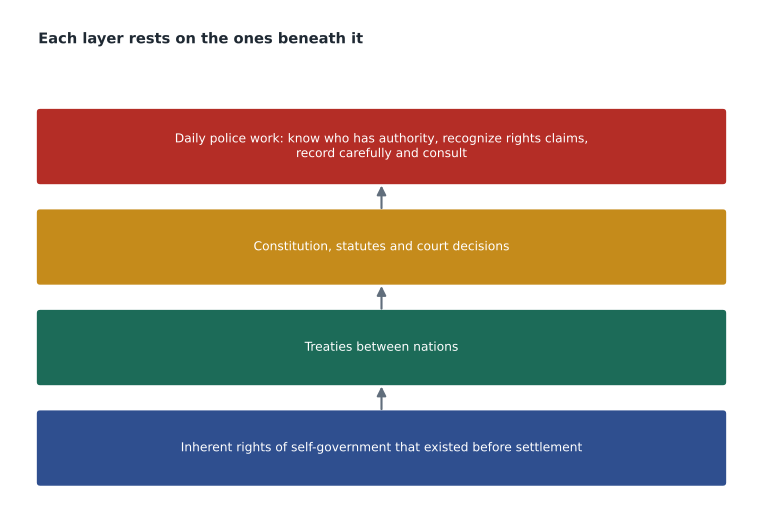
Section 35(1) of the Constitution Act, 1982 says: 'The existing aboriginal and treaty rights of the aboriginal peoples of Canada are hereby recognized and affirmed.' Section 35(2) defines the Aboriginal peoples as the Indian, Inuit and Métis peoples. The section did not create these rights; it recognized rights that already existed because Indigenous peoples occupied and governed the land before European settlement, and rights set out in treaties. Section 25 of the Charter adds that Charter rights are not to be interpreted so as to diminish Aboriginal and treaty rights. Separately, section 91(24) of the Constitution Act, 1867 gives the federal government power over 'Indians, and Lands reserved for the Indians', which is why the Indian Act is a federal law; in Daniels v. Canada (2016), the Supreme Court held that Métis and non-status Indians are also 'Indians' for that purpose.
In the decades after 1982, the Supreme Court of Canada built a body of law on section 35. In R. v. Sparrow (1990), a Musqueam fisherman was charged with fishing with a longer net than his licence allowed. The Court held that the Musqueam had an existing Aboriginal right to fish for food and ceremonial purposes, that the right had not been extinguished simply because it had been regulated, and that governments may limit such a right only with a valid objective, such as conservation, and in a way consistent with the honour of the Crown, including giving the right priority after conservation and consulting the community. In R. v. Van der Peet (1996), the Court held that an Aboriginal right must be an element of a practice, custom or tradition integral to the distinctive culture of the group before contact with Europeans.
Treaty rights and the honour of the Crown
Treaty rights are rights set out in treaties between the Crown and First Nations, including the historic treaties and modern land claims agreements. Courts interpret treaties generously, resolve ambiguities in favour of the First Nations and consider how the First Nations understood the agreement at the time, including oral history. In R. v. Marshall (1999), the Court held that the Peace and Friendship Treaties of 1760 and 1761 gave the Mi'kmaq a right to fish and trade for a moderate livelihood; the decision was followed by confrontations at Burnt Church, New Brunswick, between Mi'kmaq fishers, non-Indigenous fishers and federal officers, and the Court issued a further judgment explaining that the right remained subject to justified regulation. In R. v. Powley (2003), the Court recognized a Métis community's right to hunt for food near Sault Ste. Marie, Ontario, and set out a test for Métis rights.
Behind all of this is the honour of the Crown, the principle that governments must act honourably in their dealings with Indigenous peoples, fulfil their promises diligently and never sharp-deal. In Haida Nation v. British Columbia (2004), the Court held that the honour of the Crown gives rise to a duty to consult, and where appropriate accommodate, Indigenous peoples whenever the Crown is considering action that might adversely affect an Aboriginal or treaty right, even before the right has been proved in court. In Tsilhqot'in Nation v. British Columbia (2014), the Court for the first time declared Aboriginal title to a specific area, and held that title gives the First Nation the right to decide how the land is used. Police are not usually the ones consulting, but disputes about consultation are behind many of the blockades described in Lesson 3.
| Case | Year | What it held |
|---|---|---|
| R. v. Sparrow | 1990 | Existing Aboriginal rights are protected; limits need a valid objective and must respect the honour of the Crown |
| R. v. Van der Peet | 1996 | Aboriginal rights protect practices integral to the group's distinctive culture before contact |
| Delgamuukw v. British Columbia | 1997 | Aboriginal title exists; oral histories are admissible evidence |
| R. v. Marshall | 1999 | Treaty right to fish and trade for a moderate livelihood, subject to justified regulation |
| R. v. Powley | 2003 | Métis harvesting rights and the test for proving them |
| Haida Nation v. British Columbia | 2004 | Duty to consult and accommodate before rights are proved |
| Tsilhqot'in Nation v. British Columbia | 2014 | First declaration of Aboriginal title to a specific area |
| Daniels v. Canada | 2016 | Métis and non-status Indians are Indians under section 91(24) |
Self-government and modern treaties
Many First Nations govern under the Indian Act through elected band councils, but others have negotiated self-government agreements or modern treaties that replace parts of the Act with their own laws. Since 1995, the federal government has recognized the inherent right of self-government as an existing Aboriginal right under section 35. Examples include the Nisga'a Final Agreement in British Columbia, in force since 2000, and the Nunavut Land Claims Agreement of 1993, which led to the creation of Nunavut in 1999. Under these agreements, First Nations may make laws on matters such as education, land, culture and, in some cases, the administration of justice and policing. Officers working near a self-governing First Nation need to know which of its laws apply and who enforces them.
The UN Declaration on the Rights of Indigenous Peoples
In 2007, the UN General Assembly adopted the United Nations Declaration on the Rights of Indigenous Peoples, which sets out minimum standards for the survival, dignity and well-being of Indigenous peoples, including rights to self-determination, to their lands and resources, to their cultures and languages, and to free, prior and informed consent on matters that affect them. Canada endorsed the Declaration in 2010 and removed its objections in 2016. On June 21, 2021, the United Nations Declaration on the Rights of Indigenous Peoples Act came into force; it commits the federal government to take all measures necessary to make federal laws consistent with the Declaration and to prepare an action plan, which was released in June 2023 and is reported on each year. British Columbia passed similar legislation in 2019. In March 2025, the federal government also released Canada's first Indigenous Justice Strategy, developed with Indigenous partners, which sets out steps to address systemic discrimination and overrepresentation.
Linh Tran asks whether the Declaration changes what officers do on the street. Desjardins says not directly; it does not change the Criminal Code or give officers new powers. But it shapes the direction of law and policy, and it gives Indigenous communities a standard against which to measure the government's conduct, including its policing. Lesson 6 shows how the federal government's long-promised legislation on First Nations police services has been framed in terms of the Declaration and the inherent right of self-government.
Rights on the ground: what officers do
For most officers, rights questions arise in three kinds of situation. The first is harvesting: hunting, fishing, trapping and gathering, where a person may have a right that ordinary seasons, licences or limits do not reach. The second is land and protest: blockades and occupations, where the underlying dispute is often about rights or consultation. The third is jurisdiction: whether a First Nation or tribe's own laws and police have authority, which Lesson 5 covers. In each case, the officer's job is not to decide the legal question on the spot, but to recognize it, handle the encounter safely and respectfully, record the facts carefully and consult people who know.
For harvesting calls, Ontario's long-standing approach, worked out with First Nations, is that conservation officers generally do not charge First Nations people who are harvesting for food, social or ceremonial purposes within their treaty or traditional territory, unless there are concerns about conservation or public safety, such as hunting at night with lights near homes or dangerous use of firearms. Commercial sale may be treated differently. Police officers who come across such cases, for example a hunter stopped on a highway, should identify the people involved, note any claim of rights and the community they belong to, and contact a conservation officer, who has the training and the policy guidance to deal with it. Safety laws, such as those on carrying loaded firearms in a vehicle, apply to everyone.
Worked problem
A hunter stopped on Highway 11
At 17:40 on a Saturday in November, a Port Ardent constable on traffic duty stops a pickup for a burned-out headlight on the highway north of the city. In the box is a freshly killed white-tailed deer. The driver, a man of about 50, says he is from Nimkii Bay and was hunting for his family in the bush east of the highway, which is within the treaty territory. The regular rifle season for that area has closed. What should the constable do?
Show solution
- Deal with the reason for the stop, the headlight, in the ordinary way.
- Check safety: is any firearm in the vehicle unloaded and cased as the law requires? Safety laws apply to everyone.
- Ask respectfully about the deer and record the answers: who hunted it, where, when, and the community and status of the hunter; ask to see a status card if he has one.
- Recognize that a treaty right may apply and that closed seasons may not; do not seize the deer on the assumption that it was taken unlawfully.
- Contact the Ministry of Natural Resources conservation officer on duty, report the facts, and follow their direction.
Answer: The headlight is handled, the firearm is checked, and the rights question is recognized and passed to the people trained to deal with it. The deer stays with the hunter unless there is a clear reason to act. The officer's notes record exactly what was said, which protects everyone if the matter goes further.
Jesse says that the officer who stopped him and his uncle did almost exactly that. 'He asked, he wrote it down, he made a call, and he said have a good night,' he says. 'Took twelve minutes. My uncle said it was the first time in years he didn't feel like a criminal.'
Why rights matter beyond the law
Sergeant Keeshig ends the lesson by connecting rights to trust. For many people in his community, he says, hunting and fishing are not hobbies but ways of feeding their families, keeping their culture alive and teaching their children. When an officer treats a lawful harvest as a crime, the community hears that the government still does not respect its treaties. When an officer recognizes the right, even if the details have to be sorted out by someone else, the community hears that things may be changing. 'You don't have to be a lawyer,' he says. 'You just have to know that the question exists, and treat the person in front of you like they might be right.'
Common mistakes
MistakeAboriginal rights were created in 1982.
InsteadSection 35 recognized rights that already existed; it did not create them.
MistakeIf an activity is regulated by a licence, any Aboriginal right to it has been extinguished.
InsteadSparrow held that regulation does not extinguish a right; only a clear and plain intention could do so before 1982.
MistakeAn officer must decide on the spot whether a harvesting right applies.
InsteadThe officer's job is to recognize the question, handle the encounter safely, record the facts and consult the right people.
MistakeThe UN Declaration Act gives police new powers.
InsteadIt commits the government to align federal laws with the Declaration; it does not change police powers.
Summary and key terms
- Section 35 recognizes and affirms existing Aboriginal and treaty rights; section 91(24) gives the federal government authority over Indians and their lands.
- Sparrow, Van der Peet, Delgamuukw, Marshall, Powley, Haida and Tsilhqot'in define the scope of rights, the test for limits and the duty to consult.
- Self-government agreements and modern treaties give some First Nations law-making authority.
- The UN Declaration Act of 2021 commits the federal government to align laws with the Declaration; Canada released its first Indigenous Justice Strategy in 2025.
- Officers should recognize rights questions, handle encounters safely, record carefully and consult those who know.
- Aboriginal right
- A right that flows from a practice, custom or tradition integral to an Indigenous group's distinctive culture before contact, protected by section 35.
- Honour of the Crown
- The principle that governments must act honourably in dealings with Indigenous peoples, giving rise to duties such as consultation.
- Duty to consult
- The Crown's duty, set out in Haida Nation, to consult and where appropriate accommodate Indigenous peoples before acting in ways that may affect their rights.
- Treaty right
- A right set out in a treaty between Indigenous nations and the government, interpreted as the nations would have understood it.
- UN Declaration on the Rights of Indigenous Peoples
- The 2007 UN declaration setting minimum standards for the rights of Indigenous peoples.
Practice problems
Work each problem on paper first, then reveal the answer to check.
What did R. v. Sparrow decide?
Show answer
That the Musqueam had an existing right to fish for food, that regulation had not extinguished it and that limits need a valid objective and must respect the honour of the Crown.
What is the duty to consult?
Show answer
The Crown's duty to consult and where appropriate accommodate Indigenous peoples before acting in ways that may affect their rights.
What three kinds of situation most often raise rights questions for officers?
Show answer
Harvesting, land and protest disputes, and jurisdiction.
What should an officer do when a hunter claims a treaty right?
Show answer
Handle the original matter, check safety, record the facts and the claim respectfully, avoid seizing on assumption and consult a conservation officer.
Lesson quiz · 5 questions
Score 60% or more to complete this lesson.
Create a free account to save your progress, take quizzes and earn a certificate.