
LES-205 · Lesson 3 of 12 · 20 min
Policing and Indigenous peoples: from the North-West Mounted Police to Ipperwash
▶ Video coming soon A video version of this lesson is on the way.
Sergeant Lisa Haddad of the Port Ardent Police Service, who has worked with the class in several courses, joins Sergeant Paul Keeshig for this lesson. She begins by describing a call she took as a young officer, sixteen years ago, to a house where an Indigenous grandmother was caring for three grandchildren. A neighbour had complained about noise. When Haddad knocked, the grandmother opened the door, saw the uniform, and began to shake. 'I thought she was hiding something,' Haddad says. 'She wasn't. Her own mother had told her, when she was small, that if police came to the door the children would be taken. She'd been afraid of that knock for sixty years. I didn't understand that for a long time, and I handled it badly.'
Desjardins says the lesson is about why that knock carries so much weight. Police were not bystanders in the history covered in the last lesson. They were often the people who carried out the policies, and in some cases they used force against Indigenous people defending their land, their children or their way of life. That history is remembered in communities, and it shapes how people respond to officers today. Understanding it is not a matter of blaming today's officers; it is a matter of understanding the starting point.
The North-West Mounted Police and the West
The North-West Mounted Police were created in 1873 to bring Canadian law to the Prairies, stop the whisky trade and prepare the way for settlement. In the same year, American wolf hunters and traders killed more than twenty Nakoda people in the Cypress Hills Massacre, and the force's arrival was presented to First Nations as a promise of protection. Early relations were sometimes good: some officers were respected for treating people fairly, and the treaties were negotiated with the police present. But the force's main purpose was to secure the land for the government and settlers, and as hunger spread after the collapse of the bison herds, officers enforced the policies that kept people on reserves.
After the North-West Resistance of 1885, the police and the military arrested many First Nations people, including the Cree leaders Big Bear and Poundmaker, who were convicted of treason-felony even though they had tried to restrain the violence. On November 27, 1885, eight Cree and Assiniboine men were hanged together at Battleford, the largest mass execution in Canadian history, and the government required people from nearby reserves to watch. In the years that followed, the police enforced the pass system and helped Indian agents withhold rations. In 1920 the force became the Royal Canadian Mounted Police, and in many parts of the country its officers were responsible for enforcing residential school attendance, including taking children from their families.
The police also enforced the bans on ceremony. In 1921, after a potlatch at Village Island in British Columbia, police arrested dozens of Kwakwaka'wakw people; many were jailed and the community's ceremonial regalia were confiscated, and some items were sold to museums. The return of those objects, decades later, has been part of reconciliation. Sergeant Keeshig says that in his own territory, elders remember officers who arrived with the Indian agent and left with children. 'We had good police too,' he says. 'Some of them hated what they were made to do. But the people remember the knock.'
Confrontations over land: Oka, Ipperwash and after
In the summer of 1990, the town of Oka, Quebec, planned to expand a golf course onto land that the Mohawks of Kanehsatà:ke considered theirs, including a burial ground. Mohawk protesters blockaded a road. On July 11, the Sûreté du Québec moved in with tear gas and concussion grenades, gunfire broke out and Corporal Marcel Lemay was killed. The standoff lasted 78 days, spread to Kahnawà:ke, where the Mercier Bridge was blockaded, and ended only after the Canadian Armed Forces were deployed. Oka led directly to the creation of the Royal Commission on Aboriginal Peoples, whose 1996 report remains one of the most comprehensive studies of the relationship.
On September 4, 1995, members of the Stoney Point community occupied Ipperwash Provincial Park in southwestern Ontario, land they said included a burial ground and that had been taken from them during the Second World War for a military camp. Two nights later, on September 6, a riot unit and tactical officers of the Ontario Provincial Police marched on the occupiers in the dark. In the confrontation, Acting Sergeant Kenneth Deane shot Dudley George, an unarmed protester, who died. Deane was convicted of criminal negligence causing death in 1997. The Ipperwash Inquiry, led by Justice Sidney Linden, reported in 2007. It found that the OPP had not been adequately prepared, that racism had been present, that political pressure for a quick end to the occupation had contributed and that the shooting of an unarmed man was unjustified.
The Ipperwash Inquiry made recommendations that still guide policing of Indigenous occupations and protests across Canada. It emphasized that occupations are usually rooted in unresolved land claims and treaty grievances, that governments must address those grievances, and that police should aim for peaceful resolution through communication, patience and negotiation rather than force. The OPP adopted a Framework for Police Preparedness for Aboriginal Critical Incidents, which commits officers to minimal use of force, respect for Aboriginal and treaty rights and constant communication through trained liaison officers. Similar principles have been tested since, including at Caledonia in 2006 and during the enforcement of court injunctions on Wet'suwet'en territory in British Columbia in 2019 and 2020, which drew national protests.
Deaths, investigations and broken trust
Some of the most damaging events have not involved protests at all. In November 1990, a Saskatoon teenager, Neil Stonechild, froze to death on the outskirts of the city. In 2000, after other Indigenous men were found frozen in the same area and one, Darrell Night, reported that two officers had driven him out of town and left him in the cold, the practice that became known as starlight tours came to public attention. A 2004 inquiry led by Justice David Wright found that Stonechild had been in police custody shortly before his death and that the original investigation had been superficial. Two officers in the Night case were convicted of unlawful confinement and dismissed.
In Thunder Bay, Ontario, the deaths of seven Indigenous students who had moved from remote First Nations to attend high school, between 2000 and 2011, led to a coroner's inquest in 2015 and 2016. In December 2018, the Office of the Independent Police Review Director released Broken Trust, a systemic review that found systemic racism in the Thunder Bay Police Service, found that investigations into the deaths of Indigenous people had often been inadequate and recommended that nine deaths be reinvestigated. Across the country, the 2016 shooting death of Colten Boushie, a young Cree man, on a Saskatchewan farm, the acquittal of the farmer in 2018 by a jury with no visible Indigenous members, and a 2021 finding by the RCMP's civilian review commission that officers had treated his mother with insensitivity amounting to discrimination when notifying her of his death, became symbols of the gap between Indigenous people and the justice system.
RCMP commissioners have apologized for the force's role in the residential school system, first in 2004, and many police services have issued apologies for specific failures. Keeshig says apologies matter, but they are measured against the next call. 'Every officer who does it right is part of the apology,' he says. 'Every officer who does it wrong cancels it out.'
What the history teaches police
Desjardins asks the class to draw lessons from the history, and the students produce a list that he sorts into four themes. The first is that police have often been used to carry out government policies against Indigenous peoples, and officers should be alert when an order appears to put them on one side of a political or land dispute. The second is that force used against Indigenous people defending land or rights has repeatedly made situations worse and left lasting damage. The third is that neglect can be as harmful as force: slow responses, dismissed reports and poor investigations have cost lives and trust. The fourth is that trust rebuilt slowly can be lost quickly.
| Theme | Historical example | Lesson for today |
|---|---|---|
| Police as instruments of policy | The pass system and school attendance | Know the law and the rights involved; ask hard questions about orders that target a community |
| Force in land disputes | Oka and Ipperwash | Communication, patience and negotiation; minimal force; liaison with leaders |
| Neglect and poor investigation | Starlight tours and Thunder Bay | Take every report seriously; investigate deaths thoroughly; someone must own the case |
| Trust is fragile | Colten Boushie's death notification | Every contact counts; follow up; explain decisions |
Haddad adds that the history also includes officers who did it differently, and that their example matters. She describes the Nimkii Bay Anishinaabe Police Service, whose officers are mostly from the community, speak with elders before major decisions, and handle many incidents through the community's own processes rather than through arrests. 'They have the same law we do,' she says. 'But they start from inside the relationship instead of outside it. That changes everything.'
Worked problem
Applying the lessons of Ipperwash to a blockade
At 06:30 on a Monday in March, about twenty members of Nimkii Bay First Nation block a logging road on Crown land near the community, saying the cutting violates their treaty rights and that they were not consulted. The logging company asks the Ontario Provincial Police, which polices the area, to remove them immediately so that trucks can get through. What principles should guide the first hours?
Show solution
- Establish facts first: who is present, whether anyone is in danger, whether there is a court order, and what the protesters are asking for.
- Treat it as a dispute about rights and land, not simply a traffic problem; officers cannot resolve the underlying grievance.
- Make early contact with the First Nation's leadership and the Nimkii Bay police service, through a trained liaison officer, and keep that line open.
- Keep the scene safe, manage traffic, and avoid shows of force such as tactical units in view, which signal confrontation.
- If a court order is obtained, plan its enforcement with time, communication and minimal force, and keep commanders accountable for every decision.
Answer: Time, communication and respect for rights are the tools that work. Pressure for a quick result, which the company and sometimes politicians will apply, is exactly what the inquiries identified as a cause of disaster. The officers' job is to keep people safe and keep talking while the parties and the courts address the dispute.
Why it matters on an ordinary call
Most officers will never police a blockade. But the same history shapes ordinary calls: the grandmother who shakes when an officer knocks, the young man who refuses to answer questions because his uncle was beaten in a cell, the family that does not report a missing daughter for two days because they assume no one will care. Keeshig says the officers who do well in his community are the ones who expect that reaction and do not take it personally. 'Introduce yourself. Tell them why you're there. Tell them what happens next. Ask if they want someone with them. Then do what you said you'd do,' he says. 'It sounds simple. It is simple. It's also rare.'
Haddad agrees, and she ends by returning to the grandmother at the door. Years later, she says, she was called to the same house when one of the grandchildren, by then a teenager, was the victim of an assault. This time she sat at the kitchen table, explained every step, and brought a victim services worker the family knew. 'She remembered me,' Haddad says. 'She told me I'd been rude the first time. Then she gave me a cup of tea and told me everything I needed to know.'
Common mistakes
MistakePolice history with Indigenous peoples is mainly about protests.
InsteadMuch of the damage came from enforcing everyday policies, such as passes and school removals, and from neglect of victims.
MistakeThe Ipperwash Inquiry blamed only the officer who fired.
InsteadIt found failures of preparation, racism and political pressure, and made system-wide recommendations.
MistakeA community's distrust is personal hostility toward the officer.
InsteadIt is usually rooted in history; officers who expect it and stay respectful can change it over time.
MistakeApologies by police leaders settle the past.
InsteadTrust is rebuilt, or lost, on each call.
Summary and key terms
- The North-West Mounted Police and later the RCMP enforced the pass system, the bans on ceremony and residential school attendance.
- Oka in 1990 and Ipperwash in 1995 showed the damage done by force in land disputes; the Ipperwash Inquiry urged communication, patience and minimal force.
- Starlight tours in Saskatoon and the Broken Trust findings in Thunder Bay showed the harm of neglect and poor investigations.
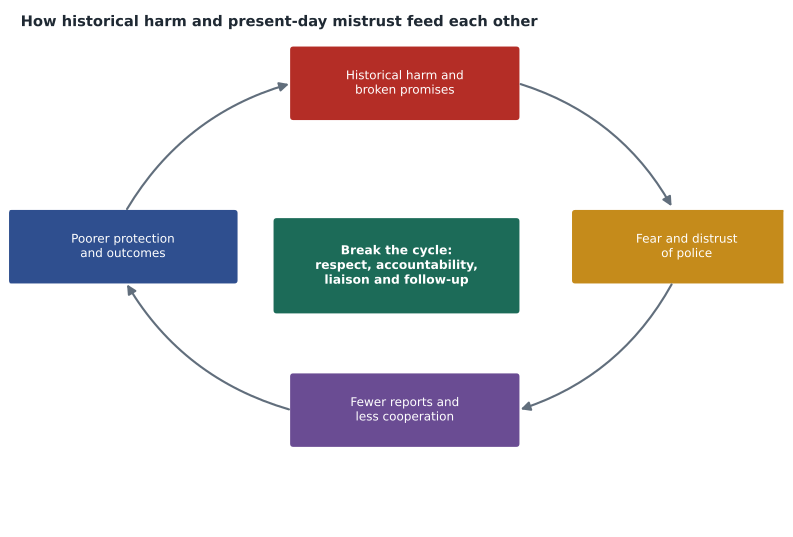
- Historical harm and present-day mistrust form a cycle that respectful, accountable policing can break.
- Ordinary calls carry the same history, and simple habits of explanation and follow-up make a difference.
- Ipperwash Inquiry
- The Ontario public inquiry, reporting in 2007, into the 1995 death of Dudley George during an OPP operation at Ipperwash Provincial Park.
- Starlight tours
- The practice, exposed in Saskatoon in 2000, of police driving Indigenous men out of the city and leaving them in the cold.
- Broken Trust
- The 2018 systemic review that found systemic racism in the Thunder Bay Police Service.
- Liaison officer
- An officer assigned to maintain communication and relationships with a community or its leaders, especially during a dispute or critical incident.
- Legitimacy
- The public's belief that police authority is fair and deserves to be obeyed.
Practice problems
Work each problem on paper first, then reveal the answer to check.
What role did police play in the residential school system?
Show answer
In many areas, Indian agents and police, including the RCMP, enforced attendance and took children from their families.
What did the Ipperwash Inquiry find?
Show answer
That the OPP was unprepared, that racism and political pressure contributed and that the shooting of Dudley George was unjustified.
Name the four themes Desjardins drew from the history.
Show answer
Police as instruments of policy, force in land disputes, neglect and poor investigation, and the fragility of trust.
What should guide the first hours of a blockade?
Show answer
Facts first, early contact with community leaders through a liaison, safety and traffic management without shows of force, and patience while the dispute is addressed.
Lesson quiz · 5 questions
Score 60% or more to complete this lesson.
Create a free account to save your progress, take quizzes and earn a certificate.