
LES-205 · Lesson 2 of 12 · 20 min
Colonialism, the Indian Act and residential schools
▶ Video coming soon A video version of this lesson is on the way.
Kyle Beaudry's file contains a line that Desjardins asks the class to read aloud. It comes from the bail hearing in January, where Kyle's lawyer told the court that his grandmother, Ruth Beaudry, attended a residential school for eight years, and that his mother had been taken into care at the age of four and raised by a non-Indigenous family in another part of Ontario. Priya Sandhu asks what any of that has to do with a fight outside a bar in 2026. Desjardins says that by the end of the course she will be able to answer the question herself, and that the answer starts with history.
Elder Marion Shawanda returns for this class. She tells the students that history is not an abstract subject in her community. 'Every family I know has someone who went to those schools,' she says. 'My mother went. My uncles went. Some of them came home and some of them didn't. When you talk about this, you are talking about people's grandparents.' She asks the students to listen to the history in that spirit, and to remember that the communities she comes from survived it, kept their languages and ceremonies alive where they could, and are rebuilding.
Before the newcomers
Long before Europeans arrived, the lands that became Canada were home to hundreds of nations with their own governments, laws, economies and diplomatic systems. The Haudenosaunee Confederacy united several nations under the Great Law of Peace, with councils, clan mothers and procedures for choosing and removing leaders. Anishinaabe nations, including the Ojibwe, Odawa and Potawatomi, organized society through clans with responsibilities for leadership, protection, healing and teaching. Nations made treaties with each other, recorded agreements in wampum belts and oral histories, and resolved disputes through processes that emphasized restoring relationships. These systems of law and order are part of the reason that, as Lesson 8 shows, restorative and community-based approaches are not new ideas for Indigenous communities.
Alliances, the Royal Proclamation and the treaties
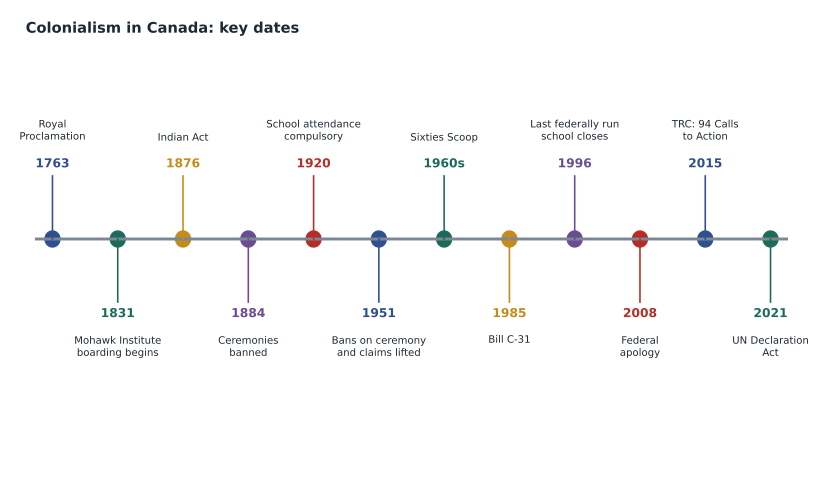
In the early colonial period, France and Britain depended on Indigenous nations as trading partners and military allies. After Britain's victory in the Seven Years' War, the Royal Proclamation of 1763 declared that Indigenous lands could be acquired only by the Crown, through public agreements with the nations themselves. At the Treaty of Niagara in 1764, about two thousand representatives of two dozen nations met Sir William Johnson, and the agreement was recorded in wampum, including the Two Row belt tradition of two peoples travelling side by side without interfering in each other's affairs. Many First Nations regard the Proclamation and Niagara together as the foundation of their relationship with the Crown.
In what is now Ontario, a series of land surrender treaties was signed in the late 1700s and early 1800s, followed by the Robinson-Huron and Robinson-Superior Treaties of 1850. After Confederation, Canada negotiated the eleven numbered treaties between 1871 and 1921, covering most of the Prairies and the North. The treaties promised reserves, annual payments, schools, farming tools and, in Treaty 6, a 'medicine chest'. Written texts in English described a surrender of land, but many First Nations understood the treaties as agreements to share the land in peace, and their oral histories record promises that do not appear in the written texts. Courts today read treaties generously, resolve ambiguities in favour of the First Nations, and consider the oral history. Nimkii Bay First Nation is a treaty community; its members' rights to hunt and fish in their traditional territory, which Lesson 4 discusses, come from that history.
The Indian Act
In 1876, the federal government consolidated earlier colonial laws into the Indian Act, which still governs many aspects of First Nations life. The Act defined who was an 'Indian', created the system of reserves and band councils, and placed reserve lands and band money under federal control. Indian agents, federal officials posted to reserves, had sweeping power over daily life. The Act's purpose was assimilation: the government's goal, as officials repeatedly said, was that First Nations would eventually disappear as distinct peoples through enfranchisement, the process by which a person gave up status and became an ordinary British subject. Status could be lost involuntarily, by earning a university degree, serving in the armed forces or, for women, marrying a man without status.
Over the following decades, the Indian Act was amended to suppress Indigenous life further. An 1884 amendment banned the potlatch and other ceremonies; the ban lasted until 1951. From 1885, after the North-West Resistance, the government introduced a pass system that required First Nations people on the Prairies to get written permission from the Indian agent to leave their reserves; it had no basis in law, but it was enforced for decades, often by the police. From 1927 to 1951, the Act made it an offence to raise money or hire a lawyer to pursue land claims without government permission. Women who married men without status lost their own status and could not pass it to their children until Bill C-31 changed the law in 1985, and later amendments in 2010 and 2017 addressed remaining discrimination. The Act remains in force, and many First Nations describe living under it as living under a colonial law that their own people did not write.
Residential schools
The residential school system was at the heart of the policy of assimilation. The first schools were run by churches in the early 1800s; the Mohawk Institute in Brantford, Ontario, opened in 1831 and was one of the longest-running. From the 1880s, the federal government funded and expanded a national system run mainly by the Catholic, Anglican, Methodist, Presbyterian and later United churches. In 1920, attendance became compulsory for First Nations children, and Indian agents and police were given authority to take children from their families. About 150,000 First Nations, Inuit and Métis children attended. The Indian Residential Schools Settlement Agreement recognized 139 schools; the last federally run school, Gordon's in Saskatchewan, closed in 1996.
Children were forbidden to speak their languages, separated from siblings, given new names and cut off from their families, sometimes for years. Many were poorly fed and housed, and diseases such as tuberculosis killed many. Physical, emotional and sexual abuse was widespread. The Truth and Reconciliation Commission identified thousands of children who died at the schools, and the National Centre for Truth and Reconciliation's memorial register now lists more than 4,000 names; many families were never told what happened to their children. In 2021, the announcement that ground-penetrating radar had detected potential unmarked graves near the former Kamloops Indian Residential School in British Columbia led to searches at former schools across the country. The TRC concluded in 2015 that the system was part of a policy of cultural genocide.
Prime Minister Stephen Harper apologized in the House of Commons on June 11, 2008, and the churches that ran the schools have apologized, most recently Pope Francis during his visit to Maskwacis, Alberta, in July 2022. The Settlement Agreement, which took effect in 2007, provided compensation to survivors and created the Truth and Reconciliation Commission, which heard from more than 6,500 witnesses and issued 94 Calls to Action in 2015. Lesson 11 returns to those Calls to Action, including those addressed to police and the justice system.
The Sixties Scoop and child welfare
As residential schools began to close, child welfare agencies took over much of their role. From the 1950s to the 1980s, in what is now called the Sixties Scoop, provincial child welfare authorities removed thousands of Indigenous children from their families and placed them with non-Indigenous families, often far away and sometimes outside Canada. Many lost their language, culture and connection to their communities. A national settlement for First Nations and Inuit survivors was approved in 2018. The pattern did not end with the Sixties Scoop: in the 2021 census, Indigenous children made up more than half of the children in foster care under the age of 15, though they were less than a tenth of all children. In 2019, Parliament passed An Act respecting First Nations, Inuit and Métis children, youth and families, which affirms Indigenous jurisdiction over child and family services; the Supreme Court of Canada upheld it in February 2024.
Intergenerational trauma
The effects of these policies did not end when the schools closed. Researchers and communities describe intergenerational trauma: harm that passes from one generation to the next. Children who grew up in institutions without their families often did not learn parenting from their own parents. Many survivors carried the effects of abuse into adulthood, sometimes through addiction, depression or violence, and their children grew up with those effects. Communities lost languages, ceremonies and the authority of elders. Researchers have linked these experiences to higher rates of poverty, poor health, suicide, substance use and contact with the justice system in many Indigenous communities.
Desjardins is careful with this point. Intergenerational trauma does not mean that Indigenous people are damaged or destined for trouble; most Indigenous people never come into conflict with the law, and many of the strongest people in any community are survivors and their children. Nor does history excuse harm done to others; the man whose cheekbone Kyle Beaudry broke is a real victim. What history does is explain patterns that are otherwise hard to understand, and it helps officers, prosecutors and judges choose responses that address causes rather than only symptoms. That is the idea behind the Gladue principles, which Lesson 8 covers in detail.
| Policy | What it did | Effects seen today |
|---|---|---|
| Indian Act | Placed reserves, status and band governments under federal control | Loss of land, economic base and self-government |
| Residential schools | Separated children from families, languages and cultures | Lost languages, trauma passed through families, distrust of institutions |
| Bans on ceremony and land claims | Suppressed spiritual life and legal resistance | Knowledge kept in secret or lost |
| Sixties Scoop and child welfare | Placed children with non-Indigenous families | Lost identity and family ties; high numbers of children in care |
Worked problem
Building a family timeline
Kyle Beaudry's Gladue caseworker builds a timeline from interviews. His grandmother Ruth was born in 1953 and attended a residential school from age 6 to 14. His mother, Carol, was born in 1978 and taken into care at age 4. Kyle was born in 2005. In which years did Ruth attend the school, when was Carol taken into care, and how old was Ruth when Kyle was born?
Show solution
- Ruth's school years run from her sixth to her fourteenth birthday: 1953 + 6 = 1959 to 1953 + 14 = 1967.
- Carol was taken into care in 1978 + 4 = 1982, during the period now called the Sixties Scoop, which continued into the 1980s.
- Ruth was 2005 - 1953 = 52 years old when Kyle was born.
- Three generations, two removals: the grandmother taken to school, the mother taken into care, and Kyle raised partly by his grandmother after his mother struggled with addiction.
Answer: Ruth attended from 1959 to 1967; Carol was taken into care in 1982; Ruth was 52 when Kyle was born. The timeline shows how two separate state policies reached the same family within one lifetime, which is exactly the kind of background a Gladue report brings before the court.
Why police need to know this history
The next lesson looks at the role police played in this history: the North-West Mounted Police enforced the pass system, and Indian agents and RCMP officers took children to residential schools. For many survivors and their families, the uniform is still associated with the day they were taken. Sergeant Keeshig says he has met elders who will not open the door to an officer they do not know, and parents who panic when a police car pulls into the driveway, because the last time that happened in their family a child disappeared. 'You can't fix that on one call,' he says. 'But you can avoid making it worse, and over time you can be the reason it changes.'
Marco DiSanto asks whether it is fair to hold today's officers responsible for things done a century ago. Keeshig says nobody is asking him to apologize for his great-grandfather. 'What I'm asking is that you understand why somebody is afraid of you,' he says. 'If a woman won't talk to you, or a family gets angry the minute you arrive, history might be part of the reason. If you know that, you slow down, you explain yourself, you bring someone they trust. If you don't know it, you think they're being difficult, and you push, and then it goes wrong.'
Common mistakes
MistakeResidential schools were a distant event that ended long ago.
InsteadThe last federally run school closed in 1996; many survivors and their children are alive today.
MistakeThe Indian Act is a historical law.
InsteadThe Indian Act is still in force and governs many aspects of First Nations life.
MistakeIntergenerational trauma means Indigenous people are destined for trouble.
InsteadMost Indigenous people never come into conflict with the law; history explains patterns, it does not predict individuals.
MistakeUnderstanding history excuses crime.
InsteadHistory explains causes and helps choose responses that work; victims' harm remains real.
Summary and key terms
- Indigenous nations had their own governments and laws before settlement; the Royal Proclamation of 1763 and the treaties set the terms of the relationship with the Crown.
- The Indian Act of 1876 placed First Nations under federal control, and amendments banned ceremonies, imposed passes and blocked land claims.
- About 150,000 children attended residential schools; the last federally run school closed in 1996, and the TRC issued 94 Calls to Action in 2015.
- The Sixties Scoop and today's child welfare system continued the removal of children.
- Intergenerational trauma helps explain present-day patterns, including contact with the justice system, without predicting any individual's life.
- Indian Act
- The federal law, first passed in 1876 and still in force, that governs status, reserves and band governments.
- Sixties Scoop
- The mass removal of Indigenous children by child welfare authorities from the 1950s to the 1980s, usually to non-Indigenous homes.
- Truth and Reconciliation Commission
- The commission created under the residential schools settlement, which reported in 2015 and issued 94 Calls to Action.
- Intergenerational trauma
- Harm from historical events and policies that is passed from one generation to the next through families and communities.
- Assimilation
- A policy aimed at ending the existence of Indigenous peoples as distinct peoples by absorbing them into the settler society.
Practice problems
Work each problem on paper first, then reveal the answer to check.
What did the pass system require, and who enforced it?
Show answer
Written permission from the Indian agent for First Nations people to leave their reserves; it had no legal basis and was enforced, often by police, for decades.
When did the last federally run residential school close?
Show answer
In 1996, when Gordon's school in Saskatchewan closed.
What is intergenerational trauma?
Show answer
Harm from historical policies, such as school removal, that passes from one generation to the next through families and communities.
Why should officers understand this history?
Show answer
Because it explains fear and distrust of police, helps officers avoid making things worse, and supports responses that address causes.
Lesson quiz · 5 questions
Score 60% or more to complete this lesson.
Create a free account to save your progress, take quizzes and earn a certificate.