
LES-112 · Lesson 7 of 12 · 19 min
Search incident to arrest
▶ Video coming soon A video version of this lesson is on the way.
At 02:29:40 on March 14, Constable Malhotra's partner handcuffed Kyle Brandt on Pine Street and, within a minute, searched him. She patted down his clothing, emptied his pockets onto the hood of the cruiser, opened the backpack fully and photographed its contents: three cordless drills, a reciprocating saw, a pair of gloves, a flashlight and a phone. No warrant was needed for any of it. Desjardins asks the class why. The answer is the most commonly used search power in policing: search incident to arrest. It is so routine that officers sometimes forget it has limits, and the limits are where cases are won and lost.
The rule: Chimel and Robinson
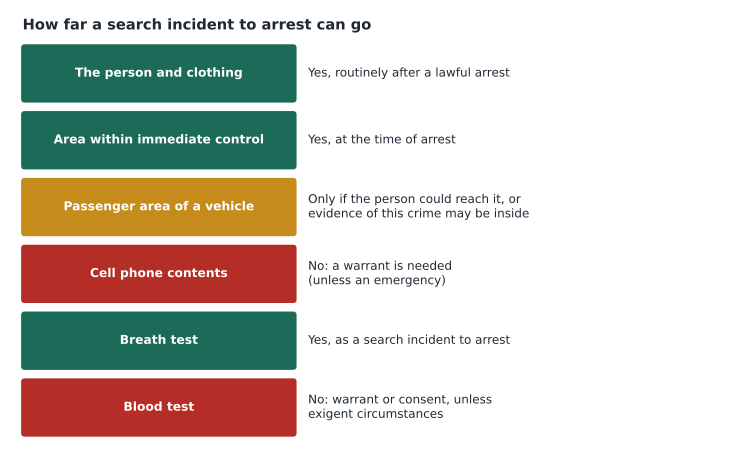
Search incident to arrest is one of the oldest exceptions to the warrant requirement. In Chimel v. California (1969), the Supreme Court held that officers making a lawful arrest may search the person arrested and the area within their immediate control, meaning the area from which they might gain possession of a weapon or destructible evidence, but not the rest of the house. In United States v. Robinson (1973), it held that a full search of the person is automatically reasonable after a lawful custodial arrest, without any case-by-case showing that the officer feared for safety or expected to find evidence: the arrest itself justifies the search. In Robinson the officer found heroin in a cigarette package during a search after an arrest for driving on a revoked license, and the Court upheld the search.
The difference matters. In the United States, the search of the person is automatic after a lawful custodial arrest, but the search of places beyond the person, such as a car, a bag that is no longer within reach, or a phone's contents, has its own limits, which the Court has developed case by case. An officer must know which rule applies to which kind of search. Either way, the search depends entirely on the arrest being lawful. If the arrest falls, so does the search.
Timing and place
A search incident to arrest normally happens at the time and place of the arrest. Courts allow some flexibility: a search of the person may be delayed a short time for safety reasons, for instance until the person is in a better-lit place or more officers arrive, or repeated at the station. Courts accept a search of the person at the station after an arrest under United States v. Edwards (1974), where clothing was seized the next morning for evidence. But a search of an area, such as a room or a car, must happen while the reason for it, the person's possible access, still exists. Desjardins describes a case where officers returned to a house the day after an arrest to search the bedroom where the man had been arrested. The search was not incidental to anything by then, and the evidence was excluded.
Searching the person
The basic search of the person after arrest is thorough: pockets, waistband, shoes, bags carried, and anything that could hide a weapon, a means of escape or evidence. Officers should search in a consistent pattern, wear gloves, and be careful of sharp objects. Items removed should be bagged, labeled and recorded, and any evidence photographed where it was found. Searches should be done by an officer of the same gender where practicable, and in any case with respect for the person's dignity. Searches of transgender and non-binary people should follow the service's policy, which in many services lets the person state a preference about the gender of the searching officer.
Desjardins stresses the safety purpose. More officers are hurt by weapons missed in a search than by any other kind of prisoner incident he knows of. He tells the story of a prisoner who was searched on the street, then again at the station, and a third time when a jail officer found a razor blade taped inside his belt. 'Search as if your life depends on it,' he says, 'because sometimes it does. And search as if a judge is watching, because sometimes one will.'
Strip searches, body cavities and bodily samples
Strip searches and body cavity searches are far more intrusive than a search of pockets. Revised Code 2933.32 restricts strip searches and body cavity searches in Ohio: for a person arrested for a misdemeanor or traffic offense, a strip search generally requires probable cause to believe the person is concealing evidence, contraband or a weapon, written authorization from a supervisor, and a private setting with an officer of the same sex, and a body cavity search requires a warrant, except in a medical emergency. In Florence v. Board of Chosen Freeholders (2012), the Supreme Court upheld visual strip searches of all detainees admitted to the general population of a jail, without individual suspicion, as a reasonable security measure, but that rule applies to jail admission, not to street searches. Bodily samples have their own rules: in Birchfield v. North Dakota (2016), the Court held that a breath test may be required as a search incident to an arrest for impaired driving, but a blood test may not, so blood needs a warrant, consent or exigent circumstances. In Maryland v. King (2013), it upheld taking a DNA cheek swab at booking from people arrested for serious offenses.
Port Ardent's cells unit keeps a log of every strip search, and Haddad reviews it every month. The program below summarizes the log for one quarter and checks each of the safeguards the service's policy requires.
# Port Ardent strip search log, one quarter (one record per search)
log = [
    # (grounds recorded, supervisor approved, private room, same-gender officer, items found)
    (True, True, True, True, True), (True, True, True, True, False), (True, True, True, True, False),
    (True, True, True, False, False), (False, True, True, True, False), (True, True, True, True, True),
    (True, False, True, True, False), (True, True, True, True, False), (True, True, True, True, False),
    (True, True, False, True, False), (True, True, True, True, True), (True, True, True, True, False),
]
names = ["grounds recorded", "supervisor approved", "private room", "same-gender officer"]
n = len(log)
print("strip searches:", n)
for i, name in enumerate(names):
    ok = sum(1 for r in log if r[i])
    print(f"{name:22} {ok}/{n}")
fully = sum(1 for r in log if all(r[:4]))
found = sum(1 for r in log if r[4])
print("all four safeguards met:", fully, "of", n)
print("items found:", found, "of", n)strip searches: 12 grounds recorded 11/12 supervisor approved 11/12 private room 11/12 same-gender officer 11/12 all four safeguards met: 8 of 12 items found: 3 of 12
Eight of the twelve searches met every safeguard. The other four each missed one: no grounds recorded, no supervisor approval, no private room, or no same-gender officer. Items were found in three of twelve searches, which Haddad notes is a reminder that most strip searches find nothing, and therefore that each one must be genuinely necessary. Her coaching goes to the officers involved in the four incomplete records, and the result goes into the service's annual report to the civilian review board.
Phones: Riley v. California
In Riley v. California (2014), the Supreme Court held unanimously that police generally may not, without a warrant, search digital information on a cell phone seized from a person arrested. The justifications for search incident to arrest, officer safety and preventing destruction of evidence, do not apply in the same way to data, and phones hold the privacies of life. Officers may seize the phone, examine it physically to make sure it is not a weapon, and take steps to prevent remote wiping, such as turning it off or placing it in a signal-blocking bag, and then get a warrant. Exigent circumstances, such as a child abduction where the phone may reveal the child's location, can still justify a warrantless search.
Malhotra's partner did exactly what Desjardins recommends. She photographed the phone where it was found, did not open it, placed it in a signal-blocking bag, recorded the time, and handed it to the detectives, who later obtained a warrant to examine it. Desjardins tells the class that this approach is almost never wrong, and that an officer who browses a phone at the roadside, even in Canada under Fearon's conditions, takes a risk with the whole case.
Vehicles after an arrest
In Arizona v. Gant (2009), the Supreme Court held that police may search the passenger compartment of a vehicle incident to a recent occupant's arrest only if the arrestee is unsecured and within reaching distance of the compartment at the time of the search, or it is reasonable to believe the vehicle contains evidence of the offense of arrest. An arrest for driving on a suspended license will rarely justify a search for evidence; an arrest for a drug sale often will. Lesson 9 covers the automobile exception and inventory searches.
Searching people in custody at the station
After arrest, a person is usually searched again when they arrive at the station, before they are placed in a cell. This search has a different purpose from the roadside search: protecting the person, other prisoners and the staff, and keeping a record of the person's property. Items such as belts, shoelaces, jewelry, phones, money and medication are removed, listed on a property form, sealed and stored until release. The person should see the list and be asked to sign it. Port Ardent's booking room has a camera that records the search and the property count, a practice the service adopted after a complaint about missing cash several years ago.
Medication raises special care. A person who needs medication for diabetes, a heart condition or a mental health condition should not be left without it because it was taken at booking. The cells policy requires the booking officer to ask about medical needs and to arrange for a nurse or doctor to assess any medication. Desjardins tells the class that the officers who take this seriously are not being soft; they are preventing medical emergencies in their own cells.
Officers should also remember that the station search is not a second chance to look for evidence that the roadside search missed for lack of authority. If a roadside search was limited, for example because the officer had no reason to look beyond a pat-down, the station search can protect safety and inventory property, but it does not create authority to examine phone contents or read private papers for evidence. That still needs a warrant.
Worked problem
Was the backpack search lawful?
Kyle Brandt was arrested at 02:29:40 for the Lakeshore Hardware break-in. The backpack was on his back. The officer removed it, opened it and found the drills, saw, gloves and flashlight. Was the search lawful, and what made it so?
Show solution
- Check the arrest: it was supported by grounds, as Lesson 2 showed, so it was lawful.
- Check the scope: a backpack worn by the arrestee is part of the person or at least within immediate control at the time of arrest, so it can be searched incident to the arrest.
- Check the timing and place: the search happened at the scene, within a minute of the arrest.
- Check the manner: the officer photographed the contents in place and recorded each item.
- Separate the phone: the backpack search did not extend to the phone's contents, which were left for a warrant.
Answer: The search was lawful: the arrest was lawful and custodial, the backpack was within the area of immediate control, and the phone's contents were left for a warrant.
Common mistakes
MistakeA lawful arrest allows any search the officer wants.
InsteadThe person can be fully searched, but areas, vehicles and phones have their own limits (Chimel, Gant, Riley).
MistakeStrip searches are routine for anyone held in cells.
InsteadOhio law requires probable cause and supervisor approval for strip searches after minor offenses; jail admission rules under Florence are separate.
MistakeLooking through a phone at the roadside is harmless.
InsteadRiley requires a warrant to search phone data, absent a true emergency.
MistakeA search can be done hours later as long as the person was arrested.
InsteadThe longer the delay, the harder it is to show the search was incidental to the arrest.
Summary and key terms
- A full search of the person is automatic after a lawful custodial arrest (Robinson); the area within immediate control can be searched (Chimel).
- Searches should be prompt, systematic, recorded and respectful of dignity.
- Strip and cavity searches are restricted by Revised Code 2933.32; breath tests are allowed incident to arrest but blood is not (Birchfield).
- Phone data needs a warrant (Riley); officers may seize and secure the phone.
- Vehicle searches incident to arrest are limited by Arizona v. Gant.
- When in doubt, seize, secure and apply for a warrant.
- Search incident to arrest
- A warrantless search of an arrested person and the area within immediate control.
- Area within immediate control
- The area from which an arrestee might gain a weapon or destroy evidence (Chimel).
- Strip search
- Removing or rearranging clothing to inspect private areas, restricted by Ohio law.
- Body cavity search
- An inspection of body cavities, which requires a warrant in Ohio except in emergencies.
- Signal-blocking bag
- A bag that prevents a seized phone from connecting to a network.
- Inventory search
- A routine listing of an impounded vehicle's contents under standard policy.
Practice problems
Work each problem on paper first, then reveal the answer to check.
What did United States v. Robinson decide?
Show answer
A full search of the person is automatically reasonable after a lawful custodial arrest.
In the strip search log, how many searches met all four safeguards?
Show answer
8 of 12.
What may officers do with a phone under Riley?
Show answer
Seize it, check it is not a weapon, prevent remote wiping, and get a warrant to search the data.
Why can a search incident to arrest not be done the next day at the place of arrest?
Show answer
By then it is no longer incidental to the arrest; the reason for it has passed.
Lesson quiz · 5 questions
Score 60% or more to complete this lesson.
Create a free account to save your progress, take quizzes and earn a certificate.