
LES-112 · Lesson 8 of 12 · 19 min
Warrantless searches: consent, plain view and exigent circumstances
▶ Video coming soon A video version of this lesson is on the way.
Desjardins starts with a short role play. He plays an officer at a traffic stop, and Priya Sandhu plays the driver. 'Mind if I take a quick look in the car?' he asks. Priya shrugs and says, 'I guess.' He asks the class whether that was consent. Opinions split. Some say yes, she agreed. Others say she did not really feel she had a choice. Desjardins then asks a second question: if he had told her first that she was free to say no, and that anything found could be used against her, would her answer mean more? Everyone agrees it would. 'Consent,' he says, 'is the easiest search to get and the easiest to lose in court.'
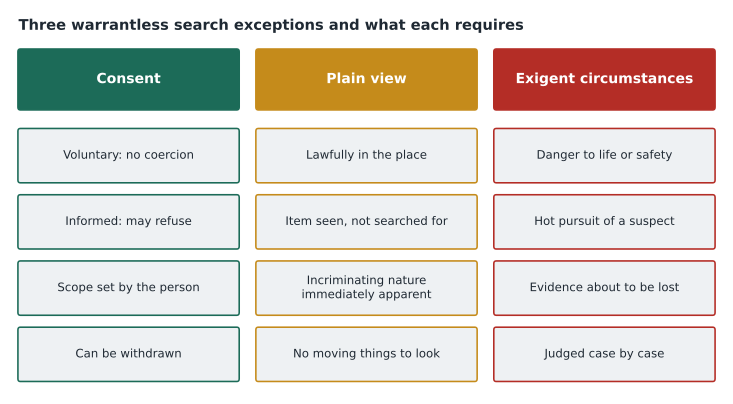
This lesson covers three exceptions to the warrant requirement that officers use often: consent, plain view and exigent circumstances. Each allows a search or seizure without a warrant, but only when its own conditions are met. The officer who relies on one must be able to show, with facts, that every condition was satisfied.
Consent
In Schneckloth v. Bustamonte (1973), the Supreme Court held that consent to search must be voluntary, judged on the totality of the circumstances, and that knowledge of the right to refuse is a factor but not a requirement; police need not tell the person they may say no. In Bumper v. North Carolina (1968), it held that a person who allows a search after an officer claims to have a warrant has not consented but merely acquiesced to a claim of lawful authority. The prosecution must prove consent was freely and voluntarily given. Courts look at the number of officers present, whether weapons were displayed, the person's age and understanding, whether they were detained, and whether they were told they could refuse. Many departments, including Port Ardent's, now require officers to tell people they may refuse and to record consent on camera or in writing, because courts are more skeptical of consent when no such advice was given.
Consent also has limits of scope and authority. In Florida v. Jimeno (1991), the Court held that the scope of consent is what a reasonable person would have understood from the exchange; consent to search a car for drugs included a closed paper bag on the floor where drugs could be. A co-occupant with common authority can consent to a search of shared space under United States v. Matlock (1974), and officers may rely on apparent authority if their belief is reasonable, under Illinois v. Rodriguez (1990). But under Georgia v. Randolph (2006), a physically present co-occupant's objection overrides another occupant's consent, though under Fernandez v. California (2014) the objection lapses once the objector is lawfully removed. Consent can be withdrawn at any time, and the search must then stop.
Port Ardent's consent search policy, revised in 2022, requires officers to read a short script, record the response on camera, and note the outcome. Haddad tracks consent requests by outcome because they reveal two things: how often people agree once they are told they can refuse, and how often consent searches actually find anything.
# Port Ardent consent search requests at vehicle and pedestrian stops, one year
requests = 240
refused = 61
granted = requests - refused
withdrawn_during = 7
evidence_found = 23
completed = granted - withdrawn_during
print("requests:", requests)
print("refused:", refused, f"({refused / requests:.2f})")
print("granted:", granted, "withdrawn during the search:", withdrawn_during)
print("completed searches:", completed)
print("evidence found:", evidence_found, f"(hit rate {evidence_found / completed:.3f})")requests: 240 refused: 61 (0.25) granted: 179 withdrawn during the search: 7 completed searches: 172 evidence found: 23 (hit rate 0.134)
About a quarter of people refused once told they could, and seven withdrew consent part way through, after which the officers stopped. Of 172 completed searches, 23 found evidence, a hit rate of about 0.134. Haddad compares that with searches based on probable cause, which find evidence far more often, and tells officers that a low hit rate is a signal that consent requests are being made without much reason to expect anything. Requests that rest on a hunch, she says, cost the public's trust for little return.
Plain view
Under Coolidge v. New Hampshire (1971) and Horton v. California (1990), officers may seize an item without a warrant if they are lawfully in the place from which they see it, they have a lawful right of access to the item, and its incriminating character is immediately apparent, meaning they have probable cause to believe it is evidence or contraband. Horton dropped any requirement that the discovery be inadvertent. But in Arizona v. Hicks (1987), the Court held that moving stereo equipment a few inches to read its serial numbers was a separate search requiring probable cause, so an officer cannot manipulate an item to make its incriminating nature apparent.
The key in plain view cases is that the officer must already be lawfully where they are. An officer who climbs a fence to look into a backyard is not in a lawful position, and nothing they see is in plain view in the legal sense. An officer standing on the sidewalk, or invited into a living room, or executing a warrant for stolen tools in a garage, is lawfully present, and what they see without searching can be seized if its nature as evidence is obvious. When Ali's team found a box of tools from a different store in Brandt's garage, they could seize it under plain view during the warrant search only because the store's labels and price stickers made its connection to another theft apparent at a glance.
Exigent circumstances
Exigent circumstances allow a warrantless search or entry when the needs of law enforcement are so compelling that the warrantless search is objectively reasonable. The Supreme Court has recognized several categories: hot pursuit of a fleeing suspect (Warden v. Hayden, 1967), emergency aid to a person who is seriously injured or threatened with injury (Brigham City v. Stuart, 2006), and preventing the imminent destruction of evidence (Kentucky v. King, 2011, which also held that police do not create an exigency by knocking and announcing lawfully). The Court has refused categorical rules: in Missouri v. McNeely (2013), it held that the natural dissipation of alcohol in the blood does not automatically justify a warrantless blood draw, though Mitchell v. Wisconsin (2019) allowed one for an unconscious driver in most cases, and in Lange v. California (2021) it held that pursuit of a fleeing misdemeanor suspect does not always justify warrantless entry into a home. Each case turns on its facts.
Desjardins tells the class that exigency is the exception most often claimed and most often rejected. The most common reason for rejection is that the urgency was not real, or that police had time to get a warrant and chose not to. Modern electronic warrant systems can produce a warrant in under an hour at any time of day, and courts know it. An officer who claims exigency should be able to explain what would have happened in the time it took to get a warrant: who would have been hurt, or what evidence would have been destroyed, and why.
There is also a difference between entering to deal with the emergency and searching for evidence once inside. Officers who enter a home because they hear screaming may do what is needed to find and protect the person, check for others in danger and secure weapons, but they may not search drawers for evidence once the emergency is over. Anything they see in plain view while dealing with the emergency can be seized, and anything else needs a warrant.
Recording consent properly
Because consent is so easy to dispute later, the way it is recorded matters as much as the words used to get it. Port Ardent's policy requires three things. First, the officer reads a short script that says what the officer wants to search and why, that the person may refuse, that the person may stop the search at any time, and that anything found may be used as evidence. Second, the request and the answer are recorded on the body-worn camera, so the court can see the tone, the setting and the person's response. Third, the officer notes the time consent was given, the scope agreed, any limits the person set, and the time the search ended.
The script is short enough to say in thirty seconds, and Desjardins has the class practice it in pairs until they can say it naturally. He warns against two common mistakes. The first is asking in a way that sounds like an order: 'You don't mind if I look, right?' is a question that expects a yes. The second is bargaining: 'If you let me look, we can get this over with quickly' suggests that refusing will cost the person something, which undermines voluntariness. A plain question, asked once, with the right information, is what courts look for.
He also tells the class what to do when a person refuses. Thank them, explain what will happen next, and move on. A refusal is the exercise of a right, not a sign of guilt, and it cannot be used as grounds for a search or an arrest. If the officer already has grounds for another power, such as probable cause under a statute or the automobile exception, they can use that power, but they should say so clearly rather than asking for consent they do not need. Asking for consent when another power already applies, and then relying on the consent, only creates confusion later.
Finally, consent from young people and people in vulnerable situations deserves extra care. A teenager stopped late at night, a person who does not speak the language well, or a person in crisis may agree to anything an officer asks. Officers should consider whether the person really understands, use an interpreter where needed, and remember that a court will look at the person's characteristics when deciding whether consent was voluntary.
Worked problem
Was the warrantless entry justified?
At 23:30, officers respond to a report of a fight in an apartment. When they arrive, it is quiet. A woman opens the door a crack, says everything is fine, and tries to close it. Officers see a smear of blood on the door frame and hear a man coughing inside. They push the door open and enter. Inside they find a man with a cut lip and, on the coffee table, a bag of white powder. Was the entry lawful, and can the bag be seized?
Show solution
- Ask whether there was an objectively reasonable basis to believe someone inside needed emergency aid: a reported fight, fresh blood and the woman's attempt to close the door fit Brigham City.
- Ask whether a warrant was practicable: a person who may be injured cannot wait an hour.
- Limit the entry to its purpose: find and check the injured man, check for others in danger, secure any weapons.
- Apply plain view to the bag: the officers were lawfully present, saw it without searching, and its nature as a likely controlled substance was immediately apparent, so it can be seized.
- Do not search further for evidence once the emergency is resolved; get a warrant for anything more.
Answer: The entry was justified by the emergency, and the bag on the table could be seized in plain view; a search of other rooms or containers for drugs would need a warrant.
Common mistakes
MistakeIf the person says yes, consent is valid.
InsteadConsent must be voluntary under the totality of the circumstances; acquiescence to a claim of authority is not consent (Bumper).
MistakeAnyone at the house can consent to a search of everything in it.
InsteadCommon or apparent authority is needed, and a present objecting co-occupant overrides consent (Randolph).
MistakePlain view allows officers to move things to get a better look.
InsteadMoving an item to see more is a separate search (Hicks).
MistakeExigency exists whenever getting a warrant would take time.
InsteadCourts reject categorical exigencies (McNeely, Lange) and examine each case on its facts.
Summary and key terms
- Consent must be voluntary on the totality of the circumstances (Schneckloth); acquiescence is not consent (Bumper).
- Scope is what a reasonable person would understand (Jimeno); third-party consent depends on authority (Matlock, Rodriguez, Randolph).
- Recording consent and telling people they may refuse protects both sides.
- Plain view requires lawful presence, lawful access and immediately apparent incriminating character (Horton); moving items is a search (Hicks).
- Exigent circumstances include hot pursuit, emergency aid and imminent destruction of evidence, judged case by case.
- Entry for an emergency allows only what the emergency requires.
- Consent search
- A search authorized by the voluntary agreement of a person with authority.
- Apparent authority
- An officer's reasonable belief that the person consenting had authority (Rodriguez).
- Plain view
- Seizing evidence openly visible from a lawful position with immediately apparent incriminating character.
- Exigent circumstances
- Compelling needs that make a warrantless search objectively reasonable.
- Emergency aid
- Entry to help a person seriously injured or threatened with injury (Brigham City).
- Hot pursuit
- Immediate, continuous pursuit of a fleeing suspect.
Practice problems
Work each problem on paper first, then reveal the answer to check.
What did Schneckloth v. Bustamonte decide about knowledge of the right to refuse?
Show answer
It is a factor in voluntariness but not a requirement.
In the code example, what was the hit rate of completed consent searches?
Show answer
23 of 172, about 0.134.
What three conditions does plain view require?
Show answer
Lawful presence, discovery without searching, and evidence whose nature is immediately apparent.
What did Missouri v. McNeely decide?
Show answer
The natural dissipation of alcohol does not automatically create an exigency for a blood draw.
Lesson quiz · 5 questions
Score 60% or more to complete this lesson.
Create a free account to save your progress, take quizzes and earn a certificate.