
LES-112 · Lesson 3 of 12 · 20 min
Arrest authority without a warrant
▶ Video coming soon A video version of this lesson is on the way.
Desjardins starts with a question that sounds simple: what is an arrest? Amara Okafor says it is when the handcuffs go on. Marco DiSanto says it is when the officer says 'you're under arrest'. Desjardins tells them both are usually true but neither is the legal test. The Supreme Court treats an arrest as a seizure of the person that a reasonable person would understand as more than a brief stop; in California v. Hodari D. (1991) it held that an arrest requires either physical force or submission to a show of authority, and in Torres v. Madrid (2021) that the application of physical force with intent to restrain is a seizure even if the person escapes. An arrest is the most serious step most officers take in an ordinary shift, and in Canada and the United States the majority are made without a warrant, on the officer's own judgment.
Revised Code 2935.03: the main warrantless arrest power
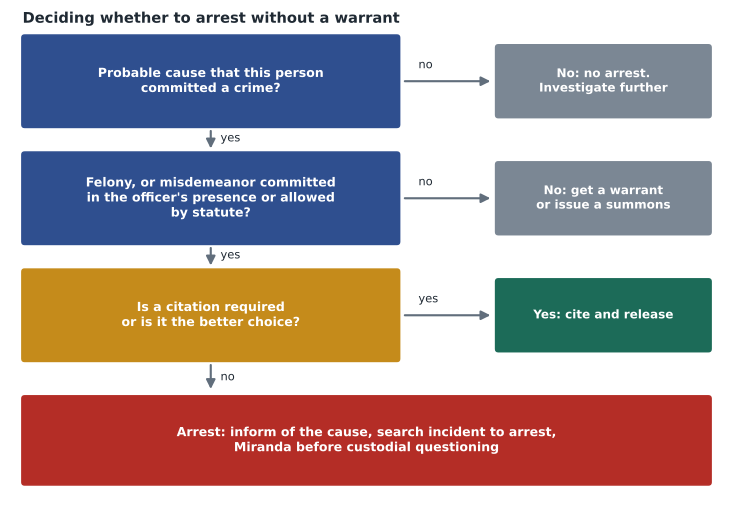
Revised Code 2935.03 lets a sheriff, deputy, police officer or state trooper arrest and detain, until a warrant can be obtained, a person found violating a state law or municipal ordinance within the officer's jurisdiction. It also allows a warrantless arrest when the officer has reasonable ground to believe that a felony has been committed and that the person committed it, and when the officer has reasonable ground to believe the person committed certain misdemeanors, including domestic violence, menacing by stalking and violating a protection order, even outside the officer's presence. The Fourth Amendment allows a warrantless public arrest whenever there is probable cause for a felony, as United States v. Watson (1976) held, and Atwater v. City of Lago Vista (2001) held that it allows a custodial arrest even for a minor offense committed in the officer's presence.
The words of each power matter. The in-presence requirement for most misdemeanors is a statutory limit, not a constitutional one, and Ohio has created exceptions for offenses where waiting for a warrant would leave victims at risk. If an officer arrives after a minor misdemeanor such as disorderly conduct is over, and no exception applies, the usual route is a complaint and summons or a warrant. Felonies have no in-presence requirement: reasonable ground to believe is enough.
Citation instead of arrest
Revised Code 2935.26 requires a citation, not an arrest, for a minor misdemeanor unless the offender requires medical care or is unable to provide for their own safety, cannot or will not offer satisfactory evidence of identity, refuses to sign the citation, or has previously been issued a citation for the same offense and failed to appear or pay. A minor misdemeanor in Ohio is an offense with a maximum fine and no jail term, such as many drug paraphernalia, littering or some disorderly conduct offenses. For other misdemeanors, Criminal Rule 4(F) and departmental policy allow officers to release a person on a summons or citation after arrest, and many departments encourage that whenever the person is identified and there is no risk to the victim or public.
The reasons for restraint are practical. Each arrest takes a patrol officer off the street for hours of transport, booking and paperwork; it exposes the person to the risks of custody, and it can cost them a job or housing even if the charge is later withdrawn. Port Ardent's data, which Haddad shares with the class, show that almost one arrest in five for a minor property or public order offense ends in release at the station within two hours, suggesting the arrest may not have been needed in the first place. Officers who release on the street with a citation spend the time back on patrol.
# Port Ardent: minor property and public order arrests in one quarter
arrests = 412
released_at_station_within_2h = 79
avg_hours_per_arrest = 3.4          # transport, booking, paperwork
avg_hours_per_street_release = 0.9  # appearance notice or citation on scene
share = released_at_station_within_2h / arrests
saved = released_at_station_within_2h * (avg_hours_per_arrest - avg_hours_per_street_release)
print("released within 2 hours:", released_at_station_within_2h, "of", arrests, f"({share:.2f})")
print("officer hours that street release could have saved:", round(saved, 1))
print("about", round(saved / 12, 1), "twelve-hour shifts")released within 2 hours: 79 of 412 (0.19) officer hours that street release could have saved: 197.5 about 16.5 twelve-hour shifts
Almost two hundred officer hours, about sixteen full shifts in a quarter, could have gone back to patrol if those cases had been handled by release on the street. Desjardins is careful to add that some of those arrests may have been needed to establish identity or stop a continuing offense; the data raise a question for supervisors rather than prove a mistake. But they show why the law asks officers to consider release first.
Arrest by private persons
Revised Code 2935.04 allows any person to arrest without a warrant when a felony has been committed, or there is reasonable ground to believe one has been committed, and the person has reasonable cause to believe the suspect committed it. Revised Code 2935.041 gives merchants and their employees a limited shopkeeper's privilege to detain a person they have probable cause to believe has unlawfully taken merchandise, in a reasonable manner and for a reasonable time, to recover the property or to wait for police. A private person who arrests must take the suspect without unnecessary delay to a court or officer, under Revised Code 2935.06. When officers arrive at a store, they must decide whether to take custody, which requires their own grounds.
Desjardins tells the story of a loss prevention officer who held a teenager in a back room for two hours because she suspected him of taking earbuds she could not find on him. The responding officer found no evidence, released the teenager, and wrote a report that later supported a complaint against the store. Officers called to a citizen's arrest should treat the person's account as information, check it, and make their own decision. If the arrest was not lawful, the officer should not continue it.
Arrest for breaches and other statutory powers
Several other powers lead to arrests that look like ordinary arrests but rest on different authority. Revised Code 2935.03 allows an arrest for violating a protection order, and Criminal Rule 46 and court orders allow arrest for violating bond conditions. Ohio's operating a vehicle while impaired statute, Revised Code 4511.19, is enforced through arrests on probable cause, often after field sobriety testing. Revised Code 5122.10 allows emergency hospitalization, which is not an arrest for an offense. Each power has its own conditions, and the officer's report should name the power used.
Arresting outside your jurisdiction and off duty
Police powers usually stop at the edge of the officer's jurisdiction. Ohio officers generally have arrest powers within their own political subdivision. Revised Code 2935.03(D) allows an officer to pursue and arrest outside the subdivision when the pursuit began inside it without unreasonable delay, and mutual aid agreements extend authority in some situations. Off duty, an officer in their own jurisdiction retains peace officer authority, but departments discourage off-duty enforcement except where life is at risk. Desjardins tells the class that one of the most dangerous situations in policing is an off-duty officer in plain clothes intervening in a crime and being mistaken for the offender by arriving officers.
Recording the arrest
The officer's notes on an arrest should answer, in order: the time and place; the power used and the offense; the facts that gave grounds, with the time each was known; the words used to tell the person they were arrested and why; the time Miranda warnings were given, if questioning followed, and the response; any force used and why; any search and what was found; and the decision on release. Haddad's quarterly audit checks each arrest report for these points. Reports that name the offense but not the power, or the conclusion but not the facts, go back to the officer.
Arrests that go wrong: three patterns
Desjardins closes the section on arrest powers with three patterns he has seen go wrong most often in reviews of Port Ardent files. The first is the arrest that runs ahead of the grounds. An officer who arrives at a scene, hears one side of a story, and arrests the person the complainant points to has not yet formed a belief of their own. The fix is simple but takes discipline: speak to both parties, look at whatever physical evidence is available, and decide only when the facts support a belief. In a fast-moving situation, a short investigative detention while those steps happen is often the right tool, and an arrest can follow if the facts support it.
The second pattern is the arrest for the wrong offense. An officer who arrests for an offense that does not allow a warrantless arrest in the circumstances, when a different offense on the same facts would have, can find the arrest challenged even though they had the power all along. Naming the right offense matters because it is how the officer shows which power they used. Desjardins advises officers to think through the possible offenses before they say the words of arrest, and to tell the person about every offense they have in mind, so that a later change of charge does not leave a gap.
The third pattern is the arrest that never ends. An officer who arrests and then forgets about the release decision, leaving a person in cells for hours while the paperwork waits, has turned a lawful arrest into an unreasonably long one. Ohio law and McLaughlin require prompt release or a prompt court appearance. The release decision, covered in Lesson 11, is part of the arrest, not an afterthought, and the record of an arrest should show when it was made and by whom.
Marco DiSanto asks how officers are supposed to keep all of this straight in a fight outside a bar at two in the morning. Desjardins admits that it is hard, and that no officer gets every decision perfect. But he points out that most arrests are not made in a fight. Most happen after a call, a conversation and a few minutes of investigation, when there is time to think about which power applies. The officers who think it through in those minutes are the ones who can act quickly and correctly when there is no time at all.
Worked problem
Choosing the arrest power
At 1:15 a.m., Officer Malhotra is called to a bar on Water Street where a man is shouting, swearing and refusing to leave. By the time Malhotra arrives, the man is outside on the sidewalk, still shouting at people walking past and blocking the entrance. Staff say he punched a doorman ten minutes earlier; the doorman has a red mark on his cheek. What powers does Malhotra have?
Show solution
- Assault under Revised Code 2903.13 is a misdemeanor not committed in Malhotra's presence, so the general in-presence rule does not allow a warrantless arrest for it unless an exception applies. Malhotra can take statements and seek a warrant or file a complaint.
- The continuing shouting and blocking of the entrance in Malhotra's presence may be disorderly conduct under Revised Code 2917.11, which Malhotra can arrest for if it is not a minor misdemeanor, or must cite for if it is, unless an exception in 2935.26 applies.
- Consider the persistence of the conduct: disorderly conduct becomes a fourth-degree misdemeanor, which allows arrest, if the person persists after a reasonable warning or request to stop.
- Warn first if it is safe: a clear request to stop and move away gives the man a chance to comply and strengthens the grounds if he does not.
- Record the power used, the facts known, and the time of each step.
Answer: Malhotra can arrest for disorderly conduct committed in his presence if the man persists after a warning; for the earlier assault he would usually proceed by warrant or complaint.
Common mistakes
MistakeAny offense allows a warrantless arrest at any time.
InsteadMost misdemeanors require the offense to be committed in the officer's presence, and minor misdemeanors generally require a citation instead.
MistakeA citizen's arrest means the officer must take the person into custody.
InsteadThe officer must make their own decision based on their own grounds and release the person if the arrest was not lawful.
MistakeIf a citation would have been allowed, arresting instead does not matter.
InsteadOhio law requires citations in many cases, and unnecessary arrests harm the person and the department.
MistakeThe notes only need to say the person was arrested for an offense.
InsteadNotes must name the power, the facts that gave grounds and the time each step happened.
Summary and key terms
- An arrest is a seizure by physical force or submission to a show of authority (Hodari D., Torres).
- Revised Code 2935.03 allows warrantless arrest for felonies on reasonable ground, offenses in the officer's presence, and listed misdemeanors outside presence.
- Revised Code 2935.26 requires citations for most minor misdemeanors.
- Private persons may arrest for felonies and merchants may detain shoplifters under 2935.04 and 2935.041.
- Breach of release, traffic, liquor and mental health powers each have their own conditions.
- The notes must name the power, the grounds, the times and the release decision.
- Arrest
- A seizure of the person by physical force or submission to a show of authority.
- In-presence rule
- The requirement that most misdemeanors be committed in the officer's presence for a warrantless arrest.
- Minor misdemeanor
- An Ohio offense with a fine only and no jail term, usually handled by citation.
- Felony
- A serious offense punishable by more than a year in prison.
- Shopkeeper's privilege
- A merchant's limited right to detain a suspected shoplifter for a reasonable time.
- Citation
- A written order to appear in court, issued instead of a custodial arrest.
Practice problems
Work each problem on paper first, then reveal the answer to check.
When may an Ohio officer arrest for a misdemeanor not committed in their presence?
Show answer
When the misdemeanor is one of those listed in 2935.03, such as domestic violence, menacing by stalking or violating a protection order.
In the code example, how many officer hours might street release have saved?
Show answer
79 x (3.4 - 0.9) = 197.5 hours.
What must a private person do after making an arrest?
Show answer
Take the person without unnecessary delay to a court or officer.
Why do services discourage off-duty enforcement?
Show answer
The officer lacks radio, backup and visible identification, and may be mistaken for the offender.
Lesson quiz · 5 questions
Score 60% or more to complete this lesson.
Create a free account to save your progress, take quizzes and earn a certificate.