
LES-112 · Lesson 6 of 12 · 19 min
Search warrants: grounds, drafting and execution
▶ Video coming soon A video version of this lesson is on the way.
When Kyle Brandt was arrested, only three drills and a saw were in his backpack. The store's receiving binder showed four drills, two impact drivers and a saw missing. Detective Sergeant Hassan Ali, who took over the file the next morning, learned from Brandt's phone records, obtained later with a production order, and from a neighbor that Brandt rented a single-car garage behind a house on Birch Lane. Ali wanted to search it. Desjardins tells the class that the decision Ali faced, and the document he wrote to get permission, are at the heart of search law. The Fourth Amendment's warrant clause, and decades of case law, start from the principle that searches conducted outside the judicial process, without prior approval by a judge or magistrate, are per se unreasonable, subject to a few well-delineated exceptions, as the Supreme Court said in Katz v. United States (1967). The warrant is the rule; everything else is an exception.
Why warrants matter
A warrant puts a neutral judicial officer between the police and the person whose privacy is at stake. The officer must set out the grounds in writing, under oath, before acting. The judicial officer decides whether the grounds are enough and sets limits on what can be searched, where and when. The written record makes it possible for a court later to review exactly what the police knew and why the search was authorized. Desjardins tells the class that a good warrant protects the officer as much as the suspect: an officer who executes a valid warrant within its terms is on the strongest legal ground there is.
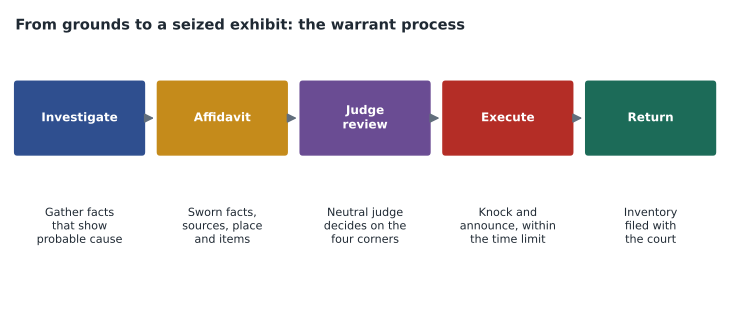
What a search warrant requires
The Fourth Amendment requires that warrants issue only on probable cause, supported by oath or affirmation, and particularly describing the place to be searched and the persons or things to be seized. Criminal Rule 41 and Revised Code 2933.22 and 2933.23 put those requirements into Ohio practice: the affidavit must name or describe the person or place, describe the property, state the offense and the facts on which probable cause is based, and the judge must be satisfied there is probable cause before issuing. The affidavit must therefore show three connections: that a crime was committed, that the items sought are evidence, fruits, contraband or instruments of it, and that they are at the place now. Federal law adds specialized processes for electronic communications and records held by providers, such as orders under the Stored Communications Act.
The requirement that the things be there now is called freshness, or staleness when it is missing. Information that drugs were in a house six months ago may say little about whether they are there today. Information that stolen tools were taken to a garage three days ago is much fresher, especially if there is no sign they have been moved. The ITO must explain why the officer believes the items are still at the place, considering how easily they could be moved, sold or destroyed.
Drafting the affidavit
Ali's draft followed the structure taught in every American detective course. It began with his own experience, then set out the offense: the break-in, the alarm times, the witness, Brandt's arrest with three drills and a saw whose serial numbers matched the store's records, and the four items still missing. It explained the connection to the garage: the neighbor's statement that Brandt had been seen carrying boxes into the garage two days before the break-in, the lease in Brandt's name found in his wallet at arrest, and Brandt's phone location data placing it in the area of the garage, two blocks east of the store, at 02:20 that night, nine minutes before he was stopped carrying only part of the stolen property. It described the place precisely, with the address, a description of the garage and a photograph, and the things sought, listed by type, make and serial number.
The affiant must be truthful and complete. In Franks v. Delaware (1978), the Supreme Court held that if a defendant shows that the affiant included a false statement knowingly and intentionally, or with reckless disregard for the truth, and the statement was necessary to the finding of probable cause, the warrant must be voided and the evidence suppressed. Courts apply the same reasoning to material omissions made with reckless disregard. Ali disclosed that the neighbor had once been convicted of a theft offense, that the phone location data showed only an area, not the exact garage, and that Brandt had denied involvement.
Desjardins tells the class that the best affiants write for a skeptical reader. Every sentence should be a fact with a source: 'Mira Osei told Constable Malhotra at 02:21 that...' rather than 'a witness saw...'. Opinions should be labeled as opinions and explained. Hearsay is allowed, but the source and the reason to believe it must be stated. And the document should be short enough that a busy judicial officer can read it carefully, often late at night.
Review: the magistrate and later the trial court
The issuing judge or magistrate must be neutral and detached, and must make a practical, common-sense decision whether, given all the circumstances in the affidavit, there is a fair probability that evidence will be found at the place. At trial, the reviewing court gives great deference to the issuing judge's decision and asks only whether there was a substantial basis for finding probable cause, under Gates. Under United States v. Leon (1984), evidence obtained by officers acting in objectively reasonable reliance on a warrant later found invalid is generally not suppressed, unless the affidavit was misleading, the magistrate abandoned their neutral role, the affidavit was so lacking in probable cause that reliance was unreasonable, or the warrant was facially deficient.
Telewarrants make it possible to get judicial authorization quickly when it is impracticable to appear in person. Criminal Rule 41 and Ohio practice allow applications by electronic means, and many Ohio courts now accept affidavits sworn by video and signed electronically, so a warrant can be obtained at any hour. Desjardins tells the class that the speed of modern warrant systems has narrowed the argument that there was no time to get one.
Executing the warrant
Ohio warrants must be executed within three days under Criminal Rule 41 and in the daytime, as the rule defines it, unless the judge authorizes nighttime execution for reasonable cause. Officers must knock and announce their identity and purpose before forcing entry, a requirement the Supreme Court recognized in Wilson v. Arkansas (1995) and Ohio codified in Revised Code 2933.231, which also allows a judge to waive the requirement in advance when there is risk of serious harm. Richards v. Wisconsin (1997) allows no-knock entry when officers have reasonable suspicion that announcing would be dangerous or futile or would allow destruction of evidence, judged case by case. Under Hudson v. Michigan (2006), a violation of knock-and-announce does not require suppression, but it can still lead to civil liability and discipline. The search must be reasonable in manner and limited to places where the items could be found.
Officers who find things not listed in the warrant may seize them if they are found in plain view during a lawful search and the officer has grounds to believe they are evidence of an offense, as Lesson 8 explains. Criminal Rule 41 requires the officer to give a copy of the warrant and a receipt for property taken to the person from whom it was taken, or leave them at the place, and to make a prompt return to the court with a written inventory of the property seized. Ali's team executed the warrant at 10:15 a.m. on a Tuesday, three days after it was issued. They found the fourth drill and both impact drivers on a shelf in the garage, along with a box of tools from a different store.
# Checking a warrant's execution window (illustrative times)
from datetime import datetime
issued = datetime(2026, 3, 17, 16, 40)
executed = datetime(2026, 3, 20, 10, 15)
day_start, day_end = 6, 21          # 6 a.m. to 9 p.m.
limit_days = 3                      # execution period written into the warrant
in_day = day_start <= executed.hour < day_end
elapsed = executed - issued
print("executed during permitted hours:", in_day)
print("days after issue:", round(elapsed.total_seconds() / 86400, 2))
print("within the execution period:", elapsed.days < limit_days or elapsed.total_seconds() <= limit_days * 86400)executed during permitted hours: True days after issue: 2.73 within the execution period: True
The program checks two of the conditions a reviewing court will look at: whether the search happened during the permitted hours and within the period the warrant allowed. The search was in daylight hours, and it took place about 2.73 days after issue, within the three-day period written on Ali's warrant. Ohio's three-day limit comes from Criminal Rule 41; a search after it expires is treated as a warrantless search. Desjardins notes that a simple check like this, done before the team leaves the station, has saved more than one investigation.
Common drafting errors
Desjardins shows the class a list of the drafting errors that Port Ardent's legal advisor sees most often in warrant applications sent for review. The most common is boilerplate: paragraphs copied from an old application that describe what drug dealers or thieves usually do, without connecting it to this suspect or this place. Judicial officers have read the same paragraphs hundreds of times and give them little weight. The second is unattributed hearsay: statements such as 'police received information that' without saying who received it, from whom, and why that source should be believed. The third is the missing link: an application that proves an offense and identifies a suspect but never explains why the evidence is at the place to be searched.
Other errors are smaller but still costly. Addresses are copied wrongly, so the warrant names the wrong unit in a building. The items are described too vaguely, such as 'evidence of the offense', leaving the executing officers with no clear limit. Dates in the application do not match the dates in the notes. And applications sometimes overstate the officer's experience or the certainty of a source. Each of these gives a defense lawyer a reason to cross-examine the affiant, and some can lead a court to find the warrant invalid.
The remedy is review. Port Ardent requires every warrant application, other than a true emergency, to be read by a supervisor before it goes to a judge, and serious cases to be read by the legal advisor. Detective Sergeant Ali's garage application went through both. The supervisor caught one error: the store's receiving binder listed the missing saw by a model number that differed by one digit from the one Ali had typed. Ali corrected it before the application was sworn. A small mistake like that would not have defeated the warrant, but it would have given the defense something to question in front of the trial judge.
Worked problem
Is the information fresh enough?
An informer tells a detective that she saw a handgun in a man's apartment three weeks ago. She has given reliable information twice before. The detective confirms the man lives at the address and has a firearms prohibition. Should the detective apply for a warrant now?
Show solution
- Assess the tip under Gates: the informant's track record supports veracity, her basis of knowledge is firsthand, and police corroborated the address and the prohibition.
- Assess freshness: three weeks is not long for a firearm, which people tend to keep rather than consume or sell quickly, but the ITO must explain why the officer believes it is still there.
- Look for more: recent sightings, social media posts, or other sources that could freshen the grounds.
- Disclose everything: the age of the information, any reasons the informer might be motivated, and what was not corroborated.
- Protect the informer's identity while still giving the judicial officer enough to assess reliability.
Answer: The detective may well have enough, because firearms tend to stay put and the informer is proven, but the application should explain freshness explicitly and disclose the weaknesses; more recent corroboration would make it much stronger.
Common mistakes
MistakeA warrant only needs to show that a crime happened.
InsteadIt must also show that the items are evidence and that they are at the place now.
MistakeLeaving out weaknesses makes the application stronger.
InsteadKnowing or reckless falsehoods and omissions can void the warrant under Franks.
MistakeOnce inside with a warrant, officers can search anywhere.
InsteadThe search is limited to the place named, the things named, and places they could be.
MistakeA warrant never expires.
InsteadOhio warrants must be executed within three days, in the daytime unless authorized.
Summary and key terms
- Warrantless searches are per se unreasonable subject to defined exceptions (Katz).
- A warrant application must show an offense, that the items are evidence, and that they are at the place now.
- The affidavit must be truthful (Franks) and is reviewed for a substantial basis (Gates), with good faith reliance protected (Leon).
- Write each fact with its source, label opinions, and disclose weaknesses.
- Execute within three days and in daytime unless authorized, knock and announce, leave a copy and receipt, and make a return with an inventory.
- Check the execution window before leaving the station.
- Affidavit
- The sworn document setting out the facts for probable cause.
- Affiant
- The person who swears the affidavit.
- Particularity
- The requirement that a warrant describe the place and items precisely.
- Staleness
- Grounds that are too old to show the items are at the place now.
- Franks hearing
- A hearing on whether false statements or reckless omissions voided a warrant.
- Return
- The officer's report to the court of the warrant's execution with an inventory.
Practice problems
Work each problem on paper first, then reveal the answer to check.
What three connections must a warrant application show?
Show answer
That an offense was committed, that the items will afford evidence of it, and that they are at the place now.
What did Franks v. Delaware decide?
Show answer
A warrant must be voided if it depended on a statement the affiant knew was false or made with reckless disregard for the truth.
In the code example, how many days after issue was the warrant executed?
Show answer
About 2.73 days.
What may officers do with evidence not named in the warrant that they find during the search?
Show answer
Seize it if it is in plain view during the lawful search and they have grounds to believe it is evidence.
Lesson quiz · 5 questions
Score 60% or more to complete this lesson.
Create a free account to save your progress, take quizzes and earn a certificate.