
LES-112 · Lesson 10 of 12 · 19 min
Entering homes and private places
▶ Video coming soon A video version of this lesson is on the way.
Desjardins reads an old saying to the class: a person's home is their castle. It goes back to an English case from 1604, and it still shapes the law in both the United States. 'Of all the places you will go as officers,' he says, 'the home is where the law gives people the most protection, and where your mistakes will be judged most harshly.' Homes hold the most private parts of people's lives, families and children live there, and an officer who enters uninvited is a stranger in the most personal space a person has. This lesson brings together the rules on entering homes and other private places: when officers may approach, knock, enter, look around, secure the premises and search.
The approach: knocking and the implied license
Officers, like anyone else, may walk up to a front door and knock. Officers, like any visitor, have an implied license to approach the front door, knock, wait briefly and leave if no one answers. In Florida v. Jardines (2013), the Supreme Court held that bringing a trained drug dog onto a front porch to sniff for drugs exceeded that license and was a search, because its purpose was to gather evidence, not to speak with the occupant. The curtilage, the area immediately around the home such as a porch, side yard or enclosed backyard, is treated as part of the home under Oliver v. United States (1984) and United States v. Dunn (1987), while open fields beyond it are not protected. In Kyllo v. United States (2001), the Court held that using a thermal imager to detect heat inside a home was a search requiring a warrant.
The practical rule is simple: officers may go where a visitor would go, for the reasons a visitor would go there. They may knock at the front door to ask questions. They may not wander around to the back, peer through windows from places visitors do not go, or use the visit as cover for gathering evidence. If no one answers, they leave. If someone answers, they may ask to speak with them, and the person may decline and close the door.
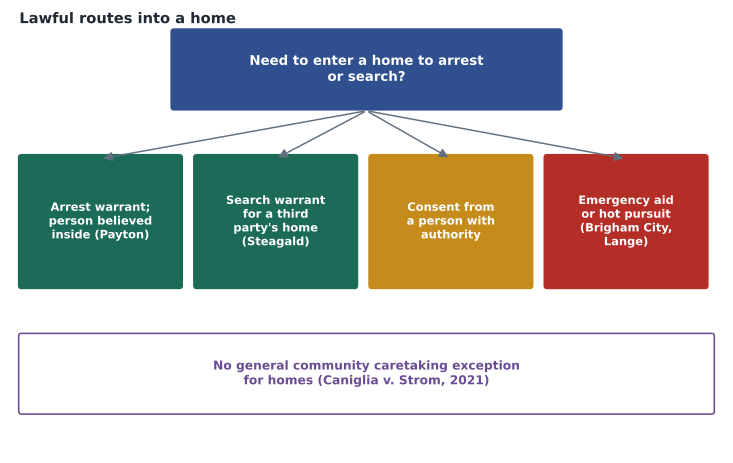
Entering: the four lawful routes
There are four ways into a home for police: a warrant, consent, exigent circumstances, and a few narrow statutory powers. An arrest warrant allows entry into the suspect's own home with reason to believe they are inside (Payton); a search warrant allows entry into the place it names (Steagald); consent from a person with actual or apparent authority allows entry within its scope; and exigent circumstances, including hot pursuit and emergency aid, allow entry without a warrant. Caniglia v. Strom (2021) made clear that there is no freestanding community caretaking exception for homes: officers who enter to check on someone must rely on emergency aid, which requires an objectively reasonable basis to believe someone inside needs immediate help.
Brigham City v. Stuart (2006) is the case officers will apply most often. Officers responding to a loud party at 3 a.m. saw through a window a fight in the kitchen in which a juvenile punched an adult, who spat blood into a sink. They entered without a warrant. The Supreme Court held unanimously that officers may enter a home without a warrant to render emergency assistance to an injured occupant or to protect an occupant from imminent injury, judged objectively, regardless of the officers' subjective motives.
Announcing before entry
The knock-and-announce rule requires officers to give notice of their identity and purpose and wait a reasonable time before forcing entry, unless they have reasonable suspicion that announcing would be dangerous, futile or would allow destruction of evidence (Richards v. Wisconsin). In United States v. Banks (2003), the Court held that waiting fifteen to twenty seconds before forcing entry to execute a drug warrant was reasonable, given the risk that drugs could be destroyed. Revised Code 2933.231 allows a judge to authorize no-knock entry in advance. Desjardins tells the class that the decision to enter without announcing is a high-risk decision that should be made by a supervisor with all available information, and recorded.
Inside: protective sweeps and safety searches
Once officers are lawfully inside a home to make an arrest, they may need to check for other people who could pose a danger. In Maryland v. Buie (1990), the Supreme Court allowed a protective sweep during an in-home arrest: officers may look in closets and spaces immediately adjoining the place of arrest from which an attack could be launched without any suspicion, and may sweep further only if they have reasonable suspicion that someone posing a danger is hiding there. A sweep is a cursory visual inspection of places a person could be, lasting no longer than needed to dispel the danger and complete the arrest. Evidence seen in plain view during a lawful sweep may be seized; evidence found by opening drawers or small containers where no person could hide may not.
Securing premises while a warrant is obtained
Sometimes officers have grounds for a search warrant but worry that evidence will be destroyed before they can get one. Can they secure the house while they wait? In Segura v. United States (1984), the Supreme Court held that the exclusionary rule did not require suppression of evidence found under a later warrant based on independent information, even though officers had entered and held the apartment for nineteen hours before the warrant issued; and in Illinois v. McArthur (2001), it upheld preventing a man from entering his home unaccompanied for two hours while officers obtained a warrant, because they had probable cause, reasonably feared destruction of evidence, and imposed a limited restriction. Securing the outside and controlling entry is far safer than entering. Detective Sergeant Ali's team kept two officers watching the Birch Lane garage from the street while he drafted his application, which Desjardins calls exactly the right approach.
# How long did securing a premises take while a warrant was obtained? (Port Ardent, one year)
holds = [  # (minutes from securing to warrant signed, entry made before warrant?)
    (95, False), (140, False), (70, False), (210, True), (55, False), (180, False),
    (120, False), (65, False), (300, True), (85, False), (150, False), (110, False),
]
times = sorted(m for m, _ in holds)
n = len(times)
median = (times[n // 2 - 1] + times[n // 2]) / 2 if n % 2 == 0 else times[n // 2]
inside = sum(1 for _, e in holds if e)
print("holds:", n, "median minutes:", median, "longest:", max(times))
print("entered before the warrant:", inside, "of", n)
print("held from outside only:", n - inside)holds: 12 median minutes: 115.0 longest: 300 entered before the warrant: 2 of 12 held from outside only: 10
Across twelve holds in one year, the median time from securing the premises to a signed warrant was 115 minutes, and the longest was five hours. In ten of twelve cases, officers secured the place from outside, as policy requires. In two, officers went in before the warrant arrived, and both files were flagged for legal review. Desjardins tells the class that the median of under two hours is the strongest argument against entering: in most cases, the warrant arrives soon enough that holding the outside is enough.
Apartments, hotels and shared spaces
Tenants and guests in multi-unit buildings have Fourth Amendment protection in their own units, and hotel guests in their rooms during their stay under Stoner v. California (1964). Courts are divided on common hallways in apartment buildings, often finding that locked common areas carry more protection than open ones. Overnight guests have a reasonable expectation of privacy in their host's home under Minnesota v. Olson (1990), though people present briefly for a business transaction may not, under Minnesota v. Carter (1998). Businesses open to the public may be entered where the public is invited.
Garages, sheds and outbuildings fall somewhere in between. A garage attached to a house is part of the home. A detached garage or shed close to the house is usually within the curtilage and protected almost as strongly. A rented storage garage, like Brandt's on Birch Lane, is a private place the renter controls and in which they have a reasonable expectation of privacy, even though it is not a dwelling. An officer cannot open its door to look inside without a warrant, consent or exigent circumstances.
Residents who are vulnerable or unwell
Many calls to homes involve people who are unwell rather than dangerous: an older person who has not answered the phone for days, a person in a mental health crisis, a child left alone. These calls test the line between helping and intruding. Officers who receive a well-being check should start with the least intrusive steps: knock and call out, look through windows from places visitors normally go, call the person's phone, speak to neighbors and family, and check with the building manager. Often one of these steps resolves the call.
If those steps raise real concern that someone inside needs help, such as a person seen lying on the floor through a window, a strong smell of gas, or a family member describing a recent overdose, the emergency route described in this lesson may apply. If they do not, officers should record what they did, leave a card, and follow up, rather than force entry because it would be reassuring to look. Desjardins tells the class that the officers he most admires on well-being calls are the ones who know when to force a door and when to keep knocking, and who can explain both choices afterward.
Mental health calls deserve particular care. Revised Code 5122.10 allows officers to take a person for assessment in defined circumstances, but it does not by itself authorize entering a home to find them; officers need a warrant, consent or an emergency. Port Ardent's co-response team, which pairs an officer with a mental health nurse on weekday afternoons and evenings, has found that most of these calls can be resolved at the door with patience and a conversation.
Worked problem
Looking into the Birch Lane garage
The morning after the break-in, before the warrant was drafted, a patrol officer drove by the Birch Lane garage. The side door was closed but unlocked. He opened it about thirty centimeters and looked in with a flashlight, then closed it and reported seeing cardboard boxes with a hardware store logo. Was that lawful, and what effect could it have?
Show solution
- Identify the place: a rented garage is a private place in which Brandt had a reasonable expectation of privacy, protected by the Fourth Amendment.
- Identify the conduct: opening the door to look inside is a search, not a plain view observation from a lawful position.
- Ask what power applied: no warrant, no consent, and no urgency, since the garage could have been watched from the street.
- Consider the consequence: the observation must be excluded from the probable cause analysis, and the warrant must stand on the other facts, under the independent source reasoning of Murray v. United States (1988).
- Ali's ITO did not rely on the observation; he disclosed it and explained that the warrant rested on the neighbor's statement, the lease and the location data.
Answer: The look inside was an unlawful search; the warrant survived only because the affidavit disclosed it and rested on independent facts, and the officer's conduct became an issue in the capstone review.
Common mistakes
MistakeOfficers can walk anywhere on a property to look for evidence.
InsteadThe implied license covers approaching the front door to communicate, not gathering evidence or going where visitors do not.
MistakeCommunity caretaking allows officers to enter homes to check on people.
InsteadCaniglia rejected that; officers need emergency aid grounds.
MistakeA protective sweep allows opening drawers.
InsteadA sweep is a look for people in places a person could be, nothing more.
MistakeEntering to hold a house while a warrant is obtained is harmless.
InsteadSecuring the outside is safer; entry raises suppression and liability risks.
Summary and key terms
- Officers may approach the front door like any visitor, but not to gather evidence (Jardines); the curtilage is part of the home.
- Entry needs a warrant (Payton, Steagald), consent, or exigent circumstances such as emergency aid (Brigham City); there is no community caretaking exception for homes (Caniglia).
- Announce presence and purpose before entering, unless an exception applies and is recorded.
- Protective sweeps are limited to places a person could be (Buie).
- Secure premises from outside while a warrant is obtained; the median wait in Port Ardent was under two hours.
- Garages, sheds, hotel rooms and some shared spaces are protected private places.
- Implied license
- The permission any visitor has to approach the front door and knock.
- Curtilage
- The area immediately around a home, treated as part of the home.
- Emergency aid
- Entry to help a person seriously injured or threatened with injury.
- Protective sweep
- A cursory look for people during an in-home arrest (Buie).
- Knock and announce
- Giving notice of identity and purpose before forcing entry.
- Securing premises
- Controlling a place from outside while a warrant is obtained.
Practice problems
Work each problem on paper first, then reveal the answer to check.
What did Florida v. Jardines decide?
Show answer
Bringing a drug dog onto a front porch to sniff exceeded the implied license and was a search.
In the code example, what was the median time from securing to a signed warrant?
Show answer
115 minutes.
What did Caniglia v. Strom decide?
Show answer
There is no community caretaking exception allowing warrantless entry into homes.
Why was opening the garage door a search?
Show answer
Brandt had a reasonable expectation of privacy in the rented garage, and opening the door to look inside intruded on it without any lawful power.
Lesson quiz · 5 questions
Score 60% or more to complete this lesson.
Create a free account to save your progress, take quizzes and earn a certificate.